


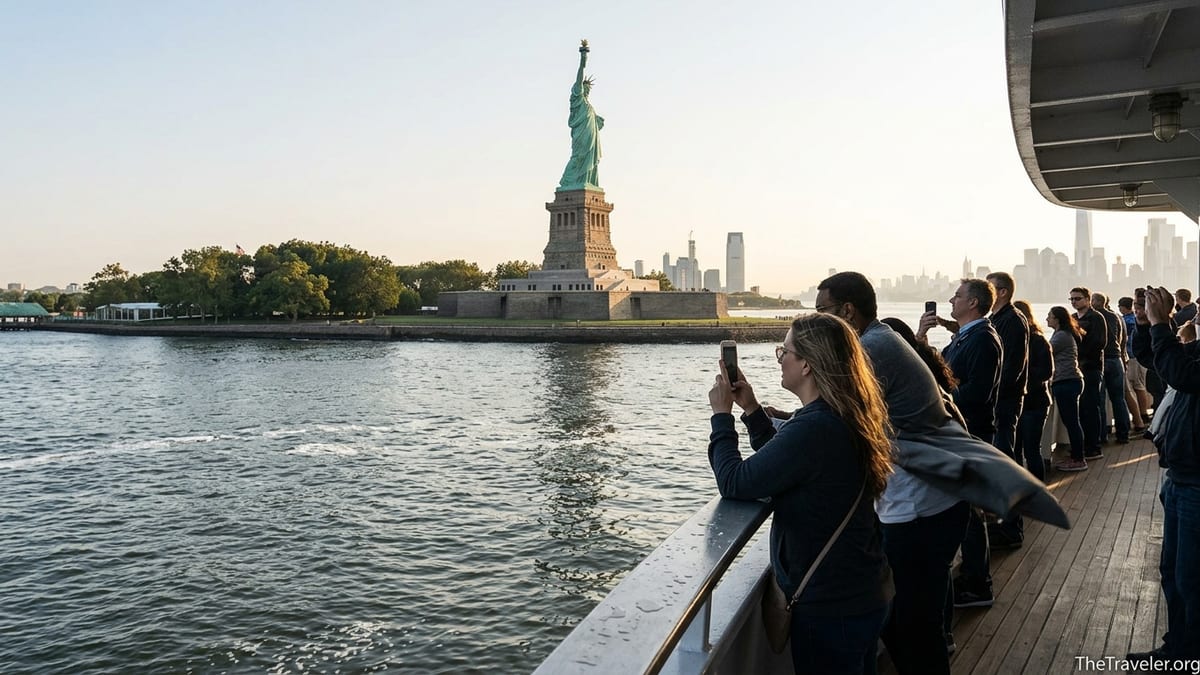
Step off the ferry into New York Harbor and, even before you set foot on Liberty Island, the Statue of Liberty has already begun her work. Phones lift into the air, conversations fall quiet, and for a brief moment the decks of the boat feel like a floating theater, every visitor turned toward the same copper-green figure. More than 3.7 million people made this trip in 2024 alone, yet for many, the first live glimpse of Lady Liberty still feels personal, emotional and unexpectedly profound. Over a century after her 1886 dedication, she continues to captivate travelers more intensely than almost any other monument on earth.
Get the latest updates straight to your inbox!
A Gift From One Democracy to Another
The Statue of Liberty’s origin story is part of what makes her so compelling to modern visitors. Conceived in the 1860s by French intellectual Édouard de Laboulaye and sculpted by Frédéric Auguste Bartholdi, the monument was meant as a gift from the people of France to the people of the United States in honor of the centennial of American independence. Rather than a top-down government project, fundraising in both countries relied heavily on ordinary citizens contributing modest sums, from French schoolchildren buying commemorative lottery tickets to Americans sending in coins to newspaper drives. That grassroots birth gives today’s travelers a sense that the monument belongs to people, not politicians.
On site, interpretation in the Statue of Liberty Museum and on National Park Service exhibits underscores this binational story. Visitors walking through the museum’s “Liberty’s Foundation” gallery see artifacts from the Franco-American campaign, including building models and period posters. The narrative connects Liberty Island not only to New York City, but to Parisian workshops where the copper plates were hammered and to the French countryside whose residents helped pay for the statue long before they would ever see it across the Atlantic. For travelers from France, Quebec or North and West Africa, where French heritage runs deep, the monument often resonates as a shared cultural achievement rather than a purely American symbol.
The collaboration behind the statue was also a technical partnership. Bartholdi’s vision was matched by the engineering of Gustave Eiffel and his team, who designed the internal iron framework that allows the copper skin to flex in strong harbor winds. Architectural enthusiasts who reach the pedestal level can literally feel this fusion of art and engineering as they stand near the massive support beams and peer up through the inner structure. For many travelers, knowing that the same mind later responsible for the Eiffel Tower helped Liberty stand tall adds another layer of fascination.
Symbolism That Still Speaks to the World
What visitors respond to most powerfully today is the statue’s dense web of symbols, many of which remain strikingly relevant. Lady Liberty’s seven-rayed crown is interpreted as light reaching every continent and sea. Her torch represents enlightenment and progress, while the tablet in her left hand bears the date July 4, 1776, linking her firmly to the American declaration of independence. Guides on the ferry and ranger talks on Liberty Island still point these out, and travelers routinely echo the symbolism in their own photos and social media captions, often pairing shots of the torch with reflections on freedom and human rights.
Other details reveal stories some visitors are hearing for the first time. At Liberty’s feet lie a broken shackle and chains, incorporated by Bartholdi to acknowledge the end of slavery in the United States. While easily missed from the harbor, they are highlighted in museum displays and audio tours. For American travelers confronting the legacies of slavery and segregation, these chains can feel like an early and imperfect, yet important, recognition of emancipation. For international visitors from countries with their own histories of oppression, they create a powerful point of connection to struggles at home.
Even Liberty’s face sparks conversation. Art historians have long discussed how Bartholdi relied on classical personifications of liberty and justice, and some accounts suggest that he used his mother as a model. Travelers looking closely up from the pedestal or through zoom lenses are often surprised at the solemn, almost stern expression rather than a welcoming smile. In person, the statue’s dignified, slightly downturned gaze hits differently than it does on postcards or souvenirs. It signals that liberty is serious work and helps explain why, despite countless reproductions and parodies, the original still carries weight.
The Immigrant Experience, Then and Now
The Statue of Liberty’s location within sight of Ellis Island is not an accident, and for many travelers it is impossible to separate the monument from the story of immigration to the United States. Between the 1890s and the 1920s, millions of newcomers arriving by steamship saw the statue as their first glimpse of America. Today’s visitors can still recreate part of that journey. Standard ferry tickets from Battery Park or Liberty State Park include both Liberty Island and Ellis Island, making it easy to stand at the rail on the approach to the harbor and imagine a crowded third-class deck below.
In conversations on the ferry and in the museum, you will often hear second- or third-generation Americans pointing out the skyline and recounting how grandparents arrived from Italy, Ireland, the Caribbean or Eastern Europe. Many carry photocopies of ship manifests or old family portraits to photograph against the backdrop of the statue. Staff at the Ellis Island National Museum of Immigration report that the research room, where visitors search passenger records, remains one of the most emotionally charged spaces in the complex. When those same visitors later walk the perimeter of Liberty Island, the monument becomes personal: not just a patriotic emblem, but a witness to a family’s first steps in a new country.
The immigrant narrative resonates far beyond the United States. Visitors from Latin America, South and East Asia or the Middle East frequently share parallels with contemporary migration, seeing in the statue both the promise and the contradictions of a country still debating its borders and identity. School groups from Germany, Brazil or Japan may arrive with classroom assignments focused on immigration policy and use their time at the statue and Ellis Island as a real-world case study. That ongoing relevance to current debates about belonging and opportunity is a major reason Liberty continues to draw millions rather than fading into the background of the skyline.
An Engineering Marvel in an Age of Skyscrapers
In an era of glass supertowers and record-breaking observation decks, it would be easy for a nineteenth-century copper statue to feel quaint. Yet visitors routinely describe being surprised at the statue’s scale and technical sophistication. From base to torch, she soars to a total height of just over 300 feet, and from the waterline of New York Harbor she commands the same instinctive awe as neighboring skyscrapers. Travelers joining ranger-led talks at the base learn that Liberty was one of the earliest examples of a curtain-wall system, where a light outer skin is supported by an internal framework, a principle that underpins much of modern high-rise architecture.
Physically, visitors experience this engineering most dramatically inside the pedestal. After clearing secondary security, those with pedestal reservations climb a series of stairs or take an elevator to a viewing platform. Along the way, glass cutouts reveal the interplay of riveted iron beams and copper plates, some of which still bear nineteenth-century workshop marks. Even those who never set foot in a design studio come away with a new appreciation for how radical the construction methods were at the time, and how these innovations influenced later landmark projects in both Europe and North America.
The statue’s endurance through harsh coastal weather also reinforces her iconic status. Exposed to salt spray, wind and the freeze-thaw cycles of New York winters, the copper skin gradually oxidized to its familiar sea-green patina. Travelers often arrive expecting a bright bronze figure and are fascinated to learn that the patina now protects the underlying metal. Close-up, especially from the pedestal balcony, visitors can see subtle variations in color and texture, reminders that this is not a static relic but a living piece of infrastructure that continues to age and adapt alongside the city around it.
A Living Site Shaped by Restoration and Resilience
One reason the Statue of Liberty still feels relevant is that she has not been left to crumble. Extensive restoration campaigns and evolving visitor facilities mean that travelers encounter a site that is both historic and clearly cared for. The high-profile conservation work leading up to the statue’s centennial in 1986, and the reopening of the crown to limited visitors in the late 2000s, reintroduced generations to the monument. More recently, the opening of the standalone Statue of Liberty Museum on Liberty Island in May 2019 marked a turning point in how the site tells its story.
The museum, which is included in all standard ferry tickets, allows every visitor to engage deeply with the statue’s history without needing pedestal or crown access. Inside, travelers wander through multimedia galleries that trace the monument’s design, construction and changing meanings over time. One highlight is the original torch, replaced in the 1980s, which now sits in a glass-walled hall where you can walk almost close enough to touch it and see the intricate glass panes and internal structure. For travelers who remember the small, crowded exhibit inside the pedestal, the new museum feels more like a modern cultural institution, on par with leading museums elsewhere in New York City.
The site’s resilience in the face of disaster has also strengthened its hold on the public imagination. After the September 11 attacks in 2001, access to the statue’s interior was closed for several years while security and safety upgrades were made. Superstorm Sandy in 2012 flooded docks and infrastructure, forcing another temporary closure and a major repair effort. Each reopening has been covered widely by American and international media, reinforcing the idea of Liberty as a symbol that can be damaged but not destroyed. Today’s visitors walking along the island’s seawall or queuing for the return ferry pass subtle reminders of these events in the form of raised pathways, reinforced docks and updated security facilities.
A Signature New York Travel Experience
Beyond its symbolism, the Statue of Liberty remains a travel magnet because visiting is simply an excellent day out in New York City. Most trips begin at Battery Park in Lower Manhattan or Liberty State Park in Jersey City, where timed ferry tickets help regulate crowds. Travelers who arrive for early morning departures often note that security lines are shorter and the light on the harbor softer, making for better photographs. As of mid-2026, base ferry tickets remain broadly affordable for a major urban attraction, and include stops at both Liberty and Ellis Islands, allowing visitors to combine skyline views with museum time.
On the water, the experience feels almost like a harbor cruise, with open upper decks offering panoramic views of Lower Manhattan, Brooklyn, the Verrazzano-Narrows Bridge and sometimes even aircraft taking off from nearby Newark and LaGuardia airports. Tourists from Europe and Asia cluster at the railings next to New Yorkers using the trip as a staycation outing, and it is not unusual to hear half a dozen languages on a single crossing. For families, the ferry ride doubles as entertainment for children, who often treat it as an adventure long before they understand the monument’s deeper meanings.
Once on Liberty Island, the experience is surprisingly tranquil compared to Midtown’s intensity. Landscaped paths circle the statue, dotted with benches and lawns where visitors picnic with snacks from the island café or sandwiches brought from the city. Photographers set up tripods along the western edge to capture Liberty with the full skyline behind her, while others aim for close-ups of the drapery folds or the torch framed against passing clouds. For travelers on tight schedules, a carefully planned three to four hours can encompass the ferry rides, a walk around the island perimeter, a visit to the museum and a quick stop on Ellis Island before returning to Manhattan in time for an afternoon Broadway show or museum visit.
Liberty in Popular Culture and Around the Globe
The Statue of Liberty’s role in films, television and visual media helps explain why so many travelers feel they “know” her before they ever see her in person. She has appeared in everything from early newsreels to disaster blockbusters and romantic comedies, often used as shorthand for both New York and the United States as a whole. The ruined crown in an apocalyptic landscape, the torch emerging from fog, the statue glimpsed from a helicopter in a sweeping establishing shot: all of these cinematic images shape expectations long before a visitor buys a ferry ticket.
Once on site, travelers frequently reenact or gently parody these famous scenes. Couples pose with arms raised like the torch, families snap group photos with the pedestal perfectly centered in the background, and solo travelers lean on the island’s railings in imitation of characters from their favorite movies. Souvenir stands in Lower Manhattan and near Times Square sell snow globes, miniature replicas and T-shirts emblazoned with Liberty’s outline, reflecting how deeply she has penetrated global pop culture. For many visitors, bringing one of these items home is less about kitsch and more about claiming a small piece of an image they have grown up with.
The statue’s fame has also led to a proliferation of replicas worldwide. Travelers who have visited Paris may recognize the smaller Statue of Liberty on the Île aux Cygnes in the Seine, while others may have encountered reproductions in Tokyo, Las Vegas or Buenos Aires. Seeing the original after visiting one or more of these copies often produces a sense of resolution. The New York harbor version is larger, more weathered and more emotionally charged than most expect. Standing at the base, hearing the gulls and the ferry horns, visitors understand why this particular statue, among all the imitations, remains the definitive Liberty.
The Takeaway
Lady Liberty’s enduring appeal is rooted in a rare combination of factors: a compelling origin story, layered symbolism, technical ingenuity, a powerful connection to immigration and a deep presence in global culture. For travelers, the experience is both intensely local, tied to the specific geography of New York Harbor, and universal, speaking to hopes for freedom, safety and opportunity that cross borders and generations. That duality helps explain why annual visitation continues to hover in the millions and why a trip to New York City still feels incomplete to many without at least a distant glimpse of her torch.
Yet what makes the Statue of Liberty truly captivating, more than a century after her dedication, is not just what she represents but how people respond to her in real time. On any given day, you can watch as children run toward the base, as recent graduates pose with caps in hand, as retirees lean quietly on the seawall, and as new citizens arrive in their best clothes following a naturalization ceremony. Each brings a different story, yet they are all drawn to the same figure in the harbor. In an age of rapidly shifting news cycles and fleeting online icons, the continued power of this copper statue to move millions in person may be her most remarkable achievement.
FAQ
Q1. How long does a typical visit to the Statue of Liberty take?
A standard visit that includes the ferry rides, a walk around Liberty Island, time in the Statue of Liberty Museum and a brief stop at Ellis Island usually takes between three and five hours. Travelers who book pedestal or crown access should allow extra time for security screenings and climbing stairs.
Q2. Do I need to buy Statue of Liberty tickets in advance?
Advance purchase is strongly recommended, especially in spring, summer and during holiday periods. Basic ferry tickets sometimes sell out on peak days, while pedestal and especially crown reservations can book up weeks or even months ahead. Buying early also helps you secure morning departure times, which many visitors prefer for cooler temperatures and softer light.
Q3. What is the difference between pedestal and crown tickets?
All standard tickets include access to Liberty Island and the museum. Pedestal tickets allow entry into the monument’s base, with indoor exhibits and an outdoor viewing platform above the treetops. Crown tickets are the most limited and require climbing a narrow, steep staircase inside the statue to a small observation area in the crown. Crown access involves significant physical effort and is not suitable for all visitors.
Q4. Can I visit the Statue of Liberty and Ellis Island in one day?
Yes, most travelers combine both in a single visit, since the same ferry route stops first at Liberty Island and then at Ellis Island before returning to Manhattan or New Jersey. With careful planning and an early departure, it is realistic to spend several hours exploring Liberty Island and the museum, then devote another hour or more to key exhibits in the Ellis Island National Museum of Immigration.
Q5. Is the Statue of Liberty accessible for visitors with mobility challenges?
Liberty Island’s main paths, museum and basic ferry services are designed to accommodate visitors using wheelchairs or with limited mobility. Elevators provide access to key levels of the pedestal, though space can be tight at peak hours. The crown, reached only by a long, narrow staircase, is not accessible, so travelers who rely on mobility aids typically focus on ground-level viewpoints, the museum and the pedestal observation areas reachable by elevator.
Q6. When is the best time of day and year to visit?
Many travelers favor early morning ferries, which often have shorter security lines and cooler temperatures in warmer months. Weekdays outside major holidays are generally less crowded than weekends. In terms of seasons, late spring and early autumn tend to offer comfortable weather and clear views, though winter visits reward those willing to bundle up with crisp air, lower crowds and a more contemplative atmosphere on the island.
Q7. Are there food and restroom facilities on Liberty Island?
Yes, Liberty Island has a café offering simple hot meals, sandwiches, snacks and drinks, along with indoor seating areas. Outdoor picnic tables are also available for those who prefer to bring their own food. Restrooms are located near the ferry landing and inside key facilities, and most travelers find them reasonably convenient, though lines can form at peak times.
Q8. Can I take large bags or luggage to the Statue of Liberty?
Large suitcases and oversized bags are not permitted through security and will be turned away at the entrance. Daypacks and small bags are typically allowed after screening, but visitors with pedestal or crown tickets may be required to place bags and certain items in rental lockers before entering the monument. Planning to travel light, with essentials only, makes the visit smoother and faster.
Q9. Is the Statue of Liberty open year-round?
The Statue of Liberty National Monument is open most days of the year, with closures typically limited to Thanksgiving Day and December 25. Ferry schedules and opening hours can vary by season, with extended hours during peak summer months and shorter days in winter. Checking the latest operating information shortly before your visit helps you avoid surprises due to weather or maintenance.
Q10. Is visiting the Statue of Liberty worth it if I am only in New York for a short time?
Many travelers with limited time still prioritize a trip to Liberty Island, describing it as one of the most memorable parts of their stay. The experience offers a rare combination of skyline views, historical insight and emotional impact. Even those who choose not to go ashore often make time for a harbor cruise or a stroll along Battery Park to at least see the statue up close from the water.