


More news on this day
Electric air taxi developers that once promised urban sky taxis by the middle of the decade are increasingly relying on military contracts to keep cash flowing and aircraft flying as civil certification timelines stretch out.
Get the latest news straight to your inbox!
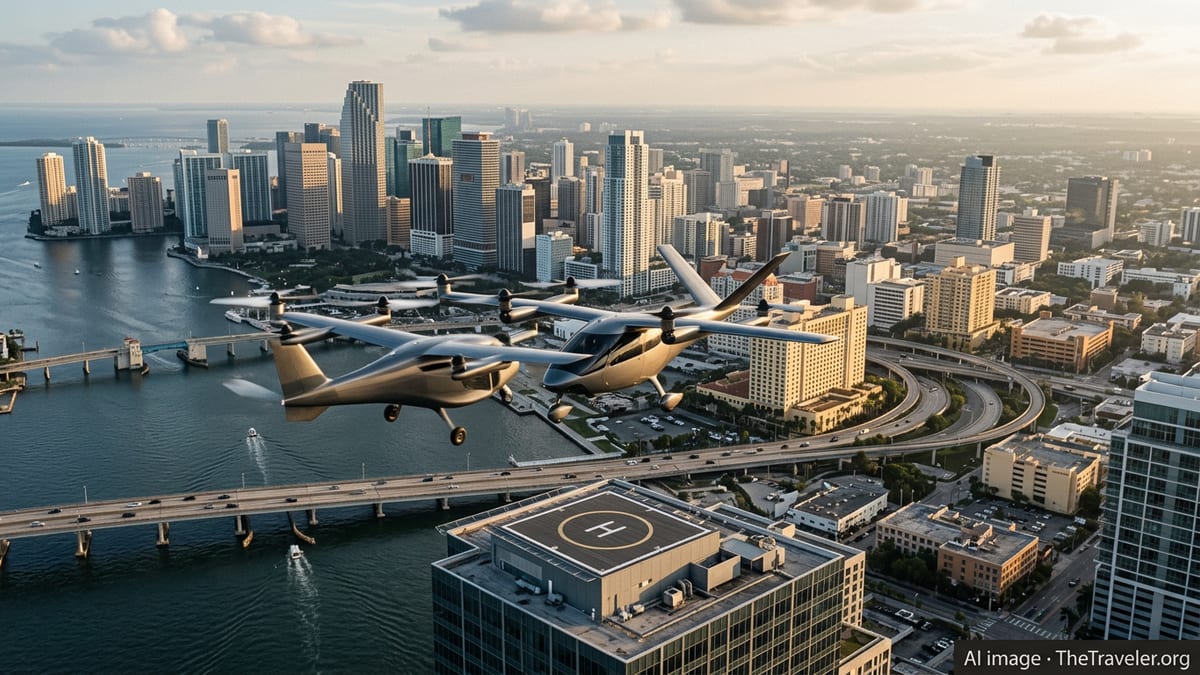
Certification headwinds reshape air taxi timelines
Ambitious plans to launch commercial air taxi services in major cities have run into the complex reality of certifying a new class of powered-lift aircraft. Publicly available information from regulators indicates that the Federal Aviation Administration and the European Union Aviation Safety Agency are still finalizing detailed guidance and standards for electric vertical takeoff and landing designs, operations and pilot training, even after issuing key rules for powered-lift operations in 2024.
Type certification for several prominent air taxi programs remains in process, with developers reporting incremental progress but avoiding firm in-service dates for civil routes. Industry disclosures show that approval of designs, manufacturing systems and maintenance regimes is proceeding under tailored frameworks rather than existing airplane or helicopter categories, adding technical and regulatory complexity. That slower pace has encouraged companies to seek alternative revenue and testing pathways while they wait for large-scale commercial operations.
Analysts following the sector note that the combination of high development costs, evolving rules and cautious investors has made access to non-dilutive funding increasingly attractive. In that environment, long-running U.S. Department of Defense innovation efforts aimed at harnessing commercial aviation technology have become a central pillar of several eVTOL business plans.
Joby builds multi-role presence with U.S. Air Force
California-based Joby Aviation has been one of the most visible beneficiaries of this shift. Company filings and defense program documents describe a multi-year relationship with the U.S. Air Force under the AFWERX Agility Prime initiative, including a contract valued at up to about 131 million dollars that covers aircraft deliveries, on-base testing and related support activities.
In 2023 Joby delivered what has been described in public coverage as the first electric air taxi to a paying customer when an early production aircraft arrived at Edwards Air Force Base in California for test and evaluation. Subsequent shareholder communications indicate that a second aircraft followed in January 2025, expanding a flight test campaign focused on performance, acoustics, maintenance procedures and operational concepts in a military environment.
Separate announcements describe a plan to deliver additional aircraft to other installations, including MacDill Air Force Base in Florida in 2025, under options in the existing agreement. The company has also begun working on a turbine-electric variant in collaboration with a major defense contractor, targeting potential longer-range and autonomous missions that align more directly with defense use cases.
These activities give Joby early exposure to logistics, training and potential medevac roles while allowing Air Force units and NASA researchers to gather real-world data on electric vertical lift operations. The work simultaneously advances the company’s civil certification effort by generating evidence about reliability, maintainability and noise performance under controlled but operationally relevant conditions.
Archer and others tap AFWERX and defense partners
Rival developer Archer Aviation has also deepened its engagement with the U.S. military. Company statements and investor materials describe a series of contracts with the Air Force dating back to 2021, culminating in a package announced in 2023 worth up to 142 million dollars. The work spans delivery of the Midnight eVTOL aircraft, pilot training, maintenance demonstrations and analysis of potential mission profiles.
Under this arrangement, Archer is expected to provide aircraft and services to support studies of how a quiet, 1,000 pound payload vertical lift platform could support base logistics, personnel transport and other non-combat tasks. The scale of the investment has been characterized in industry reporting as a landmark for the emerging eVTOL sector, signaling that defense customers view the technology as more than a speculative urban mobility concept.
Smaller advanced air mobility firms are pursuing similar paths, leveraging AFWERX’s small business innovation mechanisms to gain funding and flight test access. Public AFWERX documents highlight electric vertical lift as a priority area alongside autonomous systems, novel powertrains and advanced manufacturing, with an explicit aim of accelerating promising commercial technology into defense use while offering companies an alternative to traditional procurement timelines.
For developers, this route provides earlier opportunities to deliver hardware, validate performance claims and diversify revenue ahead of large-scale civil deployment. For defense planners, it offers a controlled way to experiment with distributed air mobility concepts that could support agile basing, disaster response and base-to-base logistics.
Defense work becomes bridge to delayed urban air services
The military’s growing role in air taxi development is emerging as a bridge between optimistic early forecasts and a more gradual commercial rollout. When several leading eVTOL companies went public earlier in the decade, investor presentations frequently pointed to urban passenger services beginning in the mid-2020s. While some targeted city partnerships and limited demonstration routes are still being pursued, broad network launches now appear likely to follow only after regulators and operators gain more experience.
Defense contracts, by contrast, allow developers to operate in controlled environments with dedicated infrastructure and trained personnel, reducing some of the integration challenges that city-center vertiports and mixed airspace operations would present. The data gathered on reliability, turnaround times and maintenance needs can then inform both military doctrine and future civil safety cases.
Publicly available information suggests that this defense-first phase is already reshaping how companies describe their strategies. Rather than focusing solely on short urban hops, some developers now emphasize roles such as cargo resupply, medical evacuation and remote-site access that may require different range and payload characteristics. Hybrid-electric concepts and autonomous flight capabilities, both of strong interest to defense customers, are receiving increased attention as potential follow-on products.
At the same time, participation in government test campaigns helps developers build relationships with regulators and demonstrate compliance with evolving standards. Industry observers note that companies able to show years of structured operations on military ranges and bases may have an advantage when seeking approvals for dense urban routes later in the decade.
Implications for travelers and urban air mobility visions
For travelers watching the advanced air mobility sector, the pivot toward military markets suggests that routine city air taxi rides may arrive more slowly, but on a more mature technological footing. While early demonstrations in locations such as the United Arab Emirates and South Korea remain part of the narrative, the bulk of near-term flight hours for some leading eVTOL types are likely to come from government and defense programs rather than tourist hops or airport shuttles.
This period may nonetheless benefit eventual civil passengers. Testing under demanding military use cases can expose design weaknesses, refine maintenance practices and prove out noise and safety performance before large numbers of aircraft are introduced over urban neighborhoods. Lessons from operating in harsh environments or around sensitive installations could translate into higher reliability and better contingency planning for city networks.
The closer alignment with defense requirements may also influence where and how early civil services appear. Routes that connect major airports with outlying business districts, technology parks or logistics hubs could see priority as operators seek predictable demand and well-controlled operating environments. Travelers might first encounter electric air taxis as premium airport links or specialized charter services rather than as fully integrated on-demand urban ridesharing.
As regulators continue to refine powered-lift rules and companies integrate insights from defense partnerships, the civil air taxi vision is evolving from rapid disruption to phased introduction. For now, the military market is providing the runway that many eVTOL developers need to keep their aircraft flying while the path to mass-market urban mobility is built out step by step.