


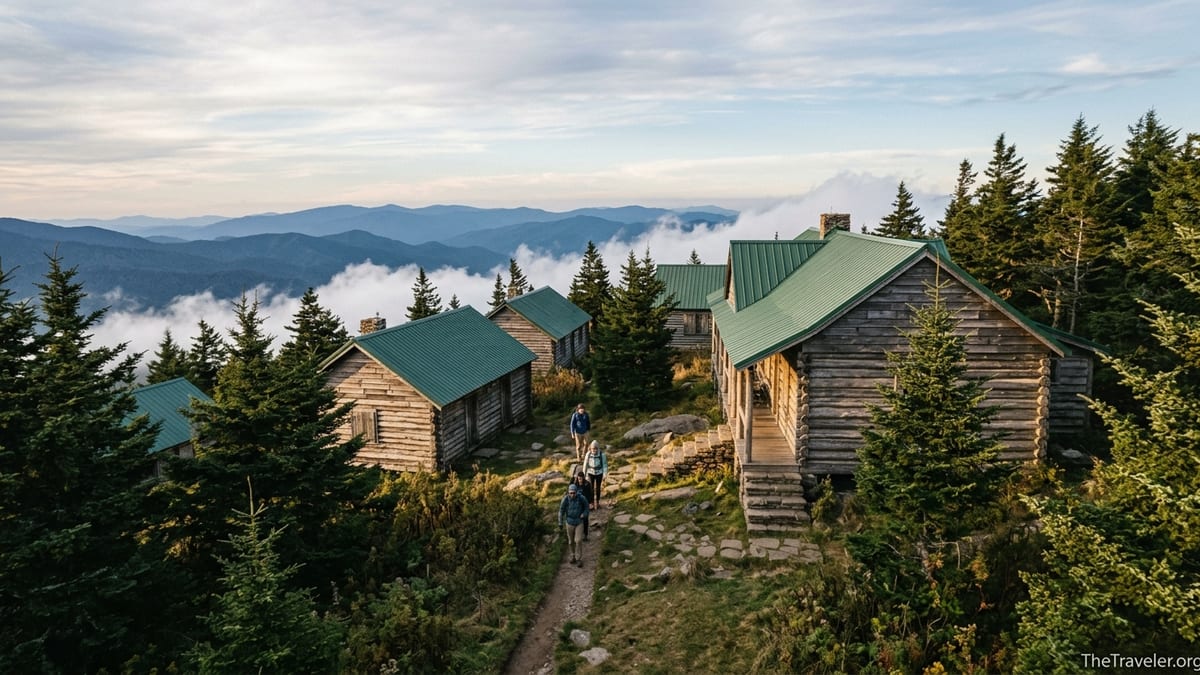
High on the crest of Great Smoky Mountains National Park, LeConte Lodge sits at roughly 6,400 feet on Mount Le Conte, with no road access, hot meals by lantern light, and clouds drifting past the cabin windows. It is also one of the hardest reservations to score in the eastern United States. With most of the 2026 operating season already booked and an active wait list in place, understanding how the reservation system works is the only realistic way to claim your spot before everything disappears.
Get the latest updates straight to your inbox!
Why LeConte Lodge Books Out So Far in Advance
LeConte Lodge holds a unique position in Great Smoky Mountains National Park. It is the only place inside the park where you can sleep in a permanent structure on a mountaintop and be served hot, family-style meals without carrying a full backpacking kit. The main lodge and a cluster of hand-built cabins and multi-room lodges sit just below the summit of Mount Le Conte, offering views toward Clingmans Dome, Newfound Gap, and the rolling ridges of Tennessee and North Carolina. Because there is no road access, every guest hikes in, which filters out casual visitors and adds to the sense of exclusivity.
The lodge operates only from late March through late November each year, so there are a limited number of nights to begin with. Within that season, the combination of small capacity, loyal repeat guests, and word-of-mouth hype means space sells out quickly. Families often treat LeConte as a tradition, returning every year on roughly the same dates; it is not unusual to meet someone at dinner who has been coming for a decade or more. That culture of repeat visitation shrinks the number of openings left for first-timers.
Demand has also been helped along by the lodge’s growing profile. Local tourism offices in Sevier County and national travel outlets have spotlighted LeConte as a “bucket list” stay in the Smokies. When a single blog post mentions watching sunset from Cliff Top followed by a warm bunk and pancakes at 6,400 feet the next morning, it inspires a new wave of would-be guests who immediately start dialing the reservations line. The result is a reservation pattern more like a famous backcountry hut or a hard-to-get national park campground than a typical mountain lodge.
Add in the practical limits of operating a high-elevation property that relies on pack llamas and helicopter supply drops instead of delivery trucks, and it becomes clear why the owners cannot simply add more cabins. The fixed capacity means that almost every available bed on almost every night of the season becomes highly contested, particularly on weekends, during wildflower season in April and May, and in fall color weeks from late September into October.
How the LeConte Lodge Reservation System Really Works
LeConte Lodge runs on a straightforward but unforgiving reservation system. The lodge is open for the 2026 season from Monday, March 23 through Tuesday, November 24. For that season, the primary booking window has already passed and the initial allocation of spaces is complete, which is why many travelers are now navigating wait lists and cancellation calls rather than picking from an open calendar.
The lodge handles reservations directly from an off-mountain office in Tennessee. There is no online booking engine to refresh at midnight. Instead, guests must submit written requests or call during business hours, depending on the stage of the booking cycle. For 2026, the office notes that the “initial 2026 booking process has been completed” and that most dates are full, but it encourages prospective guests to call the reservations line between 8 a.m. and 5 p.m. Eastern Time, Monday through Friday, to ask about cancellations or to discuss the wait list. The office is typically closed on major holidays and often closes for lunch midday, which matters if you are calling from a different time zone.
All stays are priced on an American Plan basis, meaning nightly rates include both lodging and meals. While exact prices can change year to year, recent seasons have seen many two-person cabins priced in the mid-to-high hundreds of dollars per night, including a hot dinner and breakfast, with bagged lunches available for an additional fee. Larger lodges suitable for families or small groups typically cost more in total but less per person. Because rates can shift with operating costs and concession contracts, you should always confirm the current pricing with the reservations office when you call.
An important detail for planners is the minimum stay policy. For much of the season, one-night stays are bookable when available, which is ideal for hikers linking LeConte with backcountry camping elsewhere in the park. However, on highly demanded weekends, holidays, or during peak foliage, you may find that only two-night blocks are realistically attainable or that the remaining availability falls midweek rather than on Friday or Saturday. The booking team can tell you which specific nights have single-night gaps versus multi-night openings.
Key Dates, Deadlines, and Timing Strategies
The biggest mistake first-time visitors make is assuming they can book LeConte Lodge a few months ahead of their trip. In practice, you should be thinking about your stay a year or more in advance. The lodge typically accepts written reservation requests for the next season during a defined period late in the current year, often in October. During this window, would-be guests submit forms listing preferred dates, party size, and flexibility. The office then processes those requests, allocating space as fairly as possible before opening the phones for general adjustments.
By the time winter rolls around, the following season is usually heavily booked, which is why the official reservations page now notes that “most dates during the 2026 season are now booked.” At that point, your best strategy is to work with the wait list system and monitor for cancellations. Travelers who have flexibility in their schedule, particularly those who can hike midweek in shoulder seasons such as late March, early April, or early November, stand a much better chance of picking up a spot that opens after the initial rush.
If you are looking ahead to a future season such as 2027, mark your calendar several months early. In late summer or early fall 2026, check the lodge’s reservations page or call the office to confirm the exact dates and process for submitting next-year requests. Then, as soon as that submission window opens, send in your form listing multiple acceptable date ranges rather than just one weekend. Guests who only list a single peak-season Saturday in October may be disappointed, while those who indicate flexibility over several weekdays in May, or multiple Sunday-through-Tuesday combinations in September, give the office more room to match them with available cabins.
Time of day matters once the phone lines open for adjustments and cancellations. The reservations number often rings nonstop on the first few days after new availability is posted, especially when there is a wave of cancellations following a deposit deadline. Calling right when the office opens at 8 a.m. Eastern Time can put you closer to the front of the queue. Travelers from the western United States may find themselves dialing before sunrise to compete with locals, but that effort can pay off in the form of a rare September weekend cabin.
Wait Lists, Cancellations, and How to Use Them to Your Advantage
Once the initial season booking is complete, LeConte Lodge manages demand mainly through a structured wait list. The 2026 wait list is already active, and the office is using it to fill most cancellations that occur more than 30 days before arrival. That means that if you call about a popular date in October and a family cancels six weeks out, the open spot is likely to go to someone who is already listed on the wait list for those dates, not to the next person who happens to ring the office.
To use the wait list effectively, you need to be both specific and flexible. When you submit the form, you will be asked for the size of your party, acceptable room types, and date ranges. A realistic approach might be to list, for example, any two consecutive nights between mid-April and mid-May, or any single night Monday through Thursday in late September. By casting a slightly wider net, you give the staff more options to plug you into unexpected openings. If you insist on a very narrow window, such as a single Saturday in peak color season for a large group, you may languish on the list without ever seeing a match.
Cancellations can and do happen quite close to arrival, particularly when weather forecasts turn stormy or when guests discover they are not physically ready for the hike. The lodge’s policies outline what portion of payments are refundable, and under what timing, if they are able to rebook your space. In practical terms, that means the closer you get to arrival, the more likely a last-minute opening will be filled by someone who is already on a relevant wait list and lives within driving distance. If you are within a half-day’s drive of Great Smoky Mountains National Park, you can make yourself more attractive as a last-minute replacement by telling the office that you are willing to come on short notice if a cabin opens.
One real-world example: A couple from Atlanta placed their names on the wait list for “any one-night stay in early November, parties of two.” In mid-October, they received a call about a Tuesday-night opening on November 4 after another guest canceled. Because they had already blocked out that general time and were flexible about which trail they would hike, they were able to confirm the booking immediately and be on their way a few weeks later, watching the last of the fall color spread across the lower slopes from the lodge’s porch.
Choosing Dates, Trails, and Cabins That Actually Get Confirmed
Beyond mastering the reservation mechanics, you can improve your odds by choosing dates, trails, and lodging types that are less competitive. In terms of timing, the most difficult nights to book are typically Friday and Saturday in mid-October, when fall foliage peaks across Great Smoky Mountains National Park. Closely behind are spring weekends in late April and May, when wildflowers brighten the forest floors along Alum Cave and Trillium Gap trails. If your schedule allows, aim for midweek nights, especially Monday through Wednesday, in shoulder periods such as late March, early April, or early November. These dates still offer atmospheric conditions, including lingering snow patches at higher elevations in spring and crisp, clear skies in fall, but attract fewer large family groups.
On the trail side, all access routes ultimately converge near the lodge, but your choice changes the experience. Alum Cave Trail, roughly 5.5 miles one way with about 2,700 feet of elevation gain, is the most popular approach thanks to its dramatic cliffs, staircases through Arch Rock, and views from Inspiration Point. That popularity means trailhead parking fills quickly from spring through fall, and you will be sharing the path with many day hikers. By contrast, the Trillium Gap Trail from the Roaring Fork side is longer and quieter and doubles as the supply route for the lodge’s llama pack train on designated days, a memorable sight if you time your hike accordingly.
From a reservation standpoint, your trail choice does not directly affect availability, but it does influence how realistic certain dates may be. For instance, early-season dates in late March and early April often see lingering ice on the upper sections of Alum Cave, making traction devices a wise idea, while Trillium Gap can be muddy and slow after heavy rains. If you are less experienced with shoulder-season conditions, you might target mid- to late May instead, when daylight is longer, weather milder, and snow rare. In October, build in extra time for delays at busy trailheads such as Alum Cave and Rainbow Falls, where vehicles circle for open spaces, especially on Saturdays.
Cabin configurations also matter. LeConte offers a mix of small individual cabins, larger multi-room lodges, and at least one two-bedroom structure designed for bigger groups. A solo traveler or couple has more flexibility to slip into a stray opening in a small cabin than a group of six that requires a full lodge. When filling out request forms or talking with the office, indicate that you are open to different room layouts, including shared-bath options and smaller bunks, to improve your chances of being placed. Being willing to share a multi-room building with another small party, when policies allow, can sometimes unlock spaces that would otherwise sit empty or go only to larger groups.
Budgeting for Your Stay and Understanding What Is Included
For many travelers, the cost of LeConte Lodge is a serious consideration, especially when compared with tent camping or backcountry shelters in the same national park. While the lodge does not publicly post a full rate chart far in advance, recent seasons have put most standard two-person cabins at a nightly rate that is broadly comparable to a midrange chain hotel in nearby Gatlinburg, but with meals embedded. Group cabins and lodges logically carry higher totals but often deliver better per-person value when filled close to capacity.
What makes the pricing feel more reasonable is the American Plan structure. Your stay includes a hot dinner served family-style in the rustic dining room and a full breakfast the next morning. Dinner might be something like roast beef or baked chicken with mashed potatoes, green beans, cornbread, and dessert, while breakfast often features items such as scrambled eggs, pancakes, biscuits, and fruit. Coffee and hot chocolate are staples at sunrise, particularly welcome on frosty mornings when temperatures hover near freezing in early spring or late fall.
Lunch is usually available as an optional, extra-charge item in the form of a packed lunch that guests can carry on day hikes to Myrtle Point, Cliff Top, or down alternate trails. The lodge also sells simple snacks, hot drinks, and a few souvenirs such as T-shirts and patches, which many guests treat as proof of “earning” the summit. Payments for incidentals at the top are typically handled in cash or by card, but because the lodge is off-grid and reliant on limited communication links, you should confirm current payment methods in advance and bring some cash as a backup.
Outside of the nightly rate and optional purchases, the other major cost to factor in is transportation and parking. Since March 2023, Great Smoky Mountains National Park has required a paid parking tag for most vehicles parking longer than 15 minutes at trailheads and visitor centers. A LeConte Lodge reservation does not guarantee a parking space at any trailhead, so you should plan to arrive early on busy days and include the cost of a daily or weekly parking tag in your budget. Some guests choose to pay for private shuttle services from Gatlinburg or nearby communities to avoid parking frustrations, an added cost that can be worth it during peak weekends.
Logistics on the Ground: From Trailhead to Lantern Light
Securing a reservation is only half the battle; you also need to reach the lodge safely and comfortably. Because there are no roads to LeConte, every guest must hike in on one of several official trails that climb between 5 and 9 miles one way from valley trailheads up to the 6,000-foot contour. Most first-time guests opt for the Alum Cave Trail, which combines dramatic geology with moderate distance, but Rainbow Falls, Trillium Gap, Boulevard, and Bullhead trails all provide viable alternatives depending on your starting point and desired level of solitude.
Plan your hike as you would a full-day mountain trip. Many guests underestimate the effort required to climb more than 2,500 vertical feet with an overnight pack, then arrive exhausted or dangerously late. A realistic plan from the Alum Cave trailhead might be to start hiking no later than 9 a.m., allowing four to six hours to reach the lodge with breaks. That timing places you in your cabin by midafternoon with enough buffer before the dinner bell rings, usually around 6 p.m. Arriving after dark in fog or rain can be disorienting, especially for those unfamiliar with steep, rooty Appalachian trails.
Luggage limits are another factor. While the lodge provides bedding and meals, you are responsible for carrying your clothing, rain gear, personal items, and any special diet foods or medications. Aim to keep your pack as light as practical. You will not need a tent, stove, or full cooking kit, which frees up weight for extra layers and a change of socks. If you are traveling with children, consider having adults shoulder most of the weight so that younger hikers can focus on the climb. The lodge’s pack llamas transport supplies several times per week via the Trillium Gap Trail, but they are not available to carry guest luggage.
Weather at LeConte is often drastically different from the forecast in Gatlinburg or Pigeon Forge. It is common to leave the valley in T-shirts and arrive at the lodge in fleece and gloves. Rain, wind, and sudden fog can blow in quickly over the ridges. Check the latest conditions on the lodge’s own daily update blog, then pack for colder, wetter weather than you expect. Dry socks and a light down or synthetic jacket feel luxurious as you step into the glow of kerosene lanterns in the dining hall after a damp climb.
The Takeaway
LeConte Lodge is a rare combination of backcountry immersion and creature comforts, but that rarity comes at the price of a competitive, sometimes confusing reservation process. Understanding that the lodge operates on a seasonal schedule with limited capacity, that most dates are effectively spoken for many months in advance, and that a formal wait list is used to reassign cancellations is essential if you hope to claim a bunk.
If you are planning for the current 2026 season, your focus should be on calling the reservations office to discuss the active wait list, indicating flexible date ranges, and staying ready to accept a short-notice opening. If you are thinking further ahead to 2027 and beyond, mark your calendar now for the fall request period, prepare to submit multiple acceptable date windows, and be realistic about avoiding the most competitive weekends if possible.
Combine those booking strategies with smart on-the-ground planning for parking tags, trail choices, and mountain weather, and you dramatically increase your odds of turning a hopeful phone call into a night above the clouds. In a place where the lights are lanterns, the hot water comes by bucket, and sunrise breaks over a sea of blue ridges, the extra effort to secure a reservation is repaid many times over.
FAQ
Q1. How far in advance do I need to book LeConte Lodge?
Most guests secure reservations many months, and often close to a year, in advance. The lodge typically accepts written requests for the following season in the fall, and by winter most prime dates are already full.
Q2. Can I book LeConte Lodge online?
No. Reservations are handled directly through the lodge’s reservations office by request form and phone. There is no instant online booking engine where you can click and hold a cabin.
Q3. Is there any chance of getting a last-minute reservation?
Yes, but it requires flexibility. Cancellations do occur, and the lodge uses a wait list to fill most openings that arise more than 30 days before arrival. Being able to hike midweek or on short notice improves your chances.
Q4. How much does it cost to stay at LeConte Lodge?
Rates change over time, but a stay generally costs about what you might pay for a midrange hotel in nearby Gatlinburg, with dinner and breakfast included. Larger group cabins cost more in total but can be good value per person when filled.
Q5. Do I have to hike to reach LeConte Lodge?
Yes. There are no roads to the lodge. All guests must hike between roughly 5 and 9 miles on one of several official trails, gaining more than 2,500 feet of elevation from the trailheads to the lodge.
Q6. Are children allowed at LeConte Lodge?
Yes, families with children regularly stay at the lodge. Parents should be confident that their kids can safely complete the hike and handle basic backcountry conditions such as limited electricity and shared spaces.
Q7. What is included in the nightly rate?
The standard rate includes your cabin or lodge accommodation plus a hot, family-style dinner and breakfast. Packed lunches, snacks, and souvenirs are available at extra cost at the lodge office.
Q8. Does a LeConte Lodge reservation include trailhead parking?
No. A lodge reservation does not guarantee a parking space. You still need to purchase a Great Smoky Mountains National Park parking tag and should arrive early at popular trailheads, especially on weekends.
Q9. What happens if bad weather is forecast for my reservation dates?
LeConte Lodge operates in a mountain environment where rain, fog, and cold are common. The lodge rarely closes for weather, so guests are generally expected to keep their reservations unless conditions are unsafe. You should discuss cancellation policies with the office when you book.
Q10. Is staying at LeConte Lodge worth the effort to get a reservation?
For most guests, yes. The combination of a challenging but rewarding hike, a rustic cabin above the clouds, and hot meals by lantern light creates a memorable experience that many travelers describe as a highlight of their time in Great Smoky Mountains National Park.