


For many independent travelers crossing Asia, 12Go has quietly become the default way to secure seats on crowded trains, long-distance buses and island ferries. From Bangkok night trains to Vietnamese sleeper buses and ferries out to Thai or Philippine islands, the Singapore-based platform brings thousands of local transport operators into a single, mostly English-language interface that feels familiar to anyone used to booking flights online. While it is not perfect and sometimes adds small fees on top of local prices, many travelers judge the convenience and peace of mind to be worth the premium, especially on popular routes that regularly sell out.
Get the latest updates straight to your inbox!
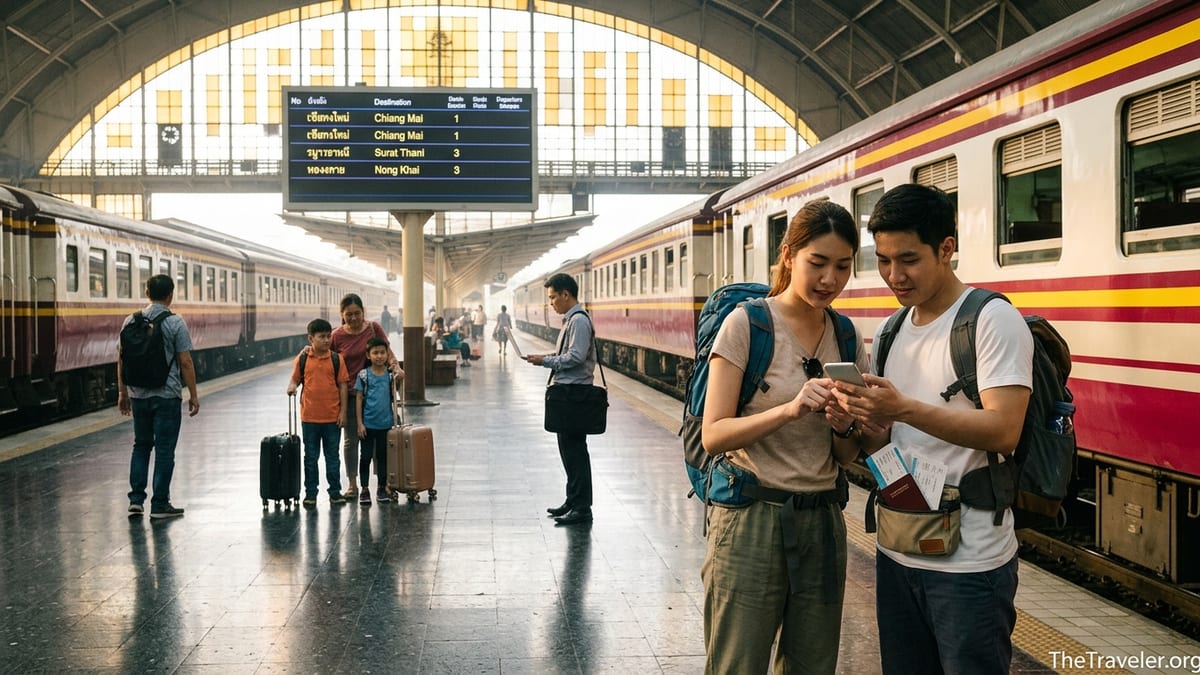
What 12Go Actually Does for Asia-Bound Travelers
12Go is a regional transport booking platform that aggregates buses, trains, ferries, airport transfers and some flights across much of Asia and a growing number of other regions. The company is registered in Singapore with major operations in Bangkok, which helps explain its particularly deep coverage in Thailand and neighboring countries. On a practical level, this means a traveler can open one site or app and see available departures from dozens of local operators that would otherwise require multiple websites, phone calls or in-person purchases at bus terminals and ferry piers.
On a typical search, such as Bangkok to Chiang Mai, 12Go will display overnight sleeper trains, express buses and even low-cost flights on the same screen, with departure times, duration, approximate prices and basic comfort information. In late June 2026, for example, sample listings for Bangkok to Chiang Mai on 12Go show second-class air-conditioned sleeper berths on Thailand’s state railway, starting around the equivalent of 25 to 30 US dollars, alongside VIP buses in a similar price range and budget flights usually starting a little higher depending on the date. Even if a traveler ultimately decides to buy tickets elsewhere, that side-by-side comparison provides a quick reality check on both schedules and budgets.
Beyond Thailand, 12Go now covers popular overland and sea routes in Vietnam, Cambodia, Laos, Indonesia, Malaysia, Singapore, the Philippines and India, along with rail passes in countries like Japan and in parts of Europe. A traveler planning a month-long Southeast Asia trip could realistically stitch together a route like Singapore to Kuala Lumpur by train, Kuala Lumpur to Penang by bus, Penang to Langkawi by ferry and onward to Thailand, all booked on the same platform. For those new to the region, that centralization can make the difference between feeling overwhelmed and feeling in control.
Ease of Booking Complex Routes and Combinations
One of the main reasons travelers turn to 12Go is its ability to package together complicated routes that combine multiple legs or modes of transport. A classic example is the Bangkok to Koh Tao journey in Thailand. Planning this independently typically involves booking an overnight bus or train from Bangkok to Chumphon or Surat Thani, arranging a local transfer from the station or bus terminal to the pier and then buying a separate ferry ticket for the morning boat to the island. On 12Go, travelers can instead choose a combined ticket where the night train, transfer and ferry are already aligned, reducing the risk of missing a connection at dawn in an unfamiliar town.
In Vietnam, similar combinations appear on routes like Ho Chi Minh City to Phu Quoc, where buses and ferries can be bundled, or Hanoi to Cat Ba Island via bus and boat. Someone landing in Hanoi for the first time can quickly see, for a date in August, that they can leave the Old Quarter by bus mid-morning, transfer directly to a fast boat at Hai Phong and reach Cat Ba early afternoon, without trying to navigate separate regional transport providers in Vietnamese. For travelers who do not speak local languages and are wary of negotiating at bus stations, having those legs clearly mapped with one voucher is appealing.
Combined tickets can also be useful where overnight trains link directly with morning mini-vans or buses. For instance, in Indonesia, travelers heading from Surabaya or Yogyakarta towards Bali often need a train plus ferry plus local bus combination via Banyuwangi. Booking through 12Go lets them see the timing between the Java-side train arrival and the ferry across to Gilimanuk, followed by onward road transport to places like Denpasar or Ubud. The platform’s role here is less about finding the absolute cheapest price and more about removing guesswork from multi-step journeys.
Transparency, Price Comparison and the Real Cost of Convenience
12Go is rarely the very cheapest way to move around Asia, because it typically adds a service fee on top of the underlying ticket price. Independent reviews in early 2026 describe common markups in the range of a few US dollars per ticket on major routes. For example, for the Bangkok to Chiang Mai night train, where a second-class air-conditioned lower berth bought directly at the station might cost roughly the equivalent of 25 US dollars, 12Go’s total price may run 2 to 5 dollars higher depending on date and demand. In practice, travelers are paying for the ability to book online in advance, often from overseas, with an English interface and card payment options that local ticket offices may not support.
Where 12Go delivers clear value is in transparent comparison across different operators and vehicle types. Search results typically label options such as “VIP 24-seater bus,” “Standard bus,” “AC sleeper train” or “High-speed ferry,” and show approximate travel times and reviews from previous passengers. On a route like Bangkok to Koh Samui, one traveler might notice that a combined train and ferry ticket listed around 35 to 45 US dollars takes 12 to 14 hours but offers more comfort, while an overnight bus and high-speed catamaran package priced a bit lower arrives earlier but with a rougher ride. Having those distinctions presented side by side helps travelers make informed choices based on budget, comfort and schedule rather than guesswork.
It is also helpful that 12Go clearly separates its own service fee from bank or card fees, even if travelers sometimes bristle at the add-ons. The platform warns, for example, that certain payment methods may trigger extra charges from banks, something that would likely surprise a traveler trying to pay a local operator directly. For many users, the certainty and upfront clarity on total cost outweigh the small savings they might find by attempting to book every leg on their own, especially on peak travel dates such as around New Year in Thailand, Tet in Vietnam or major festivals in India.
Dealing With Asian Rail Systems and Paper Ticket Logistics
Rail systems in Asia often present a steep learning curve for visitors, from language barriers to different booking windows and, in some countries, the continued reliance on paper tickets. 12Go positions itself as an intermediary that handles those local quirks behind the scenes. In Thailand, for instance, certain train tickets still require physical collection. 12Go uses partner offices in Bangkok and Chiang Mai where travelers can pick up printed tickets before boarding, or they can arrange delivery to hotels in major cities a day or two before departure for a small additional fee. For someone landing in Bangkok on a tight schedule, collecting a pre-arranged ticket at a central office is often less stressful than trying to navigate the state railway booking system on arrival.
Consider a traveler planning the Bangkok to Chiang Mai night train in December, a period that regularly sells out thanks to the cooler weather. Official Thai railway booking typically opens a fixed period in advance and can be challenging for first-timers due to slow websites and payment issues with foreign cards. 12Go allows that traveler to request a specific date and type of berth weeks or months ahead, then sends confirmation once its local staff have purchased the ticket from the station. While this introduces a layer of dependence on a third-party agency, many backpackers and short-term visitors accept the trade-off in exchange for a confirmed sleeper berth on a limited schedule.
In Vietnam, routes such as Hanoi to Da Nang or Hanoi to Lao Cai (for Sapa) also benefit from the platform’s rail integrations. Local agencies and privately run “soft sleeper” cars sometimes attach to state-operated trains, and 12Go’s listings clarify which service class a traveler is choosing. Rather than trying to decipher different carriage brands and cabin configurations on scattered Vietnamese websites, an English-speaking traveler can choose between options like a four-berth soft sleeper, a six-berth cabin or a more basic hard seat, with the approximate price difference laid out. While it still pays to confirm details close to departure, having that structure explained on a single screen makes route planning significantly easier.
Island Hopping and Ferries Made Less Intimidating
Ferry networks in Asia are both rich and bewildering, especially for first-time visitors. Boats to Thai islands like Koh Phangan, Koh Tao and Koh Phi Phi, or to Philippine islands such as Bohol and Siquijor, are often operated by a patchwork of private companies with their own timetables, ticket offices and safety standards. 12Go consolidates many of these services, offering forward planning for travelers who might otherwise only discover ferry schedules after arriving at the pier. On the Phuket to Koh Phi Phi route, for example, 12Go typically lists several departures across different companies on the same day, with prices clustered in the equivalent of 15 to 30 US dollars depending on speed and comfort, and indicates whether air conditioning or outdoor seating is available.
In the Philippines, travelers have reported using 12Go to book larger overnight ferries between Manila and major islands on lines like those running to Cebu or Iloilo. While buying tickets directly from local shipping offices can sometimes be cheaper, those offices may close early, only accept cash or be located away from tourist districts. By paying an online premium of a few US dollars per ticket, backpackers can secure bunks in advance and avoid long lines at busy ports, particularly around national holidays when ferries sell out.
Island-hopping in Indonesia also benefits from 12Go’s coverage. Routes such as Bali to the Gili Islands or Lombok are served by multiple fast boat operators, some of varying reliability. 12Go’s results let travelers compare not just departure times and prices, but also user ratings that hint at factors such as punctuality, sea sickness-prone routes or on-board comfort. A traveler who values safety and reliability might choose a slightly more expensive operator that consistently scores better reviews rather than the absolute cheapest boat. Having that information consolidated can reduce the anxiety around committing to a crossing in open seas.
Real Experiences: When 12Go Shines and When It Frustrates
Traveler reviews highlight both the strengths and weak spots of booking with 12Go, which is important context for anyone considering the platform. On the positive side, many independent travelers credit 12Go with saving them time and stress on high-demand routes. Backpackers frequently mention successfully securing coveted lower berths on Thai night trains, or coordinating seamless bus-and-ferry connections from Bangkok to Koh Pha Ngan for full moon parties without having to haggle for tickets at Khao San Road agencies. Others describe smooth experiences booking Vietnamese sleeper buses on routes like Ho Chi Minh City to Nha Trang or Da Nang, where the English-language interface and card payment made a late-night departure possible at short notice.
At the same time, some users encounter frustrations that reflect the limits of acting as a middleman between travelers and local operators. A recurring complaint in online forums involves situations where a local train or ferry is fully booked or cancelled, yet the change is not reflected immediately on 12Go’s inventory. That can lead to travelers paying for tickets that later need to be rebooked or refunded. On certain routes, such as ferries in the Philippines, a few passengers have reported confusion over check-in procedures, with port staff unfamiliar with digital vouchers or asking for printed copies, even when 12Go suggests that a mobile confirmation should be sufficient.
Understanding these patterns helps travelers deploy 12Go strategically. It tends to work best on popular, well-established routes where the company has long-standing relationships with operators, like the Bangkok to Chiang Mai railway, Thailand’s Gulf islands, or trans-Vietnam bus and rail corridors. It can be less reliable on very new, seasonal or niche routes, where schedules change frequently and communication between local companies and the platform may lag. Savvy travelers often double-check last-minute departures with operators directly at stations or piers, especially during monsoon seasons when ferries may be cancelled at short notice for safety reasons.
Alternatives and When to Book Direct Instead
12Go does not exist in a vacuum. In many Asian countries, travelers can book transport directly through national railway websites, local bus company apps or alternative aggregators. In Thailand, for example, the official railway website and mobile app have improved over recent years, and some travelers now manage to book Bangkok to Chiang Mai tickets directly, avoiding third-party fees. In Vietnam, major operators on popular sleeper bus routes also sell tickets online, sometimes in English. Indonesia, Malaysia and the Philippines host other regional booking platforms and local apps that may occasionally offer cheaper prices on specific routes.
For short distances or same-day travel, walking up to the station or bus terminal can still be the most economical approach. In low season, a traveler in Chiang Mai may find ample same-day bus seats to Pai or Chiang Rai for less than the equivalent of 10 US dollars, purchased directly from the terminal or a local guesthouse, making a 12Go booking unnecessary. Likewise, for intercity buses in rural Laos or regional trains in India, buying locally with cash can be straightforward if one has time and flexibility.
The key advantage of 12Go emerges most clearly when time, certainty or language barriers are significant concerns. Someone flying into Bangkok on the same day they need to connect to a night train north has little margin for error and may consider the 2 to 5 dollar service fee money well spent. A family with children planning a July ferry crossing to Koh Samui or Bohol around school holidays might prefer to see all major ferry departures in one place weeks in advance. Meanwhile, digital nomads or long-term travelers often blend approaches, using 12Go for peak dates and complex combinations, and booking in person for short, low-risk hops where spontaneity is an asset rather than a liability.
The Takeaway
Travelers use 12Go to book trains, buses and ferries across Asia because it turns a fragmented patchwork of local operators into something resembling a single, navigable system. From the Bangkok to Chiang Mai sleeper train to ferries among Thai, Indonesian or Philippine islands, the platform covers many of the routes that matter most to backpackers, families and first-time visitors, and presents them in a language and format that are familiar to anyone who has booked a flight online. The trade-off is that this convenience usually costs a little more than buying tickets directly and occasionally exposes travelers to miscommunications when schedules change faster than the platform’s data.
Used thoughtfully, 12Go can be a powerful planning tool rather than a one-size-fits-all solution. It works best for securing advance tickets on popular or time-sensitive routes, bundling complex combinations of trains, buses and ferries, and comparing options where travelers might otherwise feel overwhelmed. For casual, flexible legs of a journey, local booking can still offer both savings and spontaneity. Understanding both sides allows travelers to harness 12Go for what it does well while staying aware of its limitations, ultimately making overland and sea travel across Asia more accessible, predictable and enjoyable.
FAQ
Q1. Is 12Go cheaper than buying tickets directly in Asia?
In many cases 12Go is slightly more expensive than buying tickets at local stations or offices, because it adds a small service fee in exchange for online booking and coordination.
Q2. Do I always need to print my 12Go ticket?
Requirements vary by country and operator. Some accept a mobile voucher, while others, particularly certain trains in Thailand and a few ferry companies, still require a printed ticket or physical boarding pass collected in advance.
Q3. How far in advance should I book popular routes like Bangkok to Chiang Mai?
For peak periods such as November to February or major Thai holidays, many travelers aim to book sleeper berths several weeks in advance through 12Go, especially if they want specific beds or travel dates.
Q4. Can I use 12Go for travel outside Southeast Asia?
Yes, 12Go has expanded beyond Southeast Asia and now lists routes in countries such as India, Japan and some destinations outside the region, though coverage is deepest in its original core markets.
Q5. What happens if my bus or ferry is cancelled after I book on 12Go?
If a local operator cancels or changes a service, 12Go typically offers rebooking on another departure or a refund, although resolution times and outcomes can vary depending on the specific operator and route.
Q6. Are 12Go reviews for operators trustworthy?
Operator ratings on 12Go are based on feedback from previous customers and can be useful for comparing options, but travelers often cross-check impressions with independent reviews and recent forum posts.
Q7. Is it safe to pay with a foreign credit card on 12Go?
12Go processes payments through established gateways and many travelers successfully use foreign cards, though some banks may add extra fees or flag large transactions for verification.
Q8. Can I change or cancel my ticket after booking on 12Go?
Change and cancellation rules depend on the operator and fare type. 12Go displays these conditions before purchase, and any modifications usually must comply with the underlying operator’s policies.
Q9. Does 12Go provide customer support if something goes wrong during my trip?
12Go offers customer support by email and through its platform for booking-related issues, but response times can vary, so travelers are often advised to contact the local operator directly in urgent, day-of-travel situations.
Q10. When is it better not to use 12Go and just buy locally?
Buying locally is often better for short, flexible trips in low season, or on simple routes with frequent departures, where tickets rarely sell out and the small online service fee is not worth paying.