


Before my last trip through Southeast Asia, I was convinced booking transport would be the hardest part. I had visions of crowded bus stations, handwritten tickets, and missed connections between islands and border towns. Instead, I ended up planning almost the entire journey on my phone through one platform: 12Go. It did not erase every hiccup that comes with travel in the region, but it turned what felt intimidating into something surprisingly manageable.
Get the latest updates straight to your inbox!
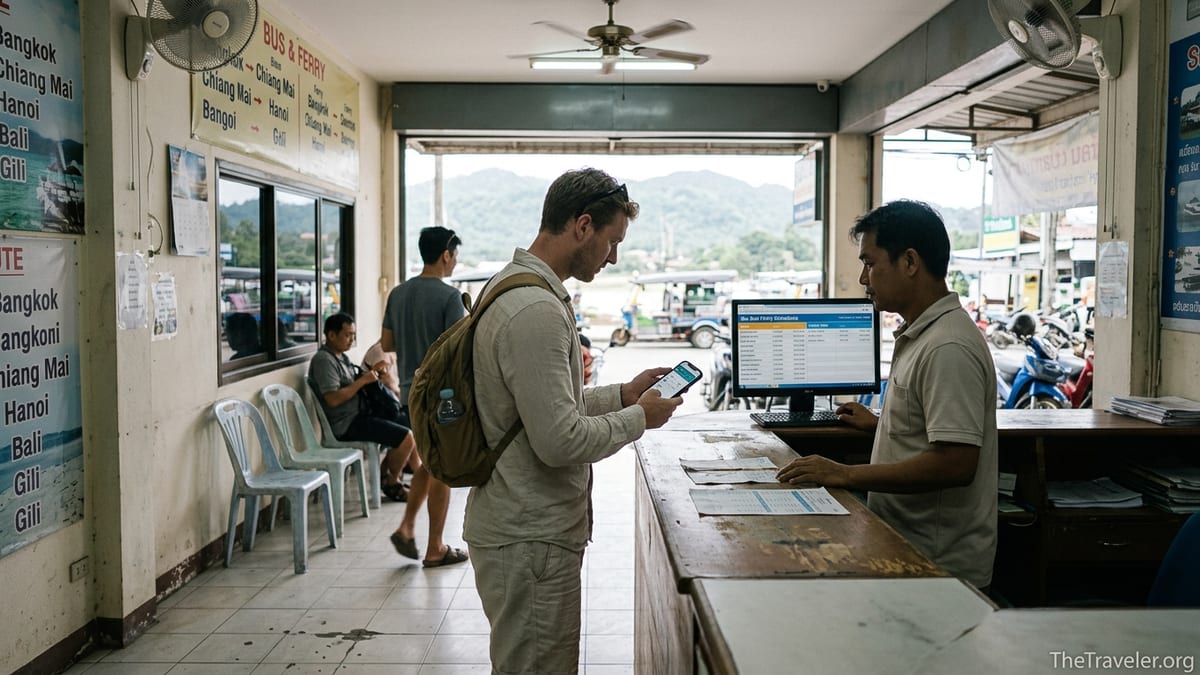
From Station Chaos to a Single Search Bar
Like many travelers, I first heard about 12Go from other backpackers swapping stories in a Bangkok hostel. It came up every time someone mentioned trains to Chiang Mai or buses to Cambodia. 12Go is a Singapore-based booking platform that pulls together tickets for trains, buses, minivans, ferries, and even some domestic flights across much of Asia. In Southeast Asia, that means you can compare options for routes such as Bangkok to Chiang Mai, Hanoi to Sapa, Kuala Lumpur to Penang, or Bali to the Gili Islands without bouncing between dozens of operator websites or walking up to counters in person.
On my first evening in Bangkok, I decided to test it on the classic Bangkok to Chiang Mai run. Instead of trying to decipher the Thai State Railway website or lining up at Hua Lamphong or Krung Thep Aphiwat station, I typed “Bangkok – Chiang Mai” into 12Go. The site laid out overnight sleeper trains, VIP buses, and even flights in one list, each with departure times, journey length, user ratings, and approximate prices. I could see, at a glance, that an air conditioned second-class sleeper train would cost a bit more than a standard VIP bus but with the comfort of a flat-ish bed and the experience of the night train.
That simple comparison is where 12Go starts to feel game changing. In many parts of Southeast Asia, there are plenty of transport options but information is scattered, often in local languages, and not always updated. 12Go’s main value is that it turns this messy reality into a searchable, sortable overview so you can plan with some confidence before you ever walk into a bus station or ferry terminal.
Real Routes, Real Prices: What Booking Actually Looks Like
Using 12Go is not just about browsing; the advantage is being able to lock in tickets on real routes you are likely to travel. Take that Bangkok to Chiang Mai journey. At the time of writing, many travelers use 12Go to book the popular overnight trains, then pick up their physical tickets in Bangkok before departure if required. Typical second-class air-conditioned bunks on the main night train often work out to the equivalent of a few dozen US dollars, while VIP buses on the same route might be somewhat cheaper but vary in comfort. You will usually see multiple train numbers and bus companies listed side by side, with past passengers rating operators on punctuality, cleanliness, and staff.
Another example is the busy Kuala Lumpur to Penang route in Malaysia. On 12Go, you can scroll through options ranging from long-distance buses departing from Kuala Lumpur’s TBS terminal for roughly the cost of a casual restaurant meal, to KTM’s Electric Train Service that whisks you to Butterworth station with a connection over to Penang Island. The platform might show, for instance, an overnight SVIP bus with reclining seats, leaving just after midnight for under 10 US dollars, alongside daytime trains and several budget and full-service flights between Kuala Lumpur and Penang for prices that start in the tens of dollars.
Island connections, which can be the trickiest part of planning in Southeast Asia, are where 12Go often shines for first-time visitors. Consider getting from Bali to Gili Air in Indonesia. Instead of bargaining at the pier in Padang Bai or Serangan, you can see multiple fast boat companies in one listing. A typical fast boat ticket might appear in the range of the low tens of US dollars, with different departure ports on Bali, varying travel times, and clear notes about whether hotel pickup is included from areas like Ubud, Kuta, or Sanur. This helps you understand at a glance whether a seemingly cheap ticket will actually save you money once you factor in a taxi to the harbor.
Comparing Options: Sleeper Trains, VIP Buses, and Fast Boats
One of the mental hurdles I had before the trip was simply choosing between all the different modes of transport. Should I pay extra for a sleeper train instead of a night bus? Is a fast boat to the islands worth the additional cost over a slower public ferry? 12Go does not make those decisions for you, but it makes the trade-offs much clearer.
For long overland routes like Hanoi to Sapa in Vietnam, the platform shows overnight buses alongside a range of trains that run to Lao Cai. You might see premium tourist trains marketed under names such as Victoria Express or Pumpkin Express next to more modest compartments on standard services. Prices often range from budget-friendly seats costing about as much as an inexpensive meal, up to private cabins with softer beds and added amenities for several times that amount. Because the listing includes user reviews, you are not just choosing based on price and schedule but also on how other travelers found the ride.
For island hops in Thailand, say between Phuket and Koh Phi Phi or from Krabi to Koh Lanta, 12Go outlines which routes are on high-speed ferries, which are on slower boats, and which offer combined bus and boat tickets. You might compare a basic ferry ride that takes a couple of hours with a slightly more expensive speedboat that cuts the journey time, then read comments about sea conditions, safety briefings, and how crowded each operator typically gets during high season.
The same logic applies to choosing between VIP buses and trains. On the Bangkok to Chiang Mai leg, for example, many travelers appreciate the privacy and motion of the sleeper train, even if it costs a bit more than a standard VIP bus. Others prefer a daytime bus that leaves from Bangkok’s Mo Chit or Ekkamai terminals, allowing them to watch the countryside roll by and arrive in Chiang Mai before nightfall. In each case, 12Go’s role is to lay out departure times and classes clearly enough that you can match the option to your budget, schedule, and comfort tolerance.
What 12Go Gets Right for Southeast Asia Travel
After several months of moving around the region, a few strengths of using 12Go stood out. The first is simply coverage. Today the platform works with thousands of operators and hundreds of thousands of routes across Asia, with particularly dense networks in Thailand, Vietnam, Malaysia, Indonesia, and the Philippines. This is not a niche tool for a handful of popular train lines; it is something you can use both for major corridors and many secondary routes, from Bangkok to Chiang Mai and Hanoi to Sapa, to inter-island hops in the Philippines or Sri Lanka.
The second strength is clarity of information. Each listing usually shows the operator name, class of service, departure and arrival points, estimated travel times, and customer ratings. On routes like Kuala Lumpur to Penang, where you might be choosing between a cheap overnight bus and a faster but pricier flight, having real departure and arrival times side by side helps you calculate not just the money but the sleep and sightseeing time you trade away. For boats around Bali and the Gili Islands, it is helpful to see which companies bundle hotel pickup and which expect you to meet them at the harbor.
Third, 12Go generally makes payment smooth for travelers who do not hold local bank cards. You can usually pay with international credit or debit cards, which removes a common barrier when trying to book directly on some smaller operators’ websites that may only accept local banking apps or in-person cash payments. Many travelers also appreciate having vouchers and confirmations in their email or app instead of keeping track of small paper tickets bought at scattered counters.
Finally, the rating and review system is practical. If a certain fast boat operator regularly runs late or squashes too many people onto the deck during peak season, that tends to appear in reviews. The same goes for sleeper buses with poor air conditioning or older trains that feel more worn than the promotional photos suggest. While reviews are subjective, seeing rough patterns across dozens or hundreds of comments is much better than stepping onto a bus or boat completely blind.
Where You Still Need to Be Cautious
Using 12Go does not completely remove the quirks of Southeast Asian transport. Prices on the platform are often a little higher than buying directly at a station, especially for trains in Thailand where official websites and government apps sometimes show lower base fares. For example, some travelers report that night train tickets booked through 12Go can work out noticeably more expensive than those purchased directly from Thai rail channels, particularly for popular routes like Bangkok to Chiang Mai during busy festivals. In exchange, you are paying for an English interface, easier payment options, and the ability to secure tickets before you even arrive in the country.
Availability is another area where expectations should stay realistic. During peak travel times like Lunar New Year in Vietnam, the Yi Peng lantern festival in Chiang Mai, or school holidays in Thailand and Indonesia, sleeper trains and fast boats can sell out or show limited availability on every platform. If 12Go shows no seats left for a given train or boat on your dates, that usually means demand is genuinely high, not that the platform is hiding space. In some cases, it may still be worth checking in person or trying alternative routes, but you should not assume that walking up to the station on the day of travel will magically reveal plenty of space.
There can also be occasional mismatches between what is shown online and what is delivered. For instance, sometimes a particular train class is not available even after you book, and you may be reassigned to a different coach. For boats, schedules might change at the last minute because of weather or port congestion. 12Go typically passes on operator updates through email, but in regions where communication infrastructure is imperfect, there is always a small chance that changes will reach you late. It is wise to build some flexibility into your schedule and avoid same-day tight connections, like trying to catch an international flight only a short time after a domestic ferry arrival.
Finally, remember that 12Go is an intermediary. Your actual journey is provided by the bus company, railway, or boat operator. If something goes wrong on the road or at sea, resolution often depends on the local operator’s policies and staff rather than the platform itself. While 12Go customer support can help in many situations, they cannot override a captain delaying departure because of rough seas or a train company’s rules on refunds. Travelers who go in expecting a Western-style, fully standardized rail or aviation system may feel frustrated; those who see the platform as a helpful organizing tool on top of a still-chaotic ecosystem tend to be more satisfied.
Practical Tips for Using 12Go on the Road
To get the most from 12Go, timing matters. For flagship routes like Bangkok to Chiang Mai sleeper trains or Hanoi to Sapa premium cabins, it is smart to book several weeks ahead in high season, especially around major festivals or long weekends. For shorter bus rides and some boat routes, one or two days’ notice is often enough outside peak travel dates. If you know you are traveling during a holiday period, checking schedules as soon as your itinerary is set can save you from expensive last-minute alternatives.
Another useful habit is to read the fine print on each listing. Routes that include phrases like “combined ticket” or “joint ticket” may cover multiple legs, such as a hotel pickup plus a fast boat to the islands. Others may require you to exchange your 12Go voucher at a specific office before boarding. For example, some Bali to Gili Air tickets include shuttle transfers from Ubud or Canggu to Padang Bai or Serangan, while others only start at the harbor. Knowing these details in advance helps you avoid scrambling for a last-minute taxi or missing a boat because you arrived at the wrong pier.
It is also worth cross-checking rough prices so you understand the premium you are paying for convenience. For instance, if a fast boat from Padang Bai to Gili Air typically costs the equivalent of a few hundred thousand Indonesian rupiah when booked locally, and 12Go’s price in your currency works out noticeably higher, you might decide whether the difference is acceptable in exchange for having a confirmed ticket and clear instructions. On some routes, like certain Bali fast boats, travelers report that prices on 12Go and the operators’ own websites can be quite similar, while for select train routes in Thailand there may be a larger markup.
Finally, keep backups of your travel details. Download or screenshot your 12Go vouchers and store them offline on your phone, as mobile data and Wi-Fi can be patchy at harbors, rural bus terminals, or border crossings. Have your passport number handy, since some operators check it against the name on your booking. Arrive early, particularly for boats and international buses, as check-in counters can be busy and luggage handling can take longer than expected.
When 12Go Is a Lifesaver and When to Book Locally
There are particular situations where 12Go feels almost indispensable. First-time visitors planning a tight itinerary across multiple countries often benefit from stitching key routes together in advance. A traveler flying into Bangkok, then heading north to Chiang Mai, crossing into Laos, and continuing towards Vietnam might book a night train, a border-crossing bus, and a regional train or bus onward from Hanoi all through 12Go. This reduces uncertainty and allows you to focus on enjoying your time in each place rather than queuing for tickets.
It is especially valuable for routes where information in English is scarce or fragmented. Some long-distance buses in Vietnam or regional connections in the Philippines fall into this category. When you see several operators on the same route, each with ratings and typical travel times, it becomes easier to avoid the least reliable options even if you have never set foot in the country before.
On the other hand, there are times when booking locally still makes sense. If you are staying flexible and traveling outside peak periods, walking into a bus station in Thailand or Vietnam can sometimes get you a slightly lower fare than the online price, especially for non-premium services. Local agents near Bali’s harbors may also offer deals on same-day fast boat tickets if boats are not full. In those cases, 12Go is still useful as a reference point for what is reasonable in terms of schedule and cost, even if you ultimately hand over cash at a ticket window.
A hybrid approach works well. Use 12Go to secure the essential journeys that would seriously disrupt your trip if they sold out or went wrong: sleeper trains, long cross-country buses, or vital island connections. Then stay open to buying short hops in person as opportunities arise, especially when you want to change plans spontaneously or take a detour based on a recommendation from someone you meet on the road.
The Takeaway
Before I tried 12Go, the complexity of buses, trains, and ferries in Southeast Asia felt like a barrier. I pictured spending hours in ticket queues, poring over outdated schedules, and gambling on unknown operators every time I needed to move on. In practice, the platform turned that anxiety into a series of clear comparisons and straightforward bookings. From Bangkok to Chiang Mai, from Kuala Lumpur to Penang, and from Bali to the Gili Islands, having the main options laid out on my screen made the region feel significantly more accessible.
12Go is not perfect. Prices can be a little higher than buying locally, seats can sell out in peak season, and last-minute changes from operators still happen. It is a tool layered on top of an inherently imperfect transport network, not a guarantee that everything will run on time. But as a planning companion, particularly for first-time visitors or anyone juggling limited vacation days, it can make the difference between a trip dominated by logistics and one focused on experiences.
If you go in with realistic expectations, use it thoughtfully, and keep a little flexibility in your schedule, you may find, as I did, that booking transport across Southeast Asia is far less complicated than it appears. In many cases, it is as simple as opening your phone, typing in two cities, and letting 12Go handle the messy middle.
FAQ
Q1: Is 12Go a legitimate company for booking transport in Southeast Asia?
Yes. 12Go is a longstanding transport booking platform registered in Singapore that partners with thousands of bus, train, ferry, and van operators across Asia. It is widely used by independent travelers for routes in countries such as Thailand, Vietnam, Malaysia, Indonesia, and the Philippines.
Q2: Is 12Go always the cheapest way to buy tickets?
Not always. In some cases, especially for government-run trains like certain Thai routes, buying directly at the station or on official websites can be cheaper. 12Go often adds a small markup for the convenience of an English interface, advance booking, and international payment options. Many travelers consider that extra cost acceptable for key journeys.
Q3: How far in advance should I book popular routes like Bangkok to Chiang Mai?
For popular sleeper trains or peak-season dates, it is wise to book several weeks in advance. During major festivals or holidays, premium classes and night trains can sell out early. Outside of busy periods, you can sometimes find availability closer to your travel date, but advance booking still gives you more choice of departure times and classes.
Q4: Can I use 12Go for island routes like Bali to the Gili Islands?
Yes. 12Go lists a range of fast boat operators between Bali ports such as Padang Bai or Serangan and islands like Gili Air, Gili Trawangan, and Lombok. You can compare departure times, approximate prices, and user ratings and see whether tickets include hotel pickup or start directly at the harbor.
Q5: Do I always get an e-ticket, or do I need to pick up a physical ticket?
It depends on the route and operator. Many buses and boats accept a digital voucher on your phone, while some train services still require a physical ticket. In those cases, 12Go usually provides clear instructions on where and when to collect your ticket, such as a partner office near the station or pier before departure.
Q6: What happens if my bus, train, or boat is delayed or canceled?
Operational issues are handled primarily by the local operator, not by 12Go itself. If there is a schedule change, 12Go typically forwards updates via email or in your booking account. Refunds or rebooking options depend on the operator’s policy. It is important to read the terms on your specific ticket and to allow extra time if you have tight onward connections.
Q7: Are the reviews on 12Go reliable?
Reviews on 12Go are written by people who have booked through the platform, so they provide a useful snapshot of common experiences. Individual opinions vary, but patterns in ratings can help you identify consistently late operators, uncomfortable buses, or fast boats that tend to be crowded. It is best to read several reviews rather than relying on a single comment.
Q8: Can I change or cancel a booking made on 12Go?
In many cases you can, but flexibility depends entirely on the operator’s policy for that route. Some tickets are non-refundable or non-changeable, while others allow changes with a fee or within a certain time frame. 12Go displays these conditions during the booking process, so it is important to check them before you pay.
Q9: Is it safer to book fast boats and ferries through 12Go instead of at the pier?
Booking through 12Go does not change the physical safety standards of a boat, but it lets you compare operators, read reviews, and avoid unlicensed sellers at harbors. Choosing companies with better ratings and clear schedules can improve your experience, yet you should still follow common sense precautions and defer to local authorities if services are suspended because of weather.
Q10: Should I book all my Southeast Asia transport on 12Go or mix online and local bookings?
A mixed approach works best for most travelers. Use 12Go to secure essential long-distance journeys, popular sleeper trains, and key island connections before you travel. Then consider buying short, flexible segments such as local buses or city-to-city hops in person if you want to stay spontaneous or if you find a good local deal that fits your plans.