


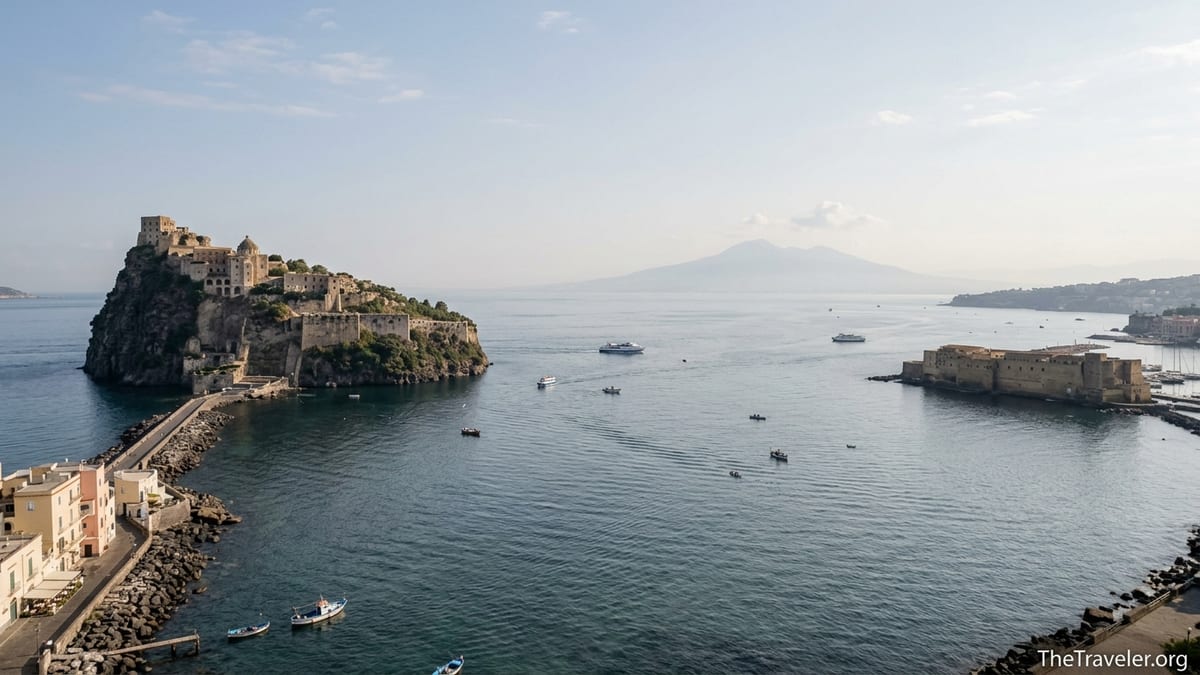
Rising from the Tyrrhenian Sea on opposite sides of the Gulf of Naples, Castello Aragonese in Ischia and Castel dell’Ovo in Naples are two of southern Italy’s most atmospheric fortresses. Both combine centuries of military history with sweeping sea views and cinematic approaches over the water. Yet they offer very different experiences for travelers deciding where to invest precious time on an already packed itinerary. This side by side comparison looks at how each castle feels in real life, what you can actually do there today, and which one tends to leave a deeper impression on different types of visitors.
Get the latest updates straight to your inbox!
First Impressions: Island Fortress vs Seafront Stronghold
Approach is everything with these two castles, and it often shapes travelers’ first emotional reaction. Castello Aragonese sits on a volcanic islet off Ischia’s eastern shore, linked to the island by a long stone causeway of around 220 meters. As you walk out over the water, the rock looms above you, topped with church domes, stone walls and Mediterranean vegetation. The feeling is almost theatrical, like entering a fortified village rather than a single monument. Many visitors say the approach alone would justify the ticket price.
Castel dell’Ovo, in contrast, stands on the former island of Megaride, now a small peninsula anchored to Naples’ waterfront. The castle is low and broad, more horizontal than vertical, and wrapped by a marina of fishing boats and seafood restaurants. Walking out from the seafront promenade, you see the walls on one side and an open view of the bay and Mount Vesuvius on the other. It feels less like entering a fortress town and more like stepping into a historic bastion that has grown into the modern city.
In terms of sheer drama, Castello Aragonese usually has the edge. The climb by tunnel or lift up into the rock, the sense of detachment from the main island, and the long views across the Gulf of Naples all contribute to a feeling of escape. Castel dell’Ovo is more understated, but the way it frames the Naples skyline and Vesuvius can leave a strong impression on those tuned into urban seascapes rather than medieval fantasies.
History You Can Feel Underfoot
Both fortresses trace their origins back over two millennia, but they channel that history in different ways. The rock of Castello Aragonese was first fortified in the 5th century BC, and later transformed under the Aragonese kings in the 15th century into a true citadel with thick walls and a stone bridge. At its height around 1700, it housed hundreds of families, several churches, a convent and a small garrison. Today, as you wander past ruined chapels, the former convent and terraces once used for gardens, the layout still feels like a self contained community.
Castel dell’Ovo also has deep roots. Megaride was a Greek settlement long before the Romans built a villa here, and the castle became a strategic stronghold in the Middle Ages. Over the centuries it served as royal residence, prison and coastal defense point. The layered history is physically visible in its massive ashlar walls, vaulted passages and courtyards. Yet the interiors are more open and less reconstructed than those of Castello Aragonese, with wide empty spaces now used for exhibitions and city events.
If you like history that is narrated through chapels, artifacts and small museums, Castello Aragonese feels more curated. Signage in multiple languages, a route that takes around 1.5 hours and clearly defined stops such as the convent cemetery and the main church help you piece together the complex story. Castel dell’Ovo, by contrast, rewards visitors who are comfortable using their imagination. You are free to wander the ramparts and inner courtyards with fewer interpretive panels, which can feel wonderfully atmospheric or slightly bare depending on your expectations.
Visitor Experience, Routes and Ticket Costs
Castello Aragonese functions very much as a paid, self guided attraction. Recent information suggests adult tickets are around 10 euros, with reduced rates for teenagers and free entry for younger children. You buy tickets at the base of the rock, then either walk through a long, gently sloping tunnel or pay a small supplement to use a lift that shortens the climb. Once on top, a clearly signposted route of about 2 kilometers loops past churches, viewpoints and gardens, with basic cafés and restrooms at key points.
Most visitors spend between 1.5 and 3 hours here, depending on how often they stop to photograph the views across to Procida, Capri and the green slopes of Ischia. The castle is open daily, with first entry in the morning and last admission roughly an hour before closing around sunset. In practice, that means you can use it as a half day highlight if you are staying on Ischia, or as the central stop on a day trip from Naples using the hydrofoil or ferry.
Castel dell’Ovo is integrated into the Naples waterfront and does not charge an entry fee, which makes it an easy, low friction stop. You simply walk out along the pier, pass the cluster of restaurants and bars at its base, and head into the castle by ramp or stairs. Opening hours can vary slightly by season and by which sections are being used for exhibitions, but it typically opens in the morning and closes before late evening. Most travelers spend about 45 minutes to an hour inside, often combining it with a stroll along Via Partenope or a meal with a view of the castle and bay.
For budget conscious visitors, Castel dell’Ovo has the advantage of being free and centrally located, requiring no advance planning. Castello Aragonese, even with a modest ticket fee, involves ferry costs to reach Ischia and more dedicated time. The trade off is that the Ischia fortress gives you a full, structured experience, while Castel dell’Ovo feels more like a beautiful open air monument folded into the city.
Views, Photography and Atmosphere
Photographers often find Castello Aragonese more rewarding simply because of its verticality and relative isolation. From the terraces at the top, you get 360 degree views over sea and island: pastel houses of Ischia Ponte, fishing boats below the bridge, green hills rising inland, and on clear days the silhouettes of Procida and Capri. Late afternoon light can be spectacular, with long shadows on the walls and warm tones on the stone and sea. Even basic smartphone cameras capture postcard shots from the olive terraces and bastions.
Inside the castle, the variety of spaces also helps your images. Cloisters overgrown with plants, stark monastic cells, narrow lanes between stone houses and occasional art installations create endless compositions. Because visitor numbers are spread out over the 2 kilometer route, you often find quiet corners where you can photograph alone, especially in shoulder seasons like April, May, September and October.
Castel dell’Ovo shines in wider cityscape shots. From its upper ramparts, you get one of the classic views of Naples: the curve of the bay, Castel Nuovo in the distance, the sprawl of the city up the hills and Vesuvius dominating the horizon. At sunset, the combination of golden light on the buildings and blue hour reflections on the water is impressive. Street photographers also enjoy the marina at its base, where fishermen mend nets, locals walk dogs and kids ride bikes along the pier.
Atmosphere wise, Castello Aragonese feels more removed from everyday life. Once you are inside the walls, motor traffic disappears and the constant buzz of Naples is replaced by sea wind and distant church bells. Castel dell’Ovo feels very much part of the city, with the hum of scooters, buskers along the promenade and the smell of espresso drifting from nearby cafés. Which leaves a deeper impression depends on whether you prefer contemplative, semi rural calm or the energy of a historical port city.
Practical Logistics: Getting There and Combining With Other Sights
Reaching Castello Aragonese requires committing to Ischia itself. From central Naples, high speed hydrofoils and slower ferries depart from the main ports and typically take between 50 minutes and 1 hour 30 minutes, depending on the service. Return fares fluctuate with season and operator, but many travelers report paying in the range of 30 to 50 euros per person for a same day round trip. Once in Ischia town, you can walk about 20 to 30 minutes to Ischia Ponte, take a local bus, or hop in a taxi for a short ride.
Because of the travel time, most people either dedicate a full day to Ischia, combining Castello Aragonese with a few hours at a beach club or thermal park, or stay several nights on the island. It works particularly well if you want to slow down after touring Naples and Pompeii. A common pattern is to visit the castle in the cooler morning hours, have a long lunch in Ischia Ponte, then spend the afternoon swimming or soaking in thermal pools before returning to Naples or your island hotel.
Castel dell’Ovo, by contrast, is an easy walk from many central Naples neighborhoods. From Piazza del Plebiscito or the historic center, you can stroll down to the seafront in 15 to 25 minutes, or take a bus or taxi for a short hop. The castle fits naturally into a day that might also include the Royal Palace, the nearby Castel Nuovo and a coffee stop in the Spanish Quarter. Even on a rushed city break, you can probably find an hour for it without adjusting your schedule.
This difference in logistics is crucial. If you only have two days in Naples and no interest in island hopping, Castel dell’Ovo is the realistic option. If you have at least three or four days in the region and like the idea of a ferry ride, thermal spas and quieter streets, then Ischia and its castle start to make much more sense.
Which Fortress Leaves a Bigger Impression for Different Travelers
In conversations with recent visitors, a pattern emerges. Travelers who make the effort to go to Ischia often name Castello Aragonese as one of the most memorable places of their trip, on par with Amalfi Coast viewpoints or the ruins at Pompeii. The combination of fortress, village, churches and panoramas feels like several experiences in one, especially if you take time to explore side paths and sit on the terraces. Many say they could easily have spent an entire half day wandering and still not seen everything.
On the other hand, Castel dell’Ovo regularly surprises visitors who were not expecting much from a free, central attraction. Its ramparts offer one of the best vantage points to understand the geography of Naples, and the walk out along the pier is particularly atmospheric in early evening when locals promenade and the city lights begin to glow. For travelers staying in the city and focused on food, street life and museums, it becomes an easy favorite precisely because it is so integrated into daily Neapolitan rhythms.
Broadly, Castello Aragonese tends to leave a deeper mark on those who prioritize scenery, slower sightseeing and layered historical storytelling. Castel dell’Ovo tends to resonate more with visitors who are drawn to urban energy, like mixing quick heritage stops into a wider day of exploring, and prefer not to commit to ferry schedules. Families with young children often appreciate Castel dell’Ovo’s open spaces and lack of entry fee, while couples on a longer trip might find the romance of Castello Aragonese and Ischia’s evening ambience more compelling.
If you have the time and budget, seeing both gives you two very different perspectives on the Gulf of Naples: one from the quieter island world of Ischia, the other from the heart of a sprawling southern metropolis. If you must choose, think honestly about whether your priority is a full excursion with a fortress as centerpiece, or a flexible city side visit that adds depth to your understanding of Naples itself.
The Takeaway
Set side by side, Castello Aragonese in Ischia usually delivers the stronger standalone experience. Its island setting, dramatic approach, curated visitor route and sweeping views make it a destination in its own right. You go out of your way to reach it, pay a ticket, and spend a significant slice of your day there. In return, it offers history, architecture, gardens and scenery that many travelers remember long after the trip.
Castel dell’Ovo, by contrast, is a classic example of a place that gains power from context. It may not be as visually dominating as Castello Aragonese, yet it anchors Naples’ seafront and helps you read the city’s relationship with the sea, with Vesuvius and with its own layered past. The fact that it is free, open and easy to integrate into any itinerary makes it one of those anchors you return to as you explore different parts of the city.
If your time in southern Italy is limited and you are staying almost entirely in Naples, Castel dell’Ovo will likely be your fortress of reference and can still leave you with unforgettable sunset memories. If you can spare the extra day, building a visit to Castello Aragonese into a wider Ischia excursion gives you a chance to experience a fortress that feels like a self contained world hovering above the sea. In the end, the castle that leaves the bigger impression is usually the one that best matches the rhythm and focus of your trip.
FAQ
Q1. If I have time for only one fortress, should I choose Castello Aragonese or Castel dell’Ovo?
For a deeper, more immersive visit, Castello Aragonese usually wins. For a quick, free and central experience in Naples itself, Castel dell’Ovo is the practical choice.
Q2. How much time should I plan for each castle?
Castello Aragonese typically takes 1.5 to 3 hours, not counting ferry travel. Castel dell’Ovo can be comfortably explored in 45 minutes to 1 hour as part of a wider Naples walk.
Q3. Is Castello Aragonese suitable as a day trip from Naples?
Yes, many travelers visit as a full day trip, combining the castle with a few hours at a beach, thermal park or in Ischia town. Just allow for ferry schedules and possible queues in high season.
Q4. Do I need to book tickets in advance?
Castel dell’Ovo does not usually require any booking. Castello Aragonese tickets are commonly purchased on site, although in peak summer it is wise to check current guidance from local tourist information or your hotel.
Q5. Are the castles accessible for visitors with limited mobility?
Both sites involve ramps and uneven stone surfaces. Castel dell’Ovo has relatively gentle inclines but still some steps. Castello Aragonese offers a lift to reduce the initial climb, yet the full route includes slopes and cobbled paths, so those with mobility issues should plan carefully.
Q6. Can I visit Castello Aragonese in bad weather?
The castle remains open in most conditions, but strong winds or heavy rain can make the exposed terraces less pleasant. If storms are forecast, consider shifting your visit to a clearer day so you can enjoy the views.
Q7. Is Castel dell’Ovo good for families with children?
Yes. Its open courtyards, wide ramparts and lack of entry fee make it easy to visit with children, though parents should still supervise closely near walls and edges.
Q8. Are there places to eat near each castle?
At Castello Aragonese, you will find simple cafés or bars inside or just outside the complex, plus many trattorias in Ischia Ponte. Castel dell’Ovo is surrounded by waterfront restaurants and bars, ranging from casual pizzerias to more formal seafood spots.
Q9. When is the best time of day to visit for views and photography?
Late afternoon into early evening is ideal for both. At Castello Aragonese, side light enhances the cliffs and sea; at Castel dell’Ovo, the sun sets behind Naples, softening the city skyline and Vesuvius.
Q10. Can I realistically see both castles in one trip to southern Italy?
Yes. Many visitors spend a few days in Naples, visiting Castel dell’Ovo while in the city, then dedicate another day or more to Ischia to explore Castello Aragonese and enjoy the island’s beaches or thermal spas.