


Rome is one of the few cities on earth that travelers keep returning to, even after they have seen the Colosseum, the Vatican Museums and the Trevi Fountain. Ask repeat visitors why they are back, and the answers rarely involve a monument. Instead they talk about an espresso ritual at a neighborhood bar, a favorite bench along the Tiber at sunset, or the way an elderly shopkeeper remembers their face from three years ago. Beyond its blockbuster landmarks, Rome works its way under a traveler’s skin through lived-in streets, small encounters and layers of daily life that reveal themselves only with time.
Get the latest updates straight to your inbox!
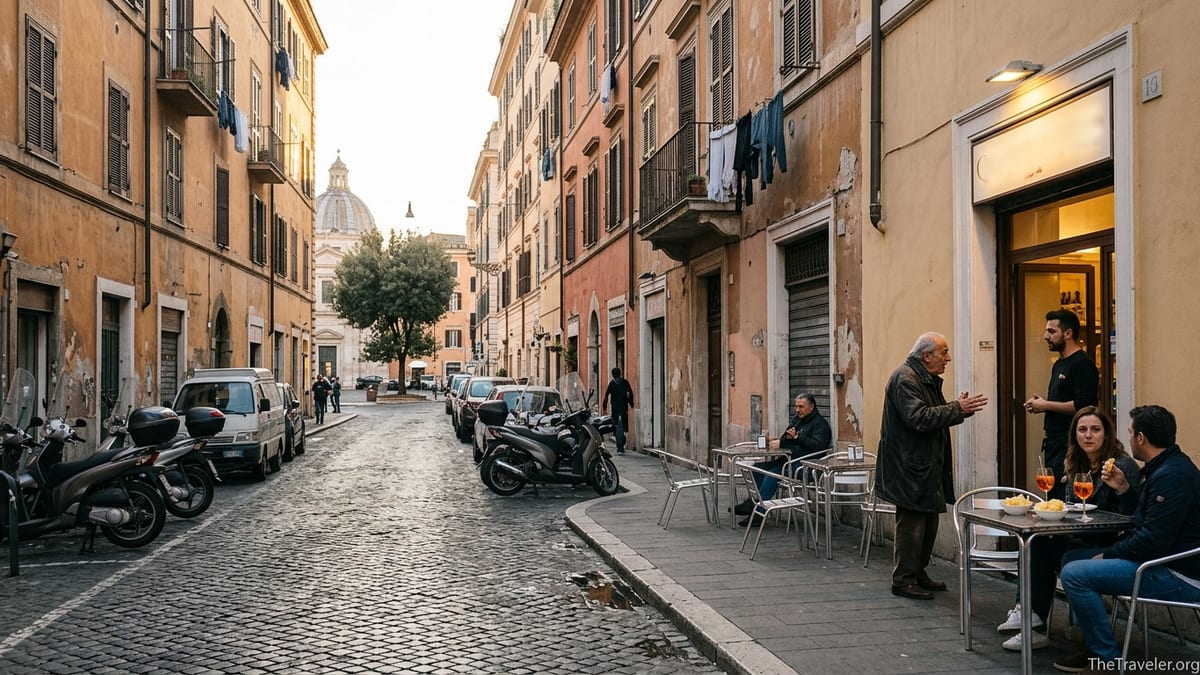
Everyday Life in Rome’s Neighborhoods
What many travelers fall in love with, often without realizing it, is not “Rome” in the abstract but a specific neighborhood they start to treat as their own. Once you have walked the imperial forums and climbed St Peter’s dome, it is areas like Trastevere, Testaccio, Monti, Pigneto and Garbatella that keep pulling you back. In these districts you see kids walking to school, neighbors arguing cheerfully from balcony to balcony, and nonne shopping for vegetables at small markets. A morning wandering the cobbled backstreets of Trastevere or Monti often feels more memorable than an afternoon queuing for a major museum.
Testaccio, just south of the Aventine Hill, is a good example of this quieter magnetism. Historically a working-class quarter tied to the river port and slaughterhouses, today it is known for no-nonsense Roman cooking, produce markets and manageable nightlife. Travelers who base themselves here often mention that their Airbnb costs a few hundred euros less for a week than an equivalent apartment in the heart of Trastevere, yet they can still walk to that more famous neighborhood in about 20 minutes and reach the Colosseum or Circus Maximus with a short bus or metro ride. In the evenings, they head back to a district where locals still outnumber visitors at most tables.
On the opposite side of the city center, Monti offers a different personality. Here ancient brick walls sit behind boutiques, vintage shops and small natural wine bars. You might start your day with a cappuccino at the counter of a corner bar near Via dei Serpenti, then wander past artisan workshops to a tiny piazza that happens to frame a perfect view of the Colosseum in the distance. Travelers who stay in Monti often describe the pleasure of walking home at night along streets where they recognize the same shop dogs and baristas each day, even though the major sights are only a 10 or 15 minute walk away.
Farther out, creative neighborhoods such as Pigneto and San Lorenzo attract travelers on their second or third visit. Here, street art, indie cinemas and low-key bars draw a younger crowd. A traveler might take the tram from Termini to Pigneto in the late afternoon, have an aperitivo at a sidewalk table for roughly 6 to 8 euros including snacks, then stay on for inexpensive Roman-style pizza and live music. These small routines, rather than any single attraction, are what many visitors point to when they explain why Rome feels like a city they could actually live in.
The Food Culture That Spills Into the Street
Rome’s food is another reason travelers get hooked, but not only in the form of big-name restaurants. It is the everyday food culture, visible from the morning cornetto to late-night slices of pizza al taglio, that gives the city its addictive quality. Walk into a typical neighborhood bar at 8 am and you will see office workers standing at the counter, drinking one-euro espresso from small porcelain cups and chatting with the barista who already knows their order. Travelers who return often talk about the particular café where they are greeted with a nod, or the bakery that wraps their favorite maritozzo with whipped cream in a twist of paper.
Local markets are where many visitors feel they get closest to the city’s culinary heartbeat. Mercato Testaccio, housed in a contemporary structure near the former slaughterhouses, blends traditional produce stalls with prepared-food counters. A traveler might buy sun-dried tomatoes and pecorino from one stall, then sit at a small table for a plate of cacio e pepe or a fried suppli for around 2 euros. On the other side of the Vatican, Mercato Trionfale rewards those who brave its maze of aisles with everything from fresh artichokes in winter to cured meats and tins of high-quality olive oil to bring home. Spending an hour here watching locals do their weekly shopping, and perhaps joining the line at a popular cheese counter, often feels more rewarding than a rushed lunch in a tourist-focused trattoria near the main squares.
New-style food halls have also become part of the repeat-visitor ritual. Near Termini station, the Mercato Centrale concept brings together independent vendors under one roof, serving everything from Roman trapizzino sandwiches to gelato and regional specialties. Families or groups with diverse tastes appreciate being able to sit at a communal table while each person chooses from a different counter, with most main dishes ranging from 8 to 15 euros. Some travelers find themselves returning here on multiple nights, treating it as an easy, reliable option after long days of walking.
Beyond eating in, food becomes a reason to explore less-visited districts. Travelers might head out to the Ostiense or Garbatella areas to try traditional cucina romana in restaurants where the menu is still largely in Italian and dinner for two, including house wine, can come to 40 to 60 euros. Others discover contemporary Roman cuisine in neighborhoods like Prati, where sleek bistros reinterpret classics such as carbonara with high-quality local eggs and artisanal guanciale. Over time, these meals begin to form a personal map of the city that is far more detailed than any checklist of “must-try” dishes.
Moments Between the Monuments
Rome is famous for its monumental skyline, but much of its magic lies in the unscripted spaces between the major sights. Repeat visitors often describe falling in love with little rituals: crossing the Tiber on the pedestrian bridge near Via Giulia at dusk, when the river reflects the orange light; or sitting on the low wall of a small piazza in the Ghetto Ebraico, listening to the sound of plates being stacked in a nearby kitchen. These interludes cost nothing and require no reservation, yet they linger in memory long after the details of an official tour fade.
Public transport, imperfect as it can be, also creates surprising windows into daily life. A single integrated ticket for buses, trams and metro in Rome costs about 1.50 euros and stays valid for 100 minutes from the first validation, so travelers often string together short hops, mixing a metro ride with a tram and a final walk through residential streets. Using a contactless bank card directly at metro turnstiles or on buses has become more common, which many visitors find easier than navigating ticket machines. A typical day might involve taking Metro Line A from the Spanish Steps to San Giovanni, then a bus onward to Appia Antica, followed by a slow walk along the ancient road under umbrella pines, encountering more cyclists and dog walkers than tour groups.
It is these in-between journeys that tend to reveal the quieter layers of Rome. Waiting for a tram in the shade near Porta Maggiore, travelers watch schoolchildren weave through traffic and elderly Romans argue over the day’s newspaper. A short commute through the city at rush hour, squeezed into a metro car alongside office workers, students and street musicians, might sound mundane. Yet for visitors used to seeing Rome only as a backdrop for history, this immersion in a contemporary, lived-in metropolis is often what makes the city feel real and worth returning to.
At night, the city’s monuments become the backdrop for local routines. The steps around Piazza del Popolo fill with teenagers eating takeaway slices of pizza. Couples stroll along Via dei Fori Imperiali, occasionally stopping to look at the illuminated ruins. Travelers who have already “checked off” the major attractions often find their favorite moments involve walking home after dinner, when the streets are quieter and the city’s stones still hold the warmth of the day.
Festivals, Culture and the Rhythm of the Year
Another reason travelers keep returning to Rome is that the city feels different in each season. Beyond the permanent museums and ruins, a dense calendar of events alters the city’s energy month by month. In summer, the long-running Estate Romana program spreads open-air concerts, film screenings, dance performances and children’s workshops across parks, riverbanks and suburban piazzas. A returning visitor in July might spend one evening at an outdoor jazz concert in a courtyard near the Capitoline Museums and the next at a film screening along the Tiber, surrounded by Roman families enjoying the warm night air.
Autumn brings cultural festivals that are more focused but no less atmospheric. The Rome Film Festival, typically held in October at the Auditorium Parco della Musica, mixes red-carpet premieres with public screenings and talks. A traveler who has seen the Colosseum on a previous trip might now plan their visit around this event, buying tickets to see a foreign-language film in a modern auditorium, then emerging to find food trucks and live music outside. Elsewhere in the city, smaller events dedicated to literature, contemporary art or dance pop up in venues ranging from historic theaters to repurposed industrial spaces.
These festivals give repeat visitors a new lens on familiar streets. A traveler who first saw the Piazza Navona as a crowded baroque showpiece in high summer may return in December to find a Christmas market with stalls selling nativity figures and roasted chestnuts. Another traveler might experience Rome in early spring, when orange trees in cloistered gardens are in bloom and the city hosts marathons or cycling events that temporarily clear traffic from major avenues. Each return trip becomes associated not only with landmarks but with a particular light, temperature and cultural rhythm.
Importantly, many of these events draw a mostly local audience. Buying an inexpensive ticket at a neighborhood cinema for a documentary festival, or attending a free dance performance organized by the city in a peripheral park, puts travelers shoulder to shoulder with Romans rather than fellow tourists. For many repeat visitors, this sense of being briefly folded into the city’s own calendar is a key part of the attachment they develop.
Affordable Pleasures and Slow Travel
Rome can be expensive in peak season, but many of the experiences that inspire lifelong affection cost little or nothing. Public transport remains relatively affordable, with integrated tickets and day passes keeping most individual journeys under a few euros. Many churches that hold extraordinary works of art, such as Caravaggio paintings or Renaissance frescoes, are free to enter or ask only a small contribution. A morning spent moving from one such church to another in the historic center, stepping from noisy streets into cool, dim interiors, allows travelers to experience centuries of art without the pressure of timed entry slots.
Slow travel habits magnify these modest pleasures. Instead of trying to cram multiple cities into a week, more travelers are choosing to stay in Rome longer, renting apartments in non-touristy districts and shopping for groceries at local markets. A couple might spend 10 days in the city, working remotely in the mornings from a kitchen table, then exploring a single neighborhood each afternoon. Their souvenirs are not only Colosseum photos, but also the memory of buying oranges from the same stall owner every few days, or knowing which bakery on their street sells bread fresh from the oven around 5 pm.
Costs, of course, vary widely depending on location and season, but it remains possible to enjoy simple daily rituals without overspending. A morning espresso at the bar rarely exceeds 1.50 euros; a glass of house wine at an unpretentious trattoria often costs 3 to 5 euros. Sitting at a café table in a busy square can be more expensive, but lingering on a bench in the Villa Borghese gardens or along the Gianicolo hillside, with a takeaway coffee and a view over the rooftops, is free. It is this combination of accessible small luxuries and grand scenery that keeps many visitors loyal to Rome.
Over time, returning travelers learn to slow down even at famous sites. Instead of racing through the Vatican Museums, they might choose only a few sections, then spend the rest of the day in the nearby Prati district, browsing residential streets and stopping for gelato at a place recommended by a local. This shift in pace, from collecting sights to inhabiting the city, often marks the moment when a one-time visitor becomes someone who calls Rome their favorite place in the world.
Human Encounters and Roman Character
Perhaps the most powerful reason travelers fall in love with Rome is also the hardest to quantify: the people. Roman character is famously direct and theatrical, which can feel chaotic at first but often becomes part of the city’s charm. Visitors who return frequently tend to collect stories about small kindnesses or humorous interactions: the bus driver who stops to let an elderly passenger buy a ticket from the newsstand, the waiter who insists on bringing an extra plate of seasonal vegetables “because you have to try them,” or the hotel receptionist who draws an entire neighborhood walking route on a map while explaining where to find the best gelato.
Language barriers are real, especially outside central tourist zones, but gestures and a few basic Italian phrases go a long way. Travelers who make an effort to greet shopkeepers with a “buongiorno” and say “grazie” learn that Rome rewards participation. They may be offered a taste of house-made limoncello at the end of a meal, or find that a barista remembers their preferred pastry after a few days. These apparently small interactions accumulate into a sense that the city is not only a museum but a place of ongoing relationships, however brief.
Repeat visitors also come to appreciate Rome’s contradictions. On the same block you might find a centuries-old church, a graffiti-covered wall and a minimalist design store. Buses may run late and bureaucracy can be bewildering, yet spontaneous conversations with strangers feel more common than in many more “efficient” capitals. Accepting these inconsistencies, rather than fighting them, is often what allows travelers to relax into the city’s rhythm. Once they do, Rome stops being a challenging destination and instead feels like a demanding but endlessly rewarding friend.
Some travelers even develop multi-year rituals with the city. One person might always schedule a haircut with the same barber in Trastevere every time they pass through Italy. Another might return annually to the same small guesthouse in Prati, where the owner remembers their breakfast order and asks about family members by name. These relationships are not unique to Rome, but the density of independent businesses and family-run establishments here makes them particularly likely to form.
The Takeaway
Rome’s famous monuments are often what bring travelers to the city for the first time, but they are rarely what keep people coming back. The real attachment grows in quieter courtyards, corner cafés, neighborhood markets and late-night walks along the river. It emerges through riding the same tram several days in a row, recognizing the vendor at the market, and discovering that you have a favorite bench in a particular park.
For travelers considering a return visit, the key is to plan less around landmark checklists and more around neighborhoods, routines and seasons. Choose one area to treat as your home base, visit a market multiple times instead of once, and allow space in your itinerary for unscheduled wandering. Over time, you may find that Rome has shifted from a city of “must-sees” to a place that feels, in some deep and surprising way, like your own.
FAQ
Q1. Is Rome still worth visiting if I have already seen the major landmarks?
Yes. After your first trip, focus on neighborhoods like Testaccio, Monti, Pigneto or Garbatella, local markets and cultural events rather than repeating the same big sights.
Q2. Which neighborhood is best for a more local experience in Rome?
Areas such as Testaccio, Garbatella, Pigneto, San Lorenzo and parts of Prati tend to feel more residential while still offering good access to central sights.
Q3. How much should I budget per day for food in Rome beyond fine dining?
For casual meals, coffees and snacks, many travelers manage comfortably on about 30 to 45 euros per person per day, excluding high-end restaurants and specialty tastings.
Q4. Are Rome’s markets worth visiting if I am not cooking?
Yes. Markets like Mercato Testaccio and Mercato Trionfale offer prepared foods, snacks and small souvenirs, and they provide a vivid glimpse of daily Roman life.
Q5. How easy is it to use public transport in Rome as a visitor?
It is relatively straightforward. A single ticket covers buses, trams and metro for 100 minutes, and many travelers now use contactless bank cards at metro gates and on some buses.
Q6. What time of year is best for experiencing Rome like a local?
Spring and autumn are ideal for milder weather and cultural events, while winter offers fewer crowds. Summer is lively but hotter and busier.
Q7. Can I enjoy Rome on a slower, longer stay without spending too much?
Yes. Renting an apartment in a residential neighborhood, using public transport and embracing simple routines like market shopping and picnics can keep costs manageable.
Q8. Is English widely spoken in less touristy neighborhoods?
English is common in central areas and among younger Romans. In more residential districts, basic Italian phrases and gestures help, and people are usually patient with visitors.
Q9. How can I avoid feeling overwhelmed by crowds in Rome?
Book major sights for early or late time slots, visit popular areas in the morning, and spend afternoons in quieter neighborhoods, parks and local cafés.
Q10. What is one simple habit that helps travelers feel at home in Rome?
Choosing a “regular” bar or café near where you are staying and visiting daily, even briefly, often leads to familiar faces and a comforting sense of routine.