


On the south coast of the Isle of Wight, Ventnor has quietly become a favourite for travellers who crave sea air and slow days without the sense of being cut off. Sheltered by chalk downland and warmed by a mild microclimate, this small Victorian resort manages to feel like a tucked-away discovery while still giving visitors coffee bars, seafood shacks and practical transport links when they want them. For beachgoers who find big-name British resorts too hectic yet do not want a remote cottage miles from the nearest shop, Ventnor strikes a rare and appealing balance.
Get the latest updates straight to your inbox!
A Small South-Coast Town That Still Feels Connected
Ventnor sits on the south-east coast of the Isle of Wight, looking straight out over the English Channel. It was developed in the Victorian era as a health resort, thanks to its sheltered position beneath steep chalk downs and its relatively mild, sunny microclimate compared with much of the United Kingdom. Today the town still feels compact and human in scale, with a population measured in the low thousands rather than tens of thousands, yet it is very much a lived-in place rather than a purpose-built holiday park.
For visitors, that scale translates into calm. Walking down to the seafront in the morning, you are more likely to pass local dog walkers and parents heading to the paddling pool than coach parties and megaphone-toting guides. Yet the town is firmly plugged into the rest of the island. Regular Southern Vectis buses link Ventnor with the train at Shanklin, the county town of Newport and other resorts, and in summer an open-top Island Coaster route makes it easy to hop along the south coast without a car. From Ryde Pier or Fishbourne ferry terminals you can realistically be in Ventnor in under an hour, including the short train or bus link across the island.
The result is a place where you feel you have gone “away” in the traditional sense, complete with views of working fishing boats and a skyline of Victorian villas, but you can still rely on a convenience store, pharmacy, cash machine and evening bus service. For many beachgoers this mix is more attractive than staying in an isolated cottage reached only by narrow lanes, where every trip out feels like a minor expedition.
Ventnor’s scale also keeps the nightlife manageable. There are pubs and a handful of bars around the town and esplanade, but no large nightclubs. On a typical summer evening the soundtrack is more likely to be live acoustic music drifting from a seafront pub terrace or the quiet clink of cutlery at a restaurant than amplified bass. Visitors looking for a calm base appreciate that they can stroll back to their guesthouse or apartment without negotiating noisy crowds.
A Beachfront Built for Lounging, Not Lining Up
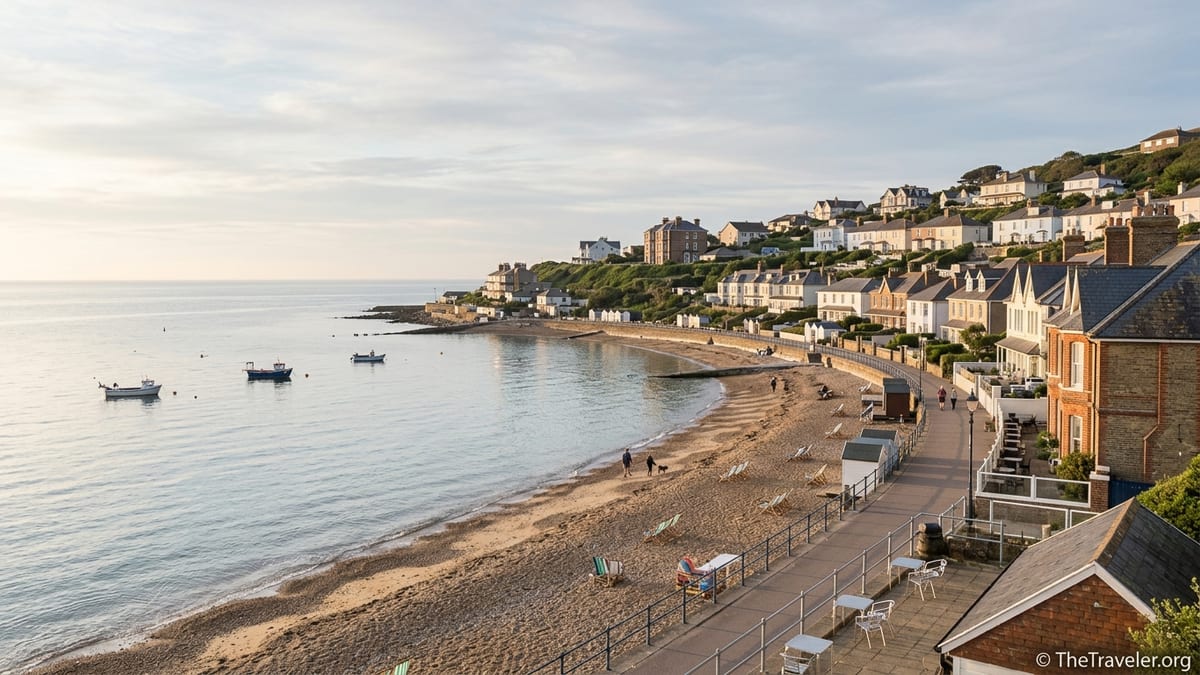
Ventnor’s main draw for many visitors is its south-facing bay, edged by a curving esplanade of low-rise cafés, small hotels and beach huts. The beach itself is a mix of shingle and sand, with fine sand exposed more clearly at low tide and shingle higher up the bank. Local tourism guides describe it as a sun trap, and on bright days the backdrop of the terraced town climbing the hillside can feel almost Mediterranean in mood. Compared with the long, packed promenades at resorts such as Bournemouth or Brighton on a busy weekend, Ventnor’s seafront typically feels gentler and more spacious.
For beachgoers who enjoy people-watching but dislike queueing for everything, the esplanade offers a useful mid-point. There is enough going on to fill a day without planning: cafés serve breakfast baps and coffee, a seafront pub offers pints and pub lunches, and an ice cream counter usually has a short line of families debating flavours. Beside the small harbour at the eastern end, a fishery sells locally landed crab and lobster in season, and a simple café opposite runs a shallow, island-shaped paddling pool that is free for small children to use. Parents often base themselves at one of the nearby outdoor tables, keeping an eye on the paddling pool while still enjoying a drink and the sea view.
At either end of the bay, low rocks and breakwaters create informal crabbing and rock-pooling spots. These rocky corners give children something to explore, but they are within sight and easy walking distance of the main esplanade, which helps anxious carers feel that they are not venturing out onto a wild, unpatrolled shoreline. Basic facilities such as public toilets, beach showers and seasonal lifeguard cover are present, which is reassuring for visitors who like to swim but may be wary of more remote coves.
Even in the height of summer, many visitors report that they can usually find a patch of sand or shingle wide enough to spread a towel without bumping elbows. Weekdays outside school holidays can feel positively sleepy, with only a handful of sunbathers and sea swimmers dotted across the bay. That quieter atmosphere is a strong contrast with many mainland beaches within similar travel time of London or the Midlands, which frequently see dense crowds and loud amplified music along the promenade.
Steephill Cove and Coastal Walks: Secluded, Yet Never Far Away
One of Ventnor’s biggest assets for calm-seeking beachgoers is what lies just beyond town. Walk west from the main esplanade and within about 20 to 30 minutes, depending on pace, you can reach Steephill Cove, a tiny fishing hamlet tucked below cliffs in the Undercliff landscape. There is no road access all the way down to the sand here; you arrive on foot, either along the coastal path from Ventnor or via a short descent from the vicinity of Ventnor Botanic Garden and local car parks. That lack of direct vehicular access naturally limits numbers and keeps the cove quiet, particularly outside peak hours.
Despite its tucked-away feel, Steephill Cove is not a bare or intimidatingly wild beach. In season you will usually find at least one seafood café, such as the Crab Shed, serving simple lunches like local crab pasties, mackerel in ciabatta or fish tacos, along with tea, soft drinks and ice cream. Another shack sells coffee and cakes a few steps from the shore. Several self-catering cottages cluster behind the beach, and on a typical mid-morning in summer you might see a mix of day-trippers, cottage guests sipping coffee on small terraces and local residents walking dogs along the shore.
For visitors based in Ventnor, this creates an appealing rhythm. You might spend one day largely in town, rotating between the main beach, the paddling pool and seafront cafés, and another day weaving in a coastal walk. A common pattern is to grab a takeaway drink near Ventnor Harbour, follow the signed coast path heading west through Ventnor Park, then emerge at Steephill Cove in good time for a late breakfast or early lunch. After a few lazy hours reading on the shingle or paddling where the waves lap up over the stones, you can either retrace your steps or loop inland via the Botanic Garden and catch the local number 31 minibus back towards the town centre.
East of Ventnor, walkers can continue via the coastal path and local roads towards Bonchurch and Shanklin. Bonchurch in particular has an almost time-capsule feel, with a wooded landslip area, a modest beach and a small village centre where the Bonchurch Inn serves Italian-influenced dishes in a courtyard. Because these walks are measured in a few miles rather than full-day hikes, they appeal to beachgoers who enjoy stretching their legs along the cliffs without committing to an all-day trek. If the weather turns or tiredness sets in, you are never very far from a bus stop or a café.
A Microclimate That Fosters Long, Unhurried Beach Days
Ventnor’s reputation as a resort originally grew from its climate. Sheltered by the steep bulk of St Boniface Down and facing south towards the open Channel, the town and its surrounding Undercliff enjoy slightly higher average temperatures and fewer winter frosts than much of the island and mainland south coast. Local tourism bodies often highlight the Isle of Wight as one of the sunnier corners of Britain, and Ventnor benefits particularly from this pattern.
For modern visitors, this microclimate translates into more days where it feels pleasant simply to sit outside. On a typical July or August day, beachgoers might comfortably spend hours reading on the shingle, punctuated by swims and shaded café breaks, without enduring the relentless crowds that descend on some mainland hotspots when the forecast looks favourable. Even in late spring or early autumn, when places exposed to northerly winds can feel chilly by mid-afternoon, Ventnor’s sheltered bay often remains inviting for a late stroll or an evening drink on a terrace.
The planting around Ventnor, including palms and other species more associated with milder regions, reinforces this impression. The Botanic Garden cultivates plants from Mediterranean and subtropical zones in the open air, reflecting how the local conditions allow specimens that might require greenhouse protection elsewhere in Britain. Walking between the town, garden and shoreline, visitors notice unexpected textures and colours: succulents spilling from stone walls, tall grasses shimmering above the esplanade, and front gardens displaying agapanthus and other sun-loving flowers.
For beachgoers seeking calm, the key benefit is how the climate encourages slower, more contemplative days. Instead of racing to the shore for a brief midday window of warmth, travellers can plan flexible days that drift between coffee in town, time on the sand, a wander through the garden and perhaps a late-afternoon paddle, without feeling rushed by weather or crowds.
Cafés, Pubs and Everyday Services That Keep You Grounded
One of the main reasons Ventnor feels calming rather than isolating is the presence of everyday services woven through the town. Along the seafront, places such as Besty & Spinky’s offer breakfast plates, local fish and coffee with outdoor seating overlooking the paddling pool, while other café-bars provide evening meals and drinks without overpowering the promenade. In town, bakeries, small supermarkets and takeaways mean you can assemble a picnic or grab a simple supper without planning days in advance.
Accommodation in Ventnor reflects this same balance. Visitors can choose from traditional seafront hotels, Victorian guesthouses perched partway up the hillside and self-catering cottages tucked along quiet residential streets. A property such as India Cottage, for example, sits in a small Victorian enclave within the town’s conservation area, just a few minutes’ walk from shops and under ten minutes from the beach. That kind of location allows guests to enjoy quiet evenings reading in a private garden or living room, yet pop out spontaneously for a morning swim or an impromptu ice cream on the esplanade.
Local pubs, both in Ventnor and nearby Bonchurch, add another layer of low-key sociability. Instead of high-volume club nights, the focus tends to be on conversation, occasional quiz evenings and seasonal live music. On cooler evenings many visitors retreat to these venues for a pint of island-brewed ale or a glass of wine and a simple supper, knowing that they have only a short stroll up or down the hill to reach their bed.
For families in particular, the presence of pharmacies, a small medical practice and regular bus services is reassuring. Staying somewhere more remote on the island can be beautiful, but if a child develops a sudden earache or someone sprains an ankle on the beach, the journey to seek help can become stressful. In Ventnor, those practicalities feel manageable, which helps parents relax into their holiday rather than quietly worrying about “what if” scenarios.
Day Trips and Island Highlights Without the Hassle
Although many visitors are content to base themselves largely in Ventnor and its immediate surroundings, the town also works well as a springboard for exploring wider parts of the Isle of Wight. In summer the open-top Island Coaster bus trundles along the island’s southern and eastern coasts, linking Ventnor with attractions such as Blackgang Chine, the Isle of Wight Pearl and Alum Bay. This makes it easy to plan car-free day trips that start and end in a calm base, rather than requiring a move to busier hubs like Sandown or Shanklin.
Closer to town, Ventnor Botanic Garden is a natural half-day outing. Located a short distance west along Undercliff Drive, it can be reached on foot from the town centre via Church Street, Belgrave Road and Park Avenue, or by hopping on the local number 31 minibus, which loops between Ventnor, the Botanic Garden, Steephill and Bonchurch. Once inside, visitors can wander among themed planting areas reflecting Mediterranean, Australasian and other warm-temperate regions, often with sea views framed between the trees and terraces. The garden’s café and seasonal events add gentle variety to a beach-focused trip without overwhelming the senses.
More active travellers can combine these attractions with coastal sections of the Isle of Wight Coast Path. A popular route involves walking from Shanklin to Ventnor via Luccombe and Bonchurch, enjoying a chain of beaches and viewpoints before settling into the quieter pace of Ventnor in the late afternoon. Others might start in Ventnor, walk to Steephill Cove for lunch, then continue west towards St Lawrence, returning by bus when legs tire. In each case, the knowledge that a modest town with services awaits at one end of the walk reduces the sense of risk for those unused to rural hiking.
Because distances on the island are relatively short, a week based in Ventnor can easily include forays to the Needles, cow-grazed downland above Freshwater Bay or the castle at Carisbrooke. Yet each evening you return to the same calm streets and familiar esplanade, rather than shifting between different, potentially busier resorts. For many travellers that continuity is a major part of the appeal.
The Takeaway
Ventnor succeeds as a destination for calm-seeking beachgoers because it combines three qualities that are rarely found together. It offers a sheltered bay and microclimate that invite long, lazy days by the sea; a compact, lived-in town with enough cafés, pubs and everyday services to feel grounded; and immediate access to quieter coves, walking routes and gardens when you want deeper tranquility. Visitors are neither hemmed in by crowds nor marooned in a hamlet with no bus stop and a single shop.
For travellers who love the idea of waking to the sound of waves and strolling to a small harbour for fresh crab, but who also want a choice of coffee bars, a local bus timetable and the option of spontaneous day trips, Ventnor on the Isle of Wight offers a persuasive answer. It is the sort of place where you can close the door of a hillside guesthouse and feel delightfully removed from everyday life, yet know that within ten minutes you could be browsing a high street bakery or watching children paddle in a seafront pool. That blend of calm and connection is precisely what many modern beachgoers are seeking.
FAQ
Q1. Where exactly is Ventnor and how do I get there without a car?
Ventnor is on the south coast of the Isle of Wight. From mainland England you take a ferry to Ryde, Fishbourne or another island port, then continue by train and bus or by direct island bus to Ventnor. A common route is to arrive at Ryde Pier, ride the Island Line train to Shanklin and connect to a Southern Vectis bus for the short onward journey.
Q2. Is Ventnor beach suitable for families with children?
Yes, Ventnor beach works well for families. The main bay has a mix of sand and shingle, seasonal lifeguard cover, public toilets and a popular paddling pool near the small harbour. Cafés and ice cream counters sit directly behind the promenade, so you can easily combine short swims, rock-pooling at the breakwaters and snack breaks without moving far.
Q3. Will Ventnor feel too quiet for teenagers or young adults?
Ventnor is calm compared with big mainland resorts, but it is not cut off. There are seafront bars and pubs, seasonal live music and easy bus links to livelier towns such as Shanklin and Sandown if your group wants arcades or later-night venues. Many older children and young adults enjoy the freedom of walking to Steephill Cove or exploring coastal paths during the day, then returning to a relaxed base in the evening.
Q4. What is special about Ventnor’s microclimate?
Ventnor is sheltered by steep downs and faces south towards the Channel, which creates a relatively mild, sunny pocket compared with many parts of the UK. The conditions allow plants more typical of Mediterranean or warm-temperate regions to thrive outdoors in the Botanic Garden and private gardens. For visitors, that means more days where it feels pleasant to sit outside, even at the start or end of the traditional beach season.
Q5. How long is the walk from Ventnor to Steephill Cove and is it difficult?
The walk from Ventnor’s seafront to Steephill Cove usually takes around 20 to 30 minutes, depending on pace and the exact route. The path is well-trodden but includes some slopes and uneven sections, so flat shoes or trainers are sensible. The final descent to the cove is relatively steep, and visitors with mobility issues may find it challenging, but most reasonably fit walkers manage it comfortably.
Q6. Are there plenty of eating options if I stay in Ventnor for a week?
For a small town, Ventnor has a good range of eating options. Along the esplanade you will find cafés serving breakfast, snacks and seafood, plus a couple of seafront bars that offer evening meals. In town, pubs, small restaurants and takeaways cover everything from fish and chips to Italian-style dishes. Nearby Bonchurch and Steephill Cove add further choices, such as courtyard dining at the Bonchurch Inn or casual seafood lunches at the Crab Shed.
Q7. What kind of accommodation suits calm-seeking beachgoers in Ventnor?
Visitors who value calm often opt for hillside guesthouses, small seafront hotels or self-catering cottages in residential streets close to the town centre. Properties in the conservation area, such as restored Victorian cottages and villas, tend to offer quiet settings within easy walking distance of shops and the beach. Booking somewhere with either a sea view or a small garden gives you a private space to read and relax between outings.
Q8. Is Ventnor a good base for exploring the rest of the Isle of Wight?
Yes, Ventnor works well as a base. Local buses link the town with Newport, Shanklin, Sandown and other hubs, and in summer the Island Coaster open-top service connects Ventnor to attractions along the south and west coasts. This allows you to visit places like Blackgang Chine, Alum Bay or Carisbrooke Castle as day trips, returning each evening to a quieter seaside setting.
Q9. What should I pack for a beach holiday in Ventnor?
Pack as you would for a typical British coastal break but allow for the slightly milder microclimate. Bring swimwear, sea shoes or sandals for the shingle, a light jumper or fleece for evenings, and a waterproof jacket in case of showers. Sun protection is important on clear days, as the south-facing bay can feel surprisingly strong in midsummer. Comfortable walking shoes are useful if you plan to explore Steephill Cove, Bonchurch or sections of the coastal path.
Q10. When is the best time of year to visit Ventnor for a quiet beach break?
Late spring and early autumn are ideal for travellers who prioritise calm. May, June and September often deliver pleasantly mild weather with fewer crowds than the school summer holidays. During July and August the town is livelier, especially on sunny weekends, but Ventnor generally remains less hectic than larger mainland resorts, and quiet corners such as Steephill Cove or nearby woodland walks still offer escape.