


High above Annecy, Semnoz offers big mountain views, family-friendly snowshoeing and easy access to winter landscapes without ever renting a car. The catch is that reaching this 1,700-metre ridge by public transport depends on strictly seasonal buses, changeable weather and careful timing. With some planning, however, it can be one of the most rewarding low-impact winter days out in the French Alps.
Get the latest updates straight to your inbox!
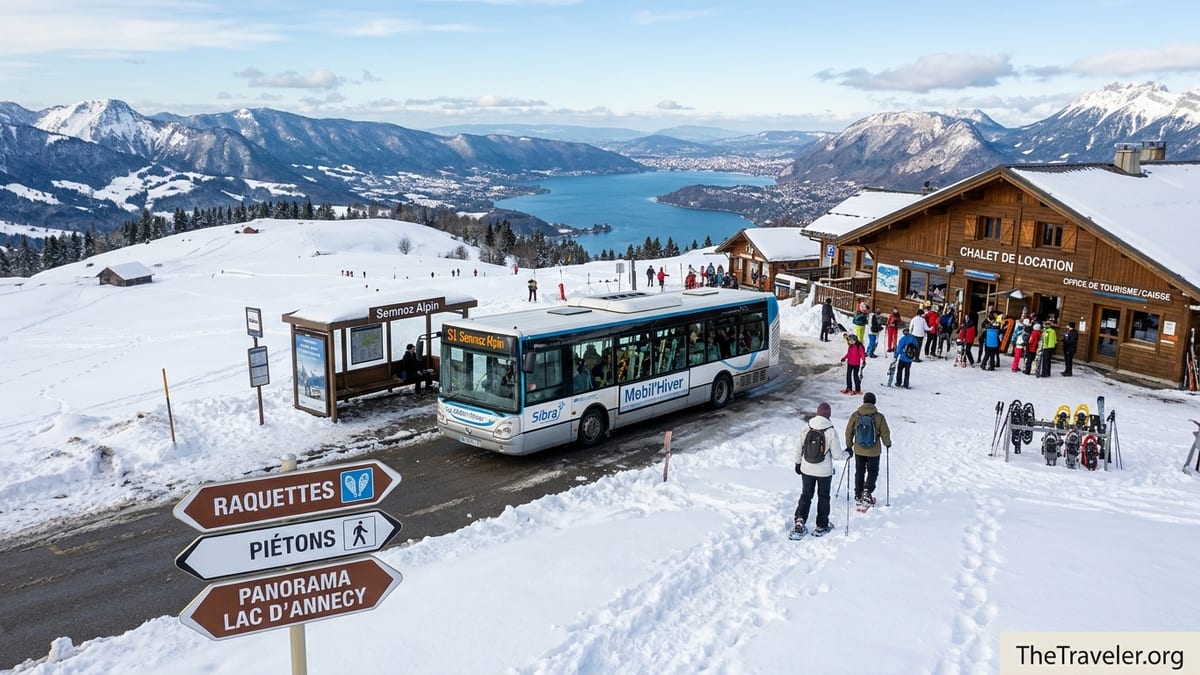
Semnoz by bus only in defined winter seasons
Semnoz is not served by regular year-round city buses. Access from Annecy relies on Grand Annecy’s seasonal Mobil’Hiver network, operated by Sibra. For winter 2025–2026, official documents for the Semnoz S1 line confirm operation from 20 December 2025 to 29 March 2026, with a similar window for the S2 route from the west side of the lake. These lines are described as seasonal services and are not integrated into the normal annual timetable.
At the time of writing in November 2026, Grand Annecy has announced the continuation of Mobil’Hiver for winter 2026–2027 but detailed Semnoz timetables and dates are typically published only in late autumn. Recent seasons have followed the same pattern of opening just before Christmas and closing around late March, but there is no guarantee that the exact dates for 2026–2027 will match the 20 December to 29 March window of 2025–2026. Travellers should therefore treat past seasons as an indication rather than a firm promise.
Services are structured around weekends and French school holidays rather than operating daily all winter. In 2025–2026, S1 and S2 buses ran at weekends outside school holidays, then more frequently during the Christmas and February holiday periods designated for zone A. On midweek days in early December or late March, there may be no public bus at all. This seasonal logic is crucial for planning: it is entirely possible to visit Annecy in snowy conditions and still find that no Semnoz bus is running that day.
Because of this, visitors must always check the current Mobil’Hiver timetable on the Grand Annecy or Sibra websites or at Annecy’s bus information office just before travel. Do not assume that because there is snow on the mountain there will be a bus, or that weekend patterns automatically extend to weekdays. Service can also be reduced or cancelled during storms or prolonged mild spells that close the ski area, so last-minute verification is essential.
Understanding S1 and S2: stops, tickets and travel times
Sibra’s S1 line is the main winter bus from Annecy to Semnoz. The 2025–2026 timetable shows it starting at “Annecy Gares,” a combined stop for the SNCF railway station and bus station. From there, it climbs through town via intermediate stops such as Pont Neuf, Marché, Malaz Golemme and Costa de Beauregard before leaving the urban area and continuing up through La Croix Ronde and Creuses to Semnoz. The final two high-mountain stops are typically labelled Semnoz Nordique and Semnoz Alpin, corresponding to the cross-country ski plateau and the alpine ski front de neige.
In 2025–2026, S1 journey times from Annecy Gares to Semnoz Alpin were around 45 to 55 minutes, depending on traffic and conditions. On busy winter Saturdays, buses often ran approximately every 60 to 90 minutes in the morning, with a cluster of downhill returns from mid-afternoon to early evening. An example late-season schedule in March 2026 shows the last return bus leaving Semnoz Alpin around 17:10 to reach Annecy shortly before 18:00. Exact times for 2026–2027 will only be known once Sibra publishes the new fiche horaire.
S2 serves Semnoz from the west side of the lake and surrounding villages. For visitors staying in central Annecy without a car, S1 from Annecy Gares remains the most straightforward option, because it starts a short walk from most city-centre accommodation and directly outside the railway station. Bus fares are charged at standard Sibra rates. In recent seasons a single urban ticket on the Sibra network has cost only a few euros, and Mobil’Hiver lines to Semnoz have been included at this normal tariff. Holders of Sibra season passes have been able to board these buses without paying extra, subject to validating their card on boarding.
It is important to factor in the possibility of modified timetables. The March 2026 Semnoz S1 leaflet explicitly notes that trips can be adjusted during the season for reasons of accessibility, especially weather. Heavy snowfalls, ice or high winds on the ridge can stop buses from reaching the upper stops even if services still run as far as lower hamlets. If visibility looks poor from Annecy, allow more time and confirm with Sibra or the tourist office whether the final section of the route is still operating that day.
Winter terrain, marked routes and where walkers may go
Semnoz is a rounded ridge whose highest point reaches about 1,702 metres above sea level. The ski-station area occupies a relatively gentle plateau, with alpine ski pistes dropping on short faces and cross-country loops extending across the summit meadows. A piste and trail map issued for winter 2024–2025 identifies distinct zones for alpine skiing, Nordic skiing, dedicated snowshoe itineraries and pedestrian areas, with each type of user directed to separate corridors.
For non-skiers, the key point is that walking is not normally allowed on groomed alpine pistes or on prepared cross-country ski tracks. These surfaces are reserved for paying users with appropriate equipment, both for safety and to protect the quality of the snow. The Semnoz map instead shows marked winter walking routes and signed snowshoe trails that weave between ski areas. These itineraries vary from short loops of roughly 1 to 2 kilometres with minimal elevation change around the top of the plateau, to longer circuits with several hundred metres of ascent and descent along the ridge.
Exact distances and gradients are updated periodically, but as a guide, a family-friendly snowshoe loop from the Semnoz Nordique sector might involve 3 to 4 kilometres of walking with 100 to 150 metres of cumulative elevation gain, mostly on broad, mellow forest and meadow paths. More ambitious itineraries from the alpine sector to panoramic knolls above the station typically run closer to 6 to 8 kilometres return with 250 to 300 metres of ascent, which can feel significantly harder in deep snow or windblown conditions.
Before setting off, visitors should obtain the current winter map at the station or download it from Semnoz’s official channels, then ask staff at the Nordic chalet or information desk which routes are open. Sections may be temporarily closed during avalanche control, forestry work or when snow cover is too thin. Staying on waymarked snowshoe and pedestrian routes also limits conflicts with toboggan zones and ski school areas, which can be extremely busy during French school holidays.
Rentals, facilities and what to wear in winter conditions
Semnoz’s practical setup is designed so that visitors arriving by Mobil’Hiver bus can rent equipment and head straight out into the snow. The main station website lists a chalet de location on the front de neige for alpine equipment and a Nordic center that organizes cross-country rentals. For snowshoes, the official information page directs people to contact the station, with email details provided for nordic and snowshoe gear. Several sports shops in Annecy, including dedicated outdoor rental outlets, also offer snowshoes for daily hire, which can be convenient if you want to arrive at the bus already equipped.
Up on the mountain, winter facilities include heated indoor spaces, food outlets and toilets near both the Semnoz Alpin and Semnoz Nordique bus stops. Cafeteria-style restaurants and snack bars serve hot drinks, basic Savoyard dishes and quick lunches, usually at mid-range resort prices. There are also outdoor picnic areas for those bringing their own food. Lockers for day storage may be available in some buildings, but availability changes from season to season and should be confirmed on arrival rather than assumed in advance.
Snowshoe rental is usually straightforward outside the busiest holiday weeks. During the Christmas and February school holidays for zone A, the station can be crowded with families and groups arriving on the same morning buses. At these times, it is prudent to contact the rental chalet or an Annecy-based shop a few days in advance to check stock and, if possible, make a reservation for snowshoes and poles. Group snowshoe outings with professional guides, which often include equipment, also book out well in advance for these peak periods.
Even for short, easy outings, winter conditions at roughly 1,500 to 1,700 metres can be harsh. Expect temperatures well below freezing, windchill on the ridge and rapidly changing visibility as clouds move over the plateau. Essential clothing includes waterproof winter boots or sturdy hiking shoes with warm socks, waterproof overtrousers, an insulated jacket, gloves, hat and neck gaiter. Microspikes or small traction devices can be invaluable on packed, icy sections around the station, and sunglasses plus sunscreen are necessary on bright days, when the snowpack reflects significant ultraviolet light.
Itineraries: half-day and full-day without a car
A realistic half-day excursion begins at Annecy railway station, ideal for visitors arriving by early train from cities such as Lyon or Geneva. Plan to catch a mid-morning Mobil’Hiver S1 departure, for example around 10:15 in a pattern similar to March 2026 timetables, arriving at Semnoz Alpin close to 11:10. On arrival, walk a few minutes to the rental chalet, pick up snowshoes if required, and obtain the current map of snowshoe and pedestrian routes. After a short safety briefing with staff, head out on a waymarked beginner loop near the top of the station, aiming for a 1.5 to 2-hour outing with views over Lake Annecy and the Bauges.
After the loop, return to the station buildings for a warm lunch at a self-service restaurant or a picnic near the bus stop. This schedule allows ample margin to return equipment and board an early afternoon bus back down, for example an S1 return sometime between 14:35 and 16:15 based on recent schedules. That timing brings you back to Annecy by mid to late afternoon, leaving daylight to stroll the old town. This half-day plan suits beginners, families with young children and anyone cautious about winter mountain exposure.
A full-day itinerary requires closer attention to daylight and the last return bus. Start with the first or second morning S1 departure from Annecy Gares, arriving on the plateau by mid-morning. After collecting a map and checking conditions with staff, follow a longer marked snowshoe route that links several viewpoints along the ridge. Allow at least 4 to 5 hours for a 6 to 8 kilometre circuit, with plenty of breaks for photographs and navigation checks. Carry enough food and hot drinks to avoid depending entirely on mountain restaurants, which may be crowded at lunchtime on peak days.
Build your day around an explicit target: for example, completing a signed “panoramic” circuit and returning to the station at least one full hour before the last scheduled S1 or S2 bus. If the last return from Semnoz Alpin is shown as 17:15 for a given date, aim to be back at the bus stop between 15:45 and 16:15. This cushion allows for slower-than-expected progress in deep snow, minor route-finding delays or queues at rental returns. Remember that in midwinter the sun sets early, and once twilight begins the plateau can empty quickly, leaving late stragglers exposed to rapidly dropping temperatures.
Alternatives: taxis, guided outings and snow-free options
Public buses are the most economical way to reach Semnoz in winter, especially for solo travellers or couples. A standard Sibra ticket for Mobil’Hiver lines has recently cost only a few euros per journey, and even assuming modest annual increases, a return trip on S1 or S2 in 2026–2027 is likely to remain far cheaper than private transport. However, the trade-off is dependence on fixed timetables and potential weather-related cancellations.
For those who prefer flexible departure and return times, Annecy-based taxi companies and ride services can drive directly to the station car parks when the road is open. A one-way fare from central Annecy to Semnoz is often quoted in the range of several tens of euros, rising with snow conditions, traffic and time of day. Return journeys can therefore approach or exceed low three-figure sums for a family, especially if waiting time is involved. Some outdoor agencies and guides also offer packaged snowshoe excursions that include minibus transport, equipment, guiding and sometimes a typical Savoyard snack, with per-person prices referenced against small-group rates.
In low-snow periods or during warm spells when the resort cannot open its ski or Nordic domains, Semnoz becomes more of a high plateau for walking than a classic winter sports area. Mobil’Hiver may still run if the authorities consider the road safe, so you can use the bus to reach the ridge for snow-free hiking on signed footpaths, weather permitting. When snow cover is absent or patchy, appropriate footwear shifts from snowshoes to robust hiking boots with good grip, possibly supplemented by light traction devices if the ground is icy.
For visitors who want mountain views with very little walking, a gentle alternative is to ride S1 or S2 up to the highest available stop and limit activity to short strolls around the station buildings and signposted belvederes. On clear days, simple five to ten minute walks from the bus stop can reveal wide panoramas over Lake Annecy, the Bauges and, in the distance, the Mont Blanc massif. This is an appealing option for older travellers, people with limited mobility and families with toddlers in sledges or all-terrain pushchairs, provided pathways are sufficiently cleared and not too icy.
Safety, children, accessibility and emergencies
Although Semnoz is a family mountain rather than a high-alpine glacier, its winter environment must be taken seriously. At around 1,700 metres, wind can be strong, and clouds can create whiteout conditions where horizon and snow merge. In such situations, distances are hard to judge and unmarked wandering can lead quickly away from safe areas. Staying on waymarked routes is not just a formality but an important safety measure. Basic navigation tools such as a paper map, a fully charged phone with offline mapping and familiarity with bus stop locations provide extra security, particularly in poor visibility.
Families with children will find dedicated beginner zones, toboggan areas and gentle snowshoe loops close to the station. Short circuits of one hour or less are recommended for younger children, allowing regular warm-up breaks in indoor spaces. Proper winter boots, waterproof mittens and spare layers are essential to prevent rapid cooling, and parents should remain attentive to signs of fatigue or cold even on sunny days. Sledging zones are fenced or clearly marked, but adults should still keep children away from ski pistes and cross-country tracks where faster users descend.
Accessibility in snow is always challenging, but Semnoz’s principal buildings, restaurants and toilets near the alpine front de neige are reached by short, relatively level stretches from the parking and bus area. For travellers with reduced mobility, advance contact with the station or Annecy tourist office can clarify which facilities and viewpoints are most realistic on a given day. Transport staff on Mobil’Hiver services can also advise on boarding and alighting procedures, though full barrier-free access to snow-covered areas cannot be guaranteed.
In case of emergency on the mountain, the standard European emergency numbers apply. Mobile coverage on the plateau is generally good but can vary; batteries also drain faster in cold conditions, so carrying a power bank is wise. For non-urgent issues such as lost property, delayed companions or timetable queries, staff at the Semnoz station offices and the Sibra customer service in Annecy can provide guidance. Importantly, if worsening weather or an incident delays your return, inform the station early so they can advise on the feasibility of catching the last bus or alternative options.
Is Semnoz worth it without skiing or a car?
For travellers based in Annecy, Semnoz is one of the rare alpine ridges that combines broad panoramas, straightforward snowshoeing and direct bus access from a mainline railway station. When the Mobil’Hiver S1 and S2 lines are running, it becomes a highly practical destination for low-emission winter exploration: you can step off a train in the morning, ride a seasonal bus up to 1,500 metres, walk through snow-covered meadows and be back in town for dinner without ever touching a steering wheel.
That convenience does come with caveats. Services are limited to a discrete winter window that has historically run from about 20 December to late March, clustered around weekends and school holidays. Buses can be curtailed in storms or during prolonged thaws, and timetables are not fixed far in advance. Visitors who ignore these constraints or fail to check the latest information risk either finding no bus at all or being stranded near the summit after the last departure has left.
For those prepared to plan around Mobil’Hiver dates, confirm return times and adapt to weather, Semnoz is very much worthwhile even without skiing or a car. Marked snowshoe and walking routes allow non-skiers to enjoy the same panoramas as alpine visitors, and the presence of rentals, food outlets and indoor facilities keeps logistics manageable. On snow-free days, it still offers accessible ridge walks and viewpoints, while lower-effort options let less mobile travellers step briefly into a mountain environment before retreating to Annecy’s lakeside comfort.
The verdict is that Semnoz rewards organisation. It is not a turn-up-any-day winter playground but a seasonal, bus-linked mountain that suits travellers who appreciate timetables, maps and layers. Approach it with that mindset and it can deliver some of the finest car-free winter scenery in the northern French Alps.