


More news on this day
Cathay Pacific plans to increase its Hong Kong–Seoul Incheon service to five daily flights from 30 March 2026, a scheduled expansion that would give South Korea‑origin passengers more one‑stop options via Hong Kong to Southeast Asia, Australia and Europe if filed timings proceed as published.
Get the latest news straight to your inbox!
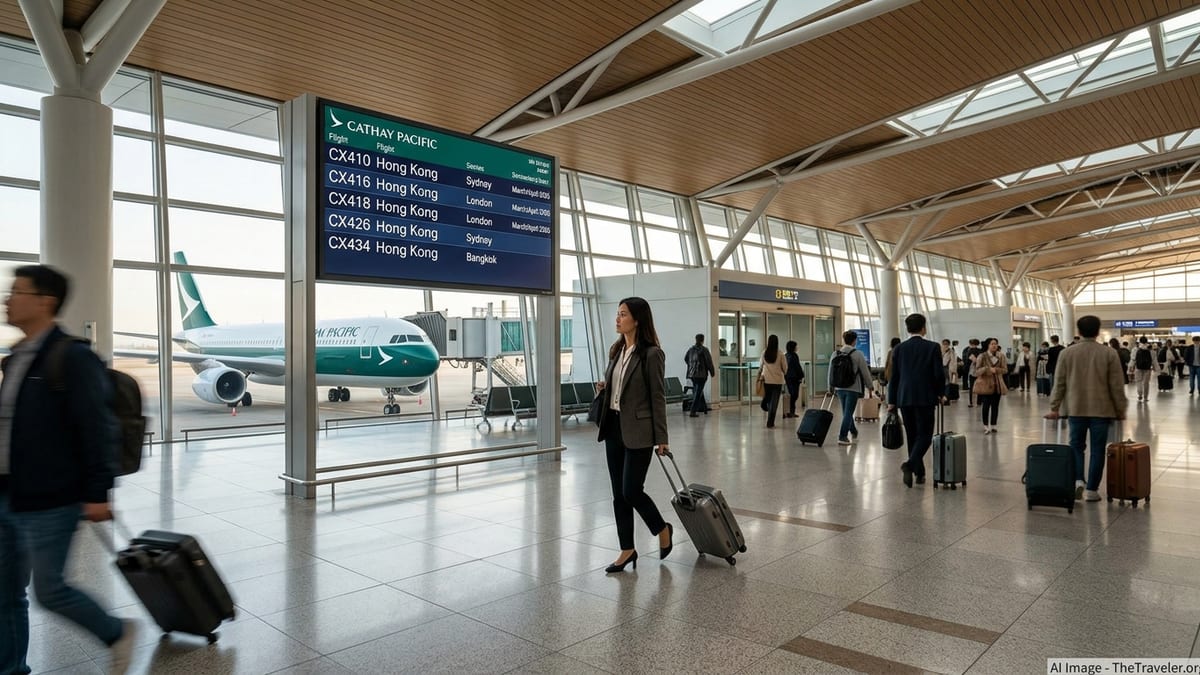
Five daily rotations scheduled from late March 2026
Cathay Pacific’s Korea offer pages currently show an “enhanced” Incheon–Hong Kong schedule from 30 March 2026, with five daily rotations filed between the two airports. The information positions the change as a confirmed timetable update rather than a tentative plan, although usual caveats apply around future aviation schedules.
The published pattern builds on Cathay’s existing Hong Kong–Incheon presence, which at present is operated several times a day using a mix of Airbus A330 and narrowbody aircraft depending on the date. Various timetable and schedule tools already show multiple Cathay flight numbers on the route, including CX410, CX416, CX418, CX426 and CX434, which are expected to form the basis of the five‑daily structure once the late‑March 2026 changes take effect.
As with any forward schedule, frequencies, timings and aircraft types remain subject to adjustment closer to the start date. Travelers and agents should therefore treat the five‑daily plan as the working timetable and recheck flight numbers and departure times when bookings for late March 2026 and beyond are finalized.
What the new pattern means for South Korea’s global links
The main practical impact for travelers is a wider spread of departure and arrival times between Incheon and Hong Kong. With five flights spaced across the day, South Korea‑based passengers gain more options for early‑morning departures geared to long‑haul connections, midday departures useful for short‑haul Southeast Asia links, and evening departures that can connect into overnight flights from Hong Kong.
For example, a Seoul–Sydney trip in early April 2026 via Hong Kong is expected to be possible on a morning Incheon departure that connects into an afternoon or evening Sydney service, keeping total journey time within the same day. Similarly, Seoul–Bangkok itineraries via Hong Kong can be structured with mid‑morning or early‑afternoon departures from Incheon, followed by short‑haul sectors into Thailand on the same calendar day.
Europe‑bound passengers should also see more same‑day one‑stop possibilities. A Seoul–London routing around late March or April 2026 can typically be arranged with an afternoon Hong Kong arrival feeding into an evening or late‑night departure to London, or conversely with an overnight London–Hong Kong leg connecting into a morning or midday Hong Kong–Incheon flight for the return, giving more flexibility in either direction.
Competitive dynamics with rival Asian hubs
The move positions Hong Kong as a stronger connecting option for South Korea traffic that might otherwise route via other Asian hubs such as Singapore or Tokyo. In markets like Seoul–Sydney or Seoul–Southeast Asia, Cathay’s five‑daily schedule is designed to tighten connections through Hong Kong, potentially trimming layover times compared with some routings via Changi or the Tokyo airports, depending on exact dates and flights chosen.
For regional itineraries such as Seoul–Bangkok or Seoul–Ho Chi Minh City, increased frequency between Incheon and Hong Kong should give Cathay more scope to offer one‑stop journeys that depart Seoul at a convenient time of day while still arriving in the final destination before midnight local time. That may appeal to travelers who prefer a single transit point and daytime flying over red‑eye services.
However, the expansion does not in itself guarantee lower fares or shorter journey times on every route. Competing carriers and hubs also adjust schedules and pricing over time, so Hong Kong’s relative attractiveness for any given origin‑destination pair will depend on how competing Korea–Singapore, Korea–Japan and nonstop long‑haul services evolve before and after March 2026.
Part of a wider post‑pandemic rebuild of the Cathay network
The Incheon increase sits within Cathay’s broader post‑pandemic rebuilding strategy. Company reports indicate that by 2025 the group had restored a network of more than 100 passenger destinations worldwide, with particular growth in North Asia, Southeast Asia and the Middle East as capacity returned to and then exceeded pre‑crisis levels on some corridors.
Recent filings and announcements highlight new and resumed services including destinations such as Urumqi and Hyderabad, and an increase in Hong Kong–Riyadh frequencies to daily flights in late 2025, alongside planned future launches such as Almaty in 2027. Together, these moves are framed by the airline as investments in Hong Kong’s role as an international aviation hub, with significant spending committed to fleet renewal and onboard product upgrades.
Within that context, the decision to concentrate more capacity on Hong Kong–Incheon fits a pattern of reinforcing key regional spokes that feed long‑haul services. South Korea is repeatedly described by the airline as a strategically important market, and the five‑daily pattern would give Cathay greater schedule flexibility to match peak leisure and business travel banks at its Hong Kong hub.
What travelers should check before booking
The five‑daily Hong Kong–Incheon pattern is currently filed from 30 March 2026, and seats on those flights are progressively appearing through airline channels and global distribution systems as the booking horizon opens. Travelers planning journeys from late March 2026 onward should verify that the specific flights they want are displaying as confirmed, not seasonal or subject to change, before committing to non‑refundable elements such as hotels or tours.
Given that future schedules can still be retimed or adjusted, passengers booking complex itineraries such as Seoul–Sydney, Seoul–Bangkok or Seoul–London via Hong Kong should pay close attention to minimum connection times and any overnight layovers shown during the booking process. It is advisable to reconfirm timings and aircraft types directly with the airline or a trusted agent as the travel date approaches, particularly if tight connections are involved.
As the start date of 30 March 2026 draws nearer, Cathay is likely to publish more detailed timetable information, and booking systems should reflect any last‑minute modifications. Checking for updates a few weeks before departure will help travelers ensure they are benefiting from the full range of new departure choices that the five‑daily Hong Kong–Incheon schedule is intended to provide.