


More news on this day
Rising global demand for 2026 cruises is colliding with capacity controls at the Panama Canal, creating a critical test for how much Caribbean and Pacific tourism growth the interoceanic route can realistically support.
Get the latest news straight to your inbox!
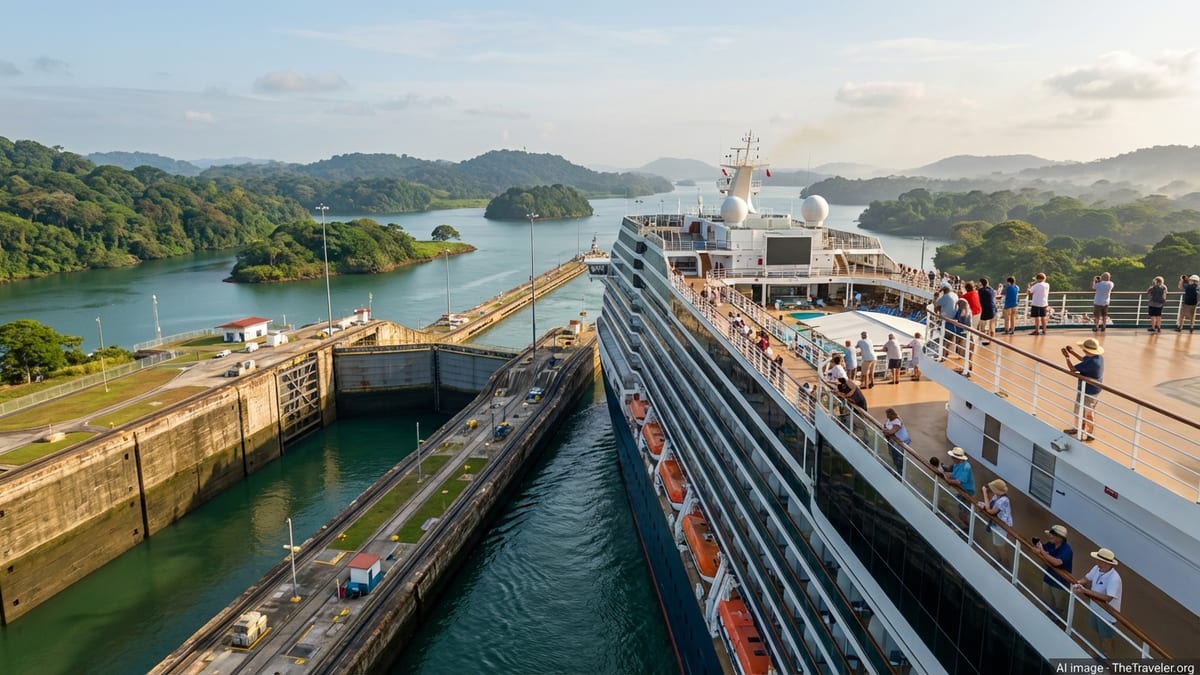
Canal Capacity Rules Confront Surging Cruise Demand
Published information from the Panama Canal Authority shows that transit reservation rules and vessel scheduling fees remain central to managing daily ship slots as the waterway emerges from recent drought-related restrictions. Adjustments to the booking system and last-minute transit services continue to prioritize vessel mix and operational efficiency, limiting how many cruise ships can be accommodated on peak days.
At the same time, industry forecasts for 2025 and 2026 indicate that global cruise demand is accelerating, with the Caribbean, Bahamas and Bermuda remaining the largest destination region. Trade association data for 2025 highlights double-digit percentage growth for South America and Panama Canal itineraries compared with the previous year, pointing to renewed traveler interest in routes that combine the isthmus crossing with Caribbean and Pacific ports.
This tension between infrastructure limits and market appetite is particularly visible as lines open sales for 2026 departures that either transit the canal or rely on its role as a repositioning corridor between the Caribbean and the U.S. West Coast. While the canal is not operating at the most severe constraint levels seen during earlier drought episodes, capacity remains carefully managed, requiring cruise operators to plan itineraries several seasons ahead to secure transit windows.
For travelers, the effect is being felt less in outright cancellations and more in itinerary design, ship deployment choices and pricing strategies. Longer repositioning voyages that feature a single Panama Canal transit, combined with an expanded list of Caribbean and Pacific ports, are becoming a hallmark of the way cruise brands are absorbing capacity limits while still capitalizing on strong demand.
2025–2026 Cruise Season Signals Ongoing Confidence
The formal opening of the 2025–2026 cruise season at the Panama Canal, marked by the transit of a major international cruise ship, underscores that lines continue to view the route as commercially viable. Public information from the canal operator describes a season in which large brands such as Norwegian Cruise Line, Carnival Cruise Line and Royal Caribbean maintain full and partial transit itineraries through the locks.
These programs position the canal as both a marquee attraction and a connective corridor between Caribbean hubs and Pacific turnaround ports. Itineraries marketed for the 2025–2026 season frequently package the canal experience alongside calls at destinations such as Colón on the Atlantic side, Panama City and Gatun Lake, as well as ports in Costa Rica, Colombia and Mexico. This structure allows lines to distribute capacity across several regions even as the number of canal slots is finite.
According to industry presentations, passenger volumes to South America and Panama Canal destinations rose by a strong double-digit rate in 2025 compared with 2024, outpacing growth in several other regions. That trajectory supports the rollout of additional canal-focused voyages in 2026 and 2027, including extended journeys framed as once-in-a-lifetime transits through the isthmus.
For Caribbean tourism stakeholders, the continuation of these itineraries confirms that the canal remains a powerful draw that can be combined with classic Eastern and Western Caribbean port calls. Port data from Gulf Coast and Florida homeports for 2026 reflects a mix of traditional Caribbean circuits and longer sailings that include a Panama Canal visit or full transit, pointing to robust confidence in the region’s cruise appeal.
Caribbean and Pacific Itineraries Shift Around Slot Limits
Major cruise brands are responding to the canal’s operating framework by spreading canal-linked sailings throughout the year and leaning into repositioning voyages that connect seasonal deployments. Publicly available cruise schedules show that Carnival Cruise Line, for example, is marketing Panama Canal cruises for 2026 and beyond that integrate Central American ports such as Limón and Cartagena with popular Caribbean islands.
Norwegian Cruise Line has published a multi-year worldwide cruising guide that includes 11, 15 and 19 day Panama Canal itineraries using ships such as Norwegian Jewel, often sold as part of an “extraordinary journeys” collection. These sailings typically string together Miami, Caribbean ports, canal transits and Pacific or Atlantic coastal cities, creating hybrid Caribbean–Pacific products that maximize the value of each secured canal slot.
Additional schedule information shared through line communications and third-party compilations points to 2026 voyages that either begin or end in U.S. ports such as Miami, New York and Los Angeles, tied to Panama Canal repositioning. Other departures rely on partial transits that allow ships to enter the canal, reach Gatun Lake and then return to Caribbean waters without occupying a full end-to-end slot.
On the Pacific side, port calendars for the U.S. West Coast highlight a stream of canal-linked arrivals for early 2027, with ships such as Island Princess and Zuiderdam scheduled on multi-week Panama Canal routes. These extended sailings, which often include Mexican Riviera and Central American calls, reveal how capacity-controlled canal transits are increasingly wrapped into broader regional circuits rather than treated as standalone crossings.
Revenue Management and Itinerary Design Under Scrutiny
With canal transit reservations subject to competitive booking processes and potential vessel scheduling fees, cruise lines are placing heightened emphasis on revenue management around canal-inclusive sailings. Industry observers note that longer itineraries that feature the Panama Canal, especially those crossing between the Caribbean and Pacific basins, are frequently priced at a premium relative to standard seven-day regional cruises.
Analysts tracking booking patterns for 2025 and 2026 report that canal itineraries often open for sale earlier than short-haul Caribbean voyages, reflecting the need to lock in committed demand that justifies high-value canal slots. The combination of limited capacity and strong traveler interest allows brands to test higher fares and bundled offerings, including extended pre- and post-cruise land stays in gateway cities across both coasts of the Americas.
Onboard, the canal’s operational environment is also influencing product development. Public descriptions of new itineraries emphasize educational programming about the history and engineering of the canal, exclusive viewing experiences during lock transits and curated shore excursions that highlight both Caribbean and Pacific-facing communities. These elements are designed to reinforce the perception of canal cruises as bucket-list experiences that warrant a longer vacation and higher spend.
For Caribbean ports, the trend supports a shift toward fewer but larger call days associated with long-haul voyages, while Pacific and Central American destinations benefit from increased visibility as essential links in multi-region itineraries. This redistribution of calls reflects the realities of a route where infrastructure capacity is fixed, but the commercial need to differentiate products is growing.
Travelers Face Higher Stakes in 2026 Planning
As 2026 draws nearer, publicly available booking data and trade commentary suggest that travelers aiming for Panama Canal cruises are facing both rising stakes and more choices. Early bookings are increasingly recommended by travel advisors and online communities for those seeking specific ships, cabin categories or seasonal windows, particularly around popular repositioning months.
The canal’s continued reliance on controlled transit reservations means that last-minute availability on canal-inclusive cruises is less predictable than on standard Caribbean sailings. When slots are constrained, operators have limited flexibility to add extra departures, so late planners often gravitate toward partial-transit itineraries or itineraries that visit Caribbean and Central American ports without crossing the isthmus.
Despite these challenges, the alignment of strong consumer demand, a full 2025–2026 cruise season and a pipeline of new itineraries through 2027 signals that the Panama Canal remains central to the growth story of Caribbean and Pacific cruising. The waterway’s role as both a sought-after attraction and a strategic connector is shaping how lines deploy ships, design products and price voyages in a travel landscape where demand expansion is outpacing infrastructure.
For the broader tourism economy on both sides of the Americas, the outcome of this balancing act will help determine whether the 2026 travel boom translates into sustainable gains, or whether structural constraints at one of the world’s most important maritime chokepoints begin to cap the next phase of cruise industry growth.