


More news on this day
India’s push to reshape long-distance budget rail travel has gained fresh momentum as the Railway Board clears seven new Amrit Bharat Express routes, extending the non-AC, higher-speed service into some of the country’s busiest and most underserved corridors.
Get the latest news straight to your inbox!
Seven New Corridors Added to a Rapidly Growing Network
According to recent parliamentary replies and Railway Board documentation, the latest approvals focus heavily on linking Bihar and eastern India with the national capital and other major hubs. The newly cleared Amrit Bharat Express services include corridors such as Lokmanya Tilak Terminus to Saharsa, Gaya to Delhi, Muzaffarpur to Charlapalli near Hyderabad, Darbhanga to Anand Vihar Terminal, Darbhanga to Gomtinagar, Bapudham Motihari to Anand Vihar Terminal and Rajendranagar Terminal to New Delhi. Together, they extend the network across key migration and pilgrimage belts in north and east India.
These routes build on earlier Amrit Bharat launches connecting regions like Howrah with Anand Vihar Terminal, Kamakhya with Rohtak, and SMVT Bengaluru with Malda Town, gradually stitching together a nationwide grid of non-AC superfast services. Publicly available information shows that the trains are being introduced in phases, with inaugural runs scheduled as rakes become available and operational windows open up on congested main lines.
The new approvals are particularly significant for Bihar, where a dense population and heavy seasonal movement of workers and students have long strained conventional mail and express trains. By earmarking multiple Amrit Bharat corridors to and from the state, planners are positioning the service as a workhorse for affordable inter-state mobility rather than a niche premium product.
Non-AC, Higher-Speed Trains Aimed at the Mass Market
The Amrit Bharat Express design centers on a simple premise: offer faster, more reliable journeys without pushing fares out of reach for lower and middle-income travellers. The trains use push-pull operations with high-horsepower electric locomotives at both ends on many routes, helping them accelerate and decelerate quickly even on saturated corridors. Reports indicate that on suitable stretches the design speed can exceed that of many conventional express services, while remaining firmly within the non-AC, sleeper-and-seating segment.
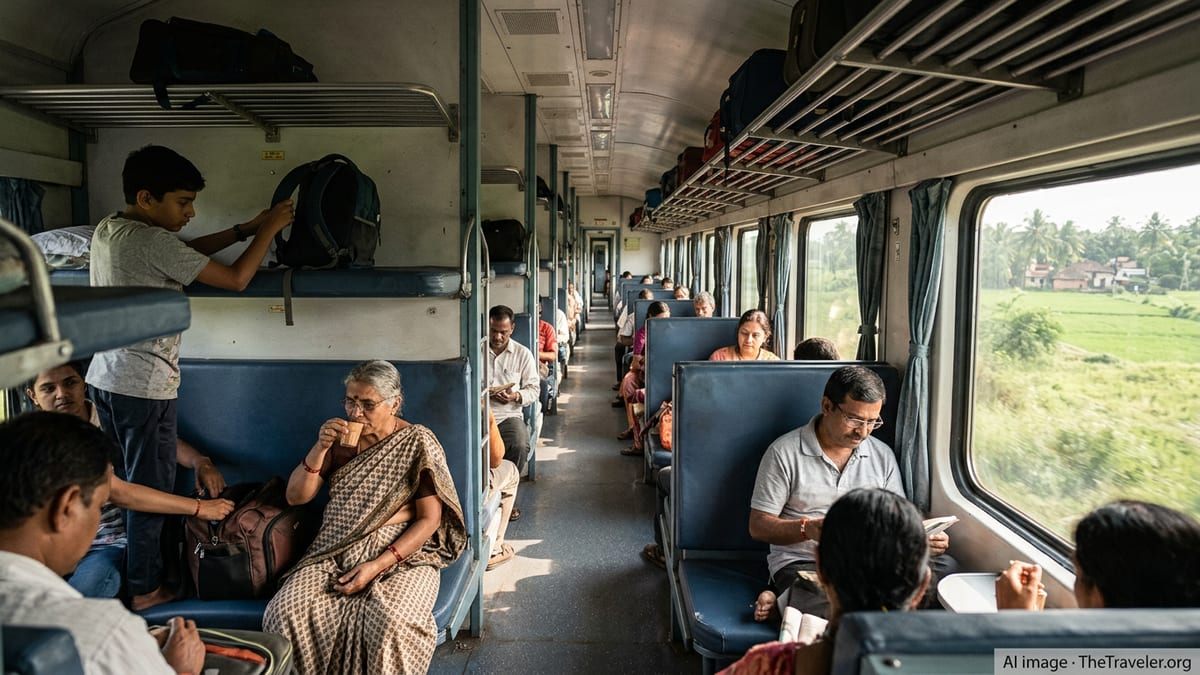
Unlike air-conditioned premium brands, Amrit Bharat coaches are geared toward high volumes and rugged day-to-day use. Sleeper layouts, large vestibules and wide doors are meant to cope with heavy boarding and alighting at intermediate stops. Public descriptions of the trainsets highlight upgraded interiors, brighter lighting and more charging points compared with older non-AC rakes, but without the added cost and complexity of full air-conditioning.
This positioning is crucial in a country where non-AC classes still account for the vast majority of long-distance passengers. By reserving the Amrit Bharat brand for budget travellers, the Railway Board is effectively creating a parallel track to the Vande Bharat and other premium initiatives, ensuring that speed gains and modern rakes also reach those who rely on low-cost travel for work, education and healthcare access.
Strategic Focus on Migration, Pilgrimage and Emerging Economic Hubs
A closer look at the latest approvals suggests a deliberate attempt to map services onto India’s real-world travel patterns rather than just political geographies. Several of the new routes directly connect Bihar’s out-migration districts with core employment markets around Delhi, the National Capital Region and southern industrial hubs. Others tie in religious destinations and rapidly growing tier-two cities, creating new options for both spiritual tourism and small business travel.
For instance, links between eastern Bihar and Anand Vihar Terminal are expected to relieve pressure on older overnight services that have been chronically overbooked for years. Additional corridors running toward Delhi and further south provide alternatives for passengers who previously had to rely on a patchwork of connecting trains. According to published coverage, planners see the combination of slightly higher speed, fewer technical halts and more modern rolling stock as a way to shave hours off journeys while still keeping ticket prices comparable to traditional express trains.
The approvals also underscore the importance of the northeast in the evolving Amrit Bharat map. Earlier services such as Kamakhya to Rohtak and Kamakhya to Charlapalli have already begun tying the region more closely to the Hindi heartland and southern India. The new set of routes, many of which intersect east-west corridors, are expected to strengthen these links further by providing more direct paths for through passengers, reducing the need to route everything via a handful of congested junctions.
Operational Challenges on Congested, Mixed-Traffic Routes
Despite the rapid expansion, the rollout of Amrit Bharat Express is constrained by familiar operational realities. Key trunk lines used by the newly approved trains already carry a dense mix of freight, traditional express, premium AC services and suburban traffic. Railway Board approvals do not automatically translate into immediate daily operations; timetable integration, rake availability and crew deployment all play a role in when each train actually starts running.
Timings are especially sensitive on corridors where speed restrictions, ongoing construction or maintenance blocks limit how much additional fast traffic can be accommodated. Public discussions within the rail community point out that on many routes, the practical operating speed may be capped below the train’s technical capability because of track conditions and congestion. This can reduce the headline time savings but still offer a better overall experience through improved punctuality and upgraded coaches.
There is also a balancing act between serving as many intermediate towns as possible and preserving the time advantage that makes the service attractive. The latest seven approvals appear to favour a limited-stop model, focusing on major junctions while still offering key regional halts. How this balance plays out once detailed timetables are published will be closely watched by both planners and passengers, especially in densely populated stretches of Bihar and eastern Uttar Pradesh.
Implications for India’s Long-Term Rail Modernisation
The decision to keep adding Amrit Bharat routes while simultaneously expanding premium AC brands reflects an emerging two-track strategy in Indian rail policy. On one track, high-speed and semi-high-speed services aim to capture air and road traffic among more affluent travellers. On the other, non-AC superfast trains such as Amrit Bharat target the country’s massive base of price-sensitive passengers who still depend on rail as their primary long-distance mode.
By clearing seven new corridors at once, the Railway Board is signalling that budget-focused modernisation is not an afterthought but a central pillar of its expansion plans. Published documents on the broader Amrit Bharat programme also reference parallel efforts to upgrade stations and basic passenger amenities along many of the same corridors, indicating an ecosystem approach rather than a train-only intervention.
For travellers, the most immediate impact will be felt in the form of new direct connections, better chance of confirmed berths and the possibility of shaving hours off journeys that have long been constrained by outdated rakes and inflexible timetables. As more of the approved trains move from paper to operational status over the coming months, the Amrit Bharat Express network is poised to become one of the most visible symbols of how India is trying to make rail travel both faster and fairer for the majority of its citizens.