


More news on this day
Wuhu, a mid-sized city on the lower reaches of the Yangtze River, has rapidly emerged as an urban rail pioneer in China, using an elevated monorail network to reshape daily mobility and support new riverside development.
Get the latest news straight to your inbox!
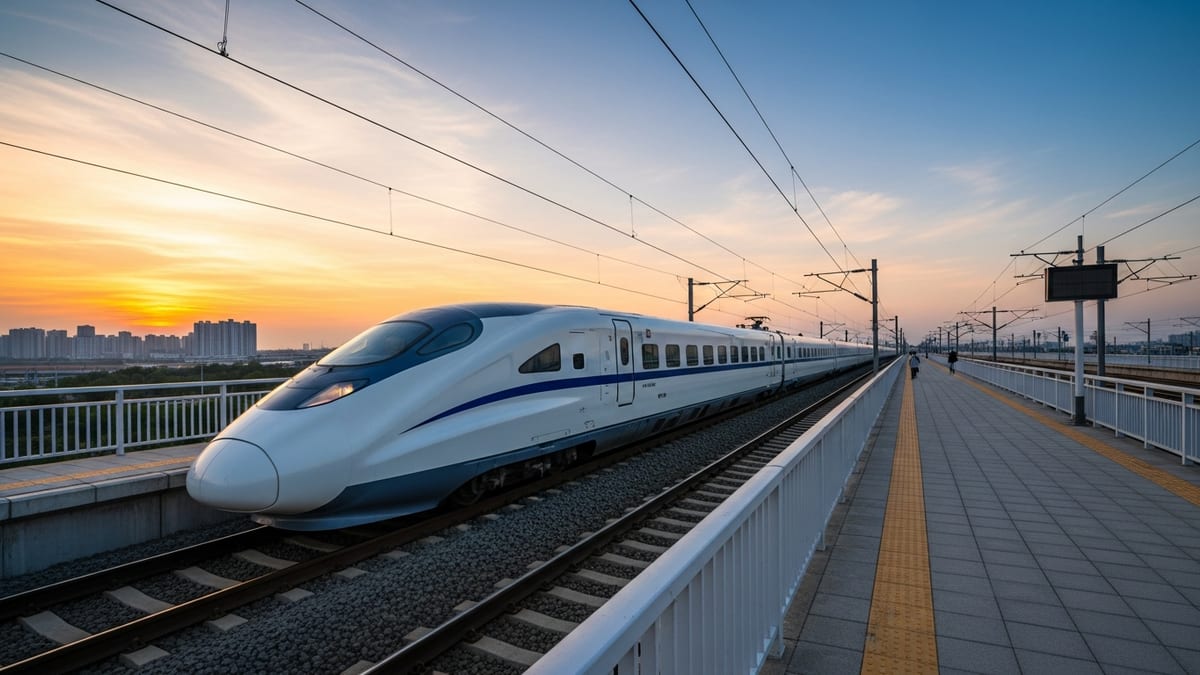
A Compact City Embraces an Automated Monorail Network
Publicly available information shows that Wuhu Rail Transit currently consists of two operational lines forming a fully elevated, straddle-type monorail system. Line 1 and Line 2 both opened in late 2021, bringing rapid transit to a city of around three million residents and making Wuhu one of the smallest urban centers in China to operate a full-scale, driverless rail network.
The system uses rubber-tired monorail trains that run on a single concrete beam, a technology that allows for tighter curves, steeper gradients and quieter operation than conventional steel-wheel metro lines. Industry coverage indicates that the monorail is equipped for fully automated, unattended train operation, with centralized control and platform screen doors at stations.
Unlike many Chinese metros that have grown from existing heavy-rail backbones, Wuhu’s network was planned largely from scratch as an elevated system. This has enabled the lines to weave above busy arterial roads and dense riverfront neighborhoods with a relatively compact footprint, while avoiding the cost and complexity of deep tunneling under the historic core and the Yangtze floodplain.
The emphasis on automation and compact elevated infrastructure reflects a broader push within China’s provincial cities to deploy lighter, more flexible rail technologies that can be built and operated at lower cost than heavy metro systems in megacities such as Shanghai or Beijing.
Line 1 and Line 2: Backbone for Daily Commuting
Line 1 functions as the north–south spine of the system, running through key districts and connecting residential areas with commercial zones near the Yangtze riverfront. Open-source route descriptions show that the line links several dense neighborhoods and intersects with major bus corridors, creating a basic grid for public transport in a city that previously relied heavily on roads and conventional buses.
Line 2 runs broadly east–west and intersects Line 1 at Jiuziguangchang station in the city center, forming Wuhu’s first high-capacity interchange hub. The dual-line arrangement allows riders to transfer between corridors without returning to surface streets, cutting cross-city journey times and offering more predictable travel during peak hours.
According to sector analyses of China’s urban rail development, both lines were built as part of a single public–private partnership package, with the same consortium responsible for construction of civil works, rolling stock and long-term operation. That structure is presented in these reports as a way for a smaller city to secure advanced rail technology while sharing financial risk with national-level manufacturers and engineering firms.
Operational data compiled in national yearbooks of urban rail transit place Wuhu’s total line length well below that of regional hubs such as Nanjing and Hefei, but highlight relatively strong ridership growth since opening. The statistics suggest that the monorail has quickly become the preferred mode for many cross-town journeys, especially where it parallels congested riverfront streets.
Linking Rail Hubs, New Districts and the Yangtze Riverfront
The Wuhu Urban Rail Transit layout is closely tied to the city’s broader development strategy along the Yangtze corridor. Planning documents and transport studies emphasize the goal of knitting together historic districts south of the river, newer residential areas and key intercity rail stations into a single, higher-capacity public transport framework.
Line 1 connects dense inner-city neighborhoods to key road junctions and commercial areas near the riverbank, supporting projects aimed at revitalizing older waterfront zones. Elevated monorail structures parallel some of Wuhu’s main thoroughfares, with stations positioned to feed pedestrian flows into shopping streets, river promenades and local bus routes.
Line 2, meanwhile, has been planned to strengthen links between the traditional urban core and rapidly growing districts to the north and west. Publicly available project descriptions indicate that ongoing and planned extensions will push the line toward major railway nodes such as Wuhu North and Jiangbei railway station, deepening integration between local transit and China’s high speed rail network.
At the junction of the two monorail lines, Jiuziguangchang station serves as an interchange and a focal point for transit-oriented development. City planning materials and academic work on Wuhu’s urban form note that land around central stations is being intensified with mixed-use projects, reflecting a national trend of using rail nodes as anchors for higher-density, pedestrian-friendly districts.
Positioning Wuhu in China’s Changing Urban Rail Landscape
Wuhu’s decision to invest in a monorail-based urban rail network places the city within a wider shift in China’s rail transit planning. After two decades of rapid metro expansion, recent policy signals point to tighter controls on new heavy metro projects, with a stronger emphasis on cost-effective systems in medium-sized cities.
Sector commentary and statistical reports show that total national investment in urban rail is under closer scrutiny, while lighter technologies such as monorails, tramways and suburban railways are being promoted as more financially sustainable options outside the country’s largest metropolitan areas. In that context, Wuhu’s compact, fully automated monorail network is often cited as a reference model for similarly sized cities along the Yangtze and beyond.
At the same time, academic research into urban rail operations highlights challenges facing smaller systems, including balancing operating costs with relatively modest ridership bases and managing the resilience of networks with only a few lines. For Wuhu, ensuring reliable service on Line 1 and Line 2 and coordinating schedules with intercity trains will be crucial to maintaining public confidence in the young network.
Observers note that the visual impact of an elevated monorail skating above streets and railway yards has also helped raise Wuhu’s profile among transport enthusiasts and domestic travelers. Images shared on social media and in rail forums, often showing monorail trains alongside high speed services and conventional rail, underscore how the city has leveraged its new transit infrastructure to stand out in a crowded tourism landscape.
Implications for Travelers Exploring Wuhu
For visitors, the Wuhu Urban Rail Transit system offers a straightforward way to navigate what remains a relatively compact urban area. The two operational lines, supplemented by a dense bus network and national rail links, give travelers fast access to commercial districts, riverfront areas and intercity stations without relying exclusively on taxis or private cars.
Travel guides and recent traveler reports describe stations and trains as modern and clean, with clear signage, platform screen doors and contactless payment options that will be familiar to anyone who has used other Chinese metro systems. As with many automated networks in the country, service frequencies are typically high during the day, which can reduce waiting times for tourists making multiple short hops between sights.
Looking ahead, the gradual extension of Line 2 toward additional railway hubs is expected to further simplify interchanges between high speed rail and the local monorail. For international and domestic visitors arriving by train along the Yangtze corridor, that integration is likely to make Wuhu a more convenient base for onward travel in Anhui province and neighboring regions.
While the city’s rail network is still modest in scale, its rapid rollout and visible presence above streets and rail yards signal Wuhu’s ambition to compete with larger regional centers on accessibility and urban quality of life, offering travelers an increasingly polished public transport experience in a smaller Chinese city.