


Managing money across borders used to mean walking into a bank, accepting whatever poor rate you were offered, and hoping your card would work abroad. Today, services like Xe Money Transfer and Wise promise cheaper, smarter ways to move and spend money overseas. For travelers, though, the question is practical: which one actually makes life easier and cheaper on the road? This guide breaks down how Xe and Wise work in real travel scenarios, from paying rent abroad to withdrawing cash at a street market.
Get the latest updates straight to your inbox!
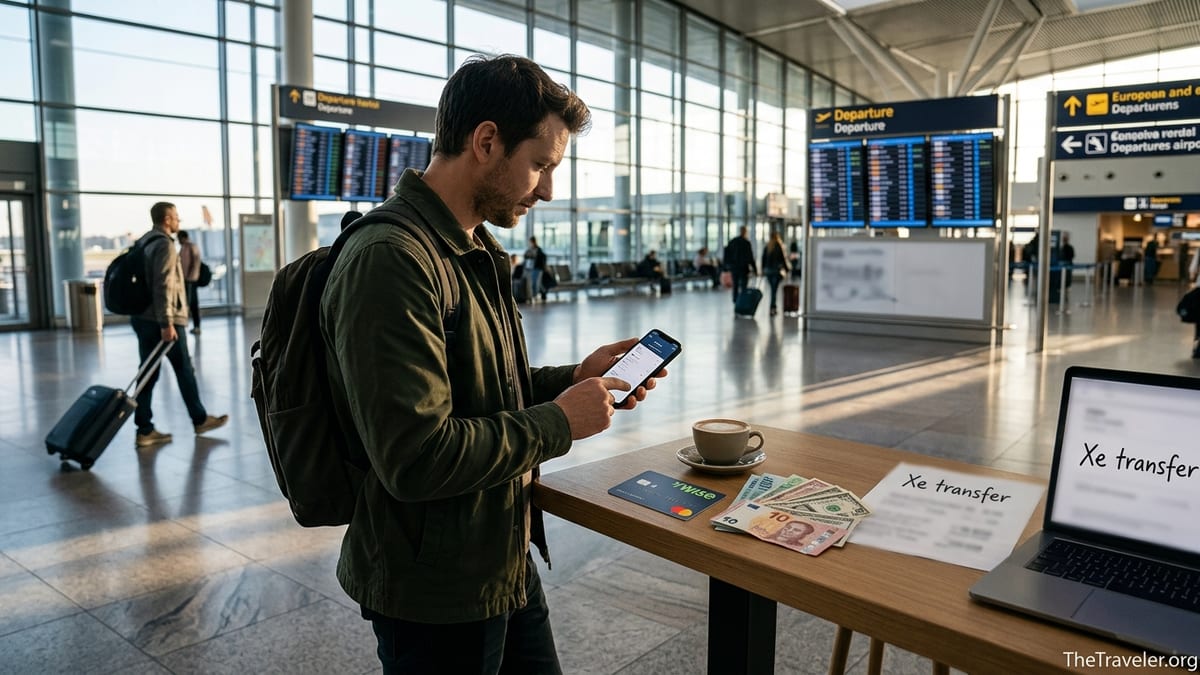
Xe vs Wise in a Nutshell for Travelers
Xe Money Transfer and Wise both let you send money internationally, but they are not built for the same jobs. Xe is primarily a money transfer service: you move funds from your bank in one country to a bank account in another currency. It focuses on one-off or occasional transfers, particularly larger amounts, such as paying a security deposit on an apartment in London from a US bank account. Wise, on the other hand, offers a multi-currency account with an attached debit card that works in more than 150 countries. This makes it a full travel money tool: you can hold balances in multiple currencies, pay by card abroad, and withdraw cash at ATMs.
In practice, that means Xe often makes more sense when your main goal is to transfer money to someone else, like paying a landlord in Paris or reimbursing a friend in Sydney who booked your hostel. Wise often fits better for day-to-day travel money needs: paying for metro tickets in Tokyo, tapping to pay at a cafe in Lisbon, or withdrawing some Thai baht from an ATM in Bangkok. Many long-term travelers end up using both, but for different purposes.
Both companies typically undercut traditional banks on exchange rates and fees, but they do it differently. Wise uses the mid-market rate and adds a clearly stated fee on top of your transfer or card spend. Xe commonly adds its margin into the rate itself and may also charge a transfer fee, especially on smaller amounts, so the cost is partly hidden in the exchange rate you see.
Exchange Rates and Fees: Who Is Cheaper in Real Life?
Exchange rates are where a few percentage points can quietly cost you a lot over a long trip. Wise bases its pricing on the mid-market exchange rate, the same benchmark you see on financial news tickers, then adds a small variable fee that depends on the currencies and payment method. Independent reviews of the Wise multi-currency account in 2026 suggest that, for most personal transfers, the total cost tends to land around 1 percent or less of the transfer amount, with the rate itself very close to mid-market. This transparent model means you see exactly what you pay before you confirm.
Xe also advertises competitive rates, but its costs are usually split between a transfer fee and a spread built into the rate. Recent comparisons show that Xe often charges a flat fee on smaller transfers, such as a few dollars under a given threshold, then a percentage-based markup on the exchange rate that can range roughly from a fraction of a percent up to a little over 1 percent depending on the corridor and amount. For a US traveler sending 300 dollars to a euro account to pay for an Airbnb deposit, this might mean paying a small flat fee plus losing a few extra dollars in the rate spread compared with the mid-market rate.
On large transfers, such as sending the equivalent of 5,000 dollars or more, the picture can shift. Several comparison sites in 2026 note that Xe’s spread can become more competitive as the transfer size increases, sometimes approaching or even undercutting Wise’s total fees for high-value payments. A digital nomad wiring 7,000 dollars from the United States to Canada to buy a used car, for example, might find that Xe’s slightly better rate on that specific corridor beats Wise’s variable fee, especially if they fund the transfer from a bank account rather than a card.
Paying and Spending While You Travel
For day-to-day spending, Wise has a major advantage: it comes with a debit card linked to a multi-currency account. You can hold more than 40 currencies, convert between them when rates look good, and then pay in local currency when you arrive. A traveler from New York planning a summer in Europe might convert 2,000 dollars to euros inside Wise a few weeks before departure, when they see a favorable rate. Once in Spain or Italy, they simply tap their Wise card on metro gates, restaurant terminals, and museum ticket machines, with no surprise foreign transaction fees from a traditional bank.
Xe does not currently provide a mainstream consumer debit card for travel spending. It focuses on bank-to-bank transfers. That means if you are in Mexico City wanting to pay for dinner, Xe is not what you reach for at the table. Instead, you might use Xe beforehand to send pesos directly to a local bank account, such as paying a landlord or language school, and then use a separate bank card or Wise card for everyday purchases.
For online travel bookings, both services can help in different ways. If you are paying a small guesthouse in Vietnam that only accepts local bank transfers, Wise lets you send VND from your multi-currency balance using the mid-market rate plus a fee. Xe can do the same, often allowing you to fund the transfer by bank or card, but you will typically not get a linked account balance to keep the leftover dong for later use. Wise’s strength is that what you do not spend on transfers remains available on the card for in-person payments.
ATM Withdrawals, Cash Culture, and Hidden Costs
Access to cash still matters in many destinations, from small towns in Japan to local markets in Morocco. Wise supports ATM withdrawals using its travel card in more than 150 countries, but its fee structure changed in 2026 in several regions. New terms introduced from May 2026 increased the variable fee on withdrawals above a free allowance, with the exact limits depending on where your card is issued. For example, some customers now receive a certain amount of free withdrawals per month, then pay around a few percent on the excess plus any local ATM charges. This made Wise’s card slightly less attractive for heavy cash users, though casual travelers who withdraw infrequently often remain within the free tier or pay relatively modest fees compared with a typical bank card.
Real-world reports underscore how local ATM fees can overshadow the card provider’s pricing. Travelers withdrawing cash with Wise in Southeast Asia and parts of Europe in 2026 frequently mention ATM operator surcharges of the equivalent of a few dollars per withdrawal, regardless of whether they use Wise, a local bank card, or another travel card. A visitor in Bali, for instance, described paying a fixed local ATM fee of around 50,000 rupiah on a 1.25 million rupiah withdrawal using their Wise card. That fee was charged by the Indonesian bank’s machine, not by Wise itself, but it still increased the effective cost of getting cash.
Xe does not currently offer its own ATM card, so travelers using Xe typically rely on their regular bank card or another travel card to access cash. The main hidden cost there is often your home bank’s foreign ATM and currency conversion fee, which can easily reach 3 percent of the withdrawal plus a local surcharge. A US traveler using a standard debit card issued by a regional bank could be hit with both a foreign ATM fee of a couple of dollars from their home bank and a percentage-based foreign transaction charge layered on top.
Speed, Coverage, and Reliability Across Borders
When you are moving money for travel, timing and coverage can matter just as much as cost. Wise supports accounts and transfers involving more than 160 countries and over 40 currencies. Transfers between major corridors such as the US, UK, Eurozone, Australia, and Singapore are often fast, sometimes near-instant if paid from a balance or a compatible local payment method. This can be a lifesaver if you are in a hostel in Berlin and need to reimburse a friend in London immediately because they covered your train ticket.
Xe has been in the foreign exchange space for decades and supports a similarly wide global network for transfers, including many developing markets that attract long-stay travelers and expats. For example, Xe is commonly used for sending funds into bank accounts in South Africa, India, or Mexico. Transfer times vary: funding by bank transfer can take a day or two, then Xe needs to process and deliver funds to the recipient bank. For large, planned payments such as paying a semester’s tuition abroad or an apartment deposit before you fly, this timeline is usually acceptable.
On reliability, both brands are well established and regulated in multiple jurisdictions. Wise operates as a licensed financial services provider in many countries and highlights its use of safeguarding measures rather than traditional bank deposit insurance. Xe is part of a larger financial group and is regulated for money transfer activities in major markets. For travelers, the key practical point is to avoid assuming either service is a full conventional bank. Wise, for example, is not protected by government-run deposit insurance schemes in the way a standard checking account might be, so it is usually sensible not to store your entire life savings there if you are risk-averse, but to keep a travel-sized balance and top it up as needed.
When Xe Makes More Sense Than Wise
Although Wise is often the obvious choice for everyday travel money, there are situations where Xe can be the better fit. The clearest is large one-off transfers where the recipient needs funds in their bank account, not on a card. Imagine you are relocating to Portugal for a year and must pay a 4,000 euro rental deposit from your US account before you arrive. Wise will show you the mid-market rate and a transparent fee, which may be around 1 percent of the amount. Xe may offer a similar or slightly better all-in cost on that large corridor, especially if its exchange rate spread on that day is narrow and you are funding the transfer by domestic bank transfer rather than by card.
Another scenario is where your destination or recipient bank is better supported by Xe for historical or regulatory reasons. Some remittance and travel money comparison sites in 2026 note that Xe remains strong for certain currency routes in Africa and parts of the Middle East, where Wise’s coverage may be more limited or where local banking relationships give Xe good rates and delivery times. A long-term traveler paying local partners or language schools in those regions might find Xe is easier to set up for recipients who are already familiar with it.
Xe can also be helpful as a backup pricing reference. Before you send money to a friend overseas, you might compare the total cost on Xe’s website and in the Wise app. If Xe happens to have a sharper rate for your specific large transfer on that day, you can use it for that payment while still relying on Wise for smaller everyday spending.
When Wise Clearly Wins for Travel Money
For most typical leisure travelers, digital nomads, and remote workers, Wise is closer to a complete travel banking toolkit. Consider a US couple spending a month across the Eurozone. They open a Wise account, move 3,000 dollars into euros at a time when the rate looks favorable, and receive a Wise card. On arrival in Rome, they pay for their airport train, hotel, and dinners by tap with the card. In most cases, the card charges them using the balance they already hold in euros, without additional conversion. When they hop to Croatia or Hungary, the same card automatically converts from their euro or dollar balance when they pay in kuna or forints, using the mid-market rate and a small conversion fee shown in the app.
This flexibility is particularly useful if you earn income in one currency and spend in others. A freelance designer based in Mexico City, for example, might receive payments from US and European clients into their Wise balances in dollars and euros, then convert some of that to Mexican pesos to pay rent by bank transfer and keep part of it in euros for a planned trip to Spain. All of this happens inside one interface, with clear breakdowns of fees and rates.
Wise also integrates with local account details in several regions. Many customers can receive money with US routing and account numbers, a European IBAN, and UK sort code details, making it easier to get paid by employers or clients as if they had a local account. For travelers doing seasonal work in Australia or Europe or remote jobs for overseas companies, this can simplify getting paid and then spending that money on the road without constantly moving it back to a home bank.
The Takeaway
For pure travel money, Wise is usually the more practical primary tool. Its multi-currency account and travel card let you hold, convert, spend, and withdraw in dozens of currencies with relatively low, transparent fees. In real-world terms, it covers most of what travelers need: tapping to pay for transport, splitting restaurant bills, booking local tours, and occasionally taking out cash at ATMs. Even with the 2026 adjustments to ATM withdrawal fees for some users, Wise typically remains cheaper and more convenient than using a standard bank card loaded with foreign transaction costs.
Xe Money Transfer, by contrast, comes into its own for larger, one-off international payments into bank accounts. If you are moving abroad, paying a large rental deposit, wiring funds to buy a vehicle overseas, or sending support payments home during a long trip, Xe can be worth comparing side by side with Wise. On certain routes and amounts, Xe’s combination of rate and fee can compete strongly, and its long-standing presence in some markets gives it broad coverage.
For many modern travelers, the best approach is not Xe or Wise, but Xe and Wise used for different jobs. Keep Wise as your everyday travel wallet and card, use Xe as a specialist service for big transfers, and always compare total costs before hitting send. That way, your travel stories are about mountain passes and night markets, not surprise fees on your bank statement.
FAQ
Q1. Is Xe or Wise cheaper for everyday travel spending?
For everyday card payments like restaurants, transport and shops, Wise is usually cheaper because it lets you spend at or near the mid-market rate with a transparent fee. Xe does not offer a consumer travel card, so you would still rely on your bank card or another provider for daily spending.
Q2. When is Xe better than Wise for travel money?
Xe can be better for large, one-off transfers into a bank account, such as paying a rental deposit or tuition abroad. On higher amounts in some currency routes, Xe’s rate spread and fees can be competitive, occasionally matching or beating Wise’s total cost.
Q3. Can I use Wise as my only travel card?
Many travelers do use Wise as their main travel card, paying for most expenses by card and withdrawing limited cash. However, it is wise to carry at least one backup card from a different provider, in case of network outages, ATM compatibility issues or card loss.
Q4. Does Xe provide an ATM or debit card for travelers?
As of mid 2026, Xe focuses on money transfers and does not offer a mainstream consumer debit card for everyday travel spending and ATM withdrawals. You would still need a separate bank or travel card for on-the-ground payments.
Q5. How do ATM fees with Wise work when I travel?
Wise gives you a limited amount of free ATM withdrawals each month, and above that charges a variable fee that depends on where your card is issued. From 2026, these variable fees increased in some markets, and local ATM owners can still add their own fixed surcharge per withdrawal.
Q6. Which service is faster for sending money while abroad?
For major currency routes, Wise is often very fast, sometimes near-instant for transfers between Wise accounts or funded from a balance. Xe can also be quick, especially when sending to well-connected banking systems, but transfers may take one to several business days depending on the corridor and payment method.
Q7. Are Xe and Wise safe for holding travel money?
Both services are regulated in multiple countries and use safeguarding arrangements to protect customer funds. However, neither is a traditional bank account with government deposit insurance in every market, so it is sensible not to store all your long-term savings there, but to keep a working travel balance and top up as needed.
Q8. Can I get paid by employers or clients through Wise or Xe while I travel?
Wise is generally more suited to receiving regular income. Many users receive payments using local bank details like US account numbers, European IBANs or UK sort codes. Xe is more commonly used for one-off transfers rather than as an ongoing incoming salary account.
Q9. Do Xe or Wise avoid all fees from ATMs abroad?
No. Even when Wise itself does not charge for a particular withdrawal, many foreign ATMs apply their own access fee or offer costly dynamic currency conversion. Xe does not provide an ATM card, so your usual bank card’s foreign ATM fees and the local machine’s surcharge will still apply.
Q10. Should I use both Xe and Wise for a long trip?
Using both can be a smart strategy. Wise can handle everyday spending, card payments and smaller transfers, while Xe can be your backup for large bank-to-bank payments. Comparing both before each big transfer helps you choose the cheaper option for that specific situation.