


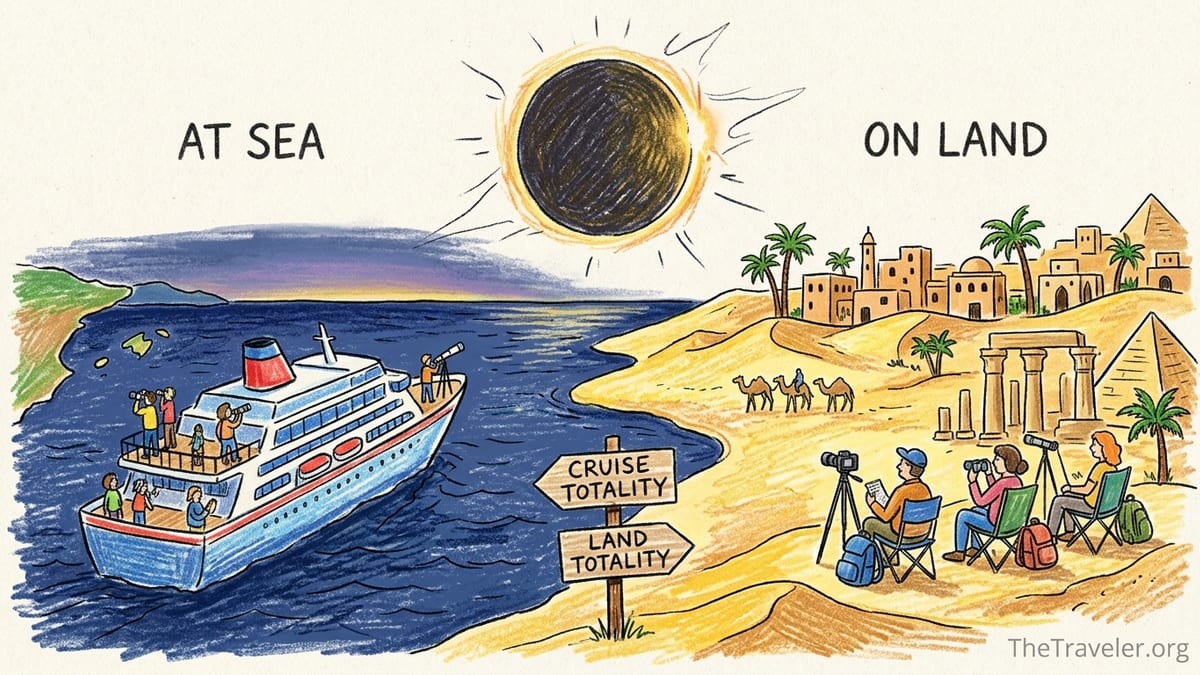
The total solar eclipse of August 2, 2027 is already shaping up to be one of the most sought after travel events of the decade. With a path of totality stretching from southern Spain across North Africa and into the Middle East, travelers are weighing two very different ways to get under the Moon’s shadow: special eclipse cruises positioned at sea, and land based tours built around hotspots like Luxor, Morocco and southern Spain. Each comes with very different trade offs in weather flexibility, viewing conditions, cost and booking risk. This guide walks through those differences, using real 2027 offerings that are on sale today.
Get the latest updates straight to your inbox!
Understanding the 2027 eclipse path and why location matters
The August 2, 2027 total solar eclipse begins over the eastern Atlantic before sweeping across the Strait of Gibraltar between Spain and Morocco, then crossing parts of Morocco, Algeria, Libya, Egypt, Saudi Arabia, Yemen and Somalia before ending in the Indian Ocean. Many of the longest totality durations, over six minutes in some forecasts, are centered on North Africa and especially Egypt, where clear summer skies are common.
Most cruise itineraries marketed for the 2027 eclipse are not in the middle of the Sahara or above Luxor. Instead they typically position in the Mediterranean between southern Spain, the Balearic Islands and the coasts of Tunisia or Morocco. Several European lines and specialty operators now sell “at sea totality” voyages that plan to be in open water south of Mallorca or off the Tunisian coast at mid eclipse, while still offering ports such as Barcelona, Valencia and Tangier before or after the event.
Land tours are concentrating on a different set of targets. Astronomy focused operators and large alumni travel programs are heavily promoting Luxor and other Nile Valley locations, along with Morocco’s interior and coastal cities such as Marrakesh, Ouarzazate and Agadir. Independent travelers are also eyeing the Gibraltar region, southern Spain’s Costa del Sol and parts of Tunisia reachable by road from major cities. Where you choose along this path has an enormous impact on both the weather odds and totality duration you are likely to experience.
When comparing cruise versus land options, the crucial point is that both can place you squarely inside the path of totality if chosen carefully. The debate is less about whether you can reach the path at all, and more about how much control you will have over fine tuning your position to chase clear skies once August 2 actually arrives.
Weather and cloud cover: North Africa vs Mediterranean at sea
Weather is often the deciding factor between a ship and solid ground. Climatological records for early August show that much of southern Spain and coastal North Africa experiences hot, dry summers, with sunshine probabilities that are significantly higher than many European locations. Travelers eyeing Luxor, inland Morocco or desert regions along the path are drawn by the combination of long totality and a relatively low climatological risk of thick cloud on a summer afternoon.
Mediterranean eclipse cruises, by contrast, tend to operate in slightly more humid, maritime conditions. Being at sea in the western or central Mediterranean can mean exposure to passing cloud decks that develop over water, even when the adjacent desert coast remains largely clear. However, a cruise ship can in principle steam tens of nautical miles north or south in the 12 to 24 hours before first contact if satellite imagery suggests a better cloud gap nearby. That limited mobility is one of the strongest arguments in favor of an eclipse cruise, as long as the itinerary has enough leeway built in and the captain has committed to prioritizing eclipse positioning.
The subtlety is that cruise ships are large and constrained by safety and navigation rules. They cannot simply sprint hundreds of miles at the last minute to reach a different section of the path near Morocco or Egypt. They can usually adjust by tens of miles along their general track, which may be enough to dodge a localized cloud band but is no guarantee if a widespread weather system covers the entire region. On land, a self driving traveler in Spain or Morocco might be able to drive several hours east or west on eclipse morning to reposition under clearer skies, as many observers successfully did for previous eclipses in North America and Europe.
For land tours, the weather advantage often comes from starting in a climatologically favorable region such as Upper Egypt, then retaining some ability to shift the final viewing site by bus. Several group itineraries in Luxor advertise the use of multiple pre scouted backup sites on either side of the city, so that if haze or dust builds in one direction, coaches can move guests along cleared roads to an alternative within the path. This sort of flexibility is much greater than a cruise can usually offer, but it depends on good local logistics and may not be available on every generic package tour.
Viewing experience and locations: deck railings or desert horizons
The physical viewing experience is where cruise and land options diverge most. On an eclipse cruise you are likely to view totality from an open deck, perhaps on the top level of a mid size ship with several thousand passengers. Some lines reserve specific sections for organized astronomy groups, while others allow general guests to spread out across multiple decks. The best spots tend to be along railings with a clear view of the Sun’s altitude at mid eclipse, which in early afternoon may be substantial above the horizon in the Mediterranean.
At sea, horizons can be extraordinarily wide and unobstructed. As totality approaches, many observers describe the eerie 360 degree twilight over the water and the chance to see the Moon’s shadow racing across the surface of the sea. For some travelers that immersive sky and sea combination is the single most compelling reason to choose a ship. A few specialty voyages advertise expert lecturers and on deck commentary by professional astronomers, along with filtered telescopes and shared binoculars set up by the cruise’s science team.
On land, the viewing setting is far more varied. In Spain, groups might assemble at inland ridges above the Costa del Sol or open plains near Granada. In Morocco, some programs plan viewing from plateaus outside Ouarzazate or desert fringes reachable by paved road. In Egypt, several well publicized itineraries place guests among ancient temples near Luxor or on private sites along the Nile. These locations offer dramatic foregrounds and a sense of place that a ship cannot match. Watching totality above the silhouettes of palm groves or desert hills is a different emotional experience than viewing from a steel deck.
There are also practical viewing constraints to consider. On a crowded ship, space can be tight near optimal viewing spots, and vibration from the vessel can affect long camera exposures. Wind at sea can be surprisingly strong on open decks, which affects both comfort and the stability of tripods. On land, by contrast, tripods and chairs can be spread over a larger area, and tours often provide shade, seating and restrooms a short walk away. However, dust, heat and local crowds can be challenging in parts of North Africa in August, particularly for travelers who are not accustomed to high temperatures.
Pricing: what current cruises and land tours actually cost
As of late 2026, pricing for 2027 eclipse cruises varies widely by cruise line, cabin category and itinerary length. Some mainstream Mediterranean eclipse cruises in inside cabins have been advertised at several thousand US dollars per person for roughly one to two weeks at sea, while more upscale or small ship lines quote significantly higher fares. Specialty astronomy charters or partially chartered voyages that guarantee expert programming, dedicated viewing areas and additional pre eclipse lectures tend to sit at the higher end of that range.
Concrete examples illustrate the spread. Certain themed Mediterranean voyages built around the August 2 eclipse are marketed as 10 to 12 night cruises visiting ports such as Barcelona, Valencia, Palma de Mallorca, Tunis or Tangier, with at sea totality on a designated day. Publicly available fares for these kinds of sailings in standard balcony cabins often start in the mid to upper four figure range per person, excluding international air. At the luxury end of the spectrum, small ship or ultra luxury cruise lines that include most drinks and excursions can price eclipse sailings at several times that amount, particularly for suites.
Land based eclipse tours attached to well known universities, alumni associations and specialist astronomy travel agencies show a similar span. Packages centered on Egypt or Morocco, lasting from about a week to twelve days and including hotels, domestic transport, many meals, guided sightseeing and a curated eclipse day program, often price in the low to mid five figure range per person based on double occupancy. More budget conscious group tours using simpler hotels or focusing on fewer pre and post eclipse excursions tend to come in lower, while private custom itineraries can run considerably higher.
For independent travelers skipping organized tours, base costs can be lower but availability is a challenge. Reports from travelers already holding reservations in Luxor and southern Spain indicate that many centrally located hotels with good access to the path increased rates significantly after eclipse demand became clear, and some properties now require non refundable multi night minimum stays around August 2. Airfares into key hubs such as Cairo, Marrakech and Malaga for late July and early August 2027 are also expected to climb as the date approaches, particularly from North America and Europe.
Booking risks and availability: sell outs, fine print and path accuracy
Both cruise and land options for the 2027 eclipse come with real booking risks that travelers should understand before committing. On the cruise side, one of the most significant concerns raised within eclipse watching communities involves whether a given ship will actually be inside the path of totality at mid eclipse. Enthusiast groups have already documented examples from previous eclipses in which generic “eclipse at sea” cruises provided only very deep partial coverage rather than totality, simply because the ship’s scheduled route never crossed the central shadow.
This risk is lower for 2027 when cruises are specifically sold as “total solar eclipse” voyages with advertised positioning off Tunisia or between Spain and North Africa, but it is still essential to confirm. Prospective guests should ask the cruise line or organizing travel agency to provide the planned latitude and longitude of the ship at the time of mid eclipse on August 2, 2027, then compare those coordinates with an official path map from a reputable astronomical source. If the numbers do not clearly place the ship inside the umbral path, there is a chance that some or all of the countdown will be spent under a partial eclipse instead.
Another cruise specific risk is itinerary change. Standard cruise contracts usually reserve broad rights for the line to alter routes, skip ports or adjust at sea days for safety or operational reasons. Storms, geopolitical concerns or port congestion could all lead to last minute changes that affect eclipse positioning. Dedicated eclipse charters or trips sold in partnership with specialist astronomy tour operators may carry stronger informal commitments to prioritize the eclipse, but even these cannot completely eliminate force majeure and maritime safety clauses.
On land, the main booking risk is availability rather than route drift. Prime hotels in Luxor, coastal Morocco and southern Spain for the dates surrounding August 2 have been selling steadily for several years, and by late 2026 many properties with direct views or easy access to the path are reported either sold out or only offering premium categories. Group tours to Egypt and Morocco advertised through alumni networks and major tour brands often maintain waitlists rather than open ended space, and some North Africa focused itineraries published by astronomy societies note that standard room blocks are already fully allocated.
There is also geopolitical risk to consider. Parts of the 2027 path pass through regions where travel advisories can shift. Tour operators building itineraries in countries such as Libya or certain interior areas of North Africa often caution that final routes will depend on security assessments closer to departure. Travelers choosing independent land plans should keep an eye on official government travel notices and purchase travel insurance that addresses both trip cancellation and medical evacuation, particularly if planning to watch the eclipse from more remote desert locations.
Flexibility on eclipse day: what you can actually change
The question of which offers better flexibility for clear skies cannot be answered in absolute terms, but it can be broken down into what is realistically changeable in each scenario. On a cruise, you have essentially no control over the macro level route but some influence over micro positioning. The ship’s officers may be willing to adjust the course slightly based on updated weather models and satellite images so long as safety and schedules are maintained. That can translate into arriving earlier at the intended observing box, altering the ship’s orientation to keep the Sun visible from more decks, or shifting north or south within the path by tens of kilometers in search of thinner cloud.
However, individual passengers cannot decide to abandon the ship on eclipse morning and drive inland. Your flexibility lives or dies with the judgment of the captain and any onboard eclipse advisors. For many travelers that surrender of control is acceptable, especially if they value the simplicity of a package that handles all meals and logistics. For serious eclipse chasers who have crossed continents for previous events, this limitation can feel restrictive compared with a rental car and a detailed weather forecast.
Land based travelers enjoy the opposite pattern. They are fixed to a region but can move more nimbly within it on the day itself. A group based in Luxor might have access to buses that can move observers to several preplanned sites on different sides of the city, choosing the clearest sky that morning. Independent travelers in Andalusia or coastal Morocco can study high resolution cloud forecasts, then get on the road with several hours to spare in order to intercept the path where it appears most promising. In 2017 and 2024, large numbers of observers in North America successfully used this strategy to escape early morning cloud decks in favor of clearer sectors of the path.
The trade off is that road travel on eclipse day can be stressful. High temperatures, crowded highways, language barriers and limited fuel or rest stops in remote areas all add friction. Organized land tours can blunt some of these issues by providing guides and pre arranged permissions for viewing sites, but participants need to accept the group’s decisions in much the same way that cruise guests accept the captain’s choices. Individual flexibility is greatest for self drivers who have done careful advance research, rented appropriate vehicles and allowed extra days around August 2 for possible last minute repositioning.
Who should choose a cruise, and who is better on land
Choosing between a 2027 eclipse cruise and a land tour ultimately comes down to your priorities, budget and risk tolerance. A cruise is often best suited to travelers who value comfort, predictability and a vacation that combines the eclipse with a broader Mediterranean itinerary. If the thought of unpacking once, enjoying a familiar onboard routine and letting professionals handle navigation appeals to you more than desert driving, a carefully chosen totality focused cruise can be an excellent option.
Land based options tend to appeal more to travelers who are primarily motivated by the eclipse itself and are willing to accept more logistical complexity in exchange for higher weather odds or longer totality. Egypt in particular offers some of the longest durations along the 2027 path, coupled with dry late summer conditions and the opportunity to combine the event with visits to ancient sites. Spain and Morocco offer slightly shorter totality but may be easier to reach from Europe and North America, and can be combined with coastal or cultural vacations before and after the event.
If mobility or sea sickness is a concern, land tours usually offer more control over daily comfort. Conversely, for those with heat sensitivity or limited interest in navigating unfamiliar road systems, a ship with air conditioning, medical facilities and structured excursions may feel safer and more relaxing. Families with school age children sometimes find cruise logistics simpler, with built in entertainment before and after eclipse day.
In many cases, the best choice also depends on your previous eclipse experience. First time observers who simply want to be somewhere in the path with minimal planning headaches may gravitate to a mainstream cruise or a well reviewed group tour. Veteran eclipse chasers who have already navigated crowded highways and last minute route changes for other totalities may be more comfortable piecing together their own land based plan, perhaps reserving a hotel in Spain or Egypt and keeping their schedule deliberately loose until short range weather forecasts firm up.
Practical planning tips and a balanced conclusion
Whichever path you choose for the 2027 eclipse, a few planning steps can significantly reduce risk. First, book early but read the fine print on cancellations and itinerary changes. Many eclipse specific cruises and land tours now require substantial non refundable deposits well in advance, so understand under what circumstances you can recover funds or rebook. Trip insurance that covers supplier default and medical emergencies is worth considering, especially for high cost itineraries or travel to regions with limited local healthcare.
Second, independently verify the astronomy. Use official eclipse maps to confirm that your ship’s planned position or your hotel’s location sits well within the path, not just at the edge. Clarify with your operator where and how the actual observing will take place, whether filtered glasses and basic equipment are provided, and what backup plans exist if clouds threaten. Ask detailed questions about crowd management on ships and on land viewing sites so that you know what kind of personal space to expect.
Third, build extra time into your journey. For land based trips, arriving at least two or three days before the eclipse gives you a buffer if flights are delayed and allows a more relaxed scouting of potential viewing spots. For cruises, consider arriving in the departure city at least one day early to avoid missing the ship, and allowing a post cruise night on shore in case of disembarkation delays. The 2027 eclipse falls in the height of summer travel in the Mediterranean and North Africa, so airports and ports will be busy regardless of the celestial event.
In the end, neither eclipse cruises nor land tours can guarantee clear skies or a perfect view of the corona. A well chosen cruise offers an all inclusive, comfortable way to witness totality at sea with modest tactical flexibility and high convenience, at the cost of dependence on a single vessel’s route. A thoughtfully planned land trip to Spain, Morocco or Egypt can deliver better weather odds, longer totality and more personal control, balanced against hotter conditions, more complex logistics and possible geopolitical uncertainties. The best viewing option for August 2, 2027 is the one that honestly matches your appetite for adventure with the realities of the path, the climate and your own travel style.