


More news on this day
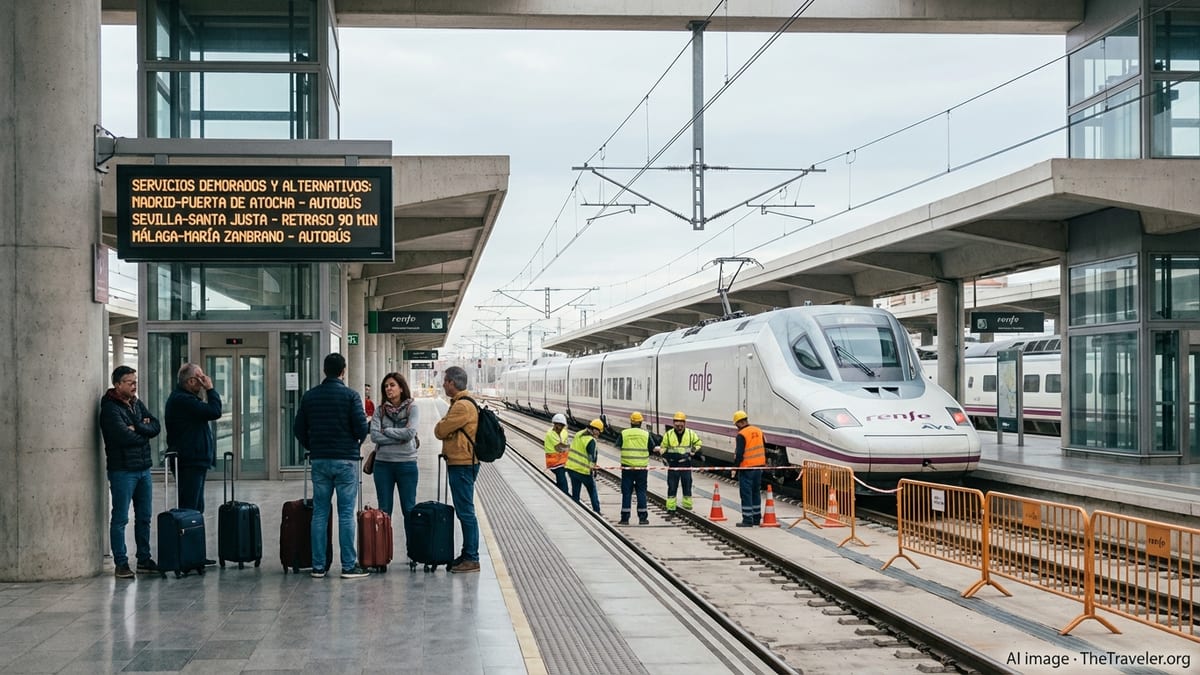
A 24-hour strike at Spain’s state-owned rail operator Renfe is set to disrupt services across the country during the peak summer getaway, with hundreds of trains cancelled and timetables trimmed under legally mandated minimum-service requirements.
Get the latest news straight to your inbox!
Strike dates, unions involved and scope of the walkout
The latest 24-hour stoppage targets Renfe services nationwide and falls at a critical point in Spain’s holiday season. Recent industrial action has centered on a full-day walkout that led to the cancellation of around 320 trains in a single day, and a second 24-hour strike has been announced for mid-July, coinciding with the start of school holidays and a surge in domestic tourism.
The current mobilization has been called by the Sindicato Ferroviario, a sector union representing a portion of Renfe’s workforce. The action follows earlier strike days in late June that already disrupted high-speed, long-distance and commuter operations on some of the country’s busiest corridors. Although representing a minority of staff, the union has selected peak travel dates in an effort to maximize visibility and pressure over staffing levels, working conditions and long-term rail policy.
The strike runs for a continuous 24-hour period, typically from midnight to midnight, and covers a broad range of Renfe-operated services. High-speed AVE and Alvia trains, conventional long-distance routes, regional services and Cercanías commuter lines are all affected to varying degrees, depending on how Spain’s transport ministry and Renfe apply minimum-service rules.
Authorities have framed the action within the wider labor unrest that has marked Spain’s rail sector this year, including earlier multi-day strikes linked to safety concerns and infrastructure maintenance. For travelers, however, the key impact is concentrated into a single intense day of cancellations and timetable changes that can upset carefully planned holiday itineraries.
Minimum services and how many trains are running
Publicly available information shows that the Ministry of Transport has again imposed relatively high minimum-service levels for this strike, particularly on long-distance and high-speed operations. On the most recent 24-hour stoppage, high-speed Renfe services were required to run at about 73 percent of their normal schedule, while medium-distance trains were limited to roughly 65 percent.
Commuter and suburban Cercanías networks, which move large numbers of workers and local residents in metropolitan areas such as Madrid and Barcelona, are subject to tiered minimums. On previous strike days, services were reduced to around half of normal frequency during off-peak hours but increased to about three-quarters of normal during the morning and evening rush. A similar pattern is expected during the current action, meaning that urban rail users can generally count on reduced but still significant coverage at the busiest times of day.
Despite these protections, the headline figure in published coverage has been the cancellation of about 320 trains across Spain during the 24-hour strike window. These include long-distance and high-speed services that connect key tourist destinations, from Madrid to Barcelona, Valencia, Seville and Málaga, along with numerous regional links that feed popular coastal and inland holiday areas.
Renfe’s own updates in late June described participation in the strike as limited, with much of the network operating close to normal outside the most affected routes and times. Even with relatively low adherence among staff, however, the combination of minimum-service caps and timetable adjustments leads to a noticeable thinning of options for passengers, especially those who booked lower-frequency services or late-evening trains.
Routes and travelers most affected
The impact of a 24-hour walkout is felt unevenly across Spain’s dense and varied rail map. High-speed corridors linking Madrid with Barcelona, Valencia, Andalusia and the northern regions are particularly sensitive, as even a modest percentage reduction in services can translate into thousands of disrupted journeys on routes that normally run near capacity at peak holiday times.
Tourism-focused destinations are among the most exposed. Holidaymakers heading to the Costa del Sol via Málaga, to the Costa Brava and Catalan coast via Barcelona, or to the beaches of Valencia and Alicante face higher chances of rebooked or cancelled services. Regional trains serving smaller resort towns and rural areas can be even more vulnerable, because a single cancelled departure may leave no practical alternative the same day.
Commuters in major cities encounter a different pattern of disruption. While minimum services keep much of the Cercanías network functioning, the reduced frequencies and occasional gaps can crowd the trains that do run and lengthen door-to-door travel times. Travelers connecting between commuter lines and long-distance trains must pay close attention to revised schedules, as missed connections are more likely when margins are already tight.
International passengers arriving by air and planning same-day rail connections also face additional uncertainty. Those landing in Madrid or Barcelona and expecting to transfer to a high-speed train may find fewer options, longer waits or, in some cases, the need to complete part of the journey by alternative transport if their chosen train has been withdrawn from the timetable.
Rights, refunds and practical advice for passengers
Travelers affected by the Renfe strike benefit from a series of passenger protections grounded in Spanish and European rail regulations. Public information released by consumer bodies in Spain in connection with recent national rail strikes highlights that, when a train is cancelled due to industrial action, operators must offer passengers the choice between a refund and rerouting under comparable transport conditions, subject to availability.
If a journey is significantly delayed, passengers may be entitled to partial reimbursement, depending on the length of the delay and the type of service. High-speed and long-distance tickets typically carry clearer compensation thresholds, while cheaper promotional fares can involve more restrictions. Travelers are advised to retain booking confirmations, boarding passes and any written communication about cancellations or delays to support subsequent claims.
For those with imminent trips, the most practical step is to check the status of their specific train repeatedly in the 24 to 48 hours before departure. Renfe publishes lists of affected services and updates timetables as strike participation and operating plans become clearer. Given that minimum services still leave a substantial number of trains in operation, many passengers may be able to shift to an earlier or later departure on the same route, particularly if they act promptly.
Travelers with fixed onward connections, such as hotel check-ins, tours or flights, should consider building extra time into their itineraries on strike days. Allowing a wider margin between planned arrival and subsequent commitments can provide a buffer against unforeseen disruptions, especially on routes that pass through areas already subject to infrastructure constraints or temporary speed restrictions.
Planning rail travel in Spain around strike risk
The 24-hour Renfe strike underscores a broader reality for visitors planning rail-based itineraries in Spain in 2026. After a series of serious rail accidents and subsequent labor disputes over staffing and safety, industrial action has become a recurring feature of the travel landscape. While not every call to strike results in widespread disruption, the risk of cancellations on selected days is higher than in previous years.
Travel news coverage suggests several strategies for reducing exposure. Travelers who have flexibility can consider avoiding the specific dates announced for strike action or planning the heaviest travel legs for days before or after. Where that is not possible, booking early departures allows more room to adjust if a train is cancelled, while choosing routes with multiple daily frequencies increases the likelihood of securing an alternative service.
For medium and long-distance trips within Spain, some travelers choose to mix rail with other modes, such as domestic flights or long-distance coaches, which are not directly affected by rail labor disputes. In regions with overlapping services from different rail operators, checking availability beyond Renfe alone can sometimes uncover additional options, though these may also be subject to separate industrial or infrastructure issues.
Despite the disruption, rail remains one of the most efficient and sustainable ways to cross Spain, and the majority of days in the calendar continue to see normal or near-normal operations. By staying informed about strike dates, monitoring train status closely and allowing greater flexibility in trip planning, visitors can continue to rely on trains for much of their Spanish itinerary while minimizing the impact of the latest 24-hour Renfe walkout.