


More news on this day
Fresh Iranian strikes on targets in Bahrain and Jordan, amid an intensifying exchange of fire with the United States, are prompting new airspace warnings and raising the prospect of prolonged flight disruption for travelers transiting Dubai and the wider Middle East.
Get the latest news straight to your inbox!
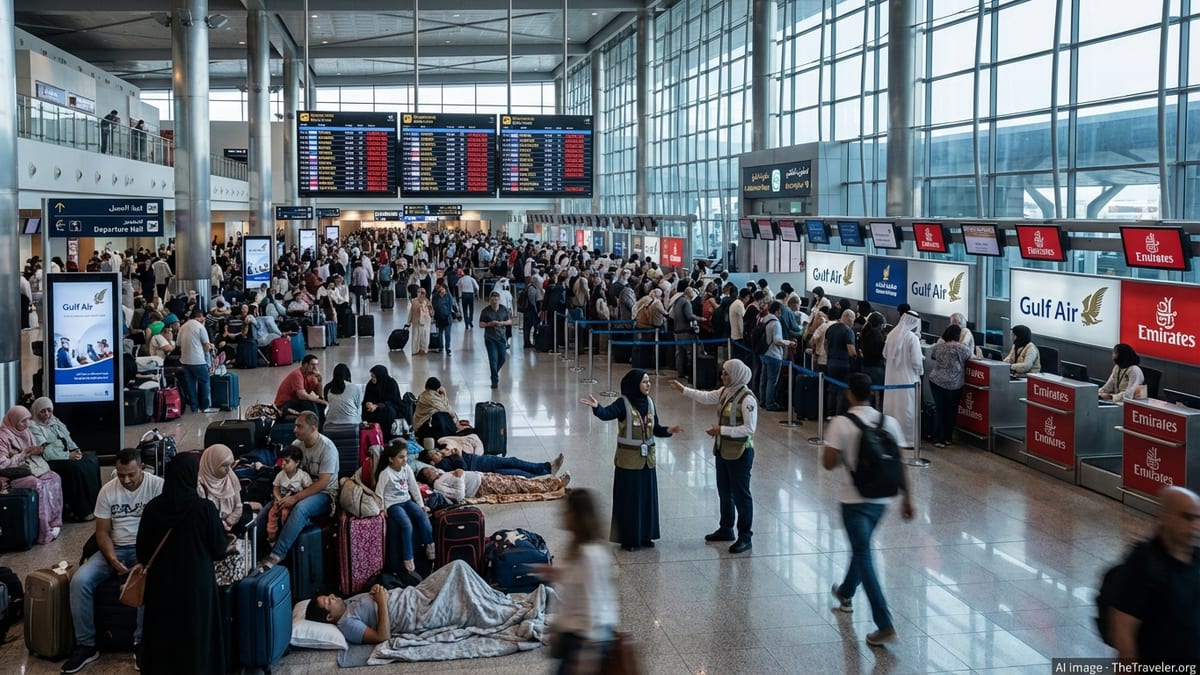
New attacks widen the arc of risk across Gulf skies
Published coverage on July 14 indicates that Iranian ballistic missiles have again targeted facilities associated with United States forces in Jordan, including a major air base used by U.S. troops, while additional barrages have been reported against sites in Bahrain. The latest bombardment follows days of cross-border strikes that have seen Iran hit multiple Gulf states in retaliation for U.S. attacks on Iranian military infrastructure.
Reports from regional outlets and international wire services describe air raid sirens sounding in Bahrain for a third time in less than 24 hours, alongside claims from Iran’s Revolutionary Guard that it has struck bases linked to U.S. operations in both Bahrain and Jordan. These moves extend a campaign of missile and drone launches that in recent days has also included targets in Kuwait, Qatar and Oman, as well as commercial tankers transiting the Strait of Hormuz.
The expanding list of countries caught in the crossfire is deepening concerns about the safety of civilian aviation in some of the world’s busiest air corridors. While Gulf states emphasize that air defense systems are intercepting incoming projectiles, the concentration of military activity around critical hubs such as the Strait of Hormuz and the northern Gulf is forcing airlines and regulators to re-evaluate routings on an almost daily basis.
Dubai hub feels pressure as regulators tighten guidance
Dubai, home to one of the world’s largest international airports, sits at the heart of many east–west flight paths that skirt Iranian, Omani and Gulf airspace. Publicly available information from recent advisories shows that the European Union Aviation Safety Agency has warned carriers to exercise extreme caution or avoid portions of the airspace above Bahrain, Kuwait, Qatar and the United Arab Emirates, as well as over the Gulf of Oman, because of the heightened risk from missile and drone activity.
These warnings do not automatically close skies, but they have significant operational effects. Airlines typically respond by shifting flight paths further south over Saudi Arabia or the Arabian Sea, climbing to higher cruising altitudes earlier in the journey, or adding contingency fuel for potential rerouting. Each of these measures can lengthen flight times, tighten aircraft schedules and increase operating costs that may eventually filter through to travelers as higher fares.
Earlier phases of the current conflict already saw intermittent disruptions at major hubs such as Dubai International and Abu Dhabi, with temporary holds on arrivals and departures during periods of nearby drone or missile alerts. Aviation risk briefings compiled in recent months highlight thousands of flight cancellations and diversions across the wider region since the start of the year, underscoring how quickly localized strikes can ripple through global airline networks.
Airspace closures and reroutes reshape regional connectivity
Risk assessments issued by global security and consulting firms in recent weeks point to a patchwork of airspace measures across the Middle East. Jordan has previously shut sections of its airspace during peak periods of overflight risk, while Kuwait and Bahrain have both reported engaging hostile missiles and drones in the vicinity of key airports and military facilities. Each closure or temporary restriction pushes more traffic into a shrinking number of safe corridors, concentrating congestion on routes over Saudi Arabia and the Red Sea.
The Gulf’s role as a transfer bridge between Europe, Asia, Africa and Australasia means that even modest adjustments can have outsized consequences. Flights connecting European cities with India, Southeast Asia and Australia frequently overfly or route close to the Gulf states now on the front line of U.S.–Iran tensions. When airlines avoid Bahrain’s skies or give a wide berth to Jordanian airspace, they often face longer routings, increased fuel burn and tighter connection windows for passengers changing planes in Dubai or Doha.
Some carriers serving the region have already signaled a preference for more southerly tracks, while others are relying on sophisticated risk modeling to maintain overflights at higher altitudes judged to be less vulnerable to most missile and drone systems. For travelers, the most visible impacts are schedule changes, extended block times and, in some cases, unexpected technical stops as aircraft adjust to new range and fuel profiles.
Escalating U.S.–Iran confrontation heightens aviation uncertainty
The latest attacks on Bahrain and Jordan are part of a broader escalation that has seen U.S. forces expand strikes on Iranian missile, drone and coastal defense sites along the country’s southern coast and near key ports on the Gulf. According to open-source reporting, U.S. Central Command has targeted dozens of locations over multiple nights in an effort to curb Iran’s capacity to threaten commercial shipping and regional bases.
In response, Iran has framed its missile and drone barrages on Gulf states as retaliatory operations. Recent statements reported by regional media describe claimed strikes on air bases and command centers associated with U.S. forces in Bahrain, Kuwait, Qatar and Jordan. Analysts note that Jordan, which had previously been relatively less affected by direct Iranian fire, is now firmly within the conflict’s geographic scope, increasing the strategic risk for airlines that have relied on Jordanian airspace as an alternative to more volatile zones.
Diplomatic efforts involving regional and international mediators are reportedly ongoing, but there is little immediate sign that either Washington or Tehran is ready to scale back military operations. For the aviation sector, this prolongs a period in which flight planning departments must navigate not only traditional weather and capacity constraints but also rapidly evolving military no-go areas and regulator advisories.
What travelers via Dubai and the Gulf can expect next
For passengers booked on routes through Dubai, Doha, Abu Dhabi or other Gulf hubs, the immediate consequence of the latest Bahrain and Jordan strikes is likely to be continued volatility rather than outright shutdowns. Most airports in the region remain operational, and airlines are adept at implementing rapid reroutes when threats emerge. However, short-notice schedule revisions, rolling delays and occasional overnight disruptions remain a realistic prospect while U.S.–Iran tensions stay elevated.
Travel specialists focusing on the Middle East recommend that passengers allow extra time for connections, monitor airline notifications closely and remain flexible about potential changes to routings or departure times. Business travelers reliant on tight turnarounds in Dubai or other regional hubs may need to build in additional buffer hours or consider alternative routings through Europe or the Indian Ocean where feasible.
Industry observers also point out that the longer the confrontation persists, the more likely it becomes that airlines will adjust capacity, either by trimming frequencies on some routes or upgauging aircraft to consolidate demand on paths deemed more secure. For now, the most visible effects are elongated flight paths and heightened security screening, but if missile and drone incidents near major hubs continue, travelers could see a more pronounced reshaping of global traffic flows around the Gulf.