


More news on this day
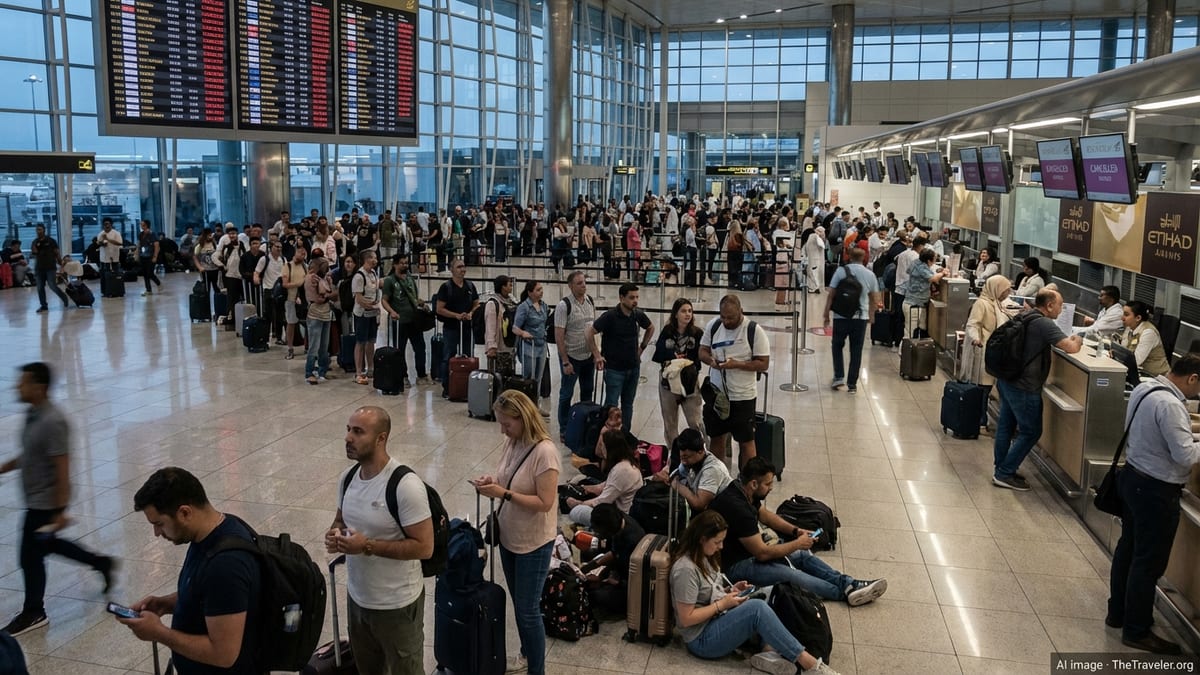
Middle East air travel has been thrust back into crisis after a missile and drone attack on Saudi Arabia’s Abha International Airport led to a temporary shutdown of the facility, sparking fresh flight cancellations, diversions and urgent safety warnings for passengers moving through the region’s already strained aviation network.
Get the latest news straight to your inbox!
Strike on Abha Airport Adds New Flashpoint
Reports from regional and international media indicate that Yemen’s Houthi movement claimed responsibility for launching ballistic missiles and drones at Abha International Airport in southwest Saudi Arabia on Monday, July 13, 2026. The group framed the operation as retaliation for airstrikes earlier the same day on Sanaa International Airport in Yemen, underscoring how civilian aviation infrastructure is once again being drawn directly into the conflict.
Initial accounts describe explosions at or near the airport complex and an immediate suspension of flight operations while passengers were moved away from affected areas. Imagery broadcast by Yemeni and Saudi outlets, along with accounts collated by global agencies, point to a targeted attack on the airport rather than on surrounding urban areas, although verification of the precise damage remains limited.
The incident at Abha follows a series of previous strikes on airports and aviation hubs across the region in 2026, contributing to a wider pattern in which airspace, runways and terminal facilities have increasingly become part of the strategic battleground. Aviation analysts note that these events are eroding confidence in what had long been marketed as some of the world’s most reliable transit corridors.
While Saudi authorities had not issued a detailed public assessment of structural damage by Tuesday afternoon, publicly available information shows that Abha’s operations were sufficiently disrupted to force diversions and cancellations that quickly rippled beyond the kingdom’s borders.
UAE–Saudi Routes Hit by Cancellations and Diversions
Travel coverage from Gulf-based outlets shows that flights linking the United Arab Emirates with Abha were among the first to be affected. Services operated by carriers such as flydubai and Saudia between Dubai and Abha were either cancelled or diverted after the attack, with at least one Dubai–Abha rotation rerouted to Taif when Abha’s runway was temporarily closed.
Additional reports from regional media state that flights between Sharjah and Abha, including services run by low-cost operators, were also cancelled on Tuesday. An Abha–Sharjah flight on Air Arabia was cited among the disrupted services, leaving passengers in both directions facing last-minute changes or overnight delays as airlines adjusted their schedules.
Travel bulletins and social media updates from passengers suggest that some services into other Saudi cities, including Jeddah and Riyadh, continued to operate, but with added congestion as airlines attempted to rebook travelers whose journeys had been routed through Abha. For UAE residents using Saudi Arabia as a transit point to South Asia, Africa or Europe, these changes have added another layer of uncertainty to itineraries that were already complicated by wider regional tensions.
By Tuesday evening, several carriers were still assessing whether to reinstate limited Abha operations or extend cancellations into the coming days, leading to rolling changes in online schedules and check-in advisories.
Wider Middle East Aviation System Under Strain
The attack on Abha arrives at a moment when Middle East aviation remains under intense strain from the broader security crisis spanning the Gulf, Red Sea and Levant. Earlier in 2026, long-haul operators were forced to reroute flights to avoid airspace over conflict zones, lengthening travel times between Europe, Asia and Africa and driving up fuel and crew costs across the industry.
Analyses by international organizations and specialist aviation trackers have highlighted how repeated missile and drone incidents targeting airports in Kuwait, the United Arab Emirates and other states have disrupted a region that normally handles a significant share of global connecting traffic. Temporary closures, partial shutdowns and sudden airspace restrictions have turned what were once highly predictable hubs into more volatile transit points.
Within this environment, Abha’s closure is viewed by many observers as another stress point in a fragile network rather than an isolated event. Any sustained suspension of operations at a Saudi regional airport can have knock-on effects on domestic connectivity, particularly for smaller cities that rely on links to major hubs such as Riyadh and Jeddah for onward long-haul travel.
Industry commentary also notes the financial pressure on airlines that must rapidly redesign flight plans, reposition aircraft and provide care for stranded passengers whenever fresh security incidents erupt. For carriers operating on thin margins or still recovering from earlier war-related disruptions, each new shock accelerates concerns about long-term viability.
Airlines Issue Warnings as Passengers Face New Uncertainty
Publicly available statements and media briefings from carriers serving Saudi Arabia show a renewed emphasis on safety warnings and flexible policies for travelers booked through the region. Several airlines have urged passengers with upcoming itineraries involving Abha or surrounding airspace to monitor status updates closely, sign up for SMS or app notifications and allow extra time for transfers in case of last-minute rerouting.
Some operators have introduced limited rebooking waivers for passengers scheduled to travel via Abha in the immediate aftermath of the attack, allowing itinerary changes without additional fees or fare differences on selected dates. However, reports from travel agents and passengers suggest that availability on alternative flights is tightening rapidly as aircraft fill up on substitute routes.
Travel forums and regional news sites also describe growing anxiety among passengers transiting the Gulf in coming weeks, particularly those using Saudi carriers for long-haul connections to North America, Europe and Asia. Concerns center not only on physical security but also on the risk of missed connections, extended layovers or unplanned overnight stays if airports are forced to close at short notice.
Insurance specialists cited in recent coverage have highlighted the importance of checking policy wording carefully, as some travel insurance products may exclude disruption caused by war or acts of armed groups, leaving passengers to negotiate directly with airlines and booking platforms for refunds or alternative arrangements.
What Travelers Should Consider Now
In the wake of the Abha incident, aviation experts quoted in regional and international reporting are advising passengers to reassess routing choices through the Middle East, especially for nonessential travel. Travelers are being encouraged to review whether they are comfortable transiting airports viewed as closer to active front lines and to consult airline advisories before committing to new bookings.
Journey planners increasingly recommend building longer connection times into itineraries that cross the region, in case flights are rerouted around closed airspace or subject to additional security checks. Passengers with early-morning or late-night departures are being urged to have contingency plans in place, such as confirmed accommodation and access to local currency, should an extended delay materialize.
For those with imminent travel involving Saudi Arabia or neighboring states, publicly available guidance from aviation regulators and carriers generally points to a cautious, case-by-case approach rather than sweeping cancellations. Many major routes continue to operate, but the attack on Abha stands as a reminder that conditions can change rapidly, sometimes within a single travel day.
Against the backdrop of a wider regional conflict that has already upended air corridors and passenger flows, the fresh disruption at Abha Airport underscores how fragile the Middle East’s role as a global aviation crossroads has become, and how closely travelers must now watch security developments before they fly.