


More news on this day
Calgary International Airport faced a fresh wave of disruption as at least 41 flights linked to WestJet, Air Canada Rouge and KLM were delayed or canceled, leaving travelers scrambling for alternatives across domestic and transatlantic routes.
Get the latest news straight to your inbox!
Wave of Disruptions Hits Calgary Hub
Calgary International Airport, a primary hub for WestJet and an important base for Air Canada services, experienced significant operational turbulence as dozens of flights were disrupted in a short window, according to real time flight tracking dashboards and passenger reports. The disruption cluster affected a mix of domestic connections, transborder flights and at least one transatlantic rotation, creating knock on delays throughout the day.
Publicly available flight status data indicates that roughly 41 services touching Calgary were either canceled outright or subject to substantial delay. The largest share involved WestJet, which dominates traffic at the airport, but services associated with Air Canada Rouge leisure routes and KLM’s Amsterdam link were also impacted as aircraft and crews struggled to remain in position.
The disruption built on an already fragile operating environment in Canada, where recent days have seen widespread delays across Toronto, Montreal, Vancouver, Edmonton and Calgary. Analysts tracking the events note that bottlenecks at one major hub can quickly cascade through the country’s tightly interlinked route networks, amplifying the effect of each cancellation.
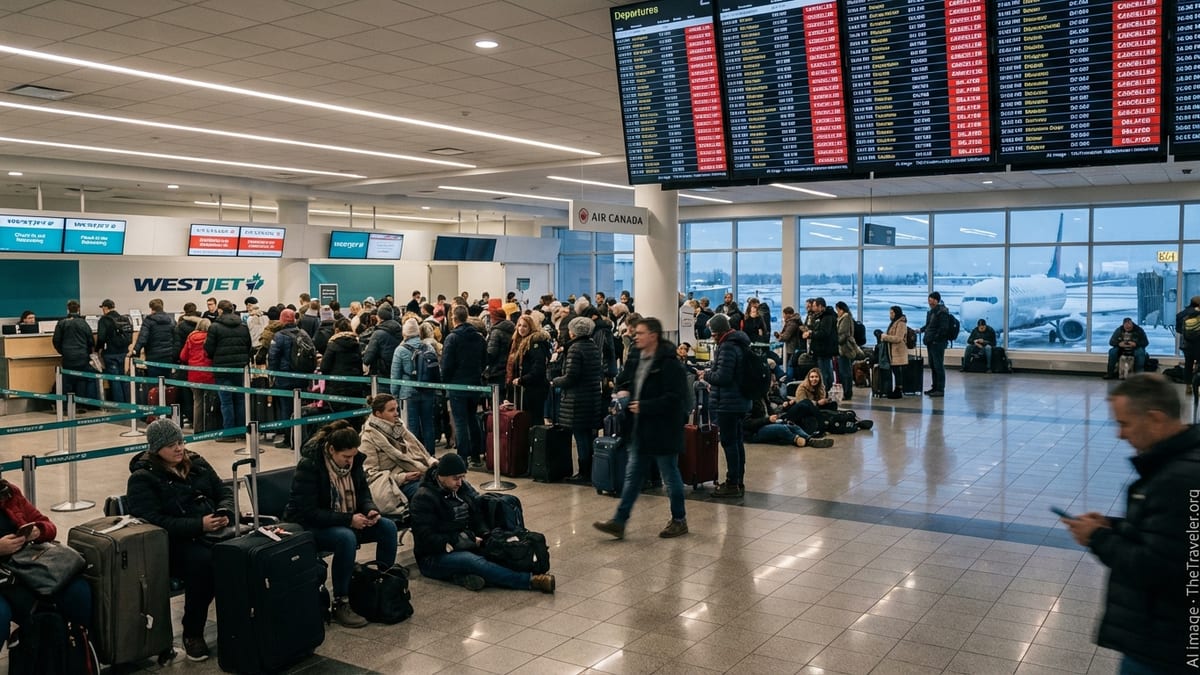
For Calgary, the result was a congested terminal, busy rebooking desks and departure boards filled with rolling time changes. While some flights eventually departed after extended ground holds, others were scrubbed as the day wore on, forcing airlines to reprioritize long haul and high demand services.
WestJet, Air Canada Rouge and KLM Among Hardest Hit
As Calgary’s largest carrier, WestJet bore the brunt of the immediate disruption. The airline has already been adjusting its network, including retreating from several smaller regional markets and fine tuning long haul plans, and this latest episode highlighted the operational pressure that comes with running a dense bank of departures from a single hub.
WestJet’s schedule from Calgary encompasses a spectrum of routes, from short hops to cities in Alberta and Saskatchewan to longer domestic services to Toronto and Montreal and international links to Europe, South America and Asia. When irregular operations strike, short haul segments are often the first to be cut to protect wide body and high revenue flights, a pattern that appeared to play out again as the 41 flight disruption tally accumulated.
Air Canada Rouge, which operates seasonal and leisure oriented services touching Calgary, also saw parts of its program affected. Although Rouge represents only a slice of Air Canada’s overall presence at the airport, disruption of even a few departures can have outsized consequences for holiday makers tied to resort stays, cruise departures or fixed tour itineraries.
KLM’s role as Calgary’s primary nonstop link to Amsterdam meant that any disruption to its flights would immediately ripple through European and onward global connections. When long haul operations from a spoke city like Calgary fall out of sync, passengers can miss carefully timed intercontinental connections, forcing rebookings that stretch across multiple carriers and alliances.
Passengers Stranded as Rebooking Options Narrow
For travelers caught in the middle, the latest breakdown translated into long queues at service counters, rebooking struggles and uncertainty about accommodation and onward plans. With 41 flights affected, alternative seats on the same day quickly became scarce, especially on peak domestic corridors and transatlantic services where load factors were already high.
Publicly available information from consumer forums and flight disruption trackers suggests that some passengers were offered rerouting via other Canadian hubs such as Toronto or Vancouver, or rebooked onto next day departures from Calgary. Others opted to abandon travel plans entirely when overnight stays or missed events made the trip no longer viable.
Travel specialists monitoring the situation note that the dense clustering of cancellations in a single hub can cause rebooking options to evaporate within hours. Once nearby alternative flights are full, airlines must look to more circuitous routings or delay travel by a full day or more, particularly for those heading to secondary European or vacation destinations served only a few times per week.
Families and travelers with complex itineraries involving multiple airlines were among the hardest hit. With WestJet, Air Canada Rouge and KLM all experiencing knock on effects from the Calgary disruption, some passengers found that rebooking one segment created new problems on the next, especially when separate tickets were involved.
Broader Pattern of Canadian Flight Turbulence
The turmoil in Calgary is part of a broader pattern of irregular operations that has affected Canadian air travel throughout the spring and early summer. Data compiled by passenger rights organizations and travel claims services points to multiple days when hundreds of flights were disrupted across the country’s main airports, including Toronto Pearson, Montreal Trudeau and Calgary.
Several factors have combined to drive the current instability, including volatile weather systems on the Prairies and in central Canada, tight aircraft and crew utilization, and ongoing adjustments in airline networks. WestJet and Air Canada have both been reconfiguring route maps in response to shifting demand, while also contending with staffing and maintenance constraints that can leave little buffer when storms or air traffic control restrictions emerge.
Observers highlight that when major hubs like Calgary experience concentrated disruption, ripple effects can extend for days. Aircraft may end up out of position, crews can hit duty time limits, and luggage handling systems can struggle to keep up with repeated changes, making it harder to restore normal operations quickly even after weather or technical triggers have eased.
In this context, the 41 flight disruption wave in Calgary is seen less as an isolated incident and more as another flashpoint in a challenging travel season. With the busy summer travel period ramping up, industry watchers are closely following how airlines adjust schedules and resource levels to reduce the risk of repeat episodes.
What Travelers Can Do During Multi Airline Disruptions
The Calgary events underline how vulnerable travelers can be when multiple airlines at a single hub experience simultaneous disruption. Passenger advocates emphasize the importance of proactive trip management, including closely monitoring flight status via airline apps, signing up for text or email alerts and checking airport departure boards before leaving home or a hotel.
Canada’s Air Passenger Protection Regulations set out specific obligations for airlines when flights are delayed or canceled, and publicly available guidance from consumer organizations encourages passengers to familiarize themselves with their entitlements. These can include food vouchers, hotel accommodation, rebooking on the next available flight and, in some cases, financial compensation when the disruption is within an airline’s control.
Experienced travelers also recommend preparing fallback plans, such as identifying alternative routings, being ready to accept flights through different hubs and carrying essential items in hand baggage in case of unexpected overnight stays. When disruption is widespread, same day solutions may be scarce, but passengers who respond quickly and remain flexible often secure the limited seats that become available as airlines rebuild schedules.
With WestJet, Air Canada Rouge and KLM all affected during the latest Calgary turmoil, the episode serves as a reminder that even well established routes and carriers are not immune to operational shocks. For now, those planning to travel through Calgary International Airport are watching schedules closely, aware that a single day of disruption can reverberate long after departure boards return to normal.