


More news on this day
A Hawaii-bound jet at San Diego International Airport aborted its takeoff and returned to the gate for deplaning just as the Labor Day travel rush was ramping up, adding another layer of disruption for passengers already facing one of the busiest weekends of the year.
Get the latest news straight to your inbox!
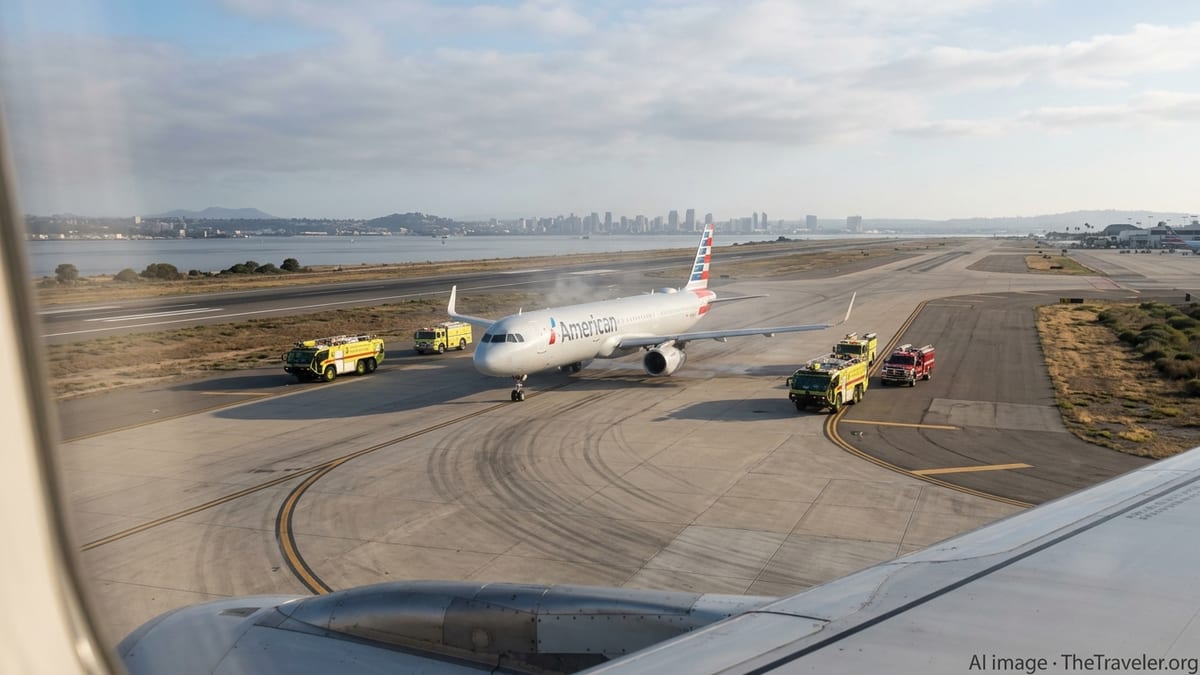
Smoke in Cabin Prompts Aborted Takeoff
Publicly available reports indicate that an Alaska Airlines flight operating as Hawaiian Airlines Flight 815 from San Diego to Honolulu was accelerating for departure on Thursday, September 3, when the crew rejected the takeoff and brought the aircraft to a stop on the runway. The incident occurred at San Diego International Airport late in the morning, at the outset of the Labor Day getaway period.
Coverage from local broadcaster ABC 10News describes “heavy smoke” in the main cabin shortly after the takeoff roll began, prompting an airport alert and a response from San Diego fire crews. According to the same coverage, airport representatives later linked the smoke to overheated brakes on the Airbus widebody, which had been preparing for a nonstop flight to Daniel K. Inouye International Airport in Honolulu.
According to publicly available information from the Federal Aviation Administration, the crew of Flight 815 aborted the takeoff at around 10:10 a.m. local time and exited the runway to a nearby taxiway, where the aircraft could be inspected. The FAA notes that the episode will be subject to a standard safety review, a routine step following what aviation regulators define as a rejected or aborted takeoff.
San Diego airport representatives stated in published coverage that all passengers were deboarded after the aircraft reached a safe position away from the active runway. The jet was then taken out of service for evaluation by maintenance personnel, and the flight to Honolulu was canceled, leaving travelers to be rebooked on later departures.
Aircraft Removed from Service as Passengers Rebooked
According to airline statements cited in local news reports, pilots on Flight 815 were alerted to a mechanical issue during the initial takeoff run and chose to reject the takeoff as a precaution. The aircraft remained under control throughout the maneuver and returned safely to the gate, where passengers disembarked.
Published coverage notes that the airline canceled the remainder of the flight after maintenance teams began inspecting the jet. Data from flight-tracking services show no onward departure for the aircraft on the originally scheduled route, consistent with the carrier’s decision to withdraw the plane from the day’s operations while checks were underway.
Travelers booked to Honolulu were re-accommodated on later flights or alternate routings, according to multiple reports. While this reduced the immediate pressure on the San Diego runway system, it added to the wider pattern of schedule reshuffling already affecting holiday travelers across the network.
Aborted takeoffs, while unsettling for those on board, are treated within commercial aviation as a key safety tool. Training and regulatory guidance emphasize that crews should not hesitate to reject a takeoff if cockpit warnings, abnormal sounds, or smoke suggest a potential hazard before the aircraft has left the ground.
Labor Day Rush Magnifies Disruption
The incident came as San Diego International moved into one of its busiest weekends of the year. Data from the airport’s website and the Federal Aviation Administration on Friday, September 4, show that delays of around two hours were affecting both arrivals and departures during the afternoon, just as Labor Day travel peaked.
Local coverage from NBC 7 San Diego reports that by early Friday evening roughly 420 flights had been delayed at San Diego International, with average delays around 122 minutes. That disruption was driven in part by a separate operational challenge on Friday involving a drone sighting and a high-altitude weather balloon near the airfield, which temporarily paused arrivals and departures.
An advisory from the FAA’s Air Traffic Control System Command Center indicates that a diversion recovery program for San Diego was activated on Friday evening, a tool used when large numbers of flights are diverted or significantly delayed. The advisory set an event window stretching into the early hours of Saturday, underscoring how quickly minor schedule issues can escalate once peak holiday demand is factored in.
Although the aborted takeoff involving Flight 815 occurred a day earlier and on a single aircraft, its ripple effects played into a broader pattern of tight schedules, high passenger volumes, and limited slack in the system. Travel industry analyses of the Labor Day period note that airlines are operating fuller planes with thinner buffers, meaning any disruption, from a mechanical inspection to airspace restrictions, can cascade through the day’s operations.
Single-Runway Constraints at a Crowded Coastal Airport
San Diego International operates on a constrained footprint along the bayfront, with a single primary runway serving all commercial traffic. Aviation reference data describes the airport as a 24-hour facility that nevertheless must juggle terrain, noise abatement, and limited taxiway space, factors that can complicate recovery from irregular operations.
Commentary from frequent travelers and aviation observers, reflected in public forums and prior reporting, often highlights how even small disruptions at San Diego can quickly back up departure queues or crowd arrival banks. When an aircraft experiences an issue on the runway, as occurred with Flight 815, operations teams typically need to coordinate closely to clear the runway, reposition the aircraft, and resequence waiting flights.
In the case of the aborted takeoff before Labor Day, publicly available accounts indicate that the jet was moved promptly to a taxiway so that the runway itself could resume use. The airport later emphasized in published statements that the aircraft’s position did not significantly affect flight schedules, suggesting that the wider delays on Friday were more directly tied to airspace restrictions and overall traffic volume rather than lingering effects from the prior day’s event.
Even so, the combination of a rejected takeoff, a busy holiday weekend, and subsequent drone-related delays offers a snapshot of how sensitive a single-runway hub can be to unexpected events. Travelers heading into major holiday periods are increasingly advised by industry analysts to build additional time into their itineraries and to monitor flight status closely as conditions evolve.
What Travelers Should Take From the Incident
For passengers, the rejected takeoff at San Diego underscores both the redundancy built into modern commercial aviation and the practical challenges that follow precautionary decisions. Aborting a takeoff in response to possible mechanical issues or smoke is consistent with safety-first procedures, and the fact that Flight 815 remained on the ground and was brought to a stop without reported injuries aligns with that safety emphasis.
At the same time, the resulting cancellation illustrates how quickly travel plans can change during peak periods. With seats already at a premium over Labor Day, rebooking hundreds of passengers from a widebody flight to Hawaii can require a patchwork of later departures, connections through other hubs, and in some cases next-day travel.
Travel coverage focused on San Diego’s holiday period suggests that passengers may want to factor such contingencies into their planning, especially when connecting to cruises, tours, or events with fixed start times. Recommendations from travel analysts commonly include leaving greater buffers before time-sensitive commitments, considering earlier departures on peak days, and using airline apps to track inbound aircraft and potential knock-on delays.
While investigators review the specifics of the San Diego aborted takeoff, the visible outcome for travelers is a reminder that even routine safety measures can reshape a holiday weekend. For those passing through busy coastal airports like San Diego, the episode reinforces the value of flexibility, backups, and a clear understanding that in aviation, safety decisions will always take precedence over schedule.
ABC 10News: Pilot aborts takeoff & plane deboards at San Diego International Airport
NBC 7 San Diego: Multiple flights delayed at San Diego International Airport
FAA ATCSCC Advisory: SAN Airport Diversion Recovery Activated