

More news on this day
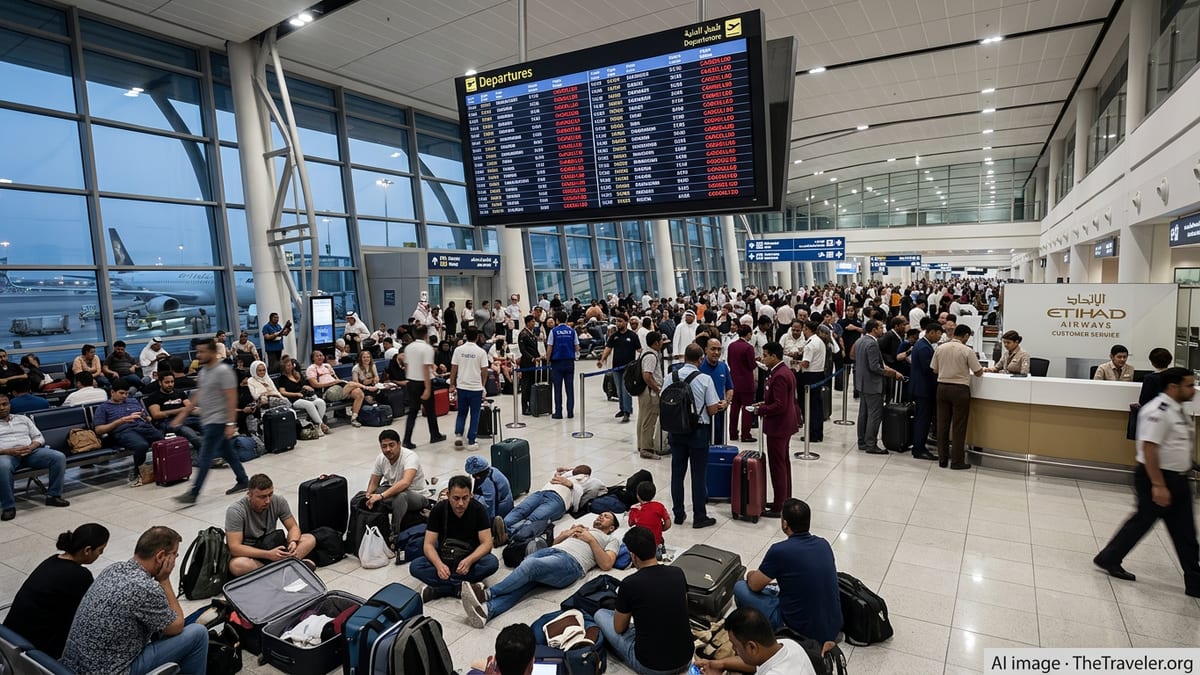
Hundreds of travellers were left sleeping on terminal floors and queueing for scarce rebooking options at Abu Dhabi International Airport on Thursday as 262 flights were cancelled and 36 delayed, disrupting services by Etihad Airways, Qatar Airways, IndiGo, Saudia and other carriers across the Middle East and on key routes to London, Cairo, Bengaluru and Mumbai.
Regional Airspace Closures Trigger Fresh Wave of Disruptions
The latest turmoil at Abu Dhabi International Airport, also known as Zayed International Airport, comes as widespread airspace closures linked to the ongoing conflict involving Iran and Israel continue to choke off some of the Middle East’s busiest corridors. Authorities in multiple countries have maintained or extended partial shutdowns of their skies, forcing airlines to divert, reroute or ground aircraft at short notice.
Etihad Airways, based in Abu Dhabi, has kept most scheduled passenger flights to and from its hub suspended or heavily curtailed, focusing instead on limited relief and recovery operations. Qatar Airways, which relies on Doha as a major connecting hub, has also been hit by ongoing restrictions, adding further strain to regional capacity and pinching options for travellers trying to bypass Abu Dhabi through neighbouring gateways.
Budget carriers such as IndiGo, along with full-service airlines including Saudia, have reported sweeping cancellations across the Gulf and the wider Middle East, underscoring how dependent long-haul traffic between Europe, Africa and Asia is on this region’s hub-and-spoke networks. Even when aircraft are able to operate, crews and ground handling teams are stretched, deepening knock-on delays.
Aviation analysts say the cumulative effect is akin to a rolling shutdown of some of the world’s most important transit points, as passengers who would usually make seamless connections in Abu Dhabi, Doha or Dubai instead find themselves stranded or funneled through a patchwork of secondary hubs from Cairo to Mumbai.
Passengers Facing Long Queues, Limited Information and Rising Costs
Inside Abu Dhabi’s terminals, stranded passengers have described scenes of confusion and fatigue as rolling cancellations upended carefully planned itineraries. Long lines formed at airline transfer desks as travellers sought any remaining seats out of the UAE, while others bedded down near charging stations and food courts, waiting for updates that often shifted by the hour.
Families connecting between Europe and India said they were particularly hard hit, with many itineraries involving Abu Dhabi as the central link to cities such as Bengaluru and Mumbai. With onward legs cancelled, they were left competing for scarce seats rerouted via Cairo, Muscat or direct services into Indian metros, frequently at higher last-minute fares.
Passengers heading to and from London and other European capitals have also faced days of uncertainty. Some were rebooked on multi-stop journeys via alternative hubs, but others were told to wait for special recovery or repatriation flights being mounted as capacity and airspace availability slowly improve.
Food, hotel vouchers and ground transport have varied widely by airline and ticket type, leaving many economy-class travellers to shoulder unexpected hotel bills or overnight stays in the terminal. Travel insurers are reporting a spike in claims related to delays, missed connections and emergency rebookings, although coverage depends heavily on the fine print of individual policies.
Etihad, Qatar Airways, IndiGo and Saudia Struggle to Rebuild Schedules
Airlines across the region are walking a tightrope between safety, operational feasibility and mounting pressure to get stranded passengers moving again. Etihad has said its priority is to resume core routes from Abu Dhabi in a phased manner, while continuing to operate select services designed explicitly to repatriate travellers who have been caught in the disruption for days.
Qatar Airways, a key competitor and codeshare partner on many global itineraries, remains constrained by closures affecting Qatari airspace and neighbouring flight corridors. That has limited the carrier’s ability to absorb spillover demand from Abu Dhabi, even as it coordinates with global partners to reroute some long-haul traffic via alternative paths where safety assessments allow.
IndiGo has announced a gradual restoration of flights connecting India with the Gulf and Saudi Arabia, including specially scheduled services to Jeddah and select UAE airports. However, the low-cost carrier continues to cancel or consolidate many departures involving Abu Dhabi, Bengaluru and Mumbai as it juggles crew availability, aircraft positioning and changing overflight permissions.
Saudi flag carrier Saudia, which links Gulf hubs with destinations such as Cairo, London and major Indian cities, has cancelled dozens of flights across its regional network. While some routes are beginning to see limited operations return, the uneven pattern of reopenings means that schedules remain subject to abrupt last-minute changes, often with little advance warning for passengers.
Key Routes to London, Cairo, Bengaluru and Mumbai Severely Affected
The disruption at Abu Dhabi International Airport has had an outsized impact on a handful of high-demand corridors, notably services to London, Cairo, Bengaluru and Mumbai. These routes are linchpins of the global network that funnels business travellers, tourists and migrant workers between Europe, the Middle East and South Asia.
Passengers bound for London have seen direct and one-stop connections via the Gulf drastically reduced, forcing some to detour through continental European hubs or major South Asian airports that still have capacity. In several cases, travellers have reported journey times more than doubling as they stitch together fragmented itineraries around active no-fly zones.
Routes linking Abu Dhabi with Cairo and onward connections into North Africa have also suffered, complicating travel plans for Egyptian expatriates and tourists returning from Gulf states. With Saudia and other carriers trimming operations, Cairo has absorbed part of the stranded traffic but is itself contending with congestion and tight seat availability.
In India, airports at Bengaluru and Mumbai are grappling with a surge of disrupted passengers arriving on irregular relief flights or rerouted services from Muscat, Jeddah and other secondary hubs. Terminal crowds and baggage handling backlogs at peak periods have reflected the strain, even as local authorities coordinate with airlines to prioritize aircraft handling and ease onward transfers.
What Stranded Travellers Can Do Now
For passengers still stuck in Abu Dhabi or at downstream airports on affected routes, airlines and travel specialists are urging a combination of patience and proactive planning. Travellers are being advised to monitor airline apps frequently for rolling schedule changes and to confirm any rebooked itinerary before leaving for the airport, as departure times and routings remain fluid.
Where possible, passengers with flexible tickets or travel insurance are exploring alternative gateways such as Cairo, Muscat, Riyadh or major Indian hubs, using separate tickets to bridge gaps between disrupted segments. This approach carries additional cost and risk, but for some travellers with urgent commitments it has proven the fastest way to exit the bottleneck in Abu Dhabi.
Experts also recommend that travellers keep all receipts for incidental expenses, including meals, accommodation and transport, in case they qualify for reimbursement under airline policies or insurance coverage. Given the extraordinary nature of the airspace closures, compensation rules that apply in more routine disruptions may not always be triggered, making clear documentation even more important.
With no firm timeline for a full return to normal operations across the region, Abu Dhabi International Airport remains a focal point of a wider aviation crisis stretching from London to Mumbai. For now, hundreds of stranded travellers are caught in the middle of a complex web of geopolitical tensions and operational constraints, waiting for the skies to reopen and the world’s key air bridges to be restored.