

More news on this day
Rail passengers faced serious disruption and scenes of visible damage on Friday after a collision between two trains on the Midland Main Line south of Bedford, halting services on one of the key routes north of London.
Get the latest news straight to your inbox!
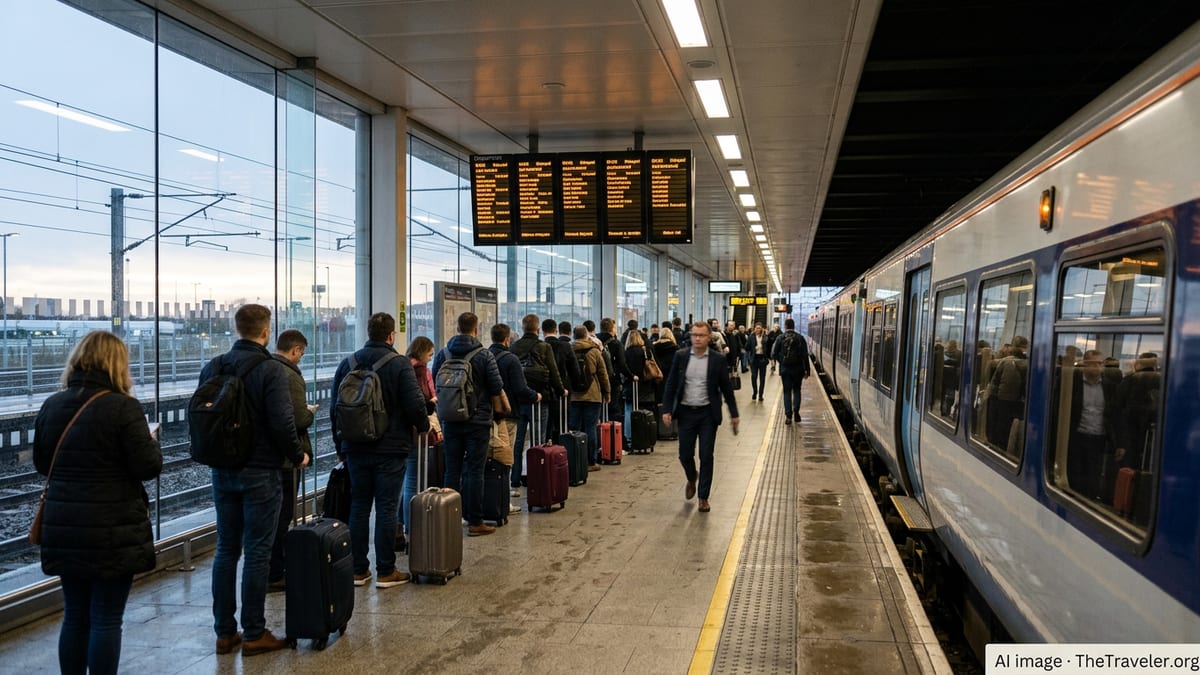
Collision South of Bedford Prompts Major Emergency Response
Early reports from rail operators and regional media on 19 June indicate that two northbound services collided on tracks a few miles south of Bedford, in Bedfordshire. Initial information suggests a rear-end impact involving intercity trains operating between London St Pancras and destinations in the East Midlands, with images shared on social platforms showing crumpled carriage ends and dislodged interior fittings.
Publicly available coverage describes how the incident occurred in the early evening, at a time when many commuters and long-distance travelers were using the route. The line forms part of the Midland Main Line corridor linking the capital with towns and cities such as Leicester, Nottingham and Sheffield, making any interruption immediately significant for both local and long-haul journeys.
Photographs from the scene show both trains remaining upright and largely on the rails, but with visible deformation to at least one cab end and adjacent coach. Witness accounts relayed in national and regional reports describe a sudden, violent jolt, broken glass and smoke in some carriages, with several passengers receiving on-the-spot treatment for visible injuries.
Ambulances, fire crews and police units were dispatched to the area, with rail operator updates advising passengers to avoid travel on affected services. Nearby roads and access points were reported to be busy as emergency vehicles reached the railway embankment south of the town.
Passengers Describe Chaotic Moments Inside Damaged Carriages
Accounts shared through broadcasters and social media posts paint a picture of confusion in the minutes following the impact. Some passengers reported being thrown from their seats, while others described overhead fixtures shaking loose and personal belongings scattered across the aisles. Several described the sensation as comparable to a powerful explosion, followed by the sound of braking and grinding metal.
Eyewitness descriptions indicate that carriage interiors quickly filled with dust and, in some cases, light smoke, prompting concern among those on board as they tried to locate exits and check on fellow travelers. Images taken after the collision show passengers with bandages and makeshift slings, suggesting that emergency teams and bystanders improvised first aid while waiting for additional medical support.
Reports circulating in national media note that passengers in the forward cars appeared to experience the most intense forces, with some seats dislodged and windows shattered. Despite the severity of the jolt, early coverage has not indicated a large number of life-threatening injuries, a fact that commentators attribute to modern rolling stock design and the trains remaining upright.
Rail community forums and discussion boards quickly filled with first-hand narratives, including detailed descriptions of how train staff moved through the coaches to check on injuries and coordinate an orderly evacuation once it was safe to do so. These posts offer an emerging picture of the human experience behind the headline disruption.
Severe Disruption Across the Midland Main Line
The collision led to immediate suspension of services on key sections of the route between London St Pancras and the East Midlands, with rail operator updates warning that trains could be cancelled or heavily delayed for the remainder of the day. Replacement bus services were organized at short notice, although capacity constraints and road congestion limited their ability to absorb displaced passengers.
Journey planners and live departure boards showed widespread knock-on delays, with some trains terminating short of their destinations or being diverted via alternative lines where possible. Travelers attempting to reach Leicester, Nottingham, Sheffield and intermediate stations were advised to postpone journeys or seek other modes of transport, while crowds built up at London St Pancras and other major hubs.
Travel information platforms reported that disruption was likely to continue into the weekend while damaged rolling stock was removed and infrastructure inspections were carried out. Rail analysts noted that the affected section is a critical artery for both intercity and regional services, meaning any extended closure or speed restrictions would have a noticeable impact on timetables across a wide area.
Hotel operators and taxi services in nearby towns were also expected to come under pressure as stranded passengers sought overnight accommodation or overland alternatives. Online travel forums began sharing real-time advice on alternative routes using other main lines or coach networks to bypass the affected corridor north of London.
Investigators Focus on Sequence Leading to Rear-End Impact
While the immediate priority remained the treatment of injuries and the safe evacuation of passengers, attention swiftly turned to how two trains came to collide on a modern, intensively managed main line. Early commentary from rail specialists cited in national reporting noted that the incident appeared to involve a following train striking the rear of a preceding service, rather than a head-on collision.
Publicly available tracking data referenced in rail enthusiast communities suggested that one service had come to a standstill or was moving slowly south of Bedford before being struck from behind. Observers highlighted that the trains were thought to be traveling in the same direction on the same pair of lines, limiting the scale of the damage compared with a converging or head-on impact but still raising urgent questions about signalling, train protection systems and operational procedures.
Rail safety commentators pointed to previous UK incidents where a combination of signalling issues, human error or technical failure led to collisions, while emphasizing that modern train protection technology is designed to prevent such events. In this case, investigators are expected to examine braking performance, communication between control centers and drivers, and any reported obstacles or irregularities on the line in the minutes before impact.
According to publicly available guidance on rail accident investigations, a formal inquiry is likely to focus on both the immediate technical triggers and the broader context, including maintenance regimes, traffic management during peak periods and the resilience of current safety barriers on the Midland Main Line.
Questions for Rail Safety and Passenger Confidence
The collision south of Bedford comes amid ongoing public discussion about rail capacity, punctuality and investment in the United Kingdom. Although serious train crashes are relatively rare compared with the volume of daily services, high-profile incidents can erode passenger confidence and fuel debate about whether infrastructure and rolling stock upgrades are keeping pace with demand.
Travel industry observers noted that the Midland Main Line has seen a series of modernisation projects, including track renewals and electrification works on certain sections. The fact that a rear-end collision has occurred on such a strategically important corridor is likely to intensify scrutiny of how traffic is managed where fast intercity services share tracks with other passenger or, in some cases, freight operations.
For passengers caught up in Friday’s events, the experience is likely to linger long after services return to normal. Early testimonies highlight not only the physical shock of the impact but also the emotional strain of waiting for information, contacting family members and negotiating unfamiliar alternative routes home.
As investigators begin the detailed process of reconstructing the sequence of events, attention from travelers and the wider public will center on what lessons can be drawn from the Bedford collision. The focus will be on how those lessons can be translated into practical changes that improve protection systems, communication protocols and emergency preparedness along one of the country’s busiest intercity rail corridors.