


More news on this day
Latvian carrier airBaltic recorded a sharp rebound in traffic in April 2026, transporting more than 437,400 passengers across its network, according to publicly available operational data, marking a 7 percent year-on-year increase that underscores resilient demand despite an unsettled financial backdrop.
Get the latest news straight to your inbox!
Passenger Growth Outpaces Recent Trends
The April 2026 figures represent one of airBaltic’s strongest monthly results since the pandemic, outpacing the airline’s more modest full-year growth in 2025 and building on the record first-quarter volumes reported for that year. Industry coverage of the carrier’s recent performance indicates that March 2026 traffic had already reached a record for that month, creating a momentum that continued into April.
Based on the reported 7 percent year-on-year increase, the April 2026 total surpasses roughly 409,000 passengers carried in April 2025, when airBaltic’s traffic had already risen by double digits compared with 2024. The latest data point therefore extends a multi-year recovery curve, suggesting that the Baltic and wider Northern European markets are sustaining a broad return of leisure and business travel.
The airline’s network, centered on Riga with important bases in Tallinn and Vilnius, appears to be benefiting from both point-to-point demand and connecting flows between Western Europe, the Baltics and destinations further east and south. Analysts following the region note that capacity additions on routes from the Baltic capitals, combined with continued interest in city-break tourism, have helped underpin passenger numbers even as economic growth in parts of Europe remains uneven.
While detailed load factor results for April 2026 have not yet been widely circulated, earlier months showed gradually improving seat occupancy, which typically supports revenue quality. If that pattern has continued alongside April’s higher volumes, it would add weight to the view that airBaltic is consolidating its position as a key regional connector.
Network Strategy in the Baltics and Beyond
AirBaltic’s latest passenger milestone comes as the airline continues to refine its network strategy across the Baltic states. Recent schedules and airport reports indicate that the carrier remains the largest operator at Riga and maintains a leading market share at Tallinn, with a strong presence in Vilnius as well. This multi-base approach is designed to capture demand from three national markets while feeding connecting traffic through Riga.
In Estonia, publicly available airport statistics for April show rising passenger numbers at Tallinn, where airBaltic retains the single largest airline share. This supports the suggestion that the Latvian carrier is successfully leveraging Tallinn as a secondary hub, channeling travelers onward to destinations in Central and Western Europe, as well as to popular leisure routes around the Mediterranean.
On the route level, airBaltic has in recent seasons emphasized a mix of high-frequency business connections and seasonal leisure services. Newer routes to Southern European destinations and selective adjustments on underperforming sectors, such as the suspension of some regional links, reflect an effort to protect profitability and aircraft utilization. Industry observers note that this capacity discipline can be especially important in an environment of elevated fuel prices and financing costs.
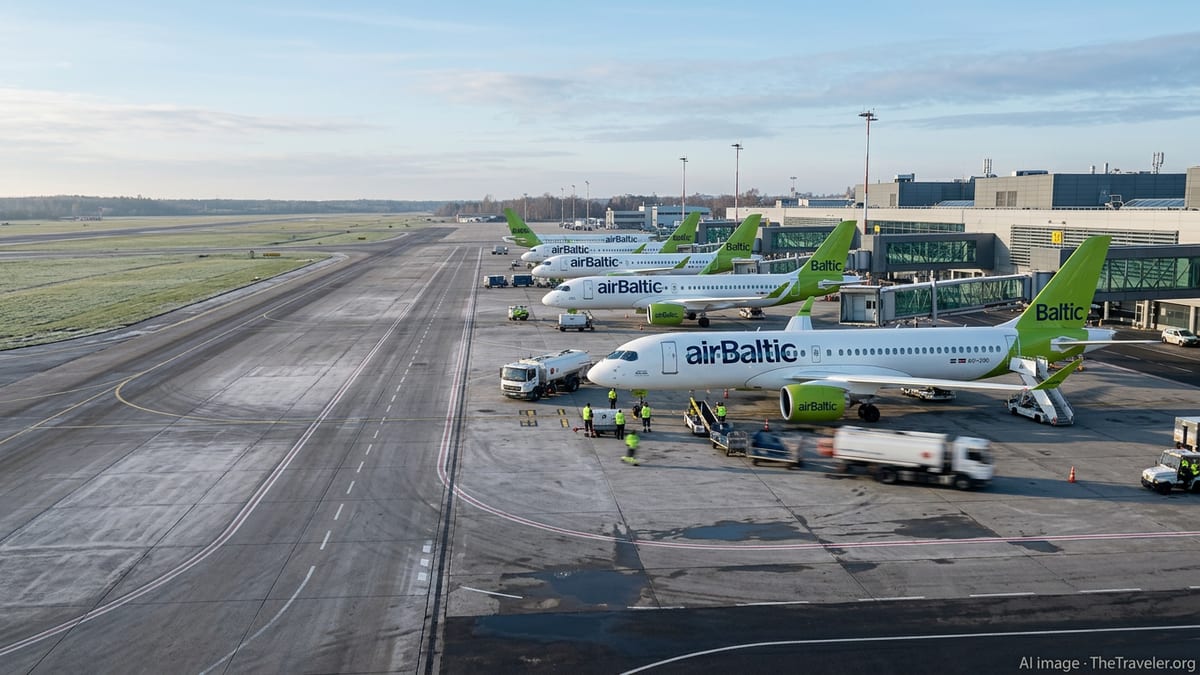
The entire network is operated primarily with a single aircraft type, the Airbus A220-300, which industry analysis continues to highlight for its fuel efficiency and range flexibility. This homogeneous fleet structure allows airBaltic to move capacity between bases and markets with relative ease, supporting its ability to match supply with evolving demand patterns across the Baltics.
Financial Headwinds and Government Support
The strong operational performance in April 2026 coincides with a period of intense financial scrutiny for airBaltic. Local and international media coverage in recent weeks has detailed concerns about the airline’s debt profile, cash burn, and exposure to volatile fuel prices, prompting debates in Latvia about the appropriate level and form of state support.
Reports indicate that the Latvian government has extended short-term financial assistance to airBaltic to stabilize liquidity, framing the intervention as a precautionary measure aimed at safeguarding continuity of services. Public commentary and analysis have emphasized the airline’s importance to the region’s connectivity and tourism industries, arguing that the broader economic impact of a severe disruption would be significant for Latvia and its neighbors.
At the same time, independent commentators have underlined that passenger growth figures such as those reported for April 2026, though encouraging, do not by themselves resolve long-term balance sheet challenges. For airBaltic, the task ahead will likely involve translating solid operational metrics into sustained profitability, managing interest and fuel costs, and navigating bond market sentiment that has been unsettled by recent headlines.
Observers suggest that the government’s approach, combined with ongoing restructuring efforts at the airline, will be closely watched by investors and regulators across Europe. The situation is seen as a test case for how smaller flag carriers in strategically important markets can balance commercial independence with state backing when faced with a confluence of external shocks.
Competitive Landscape in Northern European Skies
AirBaltic’s April surge takes place against a complex competitive backdrop in Northern Europe. Other regional and low-cost carriers have been expanding capacity into the Baltics, targeting both leisure travelers and cost-conscious business passengers. This competition has placed downward pressure on fares in some markets, even as operating costs have risen.
Despite this, the Latvian airline’s focus on a modern narrowbody fleet and an extensive regional network has allowed it to defend key corridors. Travel industry analysis points to airBaltic’s role in providing nonstop links from Baltic capitals to secondary cities in Western Europe that are not always served by larger network carriers, a niche that can generate strong brand loyalty among frequent travelers.
At the same time, the airline continues to cooperate with major alliance members through codeshare and interline arrangements, feeding long-haul traffic via partner hubs. These partnerships broaden the range of destinations accessible from Riga, Tallinn and Vilnius on a single ticket, which can be a differentiating factor for corporate accounts and higher-yield segments.
However, the broader European airline sector remains exposed to macroeconomic uncertainty, shifting demand patterns and regulatory changes. In this context, airBaltic’s ability to sustain growth beyond April 2026 will depend not only on route planning and pricing, but also on continued operational reliability, customer satisfaction and cost control.
Implications for Travelers and the Baltic Region
For travelers, April’s record passenger figure indicates that air connectivity to and from the Baltic states is recovering strongly, with more options for direct and connecting flights than in the immediate post-pandemic years. Tourism boards and local businesses in Latvia, Estonia and Lithuania are likely to view the latest data as a positive signal ahead of the peak summer season.
Higher passenger volumes typically support a wider range of routes, increased flight frequencies and, in some cases, more competitive pricing. Travel media coverage suggests that city-break trips to Riga, Tallinn and Vilnius, as well as beach and cultural holidays reachable via airBaltic’s Southern European network, have been gaining popularity among travelers from Western Europe and beyond.
At the same time, analysts caution that the airline’s financial and strategic situation remains fluid. While the April 2026 traffic results underscore the strength of underlying demand, the coming months will show whether that momentum can help underpin a durable turnaround in the company’s finances. For now, airBaltic’s latest growth milestone highlights both the resilience of travel demand in the Baltic region and the challenges of sustaining that growth in a highly competitive and cost-sensitive industry.