


More news on this day
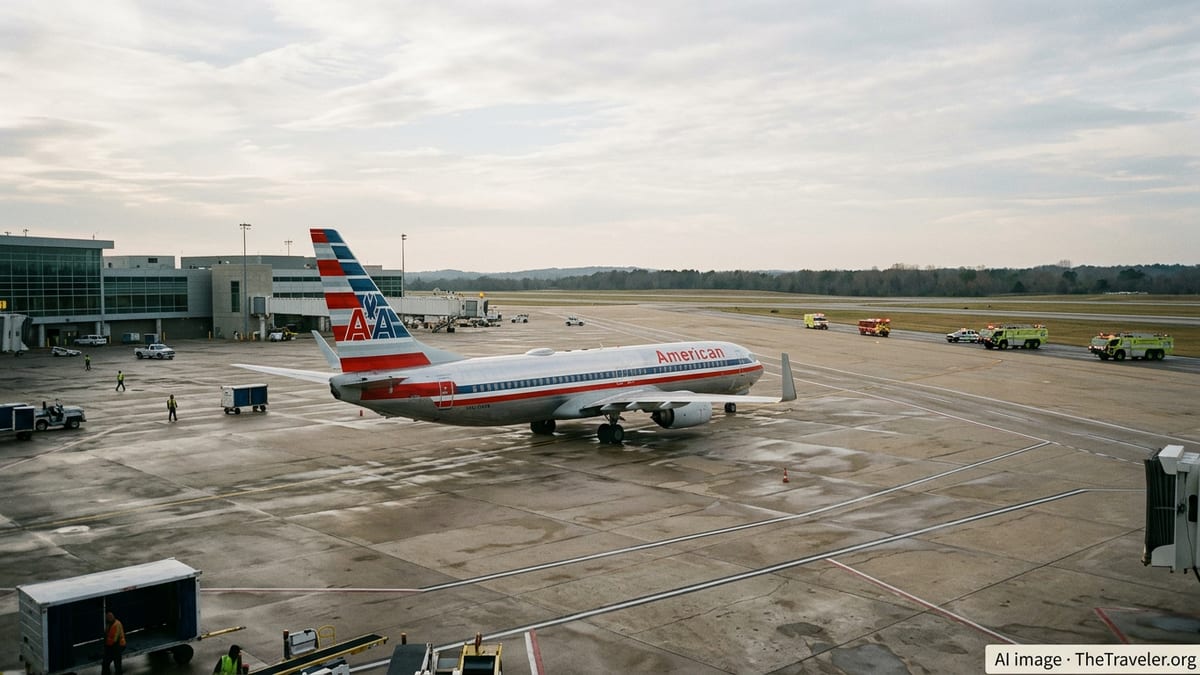
Passengers on American Airlines flight AA2617 from Washington Dulles to Dallas Fort Worth faced unexpected disruption when the Boeing 737-800 diverted to Kansas City, abruptly interrupting a routine early-morning route and adding to a summer of operational strain across major U.S. hubs.
Get the latest news straight to your inbox!
Sudden Midroute Change on a Busy Corridor
Flight AA2617 is a regularly scheduled American Airlines service linking Washington Dulles International Airport with Dallas Fort Worth International Airport, typically operated by a Boeing 737-800 and blocked at around three and a half hours. Publicly available schedule data shows the flight departing around 06:19 from Washington and arriving in Dallas shortly before 09:00 local time on most days.
On the day of the disruption, tracking information indicates the aircraft departed Washington on time on the familiar IAD to DFW routing before deviating from its planned path and diverting to Kansas City. The unscheduled stop placed the aircraft hundreds of miles short of its intended Texas hub, leaving customers facing extended travel times and missed onward connections at one of American’s busiest connecting points.
Initial route data for AA2617 shows the service remains listed as a Boeing 737-800 operation on the Washington to Dallas pairing, underscoring that the diversion appears to be an operational exception on an otherwise stable, high-frequency domestic corridor.
Weather and Operational Pressures in the Midwest
In recent days, the central United States has experienced pockets of unsettled weather, with publicly available forecasts and airline travel waivers referencing thunderstorms and convective activity across parts of the Midwest. When conditions deteriorate along key flight paths, aircraft can be forced to hold, reroute, or divert to alternate airports with more favorable conditions or available capacity.
Kansas City International Airport serves as a strategic diversion point for multiple carriers transiting the central corridor, with scheduled American Airlines service linking the Missouri city to major hubs such as Dallas Fort Worth. That existing infrastructure, including ground handling and customer service staffing, can make Kansas City a practical choice when flights cannot continue safely or efficiently to their original destination.
While specific, detailed reasons for the AA2617 diversion were not immediately published, the broader operational context of summer storms, tight schedules, and heavy hub traffic offers a likely backdrop for the decision to reroute to Kansas City.
Knock-On Effects for Passengers and Connections
The diversion of AA2617 has direct implications for travelers who relied on Dallas Fort Worth as a connecting gateway. Many passengers on early-morning flights into DFW are booked onto midmorning departures to domestic and international destinations, counting on relatively short connection windows to complete their journeys.
When a flight diverts, customers can encounter a cascade of challenges, including missed onward segments, the need for rebooking, and potential overnight stays if alternative flights are full. In peak summer, when load factors on popular routes are high, available seats onto later departures can be limited, stretching travel disruptions well beyond the original delay.
Travel advisories and consumer rights resources generally recommend that passengers impacted by diversions keep boarding passes, booking confirmations, and any written notices from airlines, since documentation can be important when seeking reimbursement of out-of-pocket costs or clarifying eligibility for compensation under applicable regulations.
American Airlines’ Network Strategy and DFW’s Role
Dallas Fort Worth is American Airlines’ largest hub and a central pillar of its domestic and international network. The carrier has recently highlighted significant investment in the airport, including additional gates and upgraded facilities, designed to increase capacity and smooth the flow of connecting passengers through North Texas.
The diversion of a high-demand route such as AA2617 into Kansas City illustrates how even a well-developed hub can feel pressure when irregular operations strike. When weather or air traffic constraints reduce available arrival slots into DFW, dispatchers may opt to divert inbound flights to preserve fuel reserves, maintain safety margins, and wait for an opportunity to continue once conditions stabilize.
Industry data shows that diversions on U.S. domestic routes, while still a small percentage of overall operations, tend to cluster during peak travel months and in regions prone to thunderstorms. As airlines add more flights to meet strong demand, the system can become less forgiving when disruptions occur, with single incidents like the AA2617 diversion reverberating across a network of tightly timed connections.
What Travelers Can Learn From the AA2617 Disruption
Episodes such as the diversion of American Airlines flight AA2617 from Washington to Dallas via Kansas City highlight the importance of preparation when traveling through busy hubs during the summer season. Travel guidance commonly suggests allowing more generous connection times on weather-sensitive routes and monitoring flights in real time through airline apps and independent trackers.
Passengers confronted with an en route diversion are typically advised, once safely on the ground, to check digital tools for updated rebooking information rather than relying solely on airport queues, which can become congested during widespread disruptions. Many carriers enable same-day changes and rebooking options through self-service channels, reducing wait times and helping travelers secure alternative routings more quickly.
Although diversions remain relatively uncommon, the AA2617 incident serves as a reminder that even routine, well-established flights can be affected by a combination of weather and operational factors. For travelers, building flexibility into itineraries, staying informed, and understanding airline policies can help mitigate the impact when journeys do not proceed as planned.