


Vatican City is one of Europe’s most intense travel experiences: part active church complex, part blockbuster museum, part functioning microstate. That mix makes it unforgettable, but it also means visitors routinely get things wrong. From buying the wrong tickets to showing up in shorts, small missteps can turn a long‑awaited Vatican day into a frustrating scramble. Knowing the most common mistakes, and how to avoid them, will help you see the Vatican at its best instead of battling queues and confusion.
Get the latest updates straight to your inbox!
Misunderstanding Tickets, “Skip the Line,” and Sold-Out Dates
One of the biggest surprises for first-time visitors is how complicated Vatican Museums tickets feel. In 2026 the standard adult ticket bought through the official system costs around 25 euros in total, made up of a 20 euro base price plus a 5 euro online booking fee. Many travelers see third-party offers for 60, 80, or even 90 euros per person and assume those are the only way in, especially when dates look sold out. In reality, those expensive options usually bundle the same basic museum ticket with an escort or group entry, not a fundamentally different level of access.
A second, related mistake is misunderstanding what “skip the line” actually means. Pre-booked Vatican Museum tickets and most guided tours let you bypass the long line at the ticket office on Viale Vaticano, which on busy summer mornings can snake along the wall for two hours or more. However, every single visitor still passes through airport-style security. If you arrive at 9:30 a.m. on a July Tuesday, you may still find a sizable queue of people with timed tickets waiting to be screened. Travelers who pay extra expecting to breeze past every line are often disappointed.
Visitors also underestimate how early popular dates sell out on the official Vatican website. During late June and early July, for example, regular admission slots are often fully booked several weeks ahead. Some travelers only discover this a few days before their Rome stay, then feel pressured into booking 80 euro “escorted entry” tickets with minimal added value. A better strategy is to check the official site as soon as you know your travel dates, secure a morning or late-afternoon slot, and treat high-priced third-party offers as a last resort rather than a default.
Finally, some guests show up with discounted student or youth tickets without the required ID, assuming staff will be flexible. The Vatican ticket desk is strict: if you cannot prove your eligibility, you will be sent to buy a new full-price ticket and the discounted one will not be refunded. For a family of four, that can mean paying twice. Always read the conditions when you book, bring the exact documents specified, and if in doubt choose a standard ticket.
Ignoring Dress Code Rules Until It Is Too Late
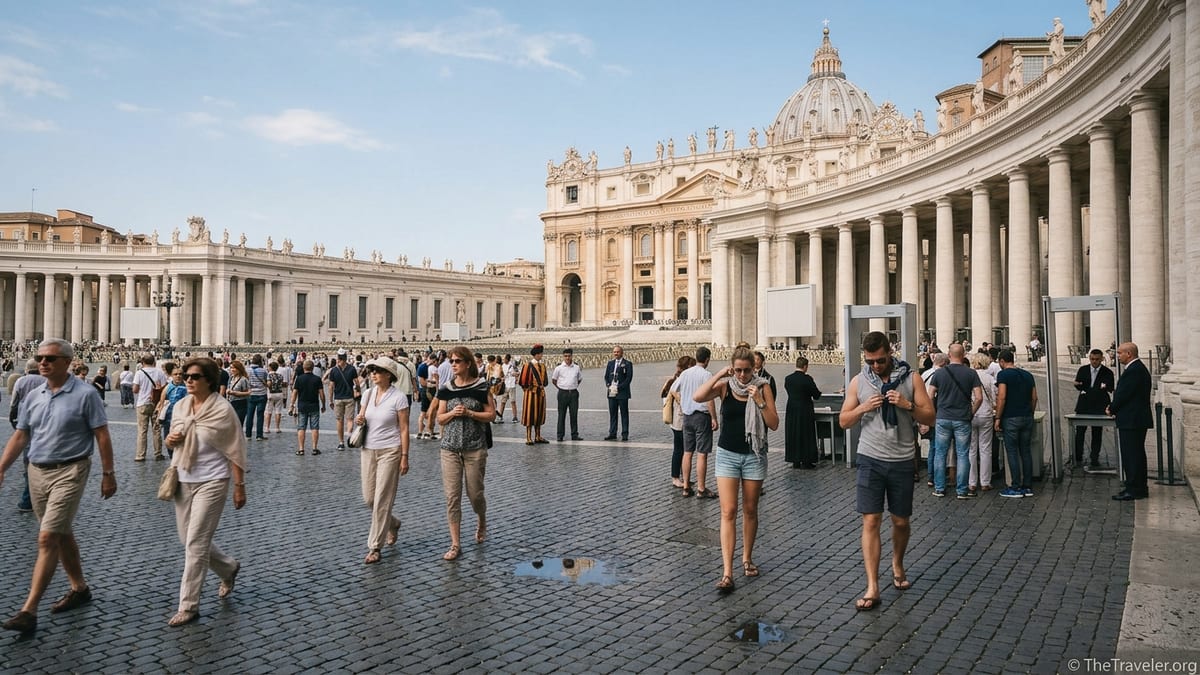
A surprisingly common way to derail a Vatican day is to arrive in clothing that fails the dress code. The Vatican requires all visitors to cover shoulders and knees in St Peter’s Basilica, the Sistine Chapel, and the Vatican Museums. That means no sleeveless tops, strapless dresses, very short skirts, or shorts that ride above the knee. The rule applies equally to men, women, and children, and it is actively enforced by security staff and, at the basilica, by personnel in the square before you ever reach the doors.
Problems usually appear on hot days, when visitors dress for the Roman heat rather than for a religious site. It is common to see people turned away from the basilica security line at 11 a.m., after standing in the sun for 45 minutes, because they are wearing athletic shorts or a crop top. Others are allowed through only after buying an overpriced scarf from hawkers on Piazza San Pietro to wrap around their waist or shoulders. Those scarves or light shawls often cost 10 to 15 euros, far more than a simple pareo or thin cotton shirt bought in advance.
The dress code also catches people out when they try to combine a Vatican visit with other activities. Travelers heading to the Vatican straight from a morning run along the Tiber, still in a singlet and running shorts, will be refused even if they have non-refundable timed museum tickets. Similarly, those planning a chic evening dinner in Trastevere sometimes show up at the museums in sleeveless dresses and sandals, expecting to add a layer later, only to be blocked at the door. Because staffing and enforcement can vary slightly by entrance and day, some visitors misinterpret others’ outfits and assume they will be fine, but relying on exceptions is risky.
The easiest solution is to plan your Vatican day wardrobe the night before. For men, lightweight long trousers or knee-covering shorts and a breathable short-sleeved shirt work well. For women, a midi skirt, loose trousers, or a dress that covers the knees paired with a light cardigan or scarf for shoulders is usually comfortable. Packable cover-ups weigh almost nothing in a day bag and save you scrambling to buy something at the last minute. Remember that indoor areas are heavily air-conditioned in summer, so dressing in thin layers is more practical than wearing the minimum allowed.
Timing Visits Badly and Underestimating Crowds
Another frequent mistake is assuming a Vatican visit can be squeezed into a couple of spare hours between other sights. The Vatican Museums alone stretch more than 7 kilometers of galleries; even a focused visit with a clear plan takes at least three hours from the moment you join the security line. Add time for the Sistine Chapel, the walk toward St Peter’s Basilica, the basilica itself, and possibly a dome climb, and you are realistically looking at half a day, not a quick stop.
Crowd patterns also catch many visitors off guard. In 2024 the Vatican Museums welcomed well over 6 million visitors, and numbers have stayed very high. In practice, that means that on peak days the main corridors can feel packed from mid-morning through the early afternoon. Guests who book 11 a.m. or noon entries often find themselves shuffled along with dense groups, seeing more backs of heads than Raphael frescoes. By contrast, people with 8 a.m. tickets frequently describe the first hour as almost calm, with space to pause in the Gallery of Maps or the Raphael Rooms before the tour groups fully flood in.
St Peter’s Basilica has its own timing quirks. The church is generally open from early morning until early evening, though exact hours shift seasonally and have recently been adjusted again. Crucially, on many Wednesdays the basilica is closed to tourists during the morning because the Papal General Audience takes place in St Peter’s Square. Visitors who arrive at 9 or 10 a.m. on a Wednesday, unaware of this, often discover that access is blocked until early afternoon and that when it reopens the security line stretches halfway across the piazza.
A related error is leaving the dome climb to the end of the day. The dome operates on slightly shorter hours than the basilica, with last entry typically one hour before closing. It takes time to pass security, tour the main nave, then queue for the elevator or stairs up to the cupola. Travelers who wander in at 4:30 p.m. in winter, or close to closing in summer, sometimes reach the ticket desk only to find the dome already shut. If standing on the basilica roof and looking out across Rome is a priority, tackle it soon after you enter, not as an afterthought.
Rushing the Sistine Chapel and Missing Key Rooms
Despite being one of the world’s most famous artworks, the Sistine Chapel is where many visitors make rushed decisions they later regret. A common mistake is to treat it as the sole reason for visiting the Museums, then hurry straight there following crowd flow lines, skipping rooms that would have deepened the experience. When people emerge, they remember feeling jostled and overwhelmed but cannot recall much detail of what they saw.
The standard route through the Museums takes you past major sections like the Pio-Clementino collection of classical sculpture, the Gallery of Maps, and the Raphael Rooms before you reach the Sistine Chapel. Yet travelers with late morning tickets often try to move quickly in the hope of seeing the ceiling before the room “gets crowded,” not realizing that from about 9:30 a.m. onward it is busy almost continuously. They end up rushing past masterpieces like Raphael’s School of Athens or the Laocoön Group that would have been highlights in any other museum day.
Once inside the Sistine Chapel, other mistakes begin. Photography is forbidden, as are loud conversations and exposed shoulders. The room is monitored constantly and staff regularly call for silence. Visitors who ignore these rules risk being reprimanded or asked to stop taking pictures. It is also easy to focus so much on trying to discreetly capture a photo that you forget to simply look up and absorb the details of Michelangelo’s work, from the Creation of Adam panel to the Last Judgment behind the altar.
A better approach is to accept that the chapel will be busy but to control what you can. Study a simple plan of the Museums beforehand and decide which sections matter most to you, whether that is Etruscan artifacts, the modern religious art collection, or the Raphael Rooms. Give yourself permission to skip some secondary areas so you can slow down when it counts. Once you are in the Sistine Chapel, put your phone away entirely. Stand or sit along the side benches if a space opens up, take a few deep breaths, and spend ten or fifteen uninterrupted minutes tracing scenes from the entrance wall toward the altar. Many visitors say that choosing to be fully present in that short window becomes the moment they remember most.
Starting at the Wrong Place and Misjudging Logistics
It is easy to think of the Vatican as one compact complex with a single front door, but in practical terms St Peter’s Basilica and the Vatican Museums function as two separate entries on opposite sides of Vatican City. First-timers often learn this the hard way. They step off the metro at Ottaviano station, follow signs to St Peter’s Square, and confidently join the massive security line in front of the basilica, assuming it leads to the Museums. Only after forty minutes shuffling forward do they discover they are in the wrong place entirely.
In reality, the main entrance to the Vatican Museums lies along Viale Vaticano on the northern side of the city-state, roughly a fifteen-minute walk from St Peter’s Square if you follow the Vatican wall. If your timed ticket is for 8:30 a.m., you should head directly there rather than detouring via the basilica. Conversely, ticket holders who emerge from the Museums hoping to “pop into the basilica” through an internal shortcut sometimes find that the route is temporarily restricted and that they have to exit, walk around the walls, and join the same exterior security queue as everyone else.
Transport choices can also create unnecessary stress. The Ottaviano and Cipro metro stops on Line A both work for the Museums, with Cipro slightly closer to the entrance on Viale Vaticano. Visitors who book early slots often underestimate rush-hour crowding on the metro and arrive flustered or late; remember that timed tickets are for specific entry windows, and latecomers may not be admitted. Allow buffer time for delays, especially if you are navigating Rome’s public transport with children or older relatives.
Inside the Museums, logistics continue with cloakroom rules that some travelers ignore. Large backpacks, tripods, and bulky umbrellas must be checked, and collecting them at closing time can be slow. If you plan to head straight to St Peter’s afterward, packing light in a small daypack can save you a time-consuming detour back to the cloakroom. Similarly, wearing very flat shoes on the long marble corridors may sound wise, but after several hours your feet will thank you for something with cushioning. Underestimating the physical effort of a Vatican day is a mistake you only make once.
Overplanning, Underplanning, and Choosing the Wrong Type of Visit
Travelers tend to fall into two opposite traps when organizing their Vatican visit. Some overplan every minute, cramming in an early museum entry, a guided tour, a dome climb, a climb into the Vatican Grottoes, and an afternoon in the Vatican Gardens all in one day. Others underplan entirely, assuming they can decide everything on the spot. Both approaches increase stress and the likelihood of disappointment.
Overplanners often stack timed experiences back to back with no margin. For instance, a couple might book an 8:30 a.m. Vatican Museums ticket, a 12:00 p.m. rooftop lunch elsewhere in Rome, and a 2:00 p.m. Colosseum entry the same day. When security takes longer than expected or they linger in the Sistine Chapel, they end up rushing the basilica or skipping the dome entirely. By the time they reach the Colosseum, they are exhausted and barely enjoy it. A more realistic plan is to dedicate most of a day to the Vatican and keep other commitments light.
Underplanners do the opposite: they show up without tickets in peak season, accept the first tour hawker who approaches them on the street, and pay far over the odds for a mediocre experience. Or they arrive at 1 p.m. in August, unaware that the Museums stop admitting new visitors several hours before closing, and are surprised when they cannot get in. Another frequent issue is choosing a guided tour that is not well suited to your group. A three-hour art-history-heavy tour may be fascinating for adults but punishing for small children; conversely, a very short “express” tour may leave keen art lovers frustrated.
A more balanced strategy begins with deciding what matters most: Is your priority the Sistine Chapel? St Peter’s dome? Time in the basilica for quiet reflection? Once you know that, choose the ticket type that fits. Independent travelers comfortable with self-guiding can do very well with standard timed-entry tickets and a good audio guide. First-time visitors who feel overwhelmed by the Museums’ scale often benefit from a small-group tour that moves at a measured pace and ends either in or near the basilica. Leaving the evening free after a morning Vatican visit, or planning only a gentle stroll along the Tiber, will make the whole day feel less pressured.
The Takeaway
Almost every “Vatican disaster story” you hear in hotel lobbies and on the plane home stems from a handful of repeatable mistakes: misunderstanding ticket types, ignoring the dress code, underestimating how long a full visit takes, or assuming that everything will work itself out on the day. Fortunately, the solutions are straightforward. Buy official timed tickets early where possible, dress with the basilica and Sistine Chapel in mind, give the Vatican a generous block of time, and choose the entry point and visit style that align with your energy and interests.
When you do, the chaos recedes and the experience changes character. The same crowded museums become a coherent journey from ancient sculpture to Renaissance genius, the basilica transforms from a photo stop into a place of awe, and the view from the dome feels like a well-earned reward instead of a rushed extra. Vatican City will probably still surprise you, but with a little forethought, it is far more likely to do so for the right reasons.
FAQ
Q1. Do I really need to book Vatican Museums tickets in advance?
Yes, for most of the year advance booking is strongly recommended. Same-day tickets are often unavailable in peak months like May, June, and September, and lines for on-the-spot purchases can stretch for hours. Booking a timed entry on the official system secures your slot and lets you go directly to security at your chosen time.
Q2. What happens if I arrive late for my timed Vatican Museums ticket?
Your ticket is tied to a specific entry window, and staff are not obliged to admit latecomers. In practice, a short delay of a few minutes may be tolerated when crowds allow, but arriving significantly late can mean losing your slot entirely and needing to buy a new ticket if space remains. Build in extra travel time so metro delays or a wrong turn do not jeopardize your visit.
Q3. Is the dress code the same for the Vatican Museums, Sistine Chapel, and St Peter’s Basilica?
The practical rules are very similar: shoulders and knees must be covered in all three, and clothing should be respectful. Sleeveless tops, very short shorts, and see-through garments can lead to you being turned away, even if you have pre-booked tickets. Light layers that you can add before entering religious areas are the easiest way to comply.
Q4. Can I visit St Peter’s Basilica without a ticket?
Yes. Entry to St Peter’s Basilica itself is free, and you do not need to book a ticket to walk into the church. You do, however, have to pass through airport-style security, and queues can exceed an hour at busy times. Separate tickets are required if you want to climb the dome or join certain guided tours or special areas.
Q5. How much time should I plan for a full Vatican visit?
For the Vatican Museums, Sistine Chapel, and St Peter’s Basilica together, most visitors should allow at least five to six hours, not counting lunch or a long break. That includes security checks, walking between sites, and a reasonable pace in the main galleries. Trying to compress everything into two or three hours almost always results in stress and missed highlights.
Q6. Are “skip the line” tickets worth paying extra for?
Standard timed tickets bought through the official Vatican system already let you bypass the long ticket-purchase line. Paying much more for “skip the line” through third parties may add little beyond an escort to the entrance. Guided tours can be worthwhile for context and navigation, but it is important to understand that no ticket lets you bypass security or guarantees an empty museum during busy periods.
Q7. Can I go straight from the Vatican Museums into St Peter’s Basilica?
Often, but not always. For many visitors the route from the Sistine Chapel into the basilica is open, allowing them to move directly inside without exiting onto the street. At other times, particularly during special liturgical events or crowd-control operations, that internal access can be restricted. In that case you will need to leave the Museums, walk around the Vatican walls, and join the basilica security line in St Peter’s Square.
Q8. Which day of the week is best for avoiding crowds at the Vatican?
No day is truly quiet, but early weekdays outside of major holidays are usually slightly less intense. Mondays can feel busy because many other Roman museums are closed on Sunday and some visitors shift their plans. Wednesdays are complicated by the Papal General Audience, which draws large crowds to St Peter’s Square and can limit morning access to the basilica. Checking for major Catholic feast days before you book is wise.
Q9. Is a guided tour necessary for the Vatican Museums?
Not strictly, but many travelers find a well-run small-group or private tour helpful. The Museums are vast, and a guide can focus your time on key works and explain their significance, which is especially valuable for first-time visitors. Independent travelers comfortable with research and audio guides can have an excellent experience on their own, but those who feel easily overwhelmed by large museums often benefit from structure.
Q10. What should I bring with me for a comfortable Vatican visit?
Comfortable, modest clothing; supportive walking shoes; a small daypack; a refillable water bottle; and a light layer or scarf for the dress code are basics. In warm months, sunscreen and a hat are important while waiting outdoors, especially in St Peter’s Square. Avoid large bags, tripods, or bulky umbrellas that will need to be checked into the cloakroom, as retrieving them later can add time at the end of your visit.