


More news on this day
One person has died and dozens more have been injured after two passenger trains collided near Bedford on Friday, triggering a large emergency response and severe disruption on one of Britain’s busiest north–south rail corridors.
Get the latest news straight to your inbox!
Evening collision on key London corridor
Publicly available information indicates that the crash occurred shortly after 5:15 p.m. local time on Friday 19 June, on the main line that links the English Midlands with London St Pancras station. Early reports suggest that both trains were traveling south toward the capital when they collided just outside the town of Bedford, around 50 miles north of central London.
Live rail-tracking data cited in media coverage points to services on the London to Corby and London to Nottingham routes being involved, routes that carry large numbers of commuters and long-distance passengers during the evening peak. Witness accounts reported by national outlets describe a sudden, violent impact that threw passengers from their seats and sent luggage crashing through carriages.
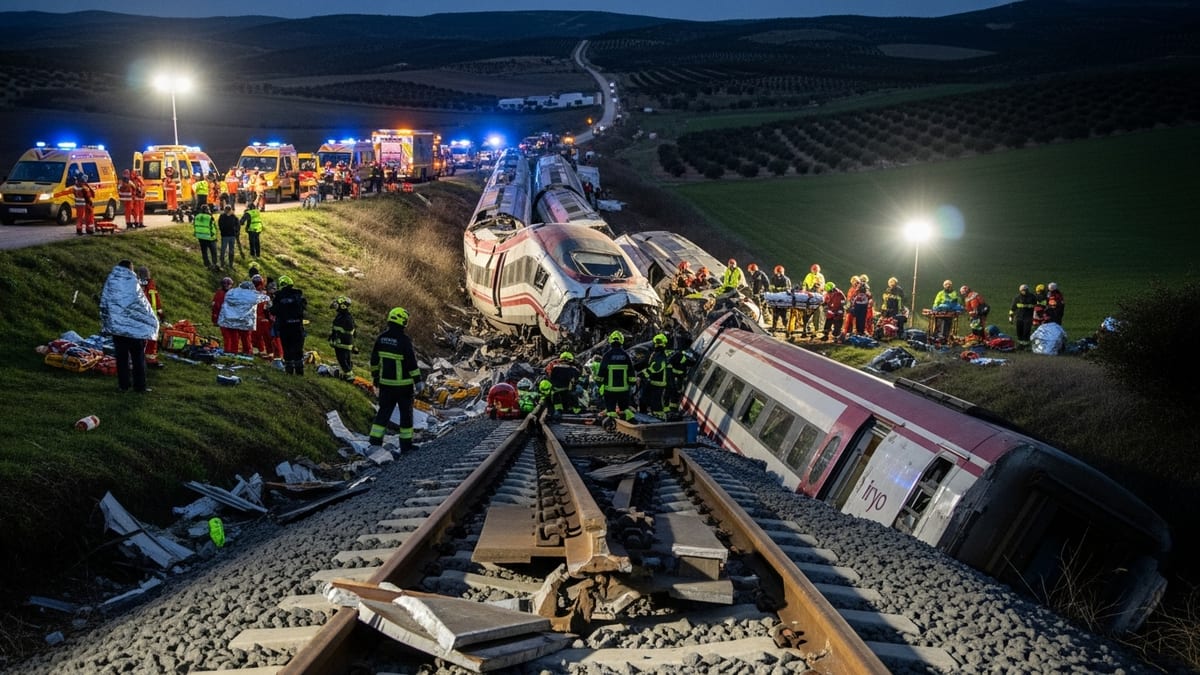
Images and descriptions from the scene shared in news coverage and on social media show at least one train partially derailed and multiple carriages visibly damaged. Emergency lights illuminated the tracks into the evening as responders worked in and around the stricken trains to reach the injured.
Casualties and major incident response
According to published coverage, one person was confirmed dead at the scene, while a significant number of others suffered serious or potentially life-changing injuries. Figures reported on Friday evening pointed to more than ten people in a critical condition, several dozen with serious injuries and many more treated for minor wounds such as cuts, bruises and suspected fractures.
Ambulance services from across the region deployed a large-scale response, including an air ambulance and specialist hazardous area teams. Nearby hospitals in Bedfordshire and surrounding counties were placed on alert to receive multiple casualties, with trauma units activated to handle the most seriously injured.
Fire and rescue crews were photographed using ladders and cutting equipment to gain access to damaged carriages, while police established wide cordons around the crash site. Reports indicate that some passengers were able to walk from the trains along the tracks, while others had to be carried out on stretchers before being transferred to waiting ambulances and medical tents set up trackside.
Severe disruption for rail passengers
The collision brought services on the Midland Main Line to an abrupt halt on Friday evening, stranding passengers on trains along the route and at stations from London to the East Midlands and South Yorkshire. According to rail operator statements and journey planners, all lines through the Bedford area were initially blocked as emergency teams worked at the scene.
Published travel updates advised passengers not to attempt to travel between London St Pancras and destinations including Leicester, Nottingham, Sheffield and Corby, with tickets accepted on alternative routes via other main lines where capacity allowed. Replacement buses were ordered but were expected to be limited given the time of day and the scale of the closure.
As darkness fell, rail industry sources quoted in news reports warned that disruption was likely to continue into the weekend while investigators examined the crash site and engineers assessed damage to tracks, signalling equipment and overhead power lines. Passengers planning trips on Saturday were urged to check for updated information before setting out.
Early focus on cause and safety systems
Formal investigations have begun into how two modern passenger trains came to collide on a heavily signalled and monitored section of track. Rail accident specialists are expected to examine data recorders from both trains, signalling logs, track conditions and speed information, as well as interview staff and passengers.
Initial commentary in transport coverage has focused on the performance of onboard safety systems and modern train design, with some analysts suggesting that reinforced carriages and automatic protection measures may have prevented a significantly higher death toll. Photographs from the scene appeared to show the leading vehicles bearing the brunt of the impact, with substantial deformation but much of the rest of the trainsets remaining upright.
While it is too early for conclusions, experts quoted in early coverage note that investigations into previous high-profile rail crashes in the United Kingdom have typically taken months, often leading to detailed safety recommendations, infrastructure changes and, in some cases, alterations to operating procedures or driver training.
Shock for local communities and regular commuters
The crash has sent shockwaves through Bedford and neighbouring communities, where the railway is a daily part of local life and a major employer. The line carries commuters to London, students to colleges and universities, and families and visitors traveling between the Midlands and the capital.
Many regular travelers shared accounts of narrowly missing the incident because of minor changes to their daily routines, while others described anxious waits for news of friends and relatives who were known to be on trains in the area at the time. Local roads around the crash site remained busy into the night as relatives traveled to rendezvous points and as rail replacement coaches tried to bypass closed sections of line.
Nationally, the collision has revived memories of earlier rail disasters that reshaped public perceptions of train travel safety. While the United Kingdom’s rail network is widely regarded as one of the safer systems in Europe, Friday’s events near Bedford are likely to prompt renewed scrutiny of how growing passenger numbers, aging infrastructure in some areas and increasingly complex timetables intersect on key intercity corridors.