


More news on this day
A routine American Airlines itinerary turned into an ordeal for dozens of travelers this week when a chain of weather delays, crew misplacements and confusing rebookings left them stranded overnight in the wrong city, underscoring how quickly small disruptions can snowball across an already-stressed U.S. aviation network.
Get the latest news straight to your inbox!
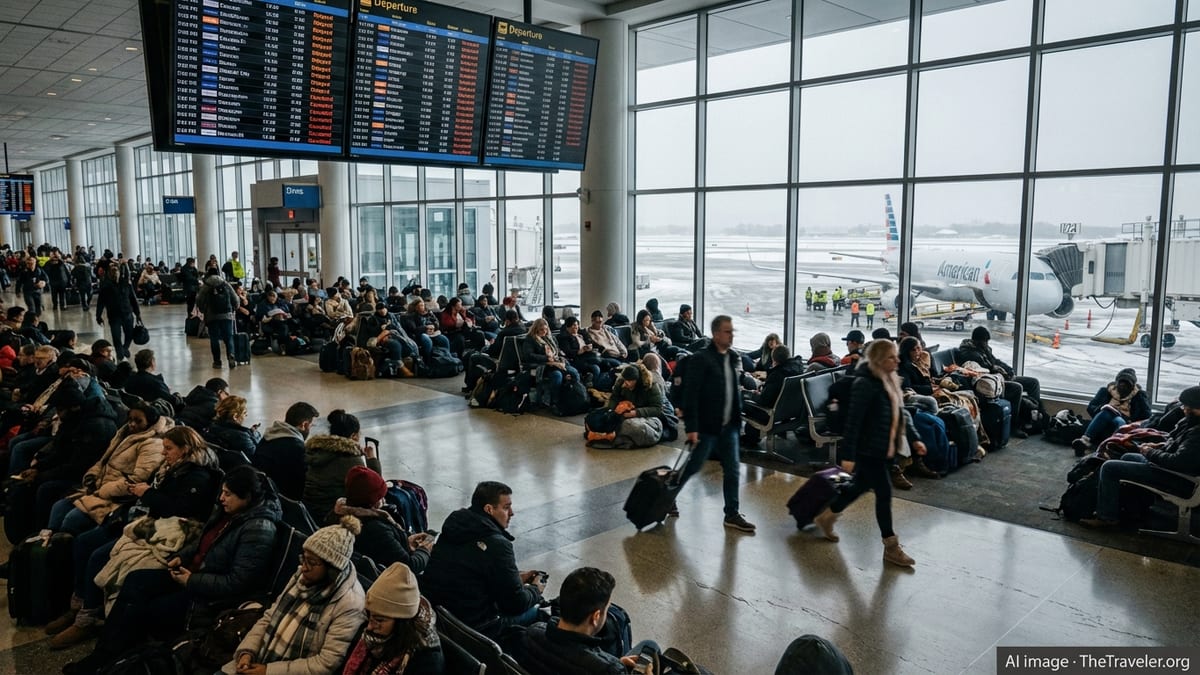
Storms, System Strain and a Misrouted Finish
According to publicly available flight-tracking data and recent coverage of widespread U.S. disruptions, thunderstorms over key hubs and tight aircraft rotations have repeatedly triggered schedule instability at American Airlines in recent weeks. Severe weather near Dallas Fort Worth and other major airports has led to hundreds of delays and cancellations on peak travel days, rippling across domestic and international routes as aircraft and crews fell out of position.
In the case of the latest incident, passengers booked on a multi-leg American itinerary found their original connection repeatedly pushed back as storms, air traffic restrictions and crew-hour limits converged. Updates initially framed the delay as temporary, with rolling estimates that suggested the flight would still depart later in the evening, a pattern now familiar to many frequent flyers watching departure boards shift in real time.
As the delay windows lengthened, automated rebooking tools began shifting passengers onto alternative routings. For some travelers, these changes resulted in new itineraries that delivered them not to their ticketed destination, but to a nearby city where hotel capacity and ground transportation could be arranged more easily at short notice.
By the time operations stabilized, a portion of the group had been transported to a different city than the one they had originally booked, with onward travel deferred to the following day. The combination of weather-related constraints, stretched staffing and real-time schedule reshuffles created what aviation observers describe as a “perfect storm” in which the fastest operational solution did not align with passengers’ planned end point.
How a Wrong-City Overnight Happens
Industry guidance and airline documentation show that when severe weather or airspace congestion triggers large numbers of delays, carriers prioritize safety and network recovery before individual convenience. Aircraft may be rerouted or terminated early, and crews can time out under federal duty rules, leaving planes without legally available pilots or flight attendants, even if they are parked just a short distance from stranded passengers.
When those factors collide late in the day, automated systems will often search the broader network for any remaining seats that can move travelers closer to their destination region. In hub-and-spoke systems, that can mean rerouting a passenger from a smaller city to a larger alternative nearby, with the expectation that ground transport or a next-day connection will complete the journey.
Travel analysis notes that this type of misdirection is not typically the result of a single error but of overlapping constraints: storms limiting takeoffs, maintenance checks keeping particular aircraft out of service, and crews stuck in earlier cities after earlier flights were delayed or diverted. In some cases, the fastest way to clear aircraft from congested hubs is to dispatch them to airports with more flexible runway capacity or gate availability, even if that means passengers disembark far from their intended destination.
For those impacted this week, the end result was an unplanned overnight stay in a city they had not chosen, along with the logistical challenges of securing accommodation, food and updated arrangements for work or family commitments at home.
Communication Gaps Frustrate Travelers
Recent traveler accounts shared publicly, including on consumer forums and social platforms, point to communication gaps as a key source of frustration when cascading delays occur. Passengers often report receiving different explanations from mobile apps, gate screens and call centers, or learning of schedule changes only minutes before boarding is expected to begin.
In this American Airlines case, passengers described hours of uncertainty as departure times shifted by increments and gate announcements remained limited. Notifications about rebooked flights and altered destinations in some situations arrived after travelers had settled at the gate of their original departure, adding confusion about where they were actually supposed to board.
Consumer advocates note that this pattern is increasingly common when airlines are operating close to capacity. With spare aircraft and reserve crews limited, any disruption requires complex manual and automated decision-making. While airlines emphasize that safety and regulatory compliance take precedence, passengers often see only the end result: long waits, abrupt reroutes and limited on-the-ground support during irregular operations.
Publicly available guidance from travel-rights organizations also underscores that while weather-related disruptions often fall outside mandatory compensation rules, carriers are still expected to provide clear, timely information about evolving situations. When travelers end up overnighted in the wrong city, expectations around meal vouchers, hotel rooms and rebooking options become central to their perception of whether the airline handled the disruption responsibly.
Systemic Pressures Behind One Bad Trip
Aviation analysts have repeatedly highlighted how the U.S. airline system’s efficiency in normal times can become a liability in periods of stress. Tight schedules, high aircraft utilization and lean staffing models leave little margin when storms, technical issues or air traffic control restrictions arise. Once a major hub experiences a day of heavy disruption, the effects often carry over for 24 to 48 hours as aircraft and crews work their way back into the correct positions.
Recent reporting on American Airlines operations has pointed to this dynamic, with storms and isolated technical problems triggering days of rolling delays that affect even routes in clear weather. When crews and aircraft are scattered across multiple cities, dispatchers must weigh whether to preserve long-haul flights, protect early-morning departures for business travelers, or focus on clearing backlogs at particularly congested airports.
For passengers, this means that a single missed connection can quickly become an overnight diversion or an unexpected arrival in a neighboring city, as happened in this latest episode. Industry observers say that until airlines build more slack into their schedules or expand the pool of reserve crews, these kinds of complex, multi-factor disruptions are likely to recur during peak travel seasons.
Travel experts recommend that passengers build additional time buffers into tight itineraries, particularly when connecting through weather-prone hubs or traveling during the busiest summer and holiday periods. While doing so cannot prevent misdirection or overnight delays, it can reduce the risk that a single missed flight cascades into a multi-day disruption.
What Stranded Travelers Can Do Next Time
Publicly available consumer guidance suggests several steps travelers can take when faced with similar situations. Monitoring both the airline’s app and independent flight-tracking services can provide early hints of brewing problems, such as an inbound aircraft that has not yet left its previous city or a crew that has just reached its scheduled duty limit.
Experts also advise that passengers act quickly when delays start to accumulate, seeking alternative routings before remaining seats disappear. In some cases, asking to be rerouted through a different hub can avoid being sent to a neighboring city, even if it means a longer connection. Keeping receipts for meals, transportation and lodging is important if travelers later seek goodwill compensation or reimbursement where policies allow.
Travel rights organizations further recommend that passengers familiarize themselves with airline contracts of carriage and government guidance on consumer protections. These documents outline when carriers typically provide hotel rooms or meal vouchers and clarify the differences between disruptions caused by weather and those stemming from controllable factors such as crew scheduling or maintenance planning.
For the American Airlines customers who found themselves asleep in the wrong city this week, the experience will likely become another cautionary tale shared online as summer travel peaks. For the broader flying public, it serves as a reminder that in today’s tightly wound aviation system, even a routine trip can be knocked far off course when a perfect storm of delays and misdirection strikes.