


More news on this day
American Airlines is charting a major shift in its onboard strategy, outlining a multi‑year plan to add significantly more premium seating and reintroduce seatback entertainment screens on large portions of its refreshed and incoming fleet.
Get the latest news straight to your inbox!
Strategic pivot toward premium cabins
Publicly available investor materials and company statements indicate that American Airlines is moving decisively toward a more premium-heavy fleet over the next several years. The carrier has signaled plans to grow its total number of lie-flat business class and premium economy seats by roughly half by the end of the decade, positioning high-yield travelers at the center of its network and cabin decisions.
The strategy touches nearly every corner of the mainline operation. Widebody jets used on long-haul international routes are being refitted with larger business cabins and redesigned premium economy sections, while narrowbody workhorses on domestic and short-haul international routes are slated to see additional first class seating and refreshed interiors. The shift marks a notable evolution for an airline that previously emphasized high-density layouts and personal-device entertainment.
Analysts note that American’s pivot places it more directly in line with rivals that have already made significant investments in premium cabins. At the same time, the airline is attempting to balance higher-revenue seating with overall capacity and operational efficiency, using a combination of new aircraft deliveries and cabin retrofits to reshape its product without sharply reducing total seat counts.
More business, premium economy and first class seats
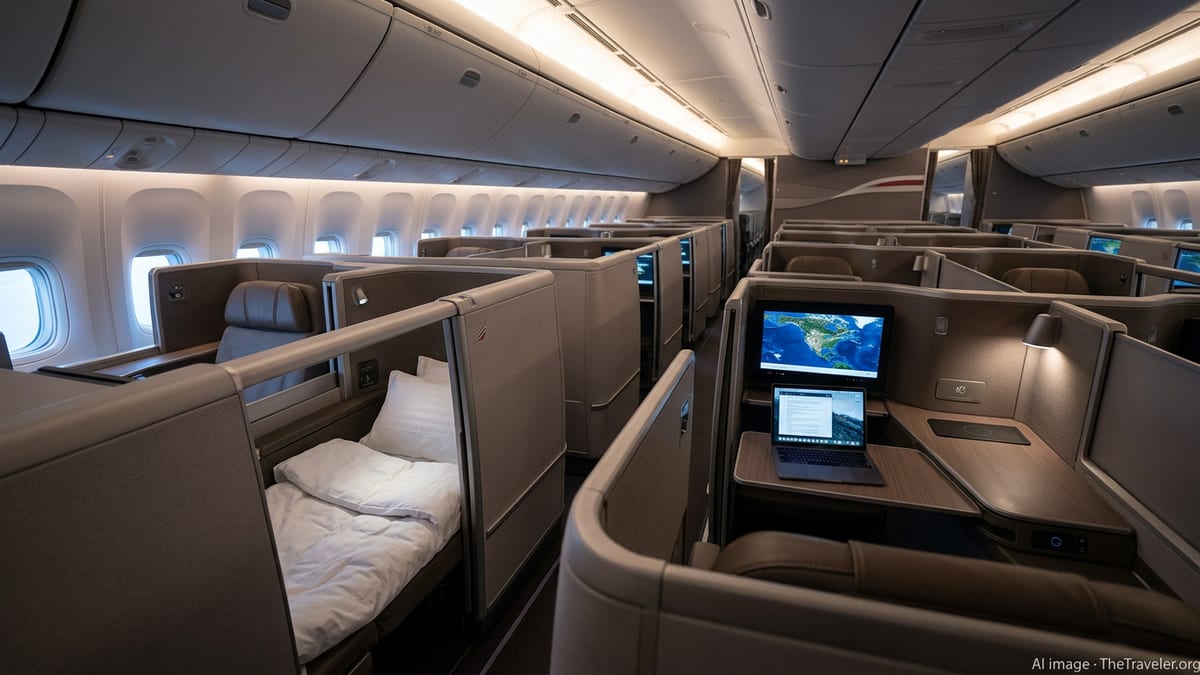
On widebody aircraft, American is rolling out its Flagship Suite concept, a new long-haul business class seat with privacy doors and expanded personal space. This product is debuting on newly delivered Boeing 787-9 aircraft and is also planned for future Airbus A321XLR narrowbodies on select long-haul missions. Company briefings describe a sizeable increase in premium seating density on these aircraft compared with the cabins they replace.
Refits are also underway or planned for Boeing 777-200 and 777-300ER jets, which form the backbone of American’s long-haul fleet. The airline is increasing the number of business class seats on these aircraft, while updating premium economy and main cabin seating and introducing new soft-product elements such as upgraded bedding and amenity kits. The reconfigured cabins are aimed at attracting higher-spend corporate and leisure travelers on transatlantic and transpacific routes.
On the narrowbody side, documents filed with regulators and fleet disclosures show that American intends to add more domestic first class seats to large portions of its Airbus A319 and A320 fleets beginning in the middle of the decade. These aircraft are being refitted with new seats, in-seat power at every position and larger overhead bins, while gaining at least one additional row of first class. Select Boeing 737 MAX and A321neo aircraft are also expected to feature expanded forward cabins, reflecting airlines’ broader push to capture strong demand for extra space at the front of the plane.
Seatback screens return to the spotlight
Perhaps the most visible aspect of the revamp for many travelers is American’s renewed embrace of seatback entertainment. After years of favoring streaming to passengers’ personal devices and gradually removing embedded screens from much of its domestic fleet, the airline is now preparing to bring modern seatback systems back to narrowbody cabins in a substantial way.
According to recently circulated internal materials and industry reporting, new Airbus and Boeing single-aisle deliveries later this decade are planned to arrive with 4K-capable seatback displays at every seat, paired with Bluetooth audio connectivity and both AC and USB power. Retrofit programs on selected existing aircraft are expected to install similar hardware, creating a more consistent experience on longer domestic and short-haul international flights.
The reversal aligns American more closely with competitors that have touted large-format screens as a differentiator, particularly on transcontinental and key hub-to-hub routes. For American, the move also represents an acknowledgement of customer feedback favoring built-in entertainment, particularly as aircraft utilization patterns put more narrowbodies on flights lasting four hours or longer.
Regional fleet and cabin harmonization
American’s premium push is not limited to its mainline jets. The airline has outlined plans to refresh the interiors of its dual-class regional aircraft, which operate under the American Eagle banner, to bring them closer in feel to mainline cabins. Recent announcements describe new seat coverings, in-seat power, upgraded Wi-Fi and a standardized two-cabin configuration on larger regional jets such as the Embraer 175.
Fleet orders and retirement plans indicate that single-class, smaller regional aircraft will progressively give way to dual-class jets with dedicated first class cabins and more spacious seating. The carrier has committed to dozens of additional E175s, which feature a mix of first class and main cabin seats, effectively expanding the share of premium seating available to travelers headed to small and medium-size markets.
Industry observers suggest that harmonizing the experience between regional and mainline flights is becoming a competitive necessity, particularly for frequent flyers who connect through hubs on multi-leg journeys. By ensuring that first class seating, power outlets and reliable high-speed connectivity are available throughout the network, American is attempting to reduce the perception gap between large and small aircraft.
Competitive context and timeline
The fleet transformation unfolds against a backdrop of intense competition among large U.S. carriers, all of which are investing in upgraded cabins, finer-grained seating products and enhanced in-flight entertainment. American’s renewed commitment to seatback screens and premium density follows similar moves by rivals that have pointed to customer satisfaction scores and corporate travel demand as justification for multi-billion-dollar cabin investments.
Most of American’s widebody refits and long-haul product introductions are scheduled to ramp up through the middle of the decade, with significant progress expected by the late 2020s. Narrowbody retrofits and new deliveries with updated interiors are planned to enter service on a rolling basis, creating a period in which multiple cabin configurations will coexist on the same routes.
For travelers, the changes may be most noticeable in the growing availability of lie-flat and premium economy seats on international routes, larger domestic first class cabins and the gradual reappearance of modern seatback screens on mainline flights. As the program advances, American’s fleet is set to become more premium focused, aligning the onboard experience more closely with the revenue contributions of its highest-yield customers.