


More news on this day
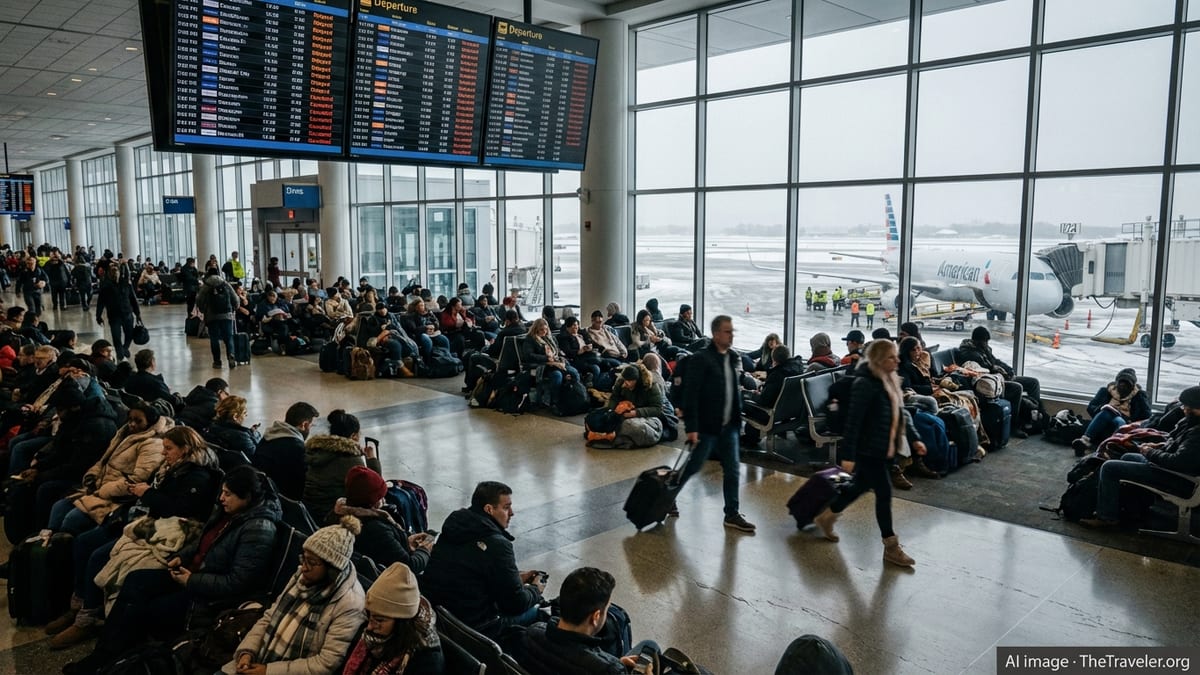
A cascade of weather disruptions, rolling delays and last minute rebookings on American Airlines has left a group of passengers unexpectedly stranded overnight in the wrong city, underscoring how quickly routine schedule changes can spiral into full scale travel breakdowns during the height of the U.S. summer peak.
Get the latest news straight to your inbox!
Storms Trigger Rolling Disruptions Across American’s Network
According to publicly available flight tracking data and airline operations summaries for early July, scattered thunderstorms across several major hubs combined with congestion in already crowded airspace to create extensive knock on delays across American Airlines’ network. Reports indicate that traffic management programs were implemented at key airports, including Dallas Fort Worth and Chicago O’Hare, forcing aircraft to wait for departure slots and stretching crew duty windows close to their regulatory limits.
Industry coverage shows that when storms slow departures at a large hub, flights often depart out of sequence, leaving arriving aircraft and crews out of position for later legs. That appears to have been the backdrop for the disrupted journey at the center of this incident, as an initially modest delay on the first leg eventually erased the scheduled connection time for dozens of travelers heading to their final destination.
Operational analyses of recent American Airlines disruptions note that the carrier, like many large U.S. airlines, is running tight summer schedules with limited slack in both aircraft and crew availability. In this environment, a storm related ground stop that might once have been absorbed within the timetable can instead ripple outward for hours, affecting flights that never flew through the worst of the weather.
Consumer advocates point out that such “perfect storms” are becoming more visible to travelers as social media posts, crowd sourced delay trackers and airline apps provide real time views of cascading schedule changes that previously unfolded mostly behind the scenes.
From Missed Connection to Misdirection
Passengers on the disrupted itinerary report that their original flight departed late from its origin after inbound aircraft and crew were delayed elsewhere in the system. By the time the plane landed at the scheduled connecting hub, the onward flight to their intended destination had already boarded and closed its doors, leaving the group and other connecting travelers at the gate.
Rebooking options were limited because later nonstop services were already heavily booked at the start of a busy holiday travel period. Publicly available information about American’s handling policies in similar situations shows that the airline typically attempts to protect passengers on the next available flight within its own network, even if that means routing them through a different hub or adding an extra stop.
In this case, that process appears to have produced a confusing series of alternative routings. Some travelers were reportedly reassigned to a flight that terminated at a secondary city with the understanding that they would then continue onward, while others say they received boarding passes for an indirect itinerary that required a tight ground connection late at night. When additional delays hit the replacement flights, the revised plans broke down.
Accounts shared on public forums describing the incident suggest that a combination of changing gate information, short connection windows and conflicting instructions created uncertainty over which aircraft would actually carry passengers to their final destination. Several travelers ultimately boarded a flight believing it would connect through to their original endpoint, only to learn after arrival that no onward service was available until the following day.
Unexpected Overnight in the Wrong City
The result was a sizable group of passengers disembarking late at night in a city that was neither their planned hub nor their ticketed destination. With the last departures of the day already gone and limited hotel availability near the airport during a busy travel week, many found themselves facing an unplanned overnight stay with few clear options.
Public guidance from frequent flyer organizations and travel rights groups notes that in the United States, passenger entitlements in these circumstances depend heavily on whether an airline categorizes the disruption as within its control or as the result of weather or air traffic constraints. Weather related disruptions are often treated as outside the carrier’s responsibility, which can limit the availability of hotel and meal vouchers even when travelers are stranded far from home.
In online posts about this episode, some travelers state that they were directed to contact customer service channels to request accommodations or explore rebookings for the next morning, while others describe staying overnight in terminals or arranging their own lodging in the unplanned city. Several passengers indicated that their checked baggage did not follow them to the unexpected stop, compounding the frustration of being stranded without access to clothing or medication.
The situation highlights how quickly a missed connection can evolve into a complete itinerary breakdown once the final wave of nightly departures closes out. With no remaining flights and limited on the ground support staff available after midnight, travelers often must navigate complex rebooking and reimbursement questions on their own.
Pattern of Strain During Peak Travel Periods
The incident unfolds against a broader backdrop of strain across the U.S. airline system during 2026, particularly during holiday and long weekend peaks. Aviation analysts have documented repeated episodes of large scale delays and cancellations this year affecting multiple carriers, including American, as storms, high demand and tight staffing combine to stress operations at major hubs.
Recent coverage of American’s performance during earlier bouts of severe weather describes long lines at customer service desks, extended hold times on call centers and challenges repositioning crews once storms pass. Observers note that when multiple hubs are affected on the same day, airlines can struggle to recover even after skies clear, leaving passengers to deal with irregular operations for several days afterward.
At the same time, federal transportation data show that travel demand has continued to climb, with U.S. airports regularly screening record numbers of passengers over holiday periods. For airlines, the combination of full flights and limited slack in schedules means that a single missed connection can be much harder to re accommodate, as spare seats on later flights are scarce or nonexistent.
Industry commentators suggest that travelers may increasingly face difficult choices when itineraries unravel: accept long overnight delays in intermediate cities, purchase last minute tickets on other carriers at significant cost, or abandon trips altogether when events at the destination are time sensitive.
What Travelers Can Learn From the Breakdown
Travel experts reviewing the episode say it illustrates several recurring themes in modern U.S. air travel. First, connections scheduled with tight layover times can quickly become vulnerable on days when storms or air traffic constraints affect even part of a route. A delay that looks manageable at departure can erase a 45 minute connection by the time an aircraft reaches its hub.
Second, the incident underscores the importance of monitoring rebookings closely when airlines make changes during disruptions. Publicly available guidance encourages passengers to confirm not only new flight numbers and departure times, but also the final destination printed on boarding passes, since some re routings may involve overnight stops or airport changes that are not immediately obvious.
Third, the experience highlights ongoing debates about passenger protections in the United States. Consumer advocates continue to urge clearer, more uniform standards for when travelers are entitled to hotels, meals and refunds in cases where they are stranded overnight in unintended cities due to complex chains of delay and misdirection.
For the passengers left in the wrong city after this particular journey, the focus has now shifted to reaching their intended destinations, recovering misplaced baggage and seeking compensation where possible. For American Airlines and the wider industry, the incident serves as a reminder that in a tightly wound system, even a modest weather delay at the start of a trip can set off a chain reaction that ends hundreds of miles from where travelers expected to be.