


More news on this day
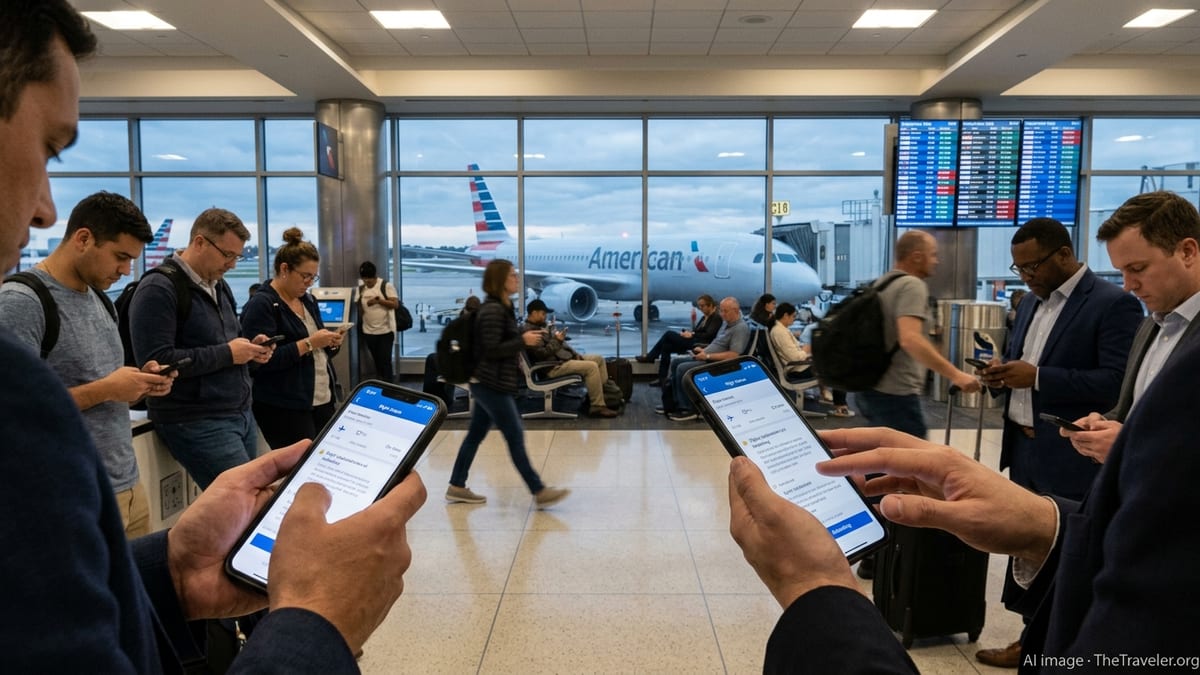
American Airlines is preparing a targeted trial at Charlotte Douglas International Airport designed to reduce the long-running frustration of “rolling delays,” a pattern in which a flight’s departure time repeatedly slips by small increments that leave travelers stuck in limbo at the gate.
Get the latest news straight to your inbox!
What the Charlotte trial is expected to change
Published coverage indicates the pilot will focus on how delay times are calculated and displayed when an outbound flight is waiting on the aircraft that will operate it. Rather than repeatedly posting small delay extensions that may not reflect reality, the concept centers on estimating boarding and departure timing based on the inbound aircraft’s estimated arrival, helping the customer-facing timeline track the airplane that has to physically get to the gate first.
That distinction matters most during irregular operations, when inbound aircraft arrive late due to weather, air traffic congestion, gate constraints, or knock-on delays elsewhere in the system. In those moments, travelers can end up watching status boards and app notifications inch forward, while the aircraft is still in the air or not yet at the gate, making the posted departure time feel disconnected from what is operationally possible.
Reports also suggest there is no broadly published start date or duration yet for the Charlotte test, and there has been no confirmed timeline for expansion to other hubs. Charlotte is a logical choice for a pilot because it is one of the airline’s most important connecting airports, where even short disruptions can cascade into missed connections and crowded gate areas.
Why “rolling delays” generate outsized passenger anger
Even when the final delay length is similar, passengers often react more negatively to rolling updates than to a single longer, realistic estimate. The rolling pattern can keep people from making practical decisions, such as rebooking earlier, arranging childcare, leaving the airport for a meal, or confirming whether they will still make a tight connection.
It also complicates airport logistics. When a departure looks like it is always “about to leave,” gate areas can remain packed, lines at podiums can grow, and standby lists and seating assignments can become more volatile. The result is not just discomfort but friction, particularly at busy hubs where gate space is already under pressure.
The frustration has been amplified in recent years by the expectation that airline apps should provide near real-time clarity. When the displayed time repeatedly moves, travelers may conclude the airline is withholding a more realistic estimate. Whether or not that is true in a specific case, the perception itself can erode trust in the information travelers rely on to plan their next move.
How this fits with American’s broader push on disruption tools
American has been rolling out more self-service disruption features and flight-information changes in its digital channels. In 2026 newsroom updates, the carrier has described app and website enhancements meant to make disruption moments easier to navigate, including clearer delay and cancellation reasons and more consolidated rebooking options when a delay, cancellation, or at-risk connection occurs.
Those improvements reflect a broader industry shift: airlines increasingly aim to reduce dependence on gate and phone agents for routine re-accommodation, while giving travelers faster access to alternatives. In practice, that strategy only works well when the core information shown to customers is credible and stable enough to support decisions.
The rolling-delay pilot in Charlotte can be read as a complement to those digital tools, addressing a specific pain point: the mismatch between posted departure estimates and the physical reality of where the inbound aircraft is. If the displayed timeline becomes more anchored to the inbound arrival, travelers may have a clearer sense of whether “wait it out” is sensible or whether they should immediately look for another option.
Operational constraints at Charlotte, and why prediction is hard
Charlotte’s role as a high-volume connecting hub means it is sensitive to congestion on ramps and taxiways, gate availability, and downstream crew and aircraft positioning. Research on airport gate-hold strategies at Charlotte has explored the trade-offs between managing surface congestion and the knock-on effects for gates and arrivals, underscoring that seemingly simple changes can shift delays from one part of the system to another.
Separately, fuel-saving and efficiency initiatives have been tested in Charlotte over the years, including efforts tied to surface management and reduced taxi time. Those kinds of programs illustrate that Charlotte is already an active environment for operational experimentation, where small procedural or technology changes can have measurable effects at scale.
Still, no system can eliminate uncertainty. Mechanical issues can change in minutes, weather impacts can evolve quickly, and crew legality constraints may resolve suddenly if a replacement crew becomes available. A more realistic initial estimate may reduce the frequency of incremental pushes, but there will still be cases where a flight’s best-known estimate changes multiple times for legitimate reasons.
What passengers can realistically expect during the trial
For travelers, the most noticeable change may be fewer instances where the posted departure time appears to ignore the inbound aircraft’s timeline. If the pilot works as intended, customers could see updates that better reflect when boarding is actually feasible, not just when the schedule originally said the flight should leave.
It is not the same as a guarantee of fewer delays. The trial appears aimed at reducing confusion and improving decision-making, rather than increasing capacity or eliminating the underlying causes of disruptions. In other words, the change is about the quality of information and expectation-setting, which can still materially affect how disruptive a delay feels.
For customers dealing with a major disruption, American’s published guidance continues to point travelers toward rebooking tools in the airline’s app and on its website when flights are canceled or when a delay causes a missed connection. The effectiveness of those tools, however, depends heavily on timely and reliable status information, making the Charlotte rolling-delay experiment a closely watched test of whether better forecasting can translate into a smoother airport experience.