


More news on this day
American Airlines has issued a broad warning to international travelers after disruptions at two of its major overseas hubs led to the cancellation of hundreds of long haul flights and widespread schedule upheaval across its global network.
Get the latest news straight to your inbox!
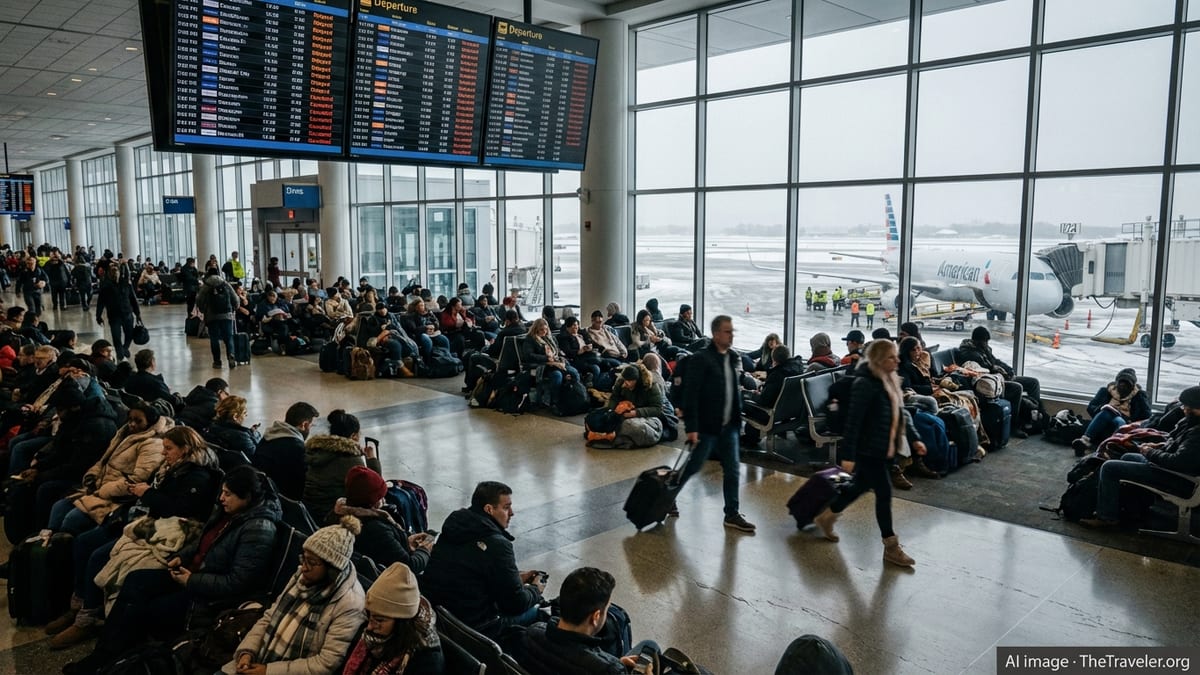
Network Strain Forces Sweeping Cancellations
Publicly available operational data for recent days shows American’s international schedule under acute strain, with hundreds of overseas flights removed from timetables or scrubbed at short notice as conditions deteriorated at two key hubs. The airline’s long haul operation depends heavily on tightly timed waves of departures and arrivals at major connecting airports, meaning localized problems can quickly cascade across the system.
Industry tracking tools indicate that the sharpest disruption has centered on transatlantic and transpacific services, where aircraft typically complete only one or two sectors per day. Once rotations are broken by cancellations or extended ground time, it can take multiple days and several further flights before aircraft and crews are repositioned and normal patterns are restored.
Reports from aviation analytics providers and consumer advocacy platforms describe spikes in cancellations that are concentrated around hub bank times, when large numbers of international flights are scheduled to depart within short windows. As those banks are thinned out, onward connections for passengers in the United States, Europe and Asia are disrupted, prompting further cancellations on feeder routes.
Published coverage notes that, while domestic flying has remained relatively more stable, the combination of long haul aircraft scarcity, complex crew scheduling and constrained slots at major overseas hubs has made the international side of the network significantly harder to normalize once large scale disruption sets in.
Two Major International Hubs at the Center of the Turmoil
Although American has not publicly identified specific airports in a single consolidated warning, multiple operational summaries and schedule snapshots point to two major international hubs as the epicenters of the current turmoil. Both airports are central to the airline’s strategy of funnelling U.S. passengers onto long haul routes, acting as gateways to Europe, the Middle East and Asia.
At the first hub, disruption has been driven largely by constrained airspace and heightened operational restrictions, which have forced airlines to reroute or suspend services for extended periods. When aircraft are unable to transit the most direct corridors, flight times lengthen, aircraft utilization falls and the number of missions that can be flown each day drops, leaving fewer available frames for scheduled departures.
The second hub has been affected by a mix of local operational limits and knock on effects from the broader regional environment. As schedules were initially trimmed to accommodate airspace closures and airport congestion, follow on impacts emerged across connecting banks, with aircraft and crews arriving significantly out of position. That misalignment has been reflected in waves of cancellations, particularly on routes linking the hub to secondary cities.
Analysts note that both hubs serve as essential linchpins in American’s international network, feeding traffic between the United States and a wide swath of destinations. When either airport suffers extended disruption, the airline must choose between operating a reduced schedule with significant delays or preemptively cancelling flights to keep the remainder of the network more predictable.
What American’s Travel Warning Means for Passengers
American’s systemwide travel advisory urges customers with upcoming overseas trips to monitor flight status closely and to build additional flexibility into their plans. The airline’s general policy framework allows for certain voluntary changes when irregular operations occur, including the option to rebook on alternative dates or routings without change fees when specific criteria are met.
Public guidance on the carrier’s travel information pages explains that during major disruption events, rebooking options are typically surfaced first in the mobile app and on the website. Customers whose flights are canceled outright are usually offered a choice between a refund for the unused portion of the ticket and alternative travel arrangements as seats become available, though the precise options depend on fare rules and the reason for the disruption.
Consumer rights organizations advise that travelers departing from or transiting the affected hubs should be prepared for significant wait times at customer service desks and call centers during peak disruption periods. They also emphasize the importance of documenting all out of pocket expenses and keeping records of delay notifications, which can be useful later when seeking reimbursements or making insurance claims.
Travel industry coverage stresses that passengers booked on multi segment itineraries or trips involving partner airlines should pay special attention to minimum connection times and the risk of missed onward flights. With cancellations concentrated at international gateways, some travelers may find that domestic feeder legs are still operating while long haul segments are not, complicating decisions about whether to begin their journeys.
Ripple Effects Across the Global Aviation System
The issues facing American at its two major international hubs are unfolding against a backdrop of broader instability in global aviation. Recent months have seen large scale flight cancellations and diversions across multiple regions following geopolitical tensions, airspace closures and severe weather systems, underscoring how interconnected the world’s air transport network has become.
Airport and airspace closures in key transit regions have forced airlines to adopt longer routing patterns, raising fuel consumption and squeezing scheduling buffers. As carriers attempt to maintain service with limited spare aircraft and tight crew rosters, the margin for absorbing additional disruption has narrowed, increasing the likelihood that localized problems trigger wider schedule breakdowns.
Analysts point out that hub and spoke networks are particularly vulnerable to such shocks. When a single major international hub experiences extended operational constraints, waves of cancellations can ripple through outstation airports and partner networks, affecting travelers who may be thousands of miles from the original point of disruption.
American’s current challenges align with that pattern. As the airline works through aircraft and crew imbalances linked to the two troubled hubs, knock on cancellations are appearing on routes that would normally feed or draw traffic from those airports. Industry observers expect it may take several operating days of relatively stable conditions before the network fully rebalances.
Strategies for Minimizing Disruption on Upcoming Trips
With American explicitly warning of ongoing disruption and publicly available data confirming elevated cancellation levels for overseas services, travel planners are recommending that passengers take practical steps to reduce risk on imminent journeys. One recurring piece of advice is to favor nonstop routes whenever possible, even if that requires minor schedule compromises, in order to avoid vulnerable connection points.
Where connections are unavoidable, experts suggest building in longer layovers than usual, particularly at hubs currently experiencing operational stress. A connection window that might be comfortable in normal times can prove insufficient when arrival delays are widespread or security and immigration queues are lengthened by surges of rebooked passengers.
Travel advisers also recommend that passengers keep essential items, medication and a change of clothes in carry on luggage in case checked bags are delayed or misrouted during irregular operations. With aircraft and crews shuffling between routes as the airline attempts to stabilize the schedule, baggage flows can become less predictable.
Finally, those with flexible plans may wish to consider adjusting travel dates away from the immediate peak of disruption at the two major hubs. As American progressively rebalances aircraft and crew resources and trims schedules to better match current constraints, operational metrics typically improve, reducing the likelihood that future travelers will face the same scale of cancellations now affecting hundreds of overseas flights.