


More news on this day
Chicago O’Hare International Airport is heading into one of its most turbulent summers in years as American Airlines pushes ahead with growth, United Airlines scales back schedules under new federal limits, and airlines from Canada, Europe, Asia and South America ramp up long-haul connections at the Midwest hub.
Get the latest news straight to your inbox!
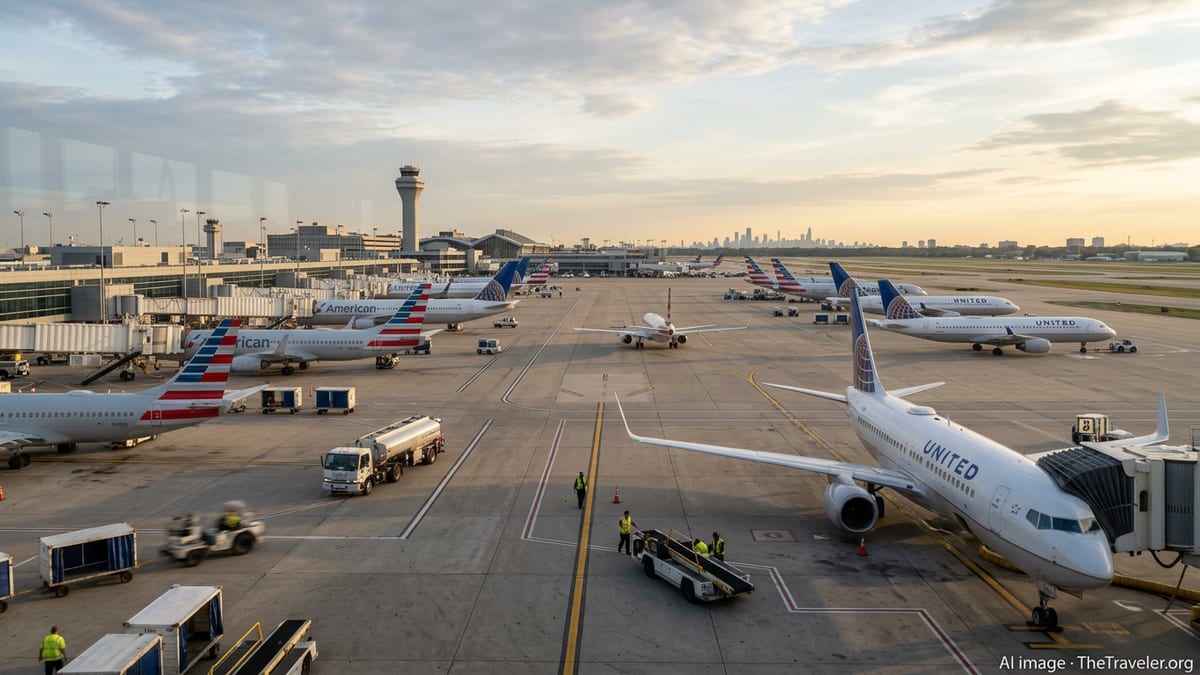
FAA Caps Force United to Shrink After Rapid Build-Up
United Airlines is cutting deeply into its once-ambitious summer schedule at Chicago O’Hare after federal regulators moved to rein in soaring flight counts at the nation’s second-busiest hub. Publicly available information shows the Federal Aviation Administration has capped O’Hare at roughly 2,700 daily flights from early June through late October 2026, a reduction of about 12 percent from what airlines had planned during the peak season.
Data reported by aviation analytics firms indicates United has removed more than 9,000 departures from its June through August schedule compared with earlier filings, amounting to around an 8 percent reduction in operations for portions of the summer. Yet even with those cuts, industry schedules still show United well above last year’s levels, reflecting how aggressively the carrier had expanded its O’Hare hub before the cap took effect.
Local coverage in Chicago notes that United’s daily departures will fall from roughly 780 to about 650 during the capped period, bringing flying closer to what the airport’s infrastructure and airspace can handle reliably in peak months. That retreat marks a sharp shift from early 2026, when United announced that O’Hare would surpass 700 daily departures and become one of the largest single-airline hubs in the world.
The new limits land just as O’Hare continues an extensive multiyear expansion and modernization program that has added new gates but also left some airfield assets constrained by construction. The result is a rare moment in which regulatory capacity ceilings, rather than pure demand, are dictating the pace of growth for United at its hometown airport.
American Holds Ground and Adds Density at Its Chicago Fortress
While United is trimming, American Airlines is quietly consolidating gains it made during what analysts have described as an “arms race” at O’Hare in late 2025 and early 2026. According to scheduling data cited in recent local and national coverage, American pursued a more modest but still noticeable increase in departures ahead of the summer season, adding flights on core domestic routes and leveraging incremental gate access provided through the city’s reallocation process.
Industry observers note that the FAA’s cap is based on approved 2025 schedules, effectively locking in American’s share of operations at O’Hare even as United pares back from more aggressive expansion plans. That structure leaves American in a comparatively stronger position on key business markets from Chicago, including high-frequency service to coastal hubs and major Midwestern cities.
Passenger statistics from the Chicago Department of Aviation show domestic air carrier operations at O’Hare rising in early 2026, with total aircraft movements up more than 6 percent year on year in January and passenger volumes climbing nearly 3 percent. Within that growth, American’s Chicago hub plays a central role, feeding traffic into the carrier’s broader network while benefiting from rising demand in the region’s corporate and leisure sectors.
For travelers, American’s strategy translates into denser schedules on many staple routes rather than a flood of entirely new destinations. That approach may offer more choice in departure times and a measure of resilience when weather or airspace constraints hit, even as the overall number of daily flights at O’Hare comes under tighter federal control.
Delta and Air Canada Build Share With Targeted O’Hare Growth
The shifting balance between United and American is opening space for competitors to refine their own positions in Chicago. Delta Air Lines, historically a smaller player at O’Hare compared with Midway and its larger coastal hubs, is using targeted expansion to improve connectivity into its broader international network. Corporate announcements in recent months highlight new and upgraded domestic links between O’Hare and Delta’s coastal gateways, which in turn feed long-haul flights across the Pacific and Atlantic.
From Los Angeles, Delta is adding additional daily service to O’Hare this summer, reinforcing a corridor that connects Chicago travelers to a growing slate of transpacific departures, including new and returning routes from the West Coast to Asia and the South Pacific. The strategy underscores how airlines can use O’Hare as a spoke into other global hubs while still tapping Chicago’s substantial local demand.
Air Canada is also leaning into Chicago as demand rebounds on transborder routes. Scheduling data and airline statements show increases in capacity between O’Hare and Toronto Pearson, as well as other Canadian cities, supported by strong business and visiting-friends-and-relatives traffic. The carrier’s Star Alliance ties give connecting passengers a range of onward options in both directions, including links to secondary Canadian markets and to United’s domestic network beyond Chicago.
The combined effect is a gradual but noticeable rise in competition on cross-border and domestic corridors that tie O’Hare to the rest of North America. Even as the FAA cap constrains total flight counts, airlines are vying to deploy seats where yields are strongest and where connectivity into their global systems is most valuable.
Surging Long-Haul Links From the UK, Brazil and South Korea
Beyond North America, O’Hare is seeing a surge of long-haul capacity from key global regions, particularly the United Kingdom, Brazil and South Korea. Official traffic summaries from the Chicago Department of Aviation show international air carrier operations growing at a double-digit pace in early 2026, even as overall passenger numbers rise more modestly. That gap reflects a pivot toward larger aircraft and more long-range flying.
Published schedules point to additional frequencies and seasonal upgrades on Chicago routes from London and other UK cities, operated by a mix of US and European carriers. The transatlantic build-up is geared toward both business travelers and the robust leisure market linking the Midwest to major tourism and financial centers in Britain.
From South America, capacity between Chicago and Brazil is climbing as airlines respond to pent-up demand and a strengthening trade and tourism corridor. Route changes filed in global distribution systems show extra seats on Chicago services to Brazilian gateways for the Northern summer, often timed to maximize onward connections into domestic networks in both countries.
Across the Pacific, South Korean connectivity is also strengthening. While most nonstop Chicago–Seoul flights are operated by alliance partners based in Asia, US carriers are increasingly using O’Hare as a feed point into their partners’ transpacific banks, with additional domestic and West Coast links designed to funnel Midwestern travelers toward South Korea and beyond. The result is a denser web of options for passengers heading to and from East Asia, even when the nonstop flight count remains relatively stable.
O’Hare’s Hub Status Evolves Under Capacity Pressure
These overlapping trends are reshaping how Chicago O’Hare functions as a global hub. City documents and academic reports highlight that O’Hare handled more than 101 million passengers and over 2,500 daily flights in 2024, making it one of the fastest-growing major airports in the United States. That rapid growth has continued into 2025 and 2026, prompting renewed debate over how quickly terminal and runway projects should proceed.
The FAA’s decision to cap operations for summer 2026 introduces a new variable into that long-term planning. Airlines that had counted on steadily rising slot availability are now forced to prioritize higher-yield routes, larger aircraft and tighter banks of flights. United’s retrenchment, American’s more measured expansion, and the calculated moves by Delta, Air Canada and long-haul carriers from the UK, Brazil and South Korea all reflect that new operating reality.
For travelers, the near-term effect may be a paradoxical mix of fewer total flights but more international options and competitive fares on key corridors. With O’Hare still investing heavily in new gates and terminal upgrades, the current summer could serve as an inflection point, revealing how one of the world’s most important connecting hubs balances growth, reliability and global reach in an era of tighter regulatory and infrastructure constraints.