


If you fly to Asia frequently, choosing the right airline credit card can easily make the difference between another cramped economy seat and a lie-flat bed over the Pacific. Two of the most discussed options for Asia-focused travelers are ANA Cards tied to Japan’s All Nippon Airways and Cathay Pacific co-branded cards that earn Asia Miles. Both unlock upgrades, free flights and priority treatment, but they fit very different types of trips and home bases. Here is how they actually perform when you put real itineraries and real costs to the test in 2026.
Get the latest updates straight to your inbox!
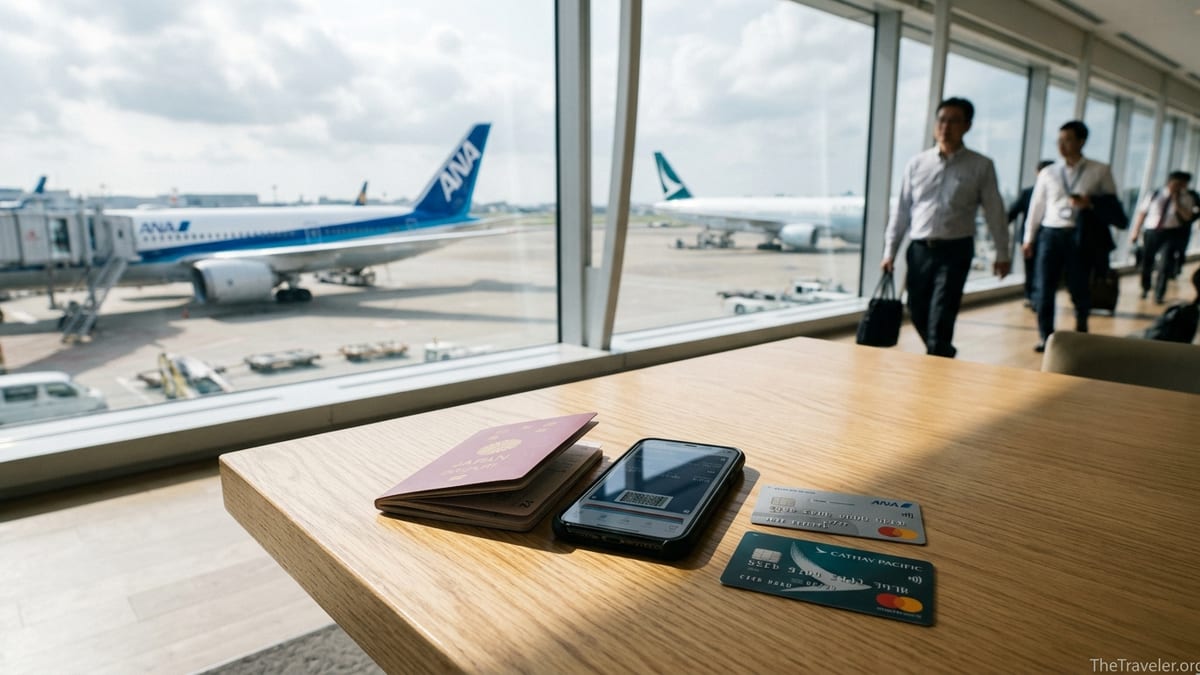
ANA vs Cathay Pacific: What These Cards Really Are
ANA Cards are credit cards linked to ANA Mileage Club, the frequent flyer program of All Nippon Airways in Japan. Most of the Japanese-issued ANA Cards are domestic products offered in partnership with issuers such as Visa, JCB, Mastercard and American Express. They let you earn ANA miles on flights and everyday spending, and often add on-airport perks like business class check in counters or domestic lounge access for the cardholder on ANA flights.
For example, a typical mid-tier ANA Wide Card issued in Japan earns around 0.5 to 1 mile per 100 yen spent, with annual fees starting from roughly 7,975 yen for the primary member, and sometimes options to pay an extra fee to double your miles on spending. Many of these cards also award a one-time mileage bonus when you first join and on every renewal year, which can be enough for a one-way domestic hop inside Japan if you fly ANA at least once a year.
Cathay Pacific credit cards, on the other hand, are co-branded products with banks in individual markets that earn Asia Miles, the mileage currency used by Cathay. In Japan, for instance, the Cathay Pacific MUFG Card Gold Mastercard earns Asia Miles on all spending and extra miles when you book Cathay flights online in Japanese yen. In North America, you will find products like the Cathay Pacific World Elite Mastercard in the United States or the Neo Cathay Pacific card in Canada, which reward Cathay tickets and travel purchases in local currency.
The key distinction is that ANA Cards are more tightly linked to one country, Japan, while Cathay Pacific cards are scattered across different home markets. When you are deciding between “ANA Card or Cathay Pacific credit card,” you are really choosing between two airline ecosystems, two route networks and two earning patterns that may or may not match your actual life and travel plans.
Route Networks and Hubs: Will You Actually Fly the Airline?
The most important question before comparing perks is simple: which airline will you realistically fly more, ANA or Cathay Pacific? ANA is based at Tokyo’s Haneda and Narita airports and belongs to Star Alliance. It operates dense routes between North America and Japan, and from its Tokyo hubs on to major cities across East and Southeast Asia. If your typical itinerary looks like Los Angeles to Tokyo to Singapore, or Seattle to Tokyo to Bangkok, ANA miles are easy to use and ANA Cards tie directly into that network.
Cathay Pacific is based in Hong Kong and is a key carrier in the oneworld alliance. Its long haul routes connect North America and Europe to Hong Kong, then fan out to cities across mainland China, Southeast Asia, North Asia and Australia. If your pattern is San Francisco to Hong Kong to Manila, or New York to Hong Kong to Ho Chi Minh City, an Asia Miles balance from Cathay-branded cards will feel more natural.
Think about where you connect. Travelers who spend a lot of time in Japan, or who love using Tokyo as a hub to visit places like Sapporo, Fukuoka or Okinawa, generally find ANA Cards more rewarding. For instance, frequent flights between Tokyo and Sapporo in winter for ski trips can be a perfect use of short haul ANA awards booked with miles earned from an ANA Wide or ANA Gold card.
By contrast, if you frequently pass through Hong Kong, especially on routes into southern China, Vietnam or the Philippines, Cathay’s network fits better. A Hong Kong based expatriate flying to Shanghai for work and Cebu for vacations would quickly build Asia Miles through a Cathay co-branded card, then redeem for short regional hops where cash fares can be high relative to distance.
Earning Miles on Everyday Spending
The earning mechanics on everyday purchases are different between ANA Cards and Cathay cards, and they matter if you plan to build up balances through grocery bills rather than constant business class tickets. Many Japanese-issued ANA Cards offer around 1 ANA mile per 100 yen of spending by default, with optional “double miles” add-ons for a separate annual transfer fee. That means a 10,000 yen restaurant bill in Tokyo might net you roughly 100 ANA miles under the standard structure, and 200 miles if you pay for a premium conversion plan.
In contrast, Cathay Pacific co-branded cards in markets like Japan, Hong Kong or Canada are often built around stronger accelerators for Cathay purchases and overseas spending. For example, a Cathay-branded Mastercard in Canada can earn multiple Asia Miles per local dollar spent on Cathay tickets when purchased on Cathay’s website in Canadian dollars, while earning a lower rate on general domestic purchases. The Japanese Cathay Pacific MUFG Card Gold Mastercard prominently advertises extra Asia Miles when you book Cathay flights on its Japanese portal, and additional miles for in flight shopping.
For a concrete comparison, imagine a US based traveler spending the equivalent of 2,000 US dollars per month on a card, mostly at supermarkets, restaurants and online retailers, and flying to Asia twice a year. A typical Japanese domestic ANA Card would be difficult for them to obtain or use efficiently if they are not resident in Japan and paying most expenses in yen. By contrast, a US issued Cathay Pacific World Elite Mastercard with 2 or more Asia Miles per dollar on Cathay purchases and 1 mile per dollar on general spend can turn that 24,000 dollars in annual spending into tens of thousands of Asia Miles that can be used for an off season Hong Kong round trip or a regional Asia business class upgrade.
The bottom line: if you live in Japan and spend heavily in yen, ANA Cards are designed for you. If you live elsewhere, but often route through Hong Kong or fly Cathay, a local Cathay Pacific co-branded product usually lines up better with your real-world spending pattern.
Annual Fees, Perks and Lounge Access
Annual fees on ANA Cards vary widely, but mid tier ANA Wide cards in Japan often start just under 8,000 yen for the primary member, with additional annual fees if you choose a double mileage option. Higher tier ANA Wide Gold products cost more but can include domestic lounge access when flying ANA, and business class check in even when you fly economy on eligible tickets. For a Tokyo based traveler who takes multiple domestic flights a year, simply being able to use ANA’s domestic lounges at Haneda or New Chitose can take the sting out of delays and crowded departure gates.
Cathay Pacific cards also span a range of annual fees depending on market. A US Cathay Pacific World Elite Mastercard has had an annual fee in the neighborhood of 99 US dollars, while cards in other markets sometimes come in both free and fee based versions. Benefits often include priority boarding on Cathay flights when you pay with the card, discounts on inflight purchases, and sometimes bonus Asia Miles for hitting certain annual spending thresholds. In Hong Kong, certain premium Asia Miles linked cards can even help you accumulate Status Points, the metric Cathay uses to determine elite tier, directly from card spending.
Travelers should translate these perks into real situations. If you fly ANA domestically in Japan eight or ten times a year, lounge access and dedicated check in desks can easily save you an hour on each round trip. Over a year, that is a full workday recaptured in quiet lounge space, making the extra cost of a Wide Gold tier card feel reasonable. If, on the other hand, you take only one ANA flight a year to visit family, a no-fee ANA Mileage Club card without credit function might be enough.
For Cathay, a Hong Kong based consultant flying economy between Hong Kong and Taipei twice a month might see real value in priority boarding and extra baggage allowances available via a premium Cathay card. A North American traveler who takes a single Cathay trip every year may care more about the initial welcome bonus miles than about ongoing elite style perks baked into the card.
How Easy Are These Miles to Use?
Earning miles is satisfying only if redemptions are straightforward. ANA miles are most powerful for round trip awards on ANA itself and Star Alliance partners. Many enthusiasts target ANA’s round the world awards, where carefully planned itineraries can let you visit several Asian cities plus Europe on a single mileage ticket, particularly in business class. For a US based traveler willing to learn the rules, ANA miles from a US issued ANA Mileage Club credit card or from bank points transfers can unlock spectacular value, such as a round trip business class flight from New York to Tokyo for fewer miles than some US carriers charge for premium economy.
Asia Miles from Cathay cards are more flexible in the sense that they work not only for Cathay flights but also for oneworld partners like Japan Airlines, Qantas and American Airlines. A traveler based in Singapore might earn Asia Miles with a Cathay card and redeem them for a Japan Airlines ticket from Singapore to Tokyo, or a Qantas flight from Hong Kong to Sydney. This cross-carrier flexibility is valuable if you live in a city where Cathay does not have as many direct services as it once did, but its oneworld partners still operate.
On the other hand, Asia Miles awards can have higher surcharges on some routes, and award availability in premium cabins out of popular cities like Hong Kong can be tight around major holidays. Similarly, ANA saver level awards in business class from North America to Tokyo often sell out quickly. In practice, both currencies demand some advance planning and flexibility with travel dates. A family hoping to use miles for four business class seats to Tokyo during cherry blossom season should be prepared to book as soon as schedules open, whether using ANA miles via an ANA Card or Asia Miles via a Cathay co-branded card.
One practical advantage for Cathay in 2026 is the growing web of transfer partnerships. Even if you do not hold a Cathay co-branded card, several bank programs in North America and Asia now allow conversion of credit card reward points into Asia Miles, sometimes with limited time transfer bonuses. This means that a traveler might use a general travel rewards card for everyday spending, top up Asia Miles when a promotion appears, and rely on a Cathay co-branded card primarily for flight purchases and specific perks.
Which Card Fits Different Types of Asia Travelers?
Consider a few concrete traveler profiles to see whether an ANA Card or a Cathay Pacific credit card makes more sense. First, imagine a Tokyo based engineer who flies ANA domestically for work every month, and internationally to the United States twice a year. He spends most of his money in yen on Japanese utility bills, supermarkets and local e commerce. In his case, a Japanese issued ANA Wide Gold Card gives him bonus miles at renewal, access to domestic lounges when flying ANA, and a straightforward way to earn miles on every yen spent. Cathay’s Hong Kong based network and cards would be inconvenient and mismatched to his actual travel.
Now imagine a New York based consultant who visits clients in both Tokyo and Hong Kong, but whose firm tends to book whatever premium cabin fare is cheapest across alliances. She spends heavily in US dollars on hotels, dining and ride shares worldwide. Holding a US issued Cathay Pacific World Elite Mastercard, she can earn multiple Asia Miles per dollar whenever she books Cathay operated flights. At the same time, she keeps a US bank travel card that can transfer points both to ANA and to Asia Miles when transfer bonuses appear. For her, the decision is less about daily earning and more about which hub she values more for connections. If she finds herself connecting through Hong Kong more often, the Cathay card wins. If most trips route via Tokyo and she can qualify for a US ANA Mileage Club card, splitting spending between both ecosystems may be the sweet spot.
A third example is a college student from Singapore studying in Canada. She flies home once a year, often through Hong Kong on Cathay because of schedule and pricing, and makes a side trip to Japan every couple of years. A Canadian Cathay branded card that offers extra Asia Miles on Cathay tickets and on foreign currency purchases will help her accumulate miles quickly for those long haul flights home. Earning ANA specific miles through a Japanese domestic ANA Card is not realistic because she lacks Japanese residency and yen based spending, although she might still transfer some bank points into ANA miles in the future for a special Japan focused trip.
These examples point to a simple rule of thumb: ANA Cards work best for residents of Japan or people deeply committed to ANA’s Star Alliance network, while Cathay Pacific credit cards are better suited to travelers who either live in Cathay’s home or partner markets or who have flexible bank points and prefer Hong Kong as a connecting hub.
The Takeaway
Choosing between an ANA Card and a Cathay Pacific credit card is not about which airline is objectively better. It is about which ecosystem fits the way you actually travel and spend money in 2026. If you live in Japan, pay most of your bills in yen and often fly ANA domestically or regionally, an ANA Wide or ANA Gold card will feel like a natural extension of your daily life, turning routine grocery trips into miles that can be redeemed for domestic and regional flights across Japan and Asia.
If you live elsewhere but frequently route through Hong Kong, or you value the ability to redeem on multiple oneworld carriers, a Cathay Pacific co-branded credit card that earns Asia Miles will typically be a better anchor for your Asia travel strategy. Combined with transferable bank points, it can help fund everything from a short hop between Hong Kong and Taipei to long haul business class to Australia or North America.
In practice, serious Asia travelers often end up with some exposure to both programs. For example, you might hold a Cathay Pacific card in your home country for long haul flights, while using an ANA Card if you later relocate to Japan. The right starting choice is the card that matches your current home base, your most common connection hub and the alliance whose route map lines up with the cities you care about most.
FAQ
Q1. Is an ANA Card worth it if I do not live in Japan?
If you do not live in Japan, most of the yen based ANA Cards issued by Japanese banks will be difficult to obtain and use efficiently. In that case, it usually makes more sense to earn ANA miles through global bank transfer partners or a US issued ANA Mileage Club card, and focus your primary credit card strategy on products available in your home country.
Q2. Which program is better for flights between North America and Asia, ANA or Cathay?
Both ANA and Cathay Pacific offer strong North America to Asia routes, but ANA often shines for nonstop flights into Tokyo and onward Star Alliance connections, while Cathay is stronger if you prefer routing through Hong Kong and using oneworld partners. The best choice depends on whether Tokyo or Hong Kong is a more convenient hub for you and which alliance you use more often.
Q3. Are ANA Cards good for earning miles on everyday spending in Japan?
Yes. For residents of Japan, mid and high tier ANA Cards can be very effective for earning ANA miles on daily spending in yen. Many cards offer around 1 mile per 100 yen on general purchases, with options to boost that via additional annual fees, plus bonus miles at enrollment and card renewal. Over a year, that can add up to enough for domestic or short regional flights on ANA.
Q4. Do Cathay Pacific credit cards give automatic elite status with the airline?
Most Cathay Pacific credit cards do not grant full elite status by themselves, but some premium cards in markets like Hong Kong can help you earn Status Points faster through spending. These Status Points contribute to tier levels in the Cathay membership program, which in turn unlock benefits such as lounge access and priority check in. Always check the specific card terms in your country to see how status is treated.
Q5. Can I use Asia Miles from a Cathay card on airlines other than Cathay Pacific?
Yes. Asia Miles can be redeemed on a range of oneworld partners, including Japan Airlines, Qantas, Qatar Airways and American Airlines, as well as some non alliance partners. This makes a Cathay Pacific credit card attractive even if you do not always fly on Cathay itself, provided partner airlines serve your usual routes.
Q6. What if I travel to both Japan and Hong Kong regularly, which card should I pick first?
If you split time between Japan and Hong Kong, start with the card that matches your main place of residence and currency. For example, if you are based in Tokyo, an ANA Card that earns on yen spending will likely deliver more value day to day, while you can still credit some Hong Kong trips to ANA’s Star Alliance partners. You can later add a Cathay Pacific card in your home market if you find yourself using Hong Kong as a frequent hub.
Q7. Are there foreign transaction fees on ANA or Cathay credit cards?
Foreign transaction fees depend on the issuing bank and country, not just the airline brand. Some premium Cathay Pacific cards in markets like North America waive foreign transaction fees, while many standard cards still charge them. Japanese issued ANA Cards may treat non yen spending less favorably. Always check the fee table for your specific card before using it heavily overseas.
Q8. Which program is better if I want to book round the world or multi city trips?
ANA Mileage Club is well regarded for its round the world award chart, which can offer strong value on multi city itineraries across several continents when booked in business class. Asia Miles also supports complex itineraries with oneworld partners, but the sweet spots are different. If round the world style travel is your priority, building a balance of ANA miles, through an ANA Card or bank transfers, is often more rewarding.
Q9. How important are limited time transfer bonuses to Asia Miles or ANA miles?
Transfer bonuses from bank points programs to Asia Miles or ANA Mileage Club can significantly boost the value you get from everyday, non airline specific cards. For instance, a 10 percent bonus on a large transfer to Asia Miles could easily cover the taxes and fees for a regional Asia award ticket. Watching for these promotions and timing large transfers accordingly can matter as much as the base earning rate on any single ANA or Cathay co-branded card.
Q10. Should I ever hold both an ANA Card and a Cathay Pacific credit card?
Yes, it can make sense for frequent Asia travelers. For example, a consultant based in Hong Kong but regularly working in Tokyo might hold a Hong Kong issued Cathay card for daily spending and Cathay flights, and also maintain an ANA linked card or bank transfer relationship for Star Alliance awards out of Japan. The key is to avoid spreading your spending too thin across many marginal cards and instead concentrate on the two programs that best match your real routes.