


As Japan travel booms again, many families flying All Nippon Airways (ANA) or touring the country wonder whether it is worth getting an ANA-branded credit card in Japan. The promise is tempting: pooled family miles, flight discounts, and special perks on the airline you are likely to fly most. But ANA cards also come with annual fees, complex rules, and limitations for non-residents. This guide looks at how ANA cards and ANA Mileage Club work in practice for family trips, using concrete examples to help you decide if they fit your plans or if you are better off with a more flexible global travel card.
Get the latest updates straight to your inbox!
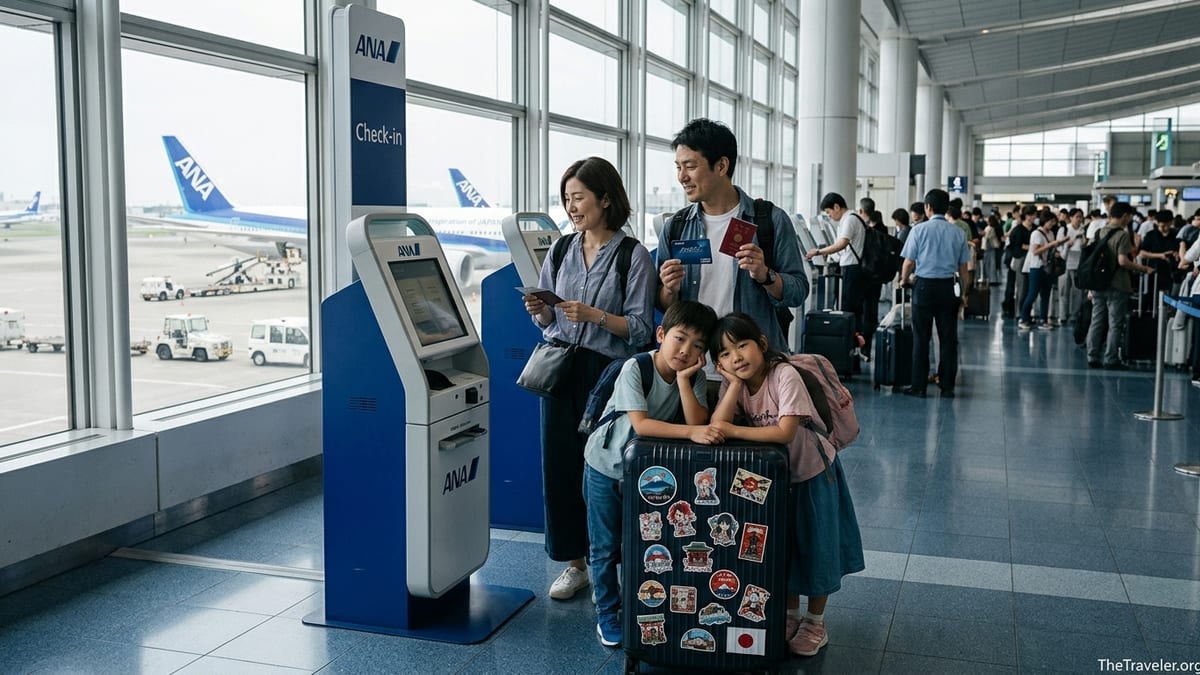
What Exactly Is an ANA Card in Japan?
In Japan, “ANA Card” usually refers to a co-branded credit card issued with domestic banks and brands such as JCB, Visa, Mastercard, American Express, Diners Club and others, carrying the ANA logo and linked directly to the ANA Mileage Club program. Typical examples include the ANA JCB General Card, ANA VISA Wide Gold Card, and premium options like ANA Diners cards. These cards differ from the ANA-branded cards issued in other markets such as the United States, where a separate “ANA CARD U.S.A.” product is marketed to American residents with its own sign-up offers and conditions.
All ANA Cards are tied to ANA Mileage Club, the frequent flyer program for All Nippon Airways and its regional subsidiaries. Card spending earns points or miles that can be converted into ANA miles and used for flights on ANA and Star Alliance partners. On top of that, many ANA Cards offer airline-specific benefits on domestic Japan flights, such as discounts on one-way fares during certain travel periods, in-flight shopping discounts when you pay with the card, and mileage bonuses on ANA ticket purchases.
For families based in Japan or spending extended time there, the most distinctive feature is the ability to pool miles through the ANA Card Family Miles service. This lets multiple ANA Card holders in the same household combine individually earned miles to reach award thresholds more quickly. However, eligibility is strict, and key rules can make or break whether a family actually benefits from the system.
How ANA Family Miles Work for Residents of Japan
The ANA Card Family Miles program is specifically designed for ANA Card members living in Japan. According to ANA’s latest Family Miles use agreement, the primary member and all registered family members must reside in Japan and hold qualifying ANA Cards or be ANA Mileage Club members at the same registered Japanese address. Up to ten people can participate in one Family Miles group, including the primary cardholder and up to nine relatives such as a spouse, same-sex partner, children, or parents living together.
In practice, this means a Tokyo-based family of four where both parents hold ANA Cards and the two teenagers hold simple ANA Mileage Club cards could register as a Family Miles group. When the parents pay for groceries, utility bills, and daily expenses with their ANA Cards, those charges generate miles that sit in each person’s account but can be combined when it is time to book award tickets. If one child has 12,000 miles and another has 8,000, those 20,000 miles can be pooled to redeem a domestic round-trip flight in low season instead of waiting for a single account to reach the total alone.
Family Miles can typically be redeemed for ANA international flight awards, domestic Japan awards, and ANA group partner flights, although ANA reserves the right to change eligible awards. Importantly, the miles remain in each individual’s account until redemption; the pooling happens at the moment you book, and the system automatically draws from accounts based on expiration dates. This is helpful for families who might otherwise lose small, scattered mileage balances when children or grandparents fly only occasionally.
Limitations for Non-Residents and Short-Term Visitors
For most overseas visitors coming to Japan simply for a two-week holiday, the ANA Card Family Miles system is largely out of reach. ANA’s current rules state that to use ANA Card Family Miles, the primary cardholder must reside in Japan, hold a personal ANA Card, and have a Japanese postal address registered with ANA Mileage Club. Family members in the pool must also be residents at a Japanese address. Families registered with overseas addresses are directed instead to the ANA Family Account Service, which is a separate product and does not rely on holding an ANA credit card in Japan.
Consider a US-based family of five planning a three-week summer trip, flying Los Angeles to Tokyo on ANA. The parents might understandably think that applying for a Japanese ANA JCB Card will let them pool every family member’s miles for that single big trip. In reality, without residence status in Japan and a Japanese address, they cannot register for ANA Card Family Miles. They may, however, be eligible for an ANA CARD U.S.A. product aimed at American residents, which has its own bonus offers and earning structure but does not give access to the Japan-only Family Miles service.
For visitors from Europe, Canada, or Australia, local ANA co-branded cards can exist through regional banks but again follow the issuing bank’s residency rules and the general ANA requirement that a Family Miles group using a Japan ANA Card setup must have its address in Japan. As a result, short-term tourists are almost always better off focusing on a strong global travel rewards card from their home market that earns flexible points transferable to ANA Mileage Club, rather than trying to obtain a Japan-issued ANA Card for a single vacation.
Real-World Earning Examples for a Japan-Based Family
To understand whether ANA Cards help families in real life, it is useful to run through a concrete scenario using approximate current conditions. Imagine a family of four living in Osaka, where both parents hold ANA JCB General Cards and are enrolled in ANA Card Family Miles. The annual fees are modest by Japanese standards, and there is an ongoing promotion for younger customers on certain JCB ANA Cards that offers up to tens of thousands of miles equivalent for meeting early spending targets over a few months. This sort of launch bonus can immediately move a family closer to a domestic award trip.
Suppose the household puts around the equivalent of several million yen per year in combined expenses on their ANA Cards. Grocery shopping at major supermarkets, utility bills, train passes, and online shopping gradually generate card points. Depending on the card and conversion option, a significant portion of those points can be converted into ANA miles. Even without exact ratios, a realistic outcome for a reasonably engaged family could be collecting enough miles every one to two years to fund four domestic round-trip tickets between Osaka and Okinawa in economy class, especially if they are flexible with travel dates and willing to book during quieter seasons.
Because the miles are pooled, even the grandparents’ occasional flights and the children’s once-a-year domestic trips help. Instead of sitting unused in separate small balances, they become part of a family pool that can unlock a full holiday. When ANA runs limited-time promotions that discount international award tickets from Japan to destinations such as Honolulu or Southeast Asia, a family pool might rapidly combine enough miles from several members to grab two or three award seats for the next school break.
Costs, Fees, and Opportunity Cost for Families
While ANA Cards can be powerful tools for families in Japan, they are not free money. Most ANA-branded cards carry annual fees that range from low to quite high for premium products. A standard general card might cost the equivalent of several thousand yen per year, while gold or premium cards can run into tens of thousands of yen annually once introductory free periods end. If two parents each hold a gold-level ANA Card, their combined annual fees quickly approach the value of a short domestic flight, which means they need to charge enough spending to justify the cost.
Families should also pay attention to foreign transaction fees when using a Japan-issued ANA Card abroad. Many Japanese credit cards, including some ANA-branded products, apply a fee on overseas transactions which can effectively add a few percent to purchases made in foreign currencies. On a family holiday in Europe where meals, hotels, and train tickets add up quickly, this fee can quietly cost the equivalent of several thousand yen or more. International travel cards from other issuers, particularly some US and European banks, increasingly waive foreign transaction fees, which can make them more attractive for spending outside Japan.
There is also an opportunity cost. Instead of putting all spending on an ANA Card, a family could funnel their expenses to a flexible points card that transfers not only to ANA but also to other airlines or hotel chains. For instance, a global bank card that earns transferable reward points could be used for ANA flights when appropriate but also support non-Japan trips on other carriers. For families that do not fly ANA or visit Japan regularly, locking into ANA-specific cards might reduce flexibility without providing enough extra value.
Choosing Between Japanese ANA Cards and Home-Country Options
For a family that actually lives in Japan or spends many months per year there, Japanese ANA Cards can be the backbone of a travel strategy centered on ANA and domestic exploration. The ANA Card Family Miles service, ANA cardholder discounts on specific domestic fares, and on-board shopping reductions all favor residents who fly ANA several times a year. If a family of four makes regular trips from Tokyo to Sapporo to visit relatives and perhaps one annual international trip to Hawaii or Singapore, pooling miles from everyday spending plus paid flights can deliver recurring savings.
For a US-based family, however, the calculation changes. Instead of seeking a Japan-issued ANA Card that is hard to obtain without local residence, they can look at ANA CARD U.S.A. products or at general travel cards that transfer points to ANA Mileage Club via major bank rewards programs. This lets them earn points on all domestic US spending, then convert a large chunk into ANA miles in the year they plan a Japan trip. Even if they cannot formally pool those miles in a Family Miles group, one parent can build up a large balance and redeem award tickets for the whole family on ANA-operated flights.
European and Australian families face similar trade-offs. Regional banks may offer ANA co-branded cards in some markets, but these often come with their own annual fees and earning quirks. In many cases, flexible travel rewards cards that partner with multiple airline alliances deliver more versatility, especially if Japan trips are just one part of a broader international travel pattern that includes North America, Europe, or the South Pacific on non-ANA carriers.
Practical Scenarios: When ANA Cards Make Sense for Families
Consider a family living in Nagoya where one parent travels domestically for work every month, usually on ANA, while the other parent takes the children on ANA flights to visit grandparents in Kyushu twice a year. They sign up for mid-tier ANA Cards with reasonable annual fees, join ANA Card Family Miles, and charge regular household expenses to the cards. Over 18 to 24 months, they accumulate a sizable pool of ANA miles from both flight activity and daily spending. When the children have a school break in March, they redeem a combination of miles from every account in the family pool to book four domestic round trips and keep cash costs low. Here, the ANA Cards and Family Miles structure clearly deliver tangible, repeated value.
Now compare that to a Canadian family that travels internationally once every year or two but rarely visits Japan. If they open a locally available ANA co-branded card with an annual fee yet only manage one ANA long-haul flight every few years, their ANA-specific benefits may go largely unused. A more flexible travel credit card that earns points redeemable through multiple airline partners and hotel chains could better fit their pattern. They might still transfer some points to ANA when planning a big Japan holiday, but they are not locked into one airline ecosystem.
There is also the case of mixed-residence families. Imagine one parent working long-term in Tokyo with an ANA Card and the rest of the family still living in the United States. Depending on how ANA interprets residency rules and addresses, they may not all be eligible to join the Japan-based ANA Card Family Miles service. Instead, the Japan-based parent could focus on building up ANA miles on their own card and use those miles to book award seats for family visits to Japan, while the US-based partner uses a domestic travel rewards card that happens to transfer to ANA when needed.
The Takeaway
Whether families should use ANA Cards for Japan travel and ANA flights depends heavily on where they live, how often they fly ANA, and how comfortable they are managing a card that is tightly linked to one airline. For households based in Japan who travel domestically and internationally with ANA at least once or twice a year, Japanese ANA Cards combined with the ANA Card Family Miles service can be a powerful tool. Pooling miles across up to ten family members makes it easier to convert scattered balances and everyday spending into real trips, especially during ANA mileage sales or domestic discount periods.
For families who live outside Japan and visit only occasionally, the picture is different. Residency rules mean they usually cannot access the Japan-only ANA Card Family Miles program, and foreign transaction fees plus annual charges may outweigh benefits. In these cases, an ANA CARD product issued in their home country or a flexible travel rewards card that transfers points to ANA Mileage Club is often more practical. Points can be saved up over several years and then converted to ANA miles to fund one big family trip to Japan, without giving up the flexibility to use those points with other airlines and hotel partners.
In the end, ANA Cards are most attractive when a family’s travel patterns are clearly ANA-centric and Japan-focused. Before applying, families should map out realistic flight plans for the next few years, estimate annual spending, and compare the potential value of ANA-specific perks to the flexibility of broader travel rewards cards. With clear expectations and the right residency conditions, an ANA Card can be a valuable companion for family journeys across Japan. For many international visitors, however, the smarter move is to treat ANA as one partner within a more flexible, global credit card strategy.
FAQ
Q1. Can visiting families on a short Japan holiday sign up for ANA Card Family Miles?
In most cases no. ANA Card Family Miles is restricted to ANA Card holders and their families who reside in Japan and share a registered Japanese address. Short-term visitors usually do not meet these residency conditions.
Q2. If my family lives in the United States, can we still pool ANA miles for a Japan trip?
You cannot usually use the Japan-only ANA Card Family Miles, but you may be able to use ANA’s separate Family Account Service for non-residents or simply have one parent collect enough ANA miles through a home-country credit card and book award tickets for everyone.
Q3. Are Japan-issued ANA Cards useful for spending outside Japan?
They can be used abroad, but many Japanese credit cards charge foreign transaction fees on overseas purchases. For heavy spending outside Japan, a travel card with no foreign transaction fees from your home market may be more cost-effective.
Q4. Do ANA Cards always offer a big welcome bonus for new family cardholders?
Welcome campaigns vary by issuer, brand, and time period. At times, certain ANA JCB cards in Japan have offered sizable mile-equivalent bonuses for new, younger customers who meet early spending targets, but offers change frequently.
Q5. How many people can join one ANA Card Family Miles group?
ANA currently allows up to ten people in a Family Miles group, typically the primary ANA Card holder plus up to nine eligible relatives who live together at the same registered address in Japan.
Q6. Can my teenage children participate in ANA Card Family Miles?
Yes, teenagers can join as long as they have individual ANA Mileage Club numbers and meet ANA’s age and membership rules. They do not need to be full credit card holders to contribute flight miles to the family pool.
Q7. Is it better for my family to use one premium ANA Card or several basic cards?
This depends on your spending level and travel frequency. One premium card may offer higher earning rates and extra perks but carries a higher fee, while multiple basic cards may spread earning across the family with lower annual costs. Calculating annual fees against expected miles is essential.
Q8. Can I combine miles from an ANA Card in Japan with miles from an ANA-branded card in another country?
All eligible ANA-branded cards can feed miles into the same ANA Mileage Club account, but cross-border pooling rules depend on which account and services are used. In general, the key is that all cards ultimately link to the same Mileage Club number rather than the country of issue.
Q9. What if I stop living in Japan after setting up ANA Card Family Miles?
If the primary member or family members no longer meet the residency or address requirements, ANA can end Family Miles eligibility. Individual ANA Mileage Club memberships remain active, but the pooled-family feature may no longer be available.
Q10. Should a first-time visitor to Japan apply for a Japanese ANA Card just for one trip?
Usually no. For a single short trip, the effort of meeting residency, language, and application requirements plus potential annual fees and foreign transaction costs rarely pays off. A strong travel rewards card from your home country that transfers points to ANA or earns general miles is typically a better option.