


More news on this day
Volcanic ash from Indonesia’s Anak Krakatau has halted operations at multiple airports, disrupting 2,961 flights and leaving around 341,000 passengers stranded across the country, according to transportation data released on Tuesday.
Get the latest news straight to your inbox!
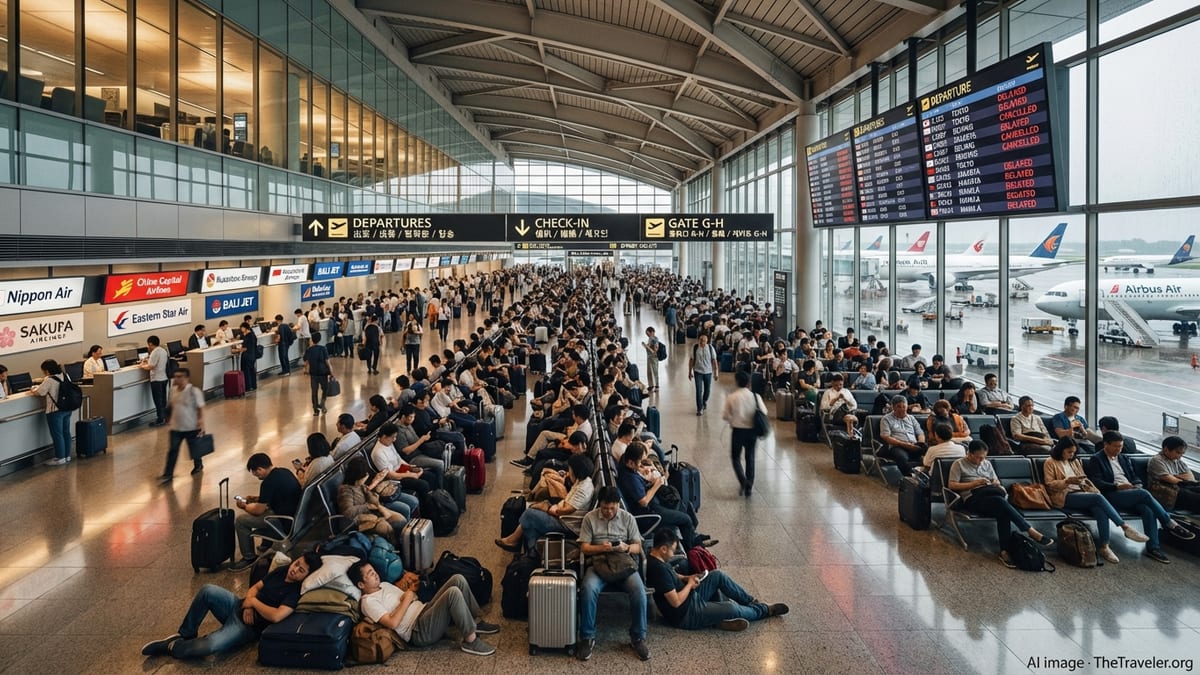
Flight Disruptions Ripple Across Major Hubs
Publicly available figures from Indonesia’s Transport Ministry and national media indicate that as of Monday afternoon, 2,961 domestic and international flights had been disrupted by the spread of Anak Krakatau’s ash cloud. The tally covers 2,339 domestic services and 622 international routes, affecting travel across the world’s largest archipelago.
The bulk of the disruption has centered on Jakarta, where Soekarno-Hatta International Airport, one of Southeast Asia’s busiest hubs, experienced a full shutdown as ash drifted over the capital region. Halim Perdanakusuma Airport, which handles domestic and some government flights, was also closed, creating a bottleneck for both domestic connections and long haul services.
Regional gateways including airports in South Sumatra, Lampung and West Java experienced extended closures or restricted operations as airspace advisories were updated in response to shifting ash clouds. Some services were diverted to unaffected airports, while others were canceled outright as carriers adjusted schedules around the evolving conditions.
Data compiled by Indonesian outlets shows that the disruption extended beyond Indonesia’s borders, with international links to Australia, the Middle East and other parts of Asia suspended or rerouted, highlighting the wide geographic reach of the ash plume that rose to cruising altitudes used by commercial jets.
341,000 Travelers Stranded as Closures Stretch Into Days
Government briefings and media coverage estimate that roughly 341,000 passengers have been affected by delays, diversions and cancellations since Anak Krakatau’s latest eruptive phase intensified late last week. The figure includes travelers who were stranded in terminals, those stuck at origin cities unable to depart, and passengers whose itineraries were abruptly rerouted through alternative hubs.
Images and eyewitness accounts from Jakarta’s Soekarno-Hatta airport show crowded departure halls with long queues at airline service counters and information displays dominated by cancellation notices. Similar scenes were reported from Bali’s I Gusti Ngurah Rai International Airport and other regional gateways, where passengers transiting via Jakarta saw onward connections suddenly removed from departure boards.
Reports indicate that several airlines, including low cost and full service carriers, introduced flexible rebooking policies, fee waivers and refund options as the scale of the disruption became clear. However, the combination of airport closures, limited spare capacity and continuing uncertainty about ash conditions left many travelers facing multi day delays and complex re routing challenges.
Beyond commercial aviation, local coverage notes that four Indonesian provinces shifted some schools to online learning due to ash fall, while coastal communities in Banten and Lampung temporarily curtailed fishing as authorities monitored visibility, air quality and maritime safety around the Sunda Strait.
Why Volcanic Ash is So Dangerous to Aviation
The sweeping shutdown of airspace around Anak Krakatau reflects the particular hazards that volcanic ash poses to aircraft. Unlike ordinary weather clouds, volcanic ash is composed of microscopic fragments of rock and glass that can sandblast windscreens, clog sensors and, most critically, melt inside jet engines before resolidifying on turbine blades.
International aviation guidelines require airlines and air navigation services to avoid ash contaminated airspace entirely, since even low concentrations can threaten engine performance and flight safety. In the case of Anak Krakatau, ash plumes were reported at altitudes up to around 50,000 feet, overlapping the cruising levels used by most commercial jets and forcing extensive rerouting or ground stops.
Indonesia’s air navigation authorities relied on advisories from the Darwin Volcanic Ash Advisory Centre in Australia and domestic monitoring agencies to determine when specific flight corridors or entire airports had to be closed. These advisories combined satellite imagery, pilot reports and ground based observations to track the dispersion of ash as winds shifted over Java, Sumatra and the Java Sea.
The wide footprint of the ash cloud underscores how a single volcanic event can cascade through regional and global aviation networks, particularly when it intersects with a major hub like Jakarta and key domestic corridors that link thousands of islands spread across a vast maritime territory.
Anak Krakatau’s Eruption and Volcanic Background
Anak Krakatau, whose name means “Child of Krakatoa,” sits in the Sunda Strait between Java and Sumatra, rising from the underwater caldera left by the catastrophic eruption of Krakatoa in 1883. That historic event generated tsunamis and atmospheric shock waves that were recorded around the world, cementing the volcano’s notoriety in geological history.
Since emerging above sea level in the late 1920s, Anak Krakatau has gone through repeated cycles of growth and partial collapse. It is classified as an active stratovolcano, producing frequent eruptions of ash, lava and gas, and has long been monitored by Indonesia’s volcanology agencies and international observers.
The current episode follows several days of elevated seismicity and intermittent ash emissions. Local reporting describes an eruption that intensified over the weekend, sending dense ash columns high into the atmosphere and triggering a sequence of protective measures for aviation, coastal activities and nearby communities.
Memories remain fresh of the 2018 eruption and sector collapse of Anak Krakatau, which generated a tsunami in the Sunda Strait and caused significant loss of life along parts of the Java and Sumatra coasts. In the present event, disaster monitoring agencies have emphasized tsunami surveillance, and publicly available information so far points to heightened caution rather than repeat coastal flooding.
Gradual Reopenings, Ongoing Caution for Travelers
By Tuesday, some international media and local outlets reported that Indonesia’s main airport in Jakarta had begun a phased reopening after a roughly two day shutdown, with the first departures and arrivals cleared once ash concentration levels fell below critical thresholds along key approach paths.
Even as runways reopen, schedules remain severely disrupted. Airlines are prioritizing stranded passengers, repositioning aircraft and crew, and attempting to clear backlogs while maintaining mandatory duty time limits and safety protocols. Recovery operations are expected to continue for several days, particularly on high demand domestic routes that lost multiple daily rotations.
Travel advisories from carriers and airport operators recommend that passengers confirm their flight status before heading to the airport, expect irregular operations, and allow extra time for check in and security. Some travelers may continue to experience last minute changes as ash forecasts are updated and as Anak Krakatau’s activity fluctuates.
The Anak Krakatau episode highlights both Indonesia’s exposure to geophysical hazards and the dependence of its tourism and business sectors on resilient aviation links. As ash levels subside and services resume, attention is likely to focus on how contingency planning, passenger communication and cross border coordination can be strengthened before the next inevitable volcanic event interacts with one of Asia’s busiest air networks.
ANTARA News: Anak Krakatau ash disrupts 2,961 flights, strands 341,000 passengers
Channel NewsAsia: Several Indonesian airports remain shut due to volcanic ash from Anak Krakatau
The Independent: Indonesia reopens airports after volcanic eruption strands travellers
Republika: Anak Krakatau eruption affects 2,961 flights and 341,000 passengers nationwide