


Nadi International Airport is the main gateway to Fiji and, for most visitors, the first moment when paradise meets practical logistics. After a long flight, knowing exactly how to find a taxi, what it should cost, and how to pay in Fijian dollars can make the difference between a smooth arrival and an expensive headache. This guide brings together the latest on official taxi ranks, fares, cash tips and common pitfalls so you can step out of Nadi Airport with confidence.
Get the latest updates straight to your inbox!
How Nadi Airport Taxis Work
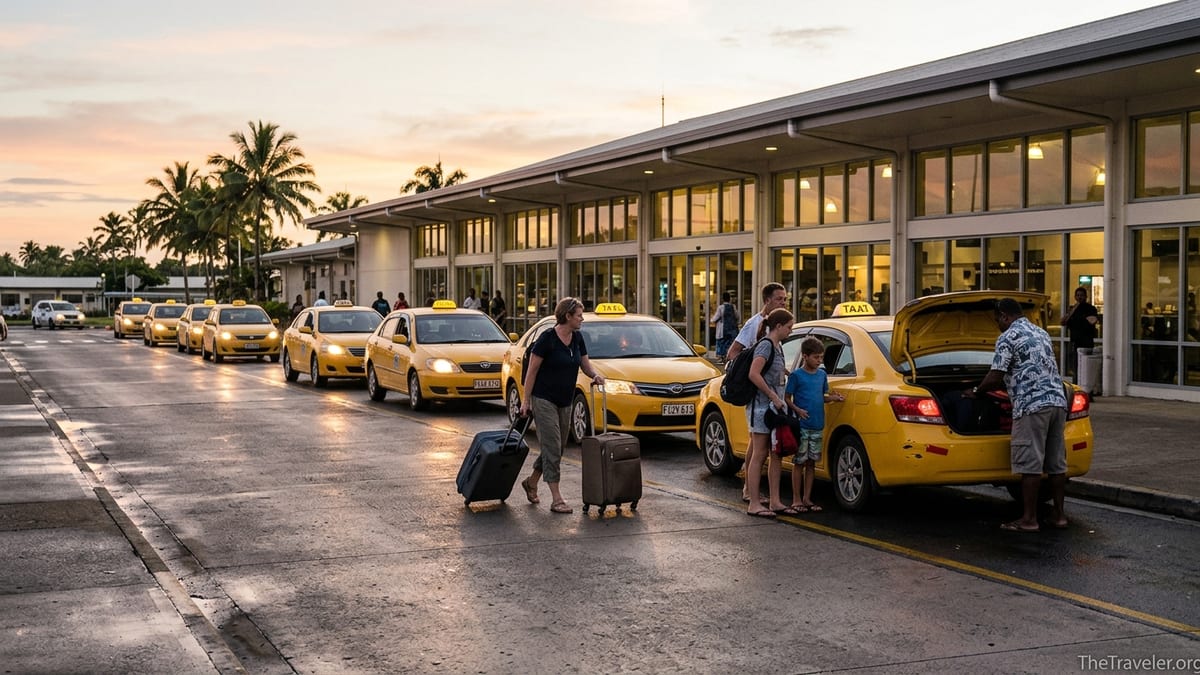
Nadi International Airport sits about 9 kilometres from Nadi town and is the primary entry point for visitors heading to Denarau Island, the Coral Coast, the Mamanuca ferries and beyond. Outside the international arrivals hall you will find a dedicated rank of yellow airport taxis, which are the only taxis allowed to pick up directly from the terminal. These are standard four-seat sedans, with a smaller number of larger vans for families or groups with surfboards and dive gear.
Airport taxis at Nadi operate under their own regulated fare structure, separate from regular town taxis elsewhere in Fiji. The Fijian Competition and Consumer Commission publishes authorised airport taxi fares, with a higher starting charge than in Nadi town and a distance-based component. In practice, this means you will usually pay more from the airport than you would for a similar distance starting in town, but you are paying for the convenience of walking straight out of arrivals and into a licensed vehicle.
While local experiences vary, it is officially mandatory for airport taxis to use their meters for all journeys from Nadi Airport. Inside the car, you will see a digital meter near the dashboard that shows the starting “flagfall” and then increments as the car moves. Some drivers may offer a flat price instead of the meter, especially at busy times, but as a visitor you are safest insisting that the meter is switched on before the car leaves the curb.
Hotel shuttles, pre-booked private transfers and tour-company coaches also operate from Nadi International Airport, but they use a separate pick-up area and must be arranged in advance. If you simply walk out of customs without a booking, the yellow airport taxis at the rank will be your most straightforward option to reach Nadi, Denarau or Lautoka.
Finding the Taxi Rank and What to Expect on Arrival
Once you clear immigration and customs at Nadi International Airport, you will step into the public arrivals hall, where you will see currency exchange counters and ATMs on your left and several tour and hotel desks ahead of you. To reach the official taxi rank, exit through the main doors at the front of the terminal. The line of yellow airport taxis is usually directly in front of arrivals, slightly to one side, with a simple queuing area and sometimes a marshal who helps direct passengers.
At busier times, such as morning arrivals from Australia and evening flights from North America, expect a short wait in the taxi line. Queues tend to move quickly, as many travellers are going to nearby Nadi or Denarau and turnaround times are short. If you are heading further afield, such as to the Coral Coast or Pacific Harbour, it is helpful to confirm that your driver is comfortable with the route before loading your bags, especially late at night.
The drivers at the airport rank are accustomed to visitors who have just landed and may not know local geography. It is usually enough to tell them your hotel name, such as “The Westin Denarau,” “Hilton Fiji Beach Resort,” or “Tanoa International Hotel near the airport.” Most drivers know the main resorts by name. If you are staying at a smaller guesthouse in Nadi town, have the address written down or on your phone so the driver can double-check the location.
As you approach the car, look for a clearly displayed taxi licence number and a meter on the dashboard. The taxis themselves are often yellow, sometimes with a light blue plate or ND registration indicating airport licensing. You should not need to negotiate with touts inside the terminal; simply join the rank and take the next licensed vehicle in line.
Typical Fares and Real-World Examples
Fares from Nadi Airport vary according to distance and traffic, but by combining official guidance and recent traveller reports, it is possible to outline realistic price ranges. Within the immediate airport area, such as to Tanoa International Hotel or nearby budget motels, you might pay somewhere in the region of 10 to 20 Fijian dollars, depending on waiting time at lights and any short detours.
For Nadi town, which is roughly 9 kilometres away, most visitors report paying around 15 to 20 Fijian dollars in a metered airport taxi. A typical example is a ride from Nadi Airport to the Nadi market or main bus station, coming in at just under 20 Fijian dollars in normal traffic. If a driver quotes a flat 40 Fijian dollars for this short hop without using the meter, that is at the very top end and you would be reasonable to insist on the metered rate instead.
Denarau Island, home to large resorts like the Sheraton, Sofitel, Radisson Blu and the Port Denarau marina, sits a little further away. Current guide prices from a variety of sources suggest a typical fare from Nadi Airport to Denarau in the range of about 30 to 45 Fijian dollars for a standard taxi, depending on exact destination on the island and time of day. Travellers continue to report real fares in the high twenties to mid-thirties when the meter is used, with higher quotes when drivers propose a flat fee.
For longer journeys, costs rise accordingly. A taxi from Nadi Airport to Lautoka, the main town to the north, usually falls somewhere around 40 to 50 Fijian dollars. Trips down the Coral Coast, such as to resorts near Sigatoka, can push over 150 Fijian dollars and sometimes more, reflecting both distance and limited alternative options late at night. For these longer transfers, consider comparing a metered taxi quote with pre-booked private transfer prices from established operators, as the difference may be small once you factor in comfort and guaranteed pick-up.
Meters, Cash in Fiji Dollars and Payment Tips
The single most important rule for taxis at Nadi Airport is to make sure the meter is on. When you sit down, glance at the meter and check that it shows the flagfall, which will be higher than the base fare you might see in Nadi town. Politely saying “Meter, please” before the car pulls away is normal, and good drivers will switch it on without hesitation. If a driver strongly resists using the meter and insists on a high flat rate, you can step out and take the next taxi in the rank.
Fares at Nadi Airport must be paid in Fijian dollars. While some drivers accept foreign currency informally, you will almost always get a poor exchange rate and may struggle with change. Before leaving the terminal, use one of the ATMs in the arrivals hall to withdraw Fiji dollars, or visit a currency exchange counter if you are comfortable with the offered rate. Having at least 100 to 150 Fijian dollars in small notes is helpful for your first taxi ride and incidental expenses like snacks or a SIM card.
Card payments are not the norm in Nadi taxis. A few drivers may have mobile card terminals, especially those who work closely with resorts or corporate clients, but as a visitor you should assume taxis are cash-only. Plan your withdrawals accordingly. If your first stop is a major resort such as those on Denarau Island, you can also use ATMs in the hotel lobby later, but having cash at the airport makes the initial transfer smoother.
Tipping in Fiji is not mandatory and is not expected in the same way as in North America. However, rounding up the fare or leaving a small token of appreciation is common. For instance, if the meter shows 18.50 Fijian dollars, many visitors simply hand over 20 and tell the driver to keep the change, especially if they helped with heavy luggage or offered friendly local advice. For longer trips like to Lautoka or the Coral Coast, adding a few dollars on top of the metered fare is a generous but optional gesture.
Late Arrivals, Luggage and Traveling With Kids
Nadi International Airport handles flights throughout the day, and many long-haul services from North America and Asia arrive either late at night or very early in the morning. The good news is that airport taxis operate whenever international flights are scheduled. Even if you land after midnight, you can expect to find yellow taxis waiting outside arrivals, though there may be fewer cars than during the daytime peaks.
For late-night arrivals, it is especially important to use the official taxi rank rather than accepting offers from individuals inside the terminal. When you reach the front of the line, tell the driver your destination and confirm that the meter will be used. It is also sensible to have your accommodation name written down, as smaller guesthouses may be harder to find in the dark. Most drivers are familiar with the major resorts and can navigate them without issue, even at 2 a.m.
Luggage is usually included in the standard taxi fare from Nadi Airport. There is no common practice of charging per suitcase, and travellers regularly report drivers loading two or three large bags into the boot without any discussion of extra fees. If you are traveling with oversized items such as surfboards, golf bags or dive tanks, you may be steered towards a larger van-style taxi or asked a modest supplement, but this should be agreed before departure.
Families with children can comfortably use airport taxis. Child seats are not standard equipment in Nadi taxis, so if you require one for safety reasons you will need to bring your own or pre-book a transfer company that can provide age-appropriate seats. Inside the car, seat belts are usually available in the front and rear, though older vehicles may have only lap belts in some positions. Take a moment before leaving the rank to check belts and ensure everyone is safely strapped in.
Avoiding Informal Offers and Overcharging
Like many busy island gateways, Nadi International Airport attracts a mix of licensed operators and informal would-be drivers. To stay safe and avoid overpaying, your best strategy is simple: walk straight past any individuals approaching you inside the terminal with unofficial offers and head to the clearly marked taxi rank outside. Licensed airport taxis are subject to regulation and checks, whereas informal drivers may not carry the proper public service licences or insurance.
Overcharging at Nadi Airport usually appears in two forms. The first is a driver refusing to use the meter and quoting a flat fare that is significantly above normal. For example, being quoted 50 Fijian dollars for a short ride to Nadi town that would normally cost under 20 on the meter. The second is a more subtle version, where the flat price is only slightly higher than the expected range but still padded, such as 45 Fijian dollars to Denarau when most metered trips fall in the low thirties.
You can protect yourself by having a general sense of what your trip should cost before you land. If you know that Nadi Airport to Denarau is typically around 30 to 45 Fijian dollars, you are better placed to push back if someone suggests 70. A polite but firm “Can we use the meter, please?” is usually enough. If a driver insists on an unreasonable flat rate, do not feel pressured to accept. Step out, return to the queue and wait for another taxi.
It can also help to ask hotel staff at check-in what they consider a normal taxi fare back to the airport, then keep that figure in mind for your departure. If you happen to have a positive experience with a particular driver, taking their mobile number and arranging your return trip directly is common practice in Fiji. Many visitors leave with the contact details of a favourite taxi driver who looked after them during their stay.
Alternatives to Taxis and When They Make Sense
Although this guide focuses on taxis, it is useful to understand what other options exist from Nadi International Airport and when they might be better value. Several large resorts, particularly on Denarau Island, operate their own shuttle buses at fixed times that meet popular flights. These can be included in accommodation packages or charged per person. If you are traveling solo or as a couple and your hotel shuttle aligns with your arrival time, it may be cheaper than a private taxi.
Private transfer companies, such as established operators based in Nadi, offer pre-booked cars and vans with meet-and-greet services inside the arrivals hall. For journeys longer than the short hop to Nadi or Denarau, such as to the Coral Coast or Pacific Harbour, these fixed-price transfers can be competitive with, or even cheaper than, taking a metered taxi all the way. They also often include options like guaranteed air-conditioned vehicles, bottled water and pre-arranged child seats.
Public buses run along the Queen’s Highway and stop outside the departures terminal at Nadi Airport rather than directly at arrivals. They are by far the cheapest way to reach Nadi or Suva, with fares between Nadi and Suva typically under 25 Fijian dollars, but they are slower and less convenient, particularly with heavy luggage. You will also need a disposable e-ticketing card, which can be purchased at a mobile phone counter in the terminal.
Ride-share platforms popular elsewhere, such as Uber or Lyft, are not currently available in Fiji. A few locally developed taxi apps and informal Facebook groups exist, but these are far from universal and should not be relied on for a late-night airport pick-up. For now, the practical reality is that your main options at Nadi International Airport remain the official taxi rank, resort shuttles and pre-booked private transfers.
The Takeaway
Arriving at Nadi International Airport should feel like the start of your holiday, not a stressful negotiation. Understanding how the airport taxi system works, what the meter should do, why you need Fiji dollar cash and what a realistic fare looks like puts you in control as soon as you step out of customs. Yellow airport taxis are convenient, regulated and generally reliable when the meter is used properly.
As a rule of thumb, expect to pay roughly 15 to 20 Fijian dollars to Nadi town, around 30 to 45 Fijian dollars to Denarau Island and more for longer journeys to Lautoka or the Coral Coast. Always ask for the meter, carry enough Fiji dollars to cover your ride, and be cautious of informal offers inside the terminal. With these basics in mind, your first journey from Nadi Airport can be as relaxed and welcoming as the rest of your time in Fiji.
FAQ
Q1. Where is the official taxi rank at Nadi International Airport?
The official taxi rank is directly outside the international arrivals hall. Exit the terminal through the main doors and you will see a line of yellow airport taxis slightly to one side with a simple queue area.
Q2. How much should a taxi from Nadi Airport to Denarau Island cost?
Most recent reports suggest a typical fare of around 30 to 45 Fijian dollars in a standard taxi from Nadi Airport to Denarau, depending on exact hotel location and traffic.
Q3. Do Nadi Airport taxis accept credit cards?
In general, no. Most airport taxis are cash-only, so you should withdraw Fiji dollars from an ATM or use a currency exchange counter in the arrivals hall before you leave the terminal.
Q4. Is it safe to take a taxi late at night from Nadi Airport?
Yes, using the official taxi rank is considered safe even for late-night or early-morning arrivals. Licensed taxis operate whenever international flights are scheduled, though there may be fewer vehicles than during the day.
Q5. Should I agree to a flat fare or insist on the meter?
It is safer to insist on the meter, which is supposed to be used on all airport journeys. You can accept a flat fare if it is clearly within the normal range you expect, but avoid unreasonably high quotes.
Q6. Can I pay for a Nadi Airport taxi in foreign currency?
Some drivers may accept foreign currency informally, but the exchange rate is usually poor and change can be an issue. It is much better to pay in Fiji dollars.
Q7. Are there extra charges for luggage or surfboards?
Standard checked luggage is normally included in the fare. For bulky items like surfboards or dive gear, you may be directed to a larger vehicle and asked for a modest supplement, which should be agreed before departure.
Q8. Do taxis from Nadi Airport provide child seats?
Child seats are not typically provided in regular taxis. If you need one, bring your own or pre-book a transfer company that can guarantee an age-appropriate seat for your child.
Q9. Are ride-share services like Uber available at Nadi Airport?
No, international ride-share platforms such as Uber and Lyft are not currently available in Fiji. At Nadi Airport, you will rely on taxis, resort shuttles or pre-booked private transfers instead.
Q10. How can I avoid being overcharged for a taxi at Nadi Airport?
Use the official taxi rank, ask for the meter to be turned on, have a rough idea of typical fares to your destination and do not hesitate to decline a ride if a driver insists on an unreasonable flat price.