


Antalya Airport is one of the busiest holiday gateways in the Mediterranean, serving millions of travelers heading to Türkiye’s Turquoise Coast. Departures can feel hectic in peak summer, but with a clear idea of how the airport works and what to expect at each stage, you can turn a stressful send-off into a smooth finish to your trip. This guide walks you through check-in timing, security, passport control, terminal layout, food and duty free, lounges, family facilities and boarding, with concrete examples to help you plan.
Get the latest updates straight to your inbox!
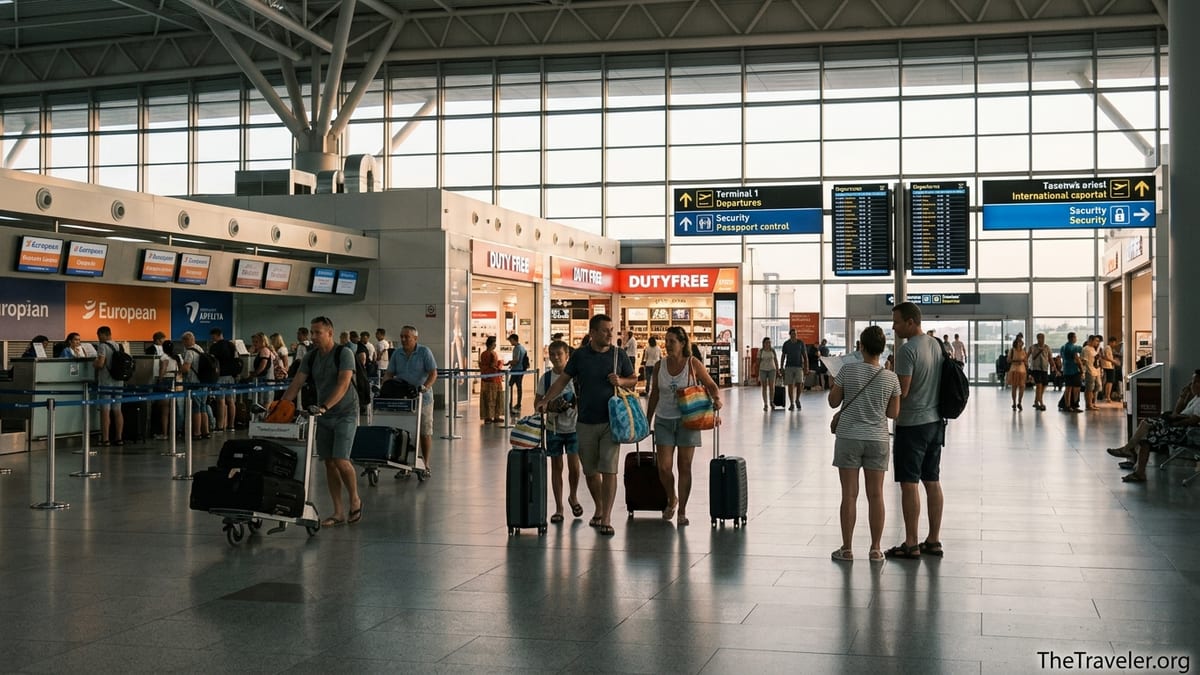
Understanding Antalya Airport’s Terminals and Departure Flow
Antalya Airport (AYT) currently operates three main passenger terminals: Terminal 1 and Terminal 2 for most international flights, and a separate Domestic Terminal for flights within Türkiye. Charter and low-cost carriers serving European holiday markets typically use Terminal 1 or Terminal 2, while Turkish Airlines and Pegasus domestic services usually depart from the Domestic Terminal. Your terminal is printed on your booking or e-ticket; if it is not obvious, check with your airline or tour operator before you travel, as the correct drop-off point saves significant time.
In practical terms, Terminal 1 and Terminal 2 feel similar once you are past security: each has standard check-in halls on the landside, followed by security and passport control, then a departures concourse with duty free, cafés and boarding gates. The Domestic Terminal is smaller and simpler but can feel just as busy at peak times, for example on Sunday evenings at the end of school holidays. All terminals are managed by Fraport TAV, which means signage, security procedures and commercial areas are broadly consistent, even if individual shops differ.
From curbside to gate, the basic departure sequence is the same in every terminal. You enter the landside hall, clear the initial security screening at the terminal entrance, check in and drop bags, then clear outbound security and passport control (for international flights) before entering the airside departures area with shops, food outlets and gates. Walking times airside are generally short compared with giant hubs: most gates in Terminal 1 or Terminal 2 are within roughly a five to ten minute walk of the main duty free shop. This compact layout makes it easier to enjoy a meal or browse shops without worrying that your gate is a long trek away.
Seasonality matters. Antalya’s traffic is highly concentrated between roughly April and October, with July and August especially busy. In those months, it is normal to see long taxi lines at the terminal access roads and heavily used check-in zones for major tour operators serving Germany, the United Kingdom, the Netherlands and Scandinavia. Build this into your plan: a departure process that feels relaxed in February can feel crowded and rushed in August, even though the official procedures are identical.
Check-in Timing, Airlines and Baggage Drop
For international departures, most airlines serving Antalya open their check-in counters about three hours before scheduled departure, and some long-haul or high-volume charter flights may open slightly earlier. For example, a morning SunExpress flight to Frankfurt or a TUI charter to Manchester typically allows passengers to check in from around three hours out, while major network carriers like Turkish Airlines for connections via Istanbul often follow similar windows. As a safe rule of thumb, plan to arrive at the correct terminal two and a half to three hours before an international flight and around two hours before a domestic one, adding extra time if you are traveling in peak school holiday weeks or on a Saturday.
Many carriers now encourage or require online check-in, which usually opens 24 to 48 hours before departure. Even if you check in online and obtain a mobile or printed boarding pass, you will still need to use a bag-drop counter if you have checked luggage. For example, if you are flying EasyJet or Corendon with hold baggage, you might use the airline’s dedicated bag-drop line in the same check-in island as standard counters. These lines can be shorter than full-service check-in, but in busy periods they can still back up, so do not cut your timing too fine simply because you already have a boarding pass.
If you are part of a package holiday, your tour operator usually has a branded check-in island. In Terminal 1 and Terminal 2, large European operators such as TUI, FTI or Jet2 often group several departure flights together under one line of desks. Practical example: if you are on a Jet2 package from Antalya to Leeds Bradford, you may find your check-in area marked by Jet2 signage listing multiple UK destinations; staff will direct you to the correct desk for your specific flight. Having your passport and booking reference ready before you reach the counter speeds things up considerably.
Oversized baggage deserves special attention. Items such as golf bags, surfboards, pushchairs or large musical instruments are normally tagged at the main check-in desk, then handed over at a nearby oversized baggage belt. In Antalya, these belts are generally within view of the regular counters, but do not assume they are directly beside them; look for overhead signage or ask the agent. Outsize baggage screening can add ten to fifteen minutes to your process, particularly at busy times when many travelers are checking in sports gear for resort holidays.
Security Screening, Passport Control and Fast Track Options
Security at Antalya Airport follows standard European practice. You will first pass a preliminary screening at the terminal entrance, where bags pass through an x-ray machine and passengers may go through a metal detector. Later, after check-in and before entering departures, you pass through the main security checkpoint. Liquids are subject to the familiar 100 milliliter container rule in a one-liter transparent bag, and large electronics such as laptops are typically removed from cabins bags for screening. It is wise to prepare before you reach the front of the line by emptying your pockets, removing belts with large buckles and keeping your liquids bag easily accessible.
After the main security checkpoint, international passengers proceed directly to passport control. Here, Turkish border police will check your passport and any visa or e-visa you require for your journey. In peak summer evenings, especially on weekends when many charter flights depart to German and British cities, queues here can lengthen considerably. Families can reduce stress by keeping passports sorted by traveler and opening passports to the photo page before reaching the officer, while non-European Union travelers should have onward travel documentation handy in case of questions.
Fast track options are available at Antalya through several providers. Some airlines and tour operators include fast track security or passport control lanes for business class passengers or premium package guests. In addition, Fraport TAV and partner companies sell fast track or meet and assist products that combine priority security with lounge access. For instance, a couple flying from Terminal 1 to London might purchase a combined fast track and CIP lounge package through a local agency, which allows them to bypass the main security queue and wait in a quieter environment airside. Prices vary depending on season and provider, but travelers often report paying a moderate surcharge per person for this convenience, which can feel worthwhile on peak travel days.
If you do not have fast track, you can still reduce waiting stress by choosing your timing carefully. Arriving very early in the small hours, for example at 2:30 for a 5:00 departure, can sometimes mean shorter security lines in shoulder season, but in dense charter waves there may be another bank of flights checking in at the same time. Watching the check-in hall and proceeding to security promptly once you have your boarding pass, rather than lingering landside, is generally the best strategy. Once you clear security and passport control, you will have access to the full range of airside cafés, duty free and seating areas.
Food, Shopping and Duty Free Before Your Flight
After passport control, the departures areas in Terminal 1 and Terminal 2 open into large duty free and shopping zones. The main duty free operators stock an extensive range of international spirits, wine, tobacco, confectionery, cosmetics and perfumes from familiar brands such as Absolut, Johnnie Walker, Toblerone, Lindt, Estée Lauder, Chanel and Dior, alongside regional items like Turkish delight, baklava gift boxes and local olive oil soaps. Prices for major international brands are often competitive compared with city-center shops, though some travelers find that local products such as sweets or nuts can be better value in Antalya’s markets or supermarkets than at the airport.
Beyond duty free, the terminals feature a mix of international and Turkish food outlets. You can expect to find coffee chains selling espresso drinks, pastries and sandwiches, plus fast-food style counters offering burgers, pizza slices or grilled items. Many travelers report that airside food prices at Antalya are relatively high by local standards, with a simple cappuccino and pastry costing more than in downtown Antalya. As a practical example, paying the equivalent of several euros for a basic coffee or branded bottled water is common inside the secure area. If you prefer to limit costs, consider having a more substantial meal in the city or your hotel before heading to the airport, then using airport cafés for lighter snacks only.
For those wanting a final taste of Turkish cuisine, look for counters serving simit (sesame-coated bread rings), gözleme (stuffed flatbreads) or kebab-style grilled meats. While the flavors may not match your favorite local restaurant, they can provide a satisfying send-off. You will also find stands selling last-minute souvenirs such as Nazar “evil eye” charms, magnets and beachwear. These are convenient if you have forgotten gifts, but as with many tourist airports, prices are usually higher than in town. Still, a small box of pistachio baklava or a tin of Turkish tea from the airport shop can be an easy gift solution if you run out of shopping time earlier in your trip.
One reassuring point about Antalya’s design is that gates are not far from the main shopping area. The airport operator notes that from most shops and restaurants it is only a short walk to any boarding gate. That means you can sit at a café near duty free and still reach your gate quickly once boarding is called, as long as you keep an eye on the departure screens and listen for announcements. However, at very busy times, queues at certain popular food outlets can be long, so avoid leaving purchases until the last twenty minutes before scheduled boarding if you can.
Lounges, CIP Services and Quiet Spaces
Antalya Airport offers a network of lounges across its terminals, operated in cooperation with Fraport TAV and various partners. These are often branded as CIP or Comfort lounges and are accessible to passengers regardless of airline or cabin class, provided they hold appropriate access. Access methods typically include airline status or business class tickets, credit card lounge programs, pre-booked passes through online platforms, or a bundled meet and assist package sold by hotels and tour operators. For instance, certain Antalya resort hotels advertise packages where departing guests are collected by private transfer, escorted through a dedicated CIP entrance at Terminal 1 or Terminal 2, and then hosted in a lounge with buffet snacks, drinks and Wi-Fi until boarding.
Within the lounges, travelers usually find soft seating, complimentary hot and cold snacks, tea, coffee, soft drinks and in some cases alcoholic beverages, along with business corners and children’s play areas. A family leaving on an evening flight to Berlin, for example, might choose to spend two to three hours in an international departure lounge where children can sit on sofas, connect to Wi-Fi and watch cartoons while parents enjoy light buffet dishes and charge their phones. Access prices reported by travelers vary by season and provider, but it is common to see per-person rates that are roughly in line with other Mediterranean leisure airports, sometimes with discounts for children.
Domestic passengers are not left out. The Domestic Terminal also offers lounge facilities, often used by frequent flyers of Turkish carriers or by travelers who purchase a separate lounge pass. These lounges are generally more compact than their international counterparts but provide similar basics: seating, refreshments and quiet away from the crowds. If you hold premium status with a Turkish or partner airline, check whether your card grants access to specific lounges at Antalya, as terms can differ between domestic and international facilities.
Outside formal lounges, Antalya’s terminals have scattered seating areas where you can rest without paying extra. Power outlets are available in some seating zones, particularly near newer boarding gates or at café seating. However, during peak outbound waves, these public seats can fill quickly, pushing late-arriving passengers to stand near their gates or lean at high-top tables by cafés. If you want guaranteed space and a calmer atmosphere, especially when traveling with young children or older relatives, paying for lounge access or a packaged CIP service can represent a worthwhile comfort upgrade for the final hours of your holiday.
Family Facilities, Accessibility and Practical Tips
Families departing from Antalya will find a range of basic facilities that make flying with children more manageable. Baby changing rooms are available in most restroom clusters, both landside and airside, and are generally signposted in both Turkish and English. Some lounges include small play corners or at least space where toddlers can move around more freely than in the public seating areas. In the wider terminal, you may see small soft play structures or themed areas; however, availability can vary by terminal and by any ongoing refurbishment, so consider simple entertainment like coloring books, downloaded cartoons or small toys as your main strategy.
Strollers and prams can usually be checked at the gate with many airlines. For example, a family flying Pegasus to Istanbul may be allowed to use their stroller up to the aircraft door, where crew then stow it in the hold and return it at the destination. Policies differ slightly by carrier, so check when you receive your boarding pass. If you hand over your stroller at check-in instead, be prepared to carry or use a baby carrier throughout security and the long-ish walk past duty free to the gate, which can feel tiring in crowded conditions.
For travelers with reduced mobility, Antalya offers standard assistance services that can be booked in advance through your airline. This may include wheelchair help from the drop-off zone through check-in and security to the gate, or from arrival to baggage claim and ground transport. In practice, passengers who request assistance in advance usually meet a staff member at a designated point in the departure hall or at the check-in counter. As at many busy resorts, summer demand for assistance is high, so confirming the service with your airline at least 48 hours before departure improves the chances of a smooth experience.
Other practical facilities include ATMs from major Turkish banks in the landside halls, currency exchange desks and pharmacy counters airside that offer basics such as over-the-counter pain relief, motion sickness remedies and travel-sized toiletries. Note that prices for medicine can be higher at the airport than in city pharmacies, and stock may be limited, so it is preferable to buy essential medication in town. Drinking water fountains are not as widely available as in some newer airports, which is one reason many travelers choose to buy bottled water after security despite the cost. If you are carrying an empty reusable bottle, be prepared that you may need to fill it from restroom taps rather than dedicated fountains.
Boarding Process and Last-minute Departure Tips
Boarding at Antalya follows airline-specific practices but tends to be brisk, especially for short-haul leisure flights. Gates are numbered clearly and indicated on overhead screens throughout the departures area. Many carriers board by seat row or by groups, and some encourage passengers who only have small cabin baggage to board earlier to speed up the process. It is smart to arrive at your gate at least 30 minutes before scheduled departure time for European flights, and a little earlier if you know your flight is full or you are traveling with a group.
At several gates, buses are used to transfer passengers to aircraft parked on remote stands. In this case, gate staff will scan your boarding pass, then direct you to a waiting bus. Once onboard, you may stand for several minutes while the bus fills, then travel across the apron to your plane. If you are traveling with small children or have reduced mobility, consider requesting to sit near the doors or asking staff if there is a less crowded alternate bus. In the heat of an Antalya summer afternoon, standing on a non-air-conditioned bus with a full load of passengers can feel uncomfortable, so having water handy and lightweight clothing is important.
Airlines are generally strict about gate closing times. If your boarding pass states that the gate closes 20 minutes before departure, treat this seriously. In high-volume charter operations, carriers often have tight turnaround schedules, so late passengers can easily miss flights even if they are physically in the terminal. A common pitfall is losing track of time in a restaurant or duty free shop, assuming that announcements will always reach you. Public address calls may be hard to hear above crowd noise, and language barriers can add to confusion, so relying solely on last-call announcements is risky.
Before leaving the departures hall, do a final check: passport, boarding pass, wallet, phone, chargers and any prescription medication should be on your person, not in checked bags. Remember that gate checks for cabin baggage size are increasingly common, particularly with low-cost airlines. If your carry-on looks borderline, staff may ask to place it in a sizer frame and, if it does not fit, send it to the hold with an extra fee payable at the gate. To avoid delays and unexpected charges, measure your bags against your airline’s published size limits before traveling to the airport, and pack accordingly.
The Takeaway
Departing from Antalya Airport can be straightforward if you understand the layout, arrive with realistic timing and make a few informed choices about security, food and comfort. Knowing your correct terminal, arriving two and a half to three hours before an international flight in high season, and moving promptly from check-in to security are simple steps that dramatically reduce stress. Once airside, the compact layout means gates are never far from cafés and duty free, as long as you keep an eye on screens and avoid getting too absorbed in last-minute shopping.
For added comfort, especially in the dense summer charter months, consider whether fast track access or a lounge makes sense for you, and factor in Antalya’s relatively high airside prices when planning your food and shopping. Families and travelers with reduced mobility will find standard facilities and assistance options, though booking and preparation remain important. With a bit of advance planning and realistic expectations, your departure from Antalya can feel like a relaxed final chapter to your holiday rather than a stressful obstacle on the way home.
FAQ
Q1. How early should I arrive at Antalya Airport for an international flight?
For most international flights, aim to arrive at your correct terminal two and a half to three hours before departure, and add extra time during July and August or on weekends.
Q2. Which terminal do international flights use at Antalya Airport?
Most international flights use Terminal 1 or Terminal 2, while domestic flights generally use the Domestic Terminal. Your booking or e-ticket should indicate the terminal, so check this before you travel.
Q3. Is online check-in enough, or do I still need to go to the counter?
Online check-in gives you a boarding pass, but if you have checked luggage you must still use your airline’s bag-drop counter. If you are traveling with hand luggage only, you can usually go straight to security.
Q4. Are there fast track security lanes at Antalya Airport?
Yes, fast track options are available through some airlines, tour operators and paid services sold by Fraport TAV and local partners. These typically allow you to use a dedicated security and sometimes passport control lane.
Q5. What kind of food and shopping can I expect after security?
After security and passport control you will find a large duty free area with international brands plus Turkish products, along with cafés, snack bars and fast-food outlets. Prices are generally higher than in the city.
Q6. Are there lounges at Antalya Airport and can anyone use them?
Yes, there are multiple lounges in both international and domestic departures. Access is available through airline status or business class, certain bank and credit card programs, or by purchasing a lounge pass or CIP package.
Q7. Is Antalya Airport family-friendly for travelers with children?
Antalya offers baby changing rooms, family restrooms and some play areas, especially inside lounges. However, terminals can be very busy in summer, so bringing your own entertainment for children is still important.
Q8. What should I know about boarding at Antalya Airport?
Boarding can involve either jet bridges or buses to remote stands. Be at your gate at least 30 minutes before departure, listen for announcements and be prepared for bus transfers in hot weather.
Q9. Can I use a stroller up to the aircraft door?
Many airlines operating at Antalya allow you to use your stroller until you reach the aircraft door, where it is tagged and placed in the hold. Policies vary, so confirm at check-in or with your airline in advance.
Q10. Are there facilities for passengers with reduced mobility?
Yes, assistance services such as wheelchairs and escort through check-in and security are available but must be requested through your airline in advance. Booking at least 48 hours before departure is recommended.