


More news on this day
Air travel across Asia and key Gulf hubs is facing fresh disruption as at least 334 flights are cancelled and 5,586 delayed, with services involving the United Arab Emirates, Russia, Qatar, Saudi Arabia and Indonesia particularly affected and major carriers such as Air China, Emirates, Saudia and Pegasus battling a rolling wave of schedule changes at airports including Dubai, Moscow, Doha, Riyadh and Jakarta.
Get the latest news straight to your inbox!
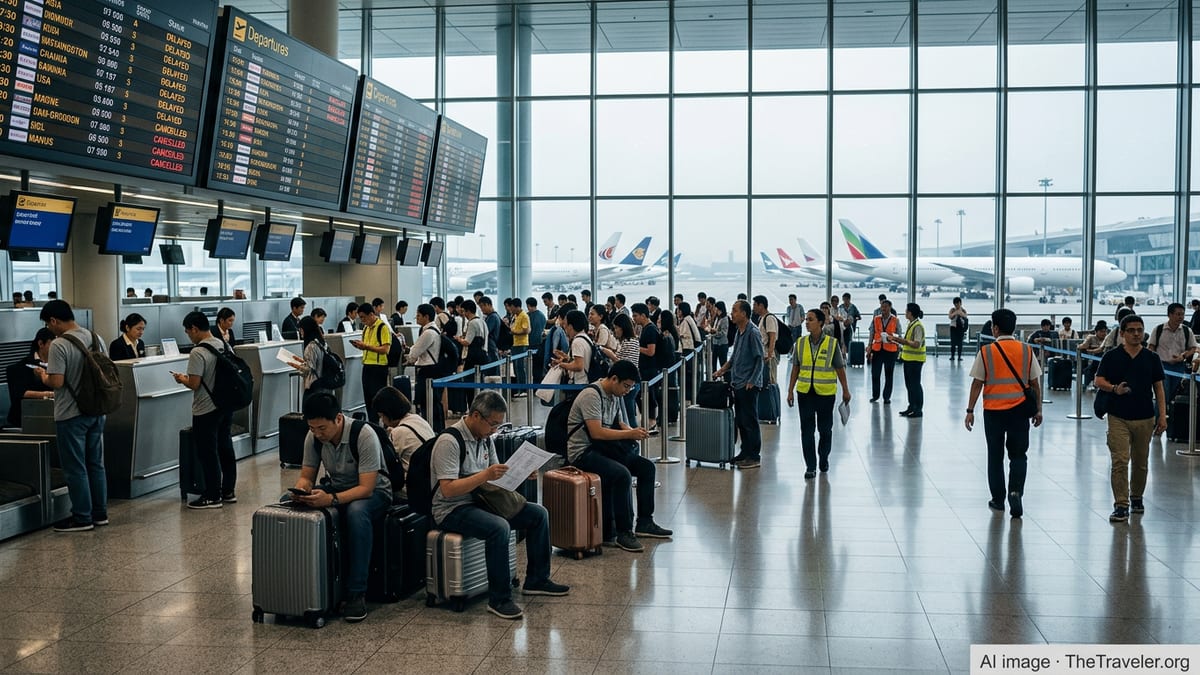
Wide-Ranging Cancellations From Gulf Hubs to Asian Gateways
Published data from flight-tracking platforms and airline advisories indicates that hundreds of flights have been grounded or rescheduled in recent days as airspace restrictions and operational constraints ripple across networks linking the Middle East, Russia and Asia. The impact is most visible at large transit hubs, where even brief suspensions can cascade into knock-on delays across multiple regions.
Dubai International and Doha’s Hamad International, two of the world’s busiest connecting airports, have seen clusters of cancellations affecting services to and from Asia, Europe and Africa. At the same time, Moscow’s major airports and Indonesia’s main international gateways, including Jakarta and Bali, have reported disrupted schedules on routes that typically rely on overflight access through Gulf and adjacent airspace.
While the exact daily impact fluctuates, aggregated figures show around 334 flights cancelled and more than 5,500 delayed across affected countries over a recent 24 to 48 hour period. Industry observers note that the imbalance between cancelled and delayed services reflects efforts by airlines to keep aircraft and crew in rotation where possible, even at the cost of extended wait times for passengers.
The latest wave of disruption follows months of heightened volatility in Middle East airspace, with earlier full or partial shutdowns forcing temporary suspension of departures and arrivals at major hubs. The current pattern is more fragmented but remains significant enough to reshape long-haul itineraries between Asia and Europe.
Major Carriers Adjust Networks in Real Time
Global and regional airlines are again redrawing their schedules as they respond to changing overflight permissions and evolving risk assessments. Publicly available information shows Emirates trimming and rerouting select services through Dubai, while continuing to operate a reduced but still extensive long-haul network that connects Asia to Europe and North America via the United Arab Emirates.
Qatar Airways has implemented rolling schedule revisions through Doha, with certain Asia bound and Europe bound flights suspended or merged, while others are retimed to operate outside constrained airspace windows. Passengers on affected itineraries have reported same day cancellations, last minute aircraft swaps and rebookings via alternative hubs in Asia or Europe as the carrier works within available corridors.
Saudi flag carrier Saudia is contending with both regional airspace complexity and localized disruptions, particularly on routes touching the country’s southern airports. Some domestic and international services routed through Riyadh and Jeddah have been adjusted to avoid bottlenecks and to manage knock on effects from earlier cancellations in the network.
In Russia and across parts of Asia, airlines including Aeroflot, Air China, Pegasus and several low cost operators have also had to recalibrate schedules. On some routes they are flying longer detours to bypass restricted zones, while on others they have reduced frequencies or paused operations altogether, especially where demand has softened in response to recent uncertainty.
Indonesia Feels the Impact Through Gulf Connections
Indonesia’s role as both a major outbound market and a popular leisure destination means it is particularly exposed to shocks affecting the big Gulf and Asian transit hubs. Jakarta and Bali rely heavily on connecting traffic routed through Dubai, Doha and other Middle Eastern airports, as well as through Russian and Northeast Asian gateways on certain long haul itineraries.
Recent days have seen further cancellations and delays on flights between Indonesia and the Gulf, including services marketed by Gulf carriers and their codeshare partners. Travellers heading to or from Indonesia via Dubai and Doha have reported itinerary changes, with some rebooked through alternative Asian hubs such as Singapore, Kuala Lumpur or Bangkok in order to avoid affected corridors.
National carrier Garuda Indonesia and regional competitors are also adapting to shifting conditions. Where Gulf or Russian connections are disrupted, they are attempting to reroute passengers through Southeast Asian and East Asian partners, though capacity on alternative routings can be limited during peak travel periods, leading to extended layovers or overnight stays.
Tourism officials and airport operators in Indonesia are monitoring the situation closely as the northern summer progresses, given the importance of reliable long haul connectivity for both inbound visitors and Indonesian residents working overseas in the Gulf and beyond.
Operational Pressures Drive Higher Delay Numbers
The disparity between the number of cancellations and the far larger volume of delays highlights the operational pressures facing airlines. Rather than cancel outright, many carriers are choosing to hold flights on the ground until new routings or departure slots can be secured, resulting in multi hour disruptions that nevertheless keep aircraft and crews within the schedule system.
Airspace closures and restrictions across parts of the Middle East have forced flight planners to file longer routes that skirt sensitive areas, adding significant extra flying time and fuel burn on some sectors. These extended routings can disrupt crew duty limits and aircraft rotation plans, creating downstream delays at hubs as planes and staff arrive later than scheduled.
Ground operations at busy airports are also affected when a cluster of delayed flights arrives within a compressed window, stretching resources such as gates, baggage handling and immigration processing. In hubs like Dubai, Doha and Riyadh this can translate into additional waiting time on the tarmac and longer queues in terminals, even for flights that depart close to schedule.
Analysts note that the cumulative effect of these operational challenges is reflected in the elevated delay count reported across the affected countries, where even airlines that have maintained most of their scheduled services are struggling to keep to published timetables.
What Travelers Can Expect in the Coming Days
Travel industry observers expect the disruption to continue in the short term as regional airspace conditions remain fluid and airlines work through backlogs of displaced passengers. While there are signs that some earlier blanket suspensions are giving way to more targeted restrictions, the situation can change rapidly, especially for flights transiting sensitive corridors between Europe, the Middle East and Asia.
Passengers booked on flights involving Dubai, Abu Dhabi, Doha, Riyadh, Moscow, Jakarta and other major hubs are being advised by airlines and airports to monitor their flight status closely in the 24 to 48 hours before departure. Same day schedule changes remain possible where airspace access, airport capacity or security assessments shift at short notice.
Publicly available advisories from airlines emphasize the importance of ensuring that contact details in bookings are up to date so that rebooking options and schedule changes can be communicated quickly. Many carriers are offering flexible policies, including date changes or refunds, for tickets on routes most exposed to regional disruptions.
With airspace restrictions and rerouting likely to remain a feature of long haul flying between Asia, Europe and parts of the Middle East for some time, regular travelers and corporate travel planners are increasingly building additional buffer time into itineraries and, where possible, considering routing options that avoid current hotspots in the global aviation network.