


Just a 15 to 20 minute boat ride from Cannes, the Lérins Islands feel surprisingly remote from the cruise ships, boutiques and traffic of the Croisette. Two main islands, Sainte-Marguerite and Saint-Honorat, offer rocky coves, shaded pine forests and an unusually dense concentration of history, from the legend of the Man in the Iron Mask to a working Cistercian monastery. If you are wondering whether the Lérins Islands are worth a precious day on the French Riviera, the answer depends on what you expect from beaches, nature and heritage. This guide looks at what you actually find on the islands today, who will love them, and when it might make sense to stay on the mainland.
Get the latest updates straight to your inbox!
Getting to the Lérins Islands: Practical First Impressions
The Lérins Islands sit just offshore from Cannes, in the Bay of Cannes. Sainte-Marguerite, the larger island, lies about 700 meters off the Palm Beach headland and is usually the first stop for most visitors. Saint-Honorat, smaller and more secluded, lies a little farther south. Regular shuttle boats run from Cannes’ Vieux Port and from the Quai Laubeuf area; in high season there are departures roughly every 30 to 45 minutes to Sainte-Marguerite and slightly less frequently to Saint-Honorat. As of 2025, return tickets typically cost in the range of 18 to 20 euros per adult to Sainte-Marguerite and a few euros more to Saint-Honorat, with discounts for children.
The trip itself feels like a mini–harbor cruise. As you leave Cannes you pass beneath the old quarter of Le Suquet and get open views of the Croisette and the big seafront hotels. On clear days you can see across to the Estérel red-rock headlands and sometimes to the snowy Alps in spring. By the time the boat swings into the Sainte-Marguerite jetty, the most noticeable change is the sound level: the city hum is replaced by wind in the pines and the occasional cry of seagulls.
There are no cars on the islands, which immediately sets the tone. Expect dirt and stone paths rather than paved streets, simple piers rather than marinas, and a low-key, almost rustic infrastructure. This is part of their appeal for many travelers, but it also means you should come prepared: bring proper walking shoes or sturdy sandals, a refillable water bottle, and anything you need for the beach. In summer there are snack kiosks and a couple of casual restaurants, but you will not find the rows of beach clubs and boutiques that line Cannes.
For most visitors with at least one full day in Cannes, a trip to at least one of the islands is worth it. The key question is whether you are coming primarily for the beaches, for walking and nature, or for the historic sites. Each island offers a different balance of these three.
Beaches on Sainte-Marguerite: Clear Water, Pebbles and Coves
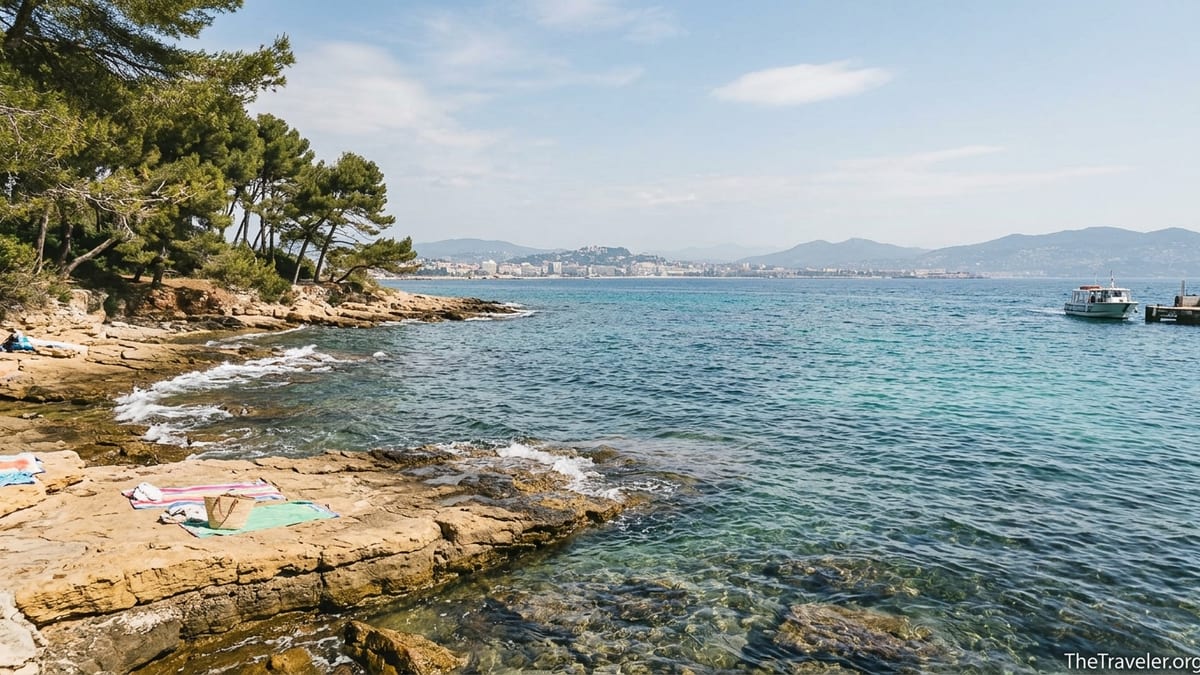
If your top priority is a classic Riviera beach scene with loungers, cocktails and soft sand, the Lérins Islands are not the best match. The coastline here is mostly rocky or pebbly, broken up by small coves with flat rock shelves and patches of coarse sand. On Sainte-Marguerite, the most popular swimming spots stretch east and west from the main harbor. Ten to fifteen minutes’ walk along the coastal path in either direction brings you to coves where locals spread towels directly on the rocks or use thin foam pads to soften the hard surface.
The water quality, however, is a major reason to come. With fewer boats close inshore and strict environmental rules, the sea here often feels cleaner and clearer than along the Cannes city beaches. On calm days you can easily see to the sea grass meadows of posidonia beneath the surface, and the color shifts from a pale turquoise in the shallows to deep cobalt blue a little further out. Snorkelers regularly spot schools of small fish near the rocks; if you bring a simple mask and snorkel from Cannes, you will get far more out of the swimming here than by the mainland promenade.
Be prepared for very limited shade on the coves themselves. The pine forest comes close to parts of the shoreline, but many popular spots have only patchy shade, so sun protection and water shoes or sandals are almost essential, especially in July and August when the rock heats up quickly. There are no sun loungers or rentals on these wild beaches. For some travelers this stripped-back setup is a huge plus; for others, especially families seeking comfort and facilities, a half-day might be enough before returning to a serviced beach in Cannes.
Crowding is another point to consider when judging whether the islands are “worth it” for beaches. In mid-summer, the easiest coves closest to the landing pier can feel very busy between late morning and mid-afternoon, particularly on weekends and during French school holidays. To find quieter spots, you need to walk 20 to 30 minutes along the coastal path, where you will still see other visitors but can more easily find your own stretch of rock or pebbles.
Nature and Walking: Forest Trails and Quiet Views
Where Sainte-Marguerite really shines is as an escape into Mediterranean woodland. Most of the island is covered by a carefully managed forest of Aleppo pines and eucalyptus, overseen in partnership with the French National Forests Office. A network of signed footpaths crisscrosses the interior, from wide fire roads suitable for families with strollers to narrower tracks along the cliffs. It takes about one and a half to two hours to make a leisurely circuit of the island’s perimeter, longer if you stop at viewpoints or for swims in the coves.
Along the northern shore you get almost continuous views back to Cannes, with its skyline of hotels and apartment blocks framed above the sea. On the southern side, the sense of remoteness deepens. Here the forest comes closer to the water, and much of the shoreline is protected for its underwater sea grass meadows and birdlife. There are information boards in French and English explaining the local ecology, including efforts to protect posidonia beds that act as nurseries for fish and as natural barriers against coastal erosion. Between April and June, the interior of the island is often dotted with wildflowers, and you may hear or spot migratory birds resting in the trees.
This focus on conservation has practical implications for visitors. For instance, there are clear rules against lighting fires or barbecues, and picnic areas are set back from the most sensitive parts of the coast. Waste bins are available near the harbor and main paths but less so in remote areas, so you should be prepared to carry your trash back with you. The result is that, despite heavy day-trip traffic in high season, much of the island feels remarkably clean and quiet compared with many accessible coastal sites on the Riviera.
For travelers who enjoy walking more than lying still on the sand, Sainte-Marguerite is an excellent investment of time. A common pattern is to arrive on one of the early boats, make a partial circuit of the island on shaded interior paths before the midday heat peaks, stop for a swim in a cove, then head back toward the harbor area for a late lunch or picnic. For those staying several days in Cannes and wanting a low-cost, low-impact outing without renting a car, this nature experience alone can make the islands worth visiting.
History on Sainte-Marguerite: Fort Royal and the Man in the Iron Mask
Even travelers without a particular interest in history tend to be drawn to Fort Royal, the seventeenth century fortress that dominates Sainte-Marguerite’s north shore. Built under Cardinal Richelieu and later reworked by Vauban, the fort became one of the most notorious state prisons in France. Its most famous detainee was the mysterious “Man in the Iron Mask,” held here in the late seventeenth century before being transferred to the Bastille. Today, one of the exhibition rooms is his presumed cell, where a small display tries to untangle the legend from the limited documentary evidence.
The fort also houses the Iron Mask and Royal Fort Museum, a compact but atmospheric institution that combines the prison history with an archaeological collection. In the cool rooms built around former cisterns and storerooms you can see amphorae, anchors and cargo recovered from Roman and later shipwrecks in the waters around the islands, as well as explanatory panels about maritime routes along the Ligurian and Provençal coasts. Allow around one to one and a half hours to explore the fort and museum; this is a good activity for the hotter part of the day, when the shade and stone walls offer a break from the sun.
The walk up to the fort from the landing pier is part of the experience. You follow a gently rising stone stairway through pines and low Mediterranean shrubs, with glimpses of the sea between trunks. As you approach, the outer walls of the fortress loom above, giving a sense of how imposing this island prison would have been to those approaching by boat in previous centuries. For historically minded visitors, this combination of architecture, sea views and the famous mystery adds real depth to a day on Sainte-Marguerite.
If your primary interest on the Riviera is glamorous modern culture, designer boutiques and contemporary art, the fort may feel a little austere. The displays are educational and fairly traditional, with limited interactivity. But for families with older children, couples who enjoy historic sites or solo travelers who like to layer stories onto landscapes, Sainte-Marguerite’s fort and museum are strong arguments in favor of visiting the islands.
Saint-Honorat: Monastic Calm, Vines and Coastal Scenery
Saint-Honorat, the smaller of the two main islands, has a very different atmosphere. It has been home to a monastic community since the early fifth century, when Saint Honoratus founded a monastery here around the year 410. Over the centuries the abbey became an important center of Christian learning, sending monks who later became bishops to cities such as Lyon and Arles. Today, a community of Cistercian monks still lives, prays and works on the island, maintaining both the abbey and its vineyards.
Visitors arriving from Cannes step onto a simple jetty and are immediately struck by the quiet. There are no hotels or private houses; the entire island is essentially the domain of the monastery, which welcomes day-trippers under clear rules of respect. A ring path circles the island through pine trees, olive groves and neat rows of vines that supply grapes for the abbey’s wines. Benches placed along the route face out toward the open sea or back to Sainte-Marguerite and the Cannes coastline, offering some of the most peaceful coastal views anywhere in the bay.
The main historic focus is the fortified monastery on the south shore. This multi-story stone structure, partly Romanesque and partly later in style, rises directly from the rocks at the water’s edge. It was fortified in the Middle Ages to protect the monks from pirate raids and now looks almost like a miniature sea castle. Inside, narrow stairways connect vaulted rooms and small chapels; the rooftop terraces give sweeping views across both islands and the mainland. Close by stands the more recent abbey church and cloister, where the monks follow a daily rhythm of contemplative prayer.
For many travelers, Saint-Honorat is less about ticking off specific sights and more about the overall atmosphere. Day visitors stroll the ring path, pause at small oratories and chapels scattered along the shore, sit quietly in the cloister gardens or sip a glass of abbey-produced wine at the simple island restaurant. If you are drawn to slower, reflective travel and to places where religious life is still active rather than fossilized, Saint-Honorat can feel like a rare find on an otherwise busy coastline.
Beaches and Swimming on Saint-Honorat
From a purely beach perspective, Saint-Honorat is less of a draw than Sainte-Marguerite, but it still offers rewarding swims. The coastline here is more uniform, with narrow rocky shelves and low cliffs dotted with small coves. Several spots along the north and east shores allow for easy entry into clear water from rock ledges; you simply lay your towel on the flat rock and step down a few submerged stone steps. Compared with Sainte-Marguerite, there are fewer people and virtually no groups playing loud music, which enhances the feeling of calm.
The same caveats about comfort apply, perhaps even more so. There are no organized beaches or rentals; the monastic community actively protects the island’s contemplative character, so you will not find beach clubs, bars or loud water sports. In practice this means Saint-Honorat is less suitable if your vision of a day at sea includes stand-up paddle boards, inflatables or party boats. Instead, it appeals to strong swimmers and snorkelers who are happy with simple conditions and respect the quiet environment.
One advantage is that the ring path brings you within a short walk of the shoreline at many points, so it is easy to alternate between gentle walking in the pines and short swims. The shade is generally better than on Sainte-Marguerite because the island is smaller and the trees often come right up to the rocks. For travelers who want a light hiking and swimming combination in a tranquil setting, Saint-Honorat can be a very satisfying alternative to busy mainland beaches.
If you are choosing between the two islands with swimming in mind, a practical approach is to spend your main beach time on Sainte-Marguerite, then dedicate a separate half-day to Saint-Honorat for its unique blend of swimming, views and monastic culture. Some organized boat tours from Cannes offer combined itineraries that allow for a short stop on each island, but many visitors find that at least a half-day per island better respects their slower rhythms.
Who Will Find the Lérins Islands Worth Visiting?
Whether the Lérins Islands are “worth it” depends on your expectations and the length of your stay on the Riviera. For nature lovers staying in Cannes or nearby, the answer is almost always yes. Sainte-Marguerite in particular offers several hours of easy walking on shaded paths, access to relatively unspoiled coves and the chance to see a more rugged side of the Mediterranean coastline. If you are spending three or more days in the area, setting aside one of them for the islands provides a welcome change from city promenades and coastal traffic.
For history enthusiasts, the combination of Fort Royal’s prison cells and the living monastic community on Saint-Honorat is unusually rich for such small islands. Few places so close to a major resort allow you to trace a line from late Roman and early Christian history through medieval fortifications and early modern state power, all within a single day. Those particularly interested in religious history or monastic architecture may even consider staying at the abbey’s guesthouse on Saint-Honorat, which offers simple retreat-style accommodation by prior arrangement with the community.
Families with children will find mixed advantages. On the positive side, the islands are car-free, relatively compact and feel adventurous without being remote. Kids often enjoy boat rides, exploring fortifications and snorkeling off the rocks. On the other hand, the lack of sandy beaches, the hard rocky entries into the sea and limited shade on some coves can be challenging for younger children. A realistic plan is to focus on Sainte-Marguerite, visit the fort in the cooler part of the day and choose a cove near the main path where you can easily walk back to facilities.
Travelers whose main priority is glamorous beach clubs, convenient service and minimal walking may feel that the Lérins Islands are less essential. If you are in Cannes for only one night and want classic Riviera photos, people-watching and shopping, you may be better off staying on the Croisette. But if you have at least a day to spare and are curious to see what the coastline looked like before mass development, the contrast provided by the islands is precisely what makes them so valuable.
Planning Tips: When to Go and How to Make the Most of It
Timing your visit has a big impact on whether the Lérins Islands feel like a peaceful escape or an extension of the crowds in Cannes. In practical terms, late April to early June and September to early October are often the most rewarding periods, with warm enough weather for swimming on many days but fewer large tour groups. July and August bring hotter temperatures, more boat traffic and busier paths and coves, especially at midday and on weekends.
Whenever you go, starting early usually pays off. Taking a morning boat between 9:00 and 10:00 from Cannes gives you a head start on the main crowds and the midday heat. You can walk or explore historic sites first, then settle on a cove for swimming by late morning. Many locals reverse the pattern in high summer, arriving later in the afternoon when day-trippers begin to leave and the light softens over the bay. Return boats typically run until early evening in high season, but schedules vary slightly by operator and season, so it is important to check the last departure times before setting off.
Food is another consideration. Sainte-Marguerite usually has at least one simple restaurant or terrace café near the landing point, along with seasonal snack kiosks selling drinks, ice cream and sandwiches. However, opening times can vary outside peak months and prices reflect the logistical costs of operating on an island, so many visitors buy picnic supplies at a supermarket or bakery in Cannes before boarding the boat. On Saint-Honorat, facilities are even simpler, with a basic restaurant and shop selling products from the abbey such as wine and liqueurs. As there are no taps of potable water scattered around the islands, carrying enough drinking water from the mainland is wise, especially in summer.
Finally, think about combining your island visit with other nearby experiences. For example, travelers staying a week or more on the Riviera often schedule the Lérins Islands as a quieter counterpoint to day trips to glamorous spots such as Antibes or Saint-Tropez. Cruise passengers with only a limited number of hours in Cannes need to weigh the boat transfer times carefully, but those who prefer nature and calm sometimes opt to skip the mainland entirely and spend their shore day walking and swimming on Sainte-Marguerite instead.
FAQ
Q1. Are the Lérins Islands worth visiting if I have only one day in Cannes?
If you enjoy nature, walking or history, devoting most of a single day in Cannes to at least Sainte-Marguerite is usually worthwhile; the boat ride is short and the contrast with the city is strong.
Q2. Which island should I choose if I have to pick just one?
Sainte-Marguerite is the better all-round choice for a first visit, with more swimming coves, forest trails and the Fort Royal museum, while Saint-Honorat suits travelers drawn specifically to monastic history and quiet contemplation.
Q3. Are the beaches on the Lérins Islands sandy?
Most swimming spots are rocky or pebbly with some coarse sand in the shallows; you will not find long stretches of soft sand or serviced beach clubs like those on the Croisette.
Q4. Can I visit both islands in one day?
It is possible to visit both in a long summer day, especially via organized boat trips, but many travelers find it more satisfying to focus on one island or to dedicate a half-day to each on separate days.
Q5. Is the boat to the Lérins Islands suitable for families and older travelers?
Yes, the shuttle boats from Cannes are short, relatively stable rides used by families, older travelers and locals; however, boarding involves stepping between pier and boat, so those with limited mobility should take extra care.
Q6. Do I need special equipment to enjoy the underwater eco-museum near Sainte-Marguerite?
To see the underwater sculptures properly, you should be comfortable swimming with at least a mask and snorkel; there is no need for scuba certification, but bring your own gear as rental options on the island are limited.
Q7. What should I wear and bring for a day on the Lérins Islands?
Sturdy sandals or walking shoes, swimwear, a hat, reef-safe sunscreen, a light cover-up, plenty of drinking water and a picnic are practical basics; water shoes can make getting in and out over rocks more comfortable.
Q8. Is there food available on the islands?
Sainte-Marguerite has a simple restaurant and seasonal snack kiosks near the pier, while Saint-Honorat has a basic restaurant and shop; choices are limited and prices higher than in Cannes, so many people bring their own food.
Q9. Are overnight stays possible on the Lérins Islands?
There is no standard hotel infrastructure; limited simple accommodation exists in specific facilities such as the abbey guesthouse on Saint-Honorat or group centers on Sainte-Marguerite, usually by prior arrangement rather than casual booking.
Q10. When is the best time of year to visit the Lérins Islands?
Late spring and early autumn are ideal, with warm but not extreme temperatures, swimmable water on many days and fewer crowds than in the peak summer months of July and August.