


More news on this day
Asia’s aviation network is facing mounting disruption as typhoons, air traffic control staffing constraints and geopolitical airspace shifts combine to push flight delays and cancellations sharply higher during the region’s peak summer travel period.
Get the latest news straight to your inbox!
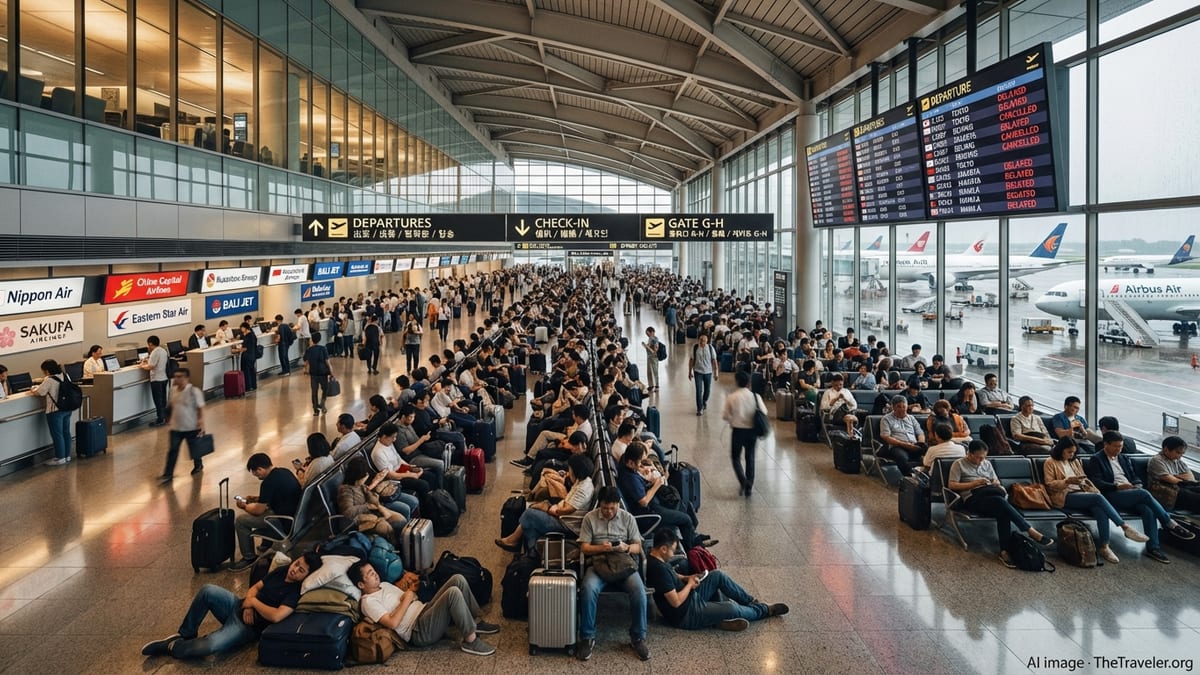
Typhoons Trigger Mass Cancellations Across East Asia
Recent typhoons have emerged as a major driver of flight chaos across Asia, with large hubs in China, Hong Kong and Japan forced to curtail operations. In early August, Typhoon Dolphin led Shanghai’s two main airports to cancel more than 1,300 flights in a single day as the storm made landfall along China’s eastern seaboard, according to international media coverage of the event.
Published reports from Hong Kong describe additional cancellations and schedule disruptions linked to the same system. Local coverage indicates that at least a dozen flights connecting Hong Kong with mainland China, Taiwan and Japan were cancelled or rescheduled, including services to Okinawa, Ishigaki and Shanghai, as airlines adjusted operations to changing weather conditions.
In Japan and South Korea, carriers have been issuing repeated travel advisories warning of “irregular operations” on routes into affected airports. Notices from regional airlines point to the prospect of rolling delays and cancellations as typhoon seasons lengthen and rainfall intensifies, with passengers urged to check real time status tools rather than relying on printed schedules.
Meteorological agencies and scientific analysis cited in regional coverage link these patterns to a broader trend of more frequent and more intense extreme weather events. The result for travelers is a less predictable flying environment, in which large numbers of flights can be grounded with relatively short notice when a storm’s track or strength changes.
Staffing Constraints Snarl Traffic in Australia’s Asian Gateway
While weather dominates disruptions in Northeast Asia, staffing constraints are creating separate bottlenecks in Australia, an important gateway for Asia Pacific itineraries. In early August, passengers at Sydney Airport were warned to expect significant delays as air traffic management authorities implemented flow control measures to cope with roster pressures in the control tower.
Australian broadcast and print coverage reported that more than 150 flights were delayed on a single Saturday, affecting both domestic and international services. Images of long check in queues and crowded departure halls at Sydney underscored how quickly a limited number of controller absences could cascade into systemwide disruption for airlines and travelers.
Further reporting highlighted concerns about repeated episodes at the airport, including a recent near miss between aircraft that has intensified scrutiny of resourcing and rostering practices. Industry groups cited in that coverage have warned that any prolonged staffing shortfall at Sydney can ripple across the wider Australian network and into Asian connections, given the airport’s role as a primary hub.
The situation illustrates how non weather related factors can amplify regional travel disruption. Even when skies are clear, limited capacity in key nodes can force airlines to push back departure times, consolidate flights or cancel rotations altogether, adding to the perception among travelers that reliability across Asia Pacific remains fragile.
Data Points to Sharp Rise in Cancellations Across Asia Pacific
Operational data compiled by aviation analytics providers reinforces the sense that disruption is deepening. A recent monthly report on Southeast Asia’s on time performance noted a 72 percent surge in flight cancellations across the broader Asia Pacific region compared with earlier periods. Although some full service carriers in Southeast Asia still rank among the most reliable, the report highlighted declining on time performance as airlines grapple with tighter margins for error.
The same analysis pointed to mixed results across major hubs, with some airports managing to stabilize punctuality while others saw a rise in both late departures and cancellations. This patchwork reflects the uneven impact of factors such as local weather, airport infrastructure, staffing and rerouting decisions taken in response to conflict zones or constrained airspace.
Slot data for airports that act as bridges between Asia and other regions underlines how fragile the system can be. Figures released by an airport coordination body for the current northern summer season at Sydney show around 4 percent of take off and landing slots being cancelled, with international services recording the largest decline. Routes connecting to parts of Asia, including China, India and Southeast Asian destinations, were among those with higher rates of slot cancellations.
Industry outlooks produced by consulting and research organizations earlier in 2026 anticipated that airport disruption rates could swing rapidly this year in response to macro shocks. Those studies identified structural issues such as air traffic control staffing, ground handling constraints and congestion at key hubs as persistent sources of volatility, especially when layered on top of strong post pandemic demand.
Weather, Conflict and Capacity Squeeze Travelers’ Options
Recent coverage of global aviation trends suggests that Asia’s current wave of delays and cancellations cannot be attributed to a single cause. Rather, the region is contending with overlapping pressures that leave airlines and passengers with fewer options when things go wrong. Extreme weather in East Asia, including typhoons hitting coastal China and Hong Kong, frequently closes runways or makes approaches unsafe, forcing aircraft to divert or remain on the ground.
At the same time, geopolitical tensions and conflicts beyond Asia are altering traditional long haul routings. Industry analyses describe how restrictions on certain air corridors, particularly over parts of the Middle East, have pushed some carriers to detour around affected regions. These longer routings can reduce schedule flexibility and increase fuel costs, leaving airlines with less buffer to absorb additional shocks in Asia such as sudden storms or airport congestion.
Capacity constraints on the ground compound the issue. Reports focusing on sustainable aviation and air traffic management note that many airports continue to face challenges recruiting and training sufficient numbers of controllers, maintenance technicians and ground handlers. When surging demand coincides with tight staffing, even routine disruptions can translate into waves of missed connections, overnight delays and equipment shortages.
For travelers, these converging forces create a more complex planning environment. Analysts and travel industry commentary increasingly recommend that passengers build in longer connection times, monitor flight status closely through airline apps and consider travel insurance products that specifically address weather related and operational disruptions in Asia Pacific.
Airlines and Airports Adjust Strategies Amid Ongoing Volatility
In response to the renewed turbulence, airlines and airports across Asia are making incremental adjustments to protect operations and reassure travelers. Low cost carriers in Southeast Asia have issued a series of travel advisories this summer tied to heavy rain, thunderstorms and approaching typhoons. These notices generally encourage passengers to arrive earlier at airports, verify schedules via digital platforms and remain alert to potential last minute changes.
Airports in China and Japan are working through phased resumptions after major storms, resuming flights in blocks while cautioning that knock on delays may persist for hours or days. Some hubs have expanded use of real time messaging and social media channels to communicate gate changes and rebooking options more quickly when typhoons or local weather systems force sudden operational shifts.
Industry data also suggests that some carriers are rebalancing their networks to hedge against disruption. Coordination statistics for Sydney indicate that while overall slots have declined in certain long haul markets facing higher fuel costs and geopolitical headwinds, other destinations in Asia, such as Malaysia, have seen increases in capacity to capture demand from travelers rerouting away from traditional hubs.
Strategic studies of aviation demand for 2026 point out that investment in resilient infrastructure, improved air traffic management technology and diversified staffing pipelines will be critical if Asia is to manage sustained growth without prolonged periods of chaos. For now, however, publicly available information shows that many travelers across the region are still encountering a summer defined by queues, cancellations and uncertain arrival times.
Sources: Cirium Southeast Asia On Time Performance Monthly Report, July 2026; Channel News Asia coverage of Typhoon Dolphin disruptions in east China; Washington Post reporting on Typhoon Dolphin flight cancellations in Shanghai; ABC News reporting on Sydney Airport delays and staffing constraints; CAPA analysis of Sydney Airport slot cancellations, northern summer 2026