


More news on this day
Cruise lines are stepping up pressure on Greece to channel new cruise taxes and stricter crowd caps at Santorini and Mykonos into a broader reshaping of Aegean itineraries, including longer calls at quieter islands, following high-level talks in Athens on October 1, 2026.
Get the latest news straight to your inbox!
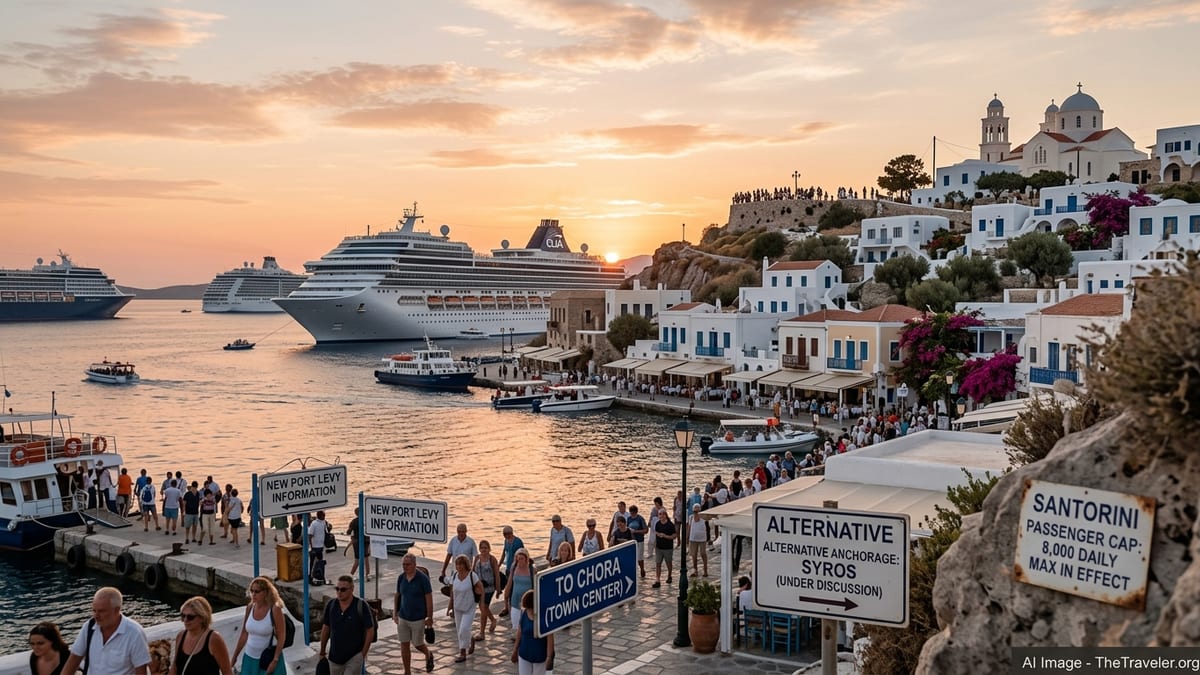
Talks focus on using new cruise fees to spread arrivals
According to the Cruise Lines International Association’s November 2026 Membership Currents update, CLIA met Greece’s Secretary General for Maritime Affairs and Ports on October 1, 2026, to discuss how the country’s new cruise passenger levy could be reinvested in port infrastructure. The industry group says it argued for “more workable passenger arrangements” at Greek islands and for a framework that would let lines rely less on a few overcrowded ports by being able to use better-equipped alternatives.
The meeting came after Greece introduced a nationwide cruise passenger fee in July 2025, now embedded in law and applied per passenger and per port of disembarkation. In high season from June 1 to September 30, the charge is 20 euros per person at Mykonos and Santorini and 5 euros at other Greek ports, with lower rates the rest of the year. The government has presented the levy as a way to fund port upgrades and support more sustainable tourism rather than simply curb cruise traffic.
CLIA’s position in recent public statements has been that if these new revenues are directed into secondary ports, cruise lines could schedule longer or additional calls at destinations that can absorb visitors more easily. The association has pointed to Aegean islands with existing berths and room for managed growth, arguing that this would both relieve the highest-pressure spots and give travelers more varied itineraries.
Santorini’s 8,000 daily cap crystallizes overtourism concerns
The policy discussion builds on concrete limits already imposed at Santorini. A decision by the Municipal Port Fund of Thira on September 19, 2024, set a maximum of 8,000 cruise passengers disembarking per day from 2025 onwards, alongside a detailed berth-allocation system for the 2025 and 2026 seasons. The document cites safety, infrastructure capacity and local quality of life as reasons to manage arrivals more tightly rather than accept all demand.
That cap followed several summers in which daily cruise peaks regularly exceeded the island’s comfort level. Greek media and local officials reported days in 2024 with around 11,000 cruise passengers going ashore, and earlier seasons saw peak estimates up toward 17,000 people in a single day. Those volumes, on an island with limited road capacity and cliffside tender operations, helped drive political support for strict quantitative limits and more active scheduling by the port authority.
In parallel with the passenger cap, Santorini’s port has been refining how cruise calls are distributed between the Old Port of Fira and Athinios, including a 70/30 allocation policy for tender passengers that CLIA’s Greece task force has been trying to soften. For travelers, this means that even when their ship maintains a scheduled call, movement between tender points, shore excursions and return to the vessel is governed by tighter operational controls than in the past.
Mykonos and Santorini face higher costs and slot controls
Nationally, Greece has combined Santorini’s local cap with broader measures targeted at its two busiest island cruise gateways, Mykonos and Santorini. From July 21, 2025, the new cruise passenger fee came into force at all Greek ports, with the highest rates reserved for those two islands during the summer. The fee schedule has been carried over into the 2026 high season, so visitors calling there in June, July, August and September 2026 continue to pay 20 euros to go ashore at each port.
Officials have also signaled a willingness to use higher port and passenger charges, together with daily ship and visitor limits, to keep overall arrivals at these islands within what authorities consider a sustainable range. Local port organizations on Mykonos and Santorini have warned that the increased fees affect cruise demand and passenger behavior, but the government has framed the moves as necessary to manage overcrowding and pay for infrastructure that serves both tourists and residents.
For cruise passengers in the 2026 and 2027 seasons, the practical effect is that Mykonos and Santorini remain tightly managed, with finite daily slots and higher taxes than other Greek destinations. Itineraries calling at either island are still available but are subject to port-allocation systems that can influence arrival times, tender arrangements and how many ships are accepted on a given day.
CLIA proposes longer calls at secondary Aegean ports, but rules not yet changed
The emerging alternative, championed by CLIA in its recent Greece outreach, is for cruise lines to adjust route planning so that more time is spent at less congested Aegean ports. The association’s public materials on Greece over the last two years highlight that more than half of the country’s cruise activity is concentrated at three hubs, led by Piraeus alongside Santorini and Mykonos. By contrast, a range of other islands and mainland ports host far fewer calls despite having established facilities.
CLIA leaders have repeatedly spoken of the need to “support lesser-known Greek ports,” arguing that directing part of the traffic to destinations such as Paros, Syros, Naxos or Volos could reduce stress on the most heavily visited islands while spreading economic benefits. In practice, that could take the form of fewer but longer calls at these secondary ports, or itineraries that swap one of the big names for a full day or even an overnight stay somewhere quieter.
At this stage, however, the proposal remains an industry ask within ongoing talks with the Greek government rather than a codified national rule. There is no law that guarantees cruise passengers more hours ashore at any particular secondary port, and capacity, environmental limits and local sentiment differ from island to island. Whether and how quickly longer calls appear in the market will depend on decisions by individual cruise lines and the willingness of each port to accommodate extra traffic.
What travelers should check for 2026 and 2027 sailings
For the 2026 and 2027 seasons, travelers booking Aegean cruises should expect the existing controls and fees at Santorini and Mykonos to remain part of the landscape. Daily caps, slot management and a 20 euro per person high-season cruise fee for those two islands continue to shape ship schedules and on-the-ground crowd management, even as discussions continue about fine-tuning the rules.
Any shift toward spending more time at quieter ports will appear gradually through cruise-line scheduling rather than overnight policy decrees. Some lines have already begun marketing itineraries that include smaller Aegean islands or mainland ports with longer stays, but the specifics vary widely by company and departure. Before booking, travelers who value extended time ashore should compare published port timetables and advertised hours in port, and be prepared for adjustments if Greek port authorities later modify daily limits or berth allocations.
Looking ahead toward the 2027 season, the key developments to watch will be any updated Greek policies on cruise caps and port pricing, concrete agreements between CLIA and the government on reinvesting cruise-fee revenue, and itinerary announcements where lines explicitly highlight longer or overnight calls at lesser-known Aegean ports as part of a decongestion strategy. Until those elements are confirmed, more time ashore at quieter islands remains a direction of travel rather than a guaranteed feature of every Greek cruise.