


More news on this day
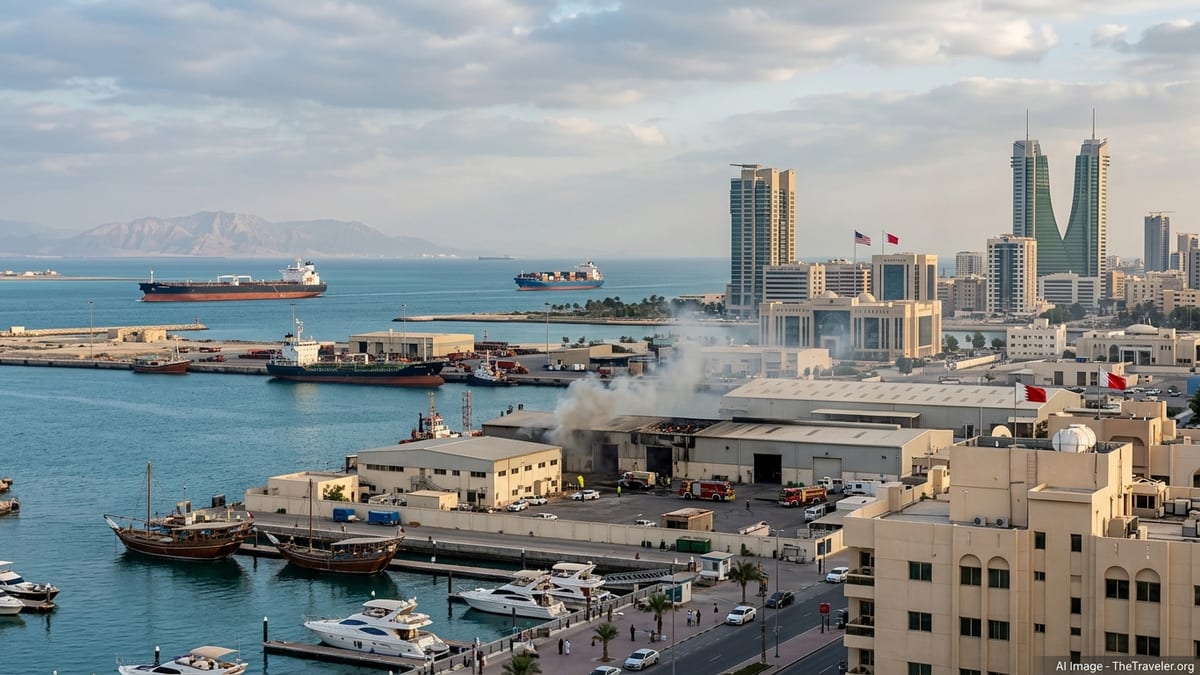
Iran’s Revolutionary Guard says it has launched combined missile and drone strikes on two US air bases in Bahrain, while Bahraini authorities report an Iranian attack on a civilian industrial facility that sparked a fire but caused no injuries, raising fresh concerns for travelers transiting Bahrain and the Strait of Hormuz on November 22, 2026.
Get the latest news straight to your inbox!
What Iran and Bahrain Say Happened
Iran’s Islamic Revolutionary Guard Corps (IRGC) announced late on November 21 that its aerospace force targeted US radar installations at two air bases in Bahrain using a mix of missiles and drones. In a statement carried by Iranian state-linked media and agencies, the IRGC said it struck Patriot air defense radars at American positions in the kingdom, describing the operation as retaliation for what it called repeated US drone incursions into Iranian airspace earlier in the day.
Bahrain’s Interior Ministry, in parallel statements on November 21 and into November 22, said an Iranian attack had hit a civilian industrial facility, causing a fire and material damage but no casualties. Officials described the strike as “Iranian aggression” against a non-military site and said civil defense teams brought the blaze under control. Authorities did not immediately specify the exact location or sector of the facility, beyond confirming it was in an industrial area and away from major tourist districts.
US officials have acknowledged ongoing Iranian attempts to hit American assets in Bahrain in recent days but have generally emphasized the role of air and missile defenses in intercepting incoming drones and missiles. Earlier this week, US and Bahraini statements about the scale of damage from Iranian attacks diverged from IRGC accounts, with Iranian outlets highlighting claimed hits on US radar infrastructure and US-linked sources stressing successful interceptions and limited impact on operations. Those discrepancies have not yet been fully reconciled by publicly available evidence.
Part of a Broader Pattern of Strikes Around the Gulf
The latest claimed IRGC operation follows a series of Iranian drone and missile attacks on US radar assets in Bahrain since early November, several of which Bahraini officials say were largely intercepted. Independent security assessments and open-source military reporting describe at least three Iranian attempts this month to hit US-linked air defense or command facilities in the kingdom, alongside retaliatory US strikes on Iranian launch sites in or near the Strait of Hormuz and Iran’s Qeshm Island.
Regional maritime security bulletins show a parallel uptick in attacks on commercial tankers in and near the Strait of Hormuz throughout November. Advisories from the United Kingdom Maritime Trade Operations (UKMTO) and joint industry updates detail multiple incidents in which tankers were struck by unknown projectiles or otherwise damaged while transiting outbound or inbound to the Gulf, including engine room fires attributed to external impacts. At least one additional tanker was reported hit on November 21 while sailing outbound through the narrow strait, underscoring that shipping has become a frontline in the wider confrontation.
These events build on a months-long crisis in which commercial traffic through the Strait of Hormuz has already been sharply reduced compared with pre-war levels, and oil and gas shipments have periodically been disrupted by strikes, mine incidents and naval inspections. For travelers, the significance is less about Bahrain alone and more about the cumulative effect of repeated attacks across the Gulf’s core shipping corridor.
Immediate Impact on Bahrain Travel and Transit
As of the morning of November 22, there were no confirmed reports that Bahrain International Airport had taken direct hits in the latest Iranian attack, nor that its passenger terminal or runways were closed as a result. Previous strikes and near-miss episodes this year have occasionally prompted temporary airspace restrictions or delays, but current official travel advisories and airport statements point primarily to a heightened security environment rather than a complete halt to civilian flights.
Bahrain’s main tourism districts, including central Manama and popular waterfront areas, have not been identified in official reporting as targets or locations of impact in this latest episode. The industrial facility hit by the Iranian strike is described as a civilian site in an industrial zone, with authorities repeatedly stressing that there were no injuries. Nevertheless, foreign ministries including the United States and several European and Asia-Pacific governments now advise against non-essential travel to Bahrain or urge heightened caution, citing the risk of further missile and drone attacks and the broader regional conflict.
Airlines serving Bahrain and neighboring Gulf hubs continue to adjust routings and schedules in response to changing risk assessments and airspace guidance. The European Union Aviation Safety Agency, for example, has already warned operators to avoid portions of Gulf airspace this year, including Bahrain’s, because of the threat from military activity and misidentification. Travelers booked on flights into or out of Bahrain should monitor real-time updates from their airline and check whether tickets are covered by flexible rebooking or cancellation policies introduced in response to the conflict.
Risks for Cruises, Ferries and Itineraries Using the Strait of Hormuz
The renewed barrage of strikes and tanker incidents is particularly relevant for travelers whose plans involve transiting the Strait of Hormuz or nearby Gulf ports by sea. Cruise itineraries that typically route through or near the strait to reach ports in Oman, the United Arab Emirates or other Gulf states are exposed to any escalation in attacks on commercial shipping, even if cruise ships themselves are not targeted. In practice, heightened risk often translates into route diversions, last-minute port swaps or cancellations when security advisories change.
Maritime security advisories issued in November point to increased insurance costs and war-risk surcharges on commercial traffic in the Gulf, costs that can feed through to higher fares or fuel surcharges on some sailings. Shipping and cruise operators may opt to reroute around the Arabian Peninsula, shorten seasons in the region or temporarily suspend transits of Hormuz if attack rates climb or naval authorities restrict movements. Because such decisions are often taken on short notice, passengers are advised to follow operator alerts closely and to verify whether their travel insurance covers disruptions linked to armed conflict.
For independent travelers using regional ferries or charter boats, local authorities may impose additional checks, timing restrictions, or temporary suspensions of services in response to specific incidents. These changes are typically announced by port authorities or transport ministries rather than tourism boards, so monitoring official government channels and port operator notices is essential in the days following serious attacks.
What to Watch in the Coming Weeks
Officials in Bahrain and partner governments have warned that further Iranian strikes or US retaliation cannot be ruled out in the short term, particularly as both sides link operations to alleged airspace violations and previous attacks. Statements from regional foreign ministries and defense officials suggest that any new incident involving casualties, a direct hit on a major US facility, or serious damage to a large tanker could trigger tighter airspace controls, expanded no-sail areas or additional naval escorts in and around the Strait of Hormuz.
Travelers planning trips that pass through Bahrain or rely on Gulf airspace and waters in late November and December should monitor three main information streams: updated travel advisories from their home foreign ministry, operational updates from airlines and cruise or ferry operators, and notices from aviation and maritime safety agencies. These sources will provide the clearest signals of any widening restrictions, such as broader airspace avoidance zones or recommended re-routing of commercial ships.
While there is no confirmed, large-scale disruption to passenger flights, cruise schedules or visas linked specifically to the November 21–22 strikes at the time of writing, the pattern of tit-for-tat attacks around Bahrain and the Strait of Hormuz points to a fluid situation. Anyone with time-sensitive travel through the region should build flexibility into their plans, consider refundable or changeable bookings, and be prepared for short-notice adjustments if the security picture deteriorates.