


More news on this day
Travel across Asia faced another turbulent day as more than 365 flights were cancelled and about 4,700 delayed in and out of key hubs including Bangkok, Beijing, Tokyo, Singapore and Hong Kong, disrupting schedules for Thai Airways, Cathay Pacific, Air China, All Nippon Airways (ANA) and a wide range of regional and low cost carriers.
Get the latest news straight to your inbox!
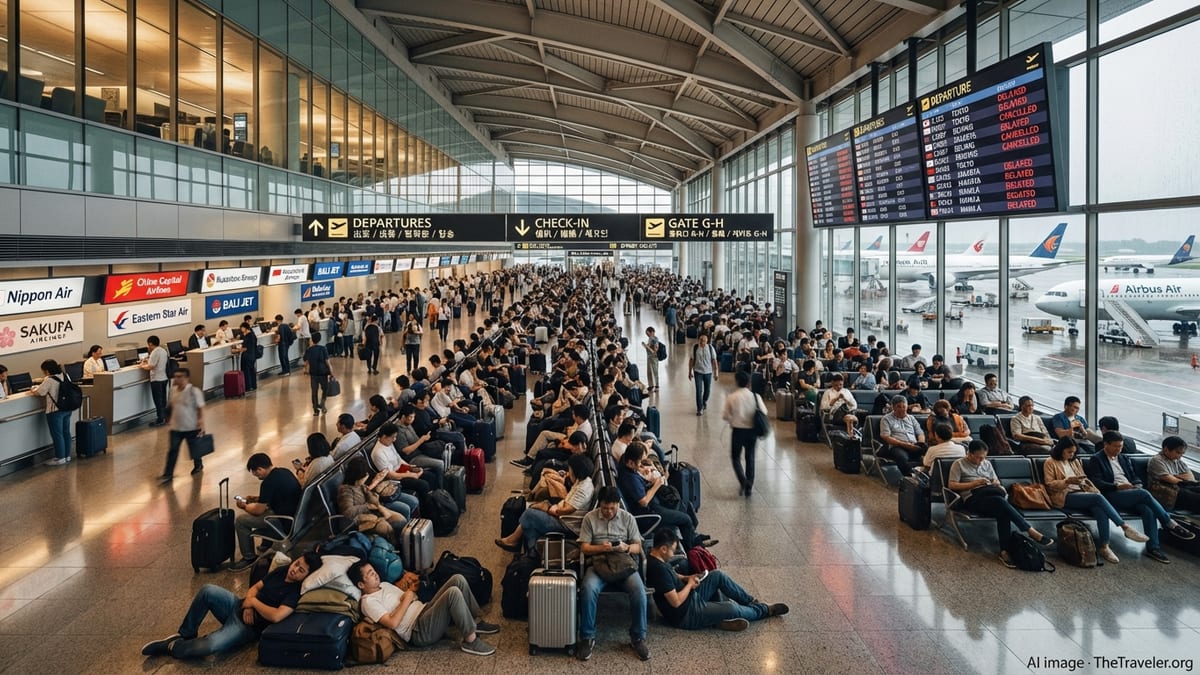
Regional Hubs Struggle With Heavy Operational Strain
Operational data from airport trackers and industry outlets shows a fresh wave of disruption sweeping through some of Asia’s busiest airports, including Bangkok Suvarnabhumi, Beijing Capital, Tokyo Haneda and Narita, Singapore Changi and Hong Kong International. Combined, airports in Thailand, Japan, Singapore, Hong Kong, mainland China and Indonesia reported at least 365 cancellations and roughly 4,688 delayed departures and arrivals over a single 24 hour window.
The impact has been most visible at major connecting hubs where waves of delays rapidly cascade through tightly timed schedules. In Bangkok, Thai Airways and other carriers have had to revise departures to Hong Kong, Singapore and key regional business routes as aircraft and crews fell out of position. In Beijing and Shanghai, knock on delays reduced already limited slack in aircraft rotations, affecting both domestic services and long haul connections into Europe and North America.
Tokyo’s two key airports, Haneda and Narita, continued to see bottlenecks as a mixture of weather related disruption, congested airspace and busy summer schedules squeezed available runway capacity. Publicly available tracking data indicates that even relatively small pockets of delay at peak hours quickly built into long queues for take off and landing, pushing back departures for ANA, Japan Airlines and international partners.
Singapore Changi and Hong Kong International, both known for efficient operations, were not immune. Industry reports describe a steady build up of late running flights, particularly during evening bank periods, as inbound delays from China, Japan and Southeast Asia translated into missed departure slots and extended turnaround times.
Thai Airways, Cathay Pacific, Air China And ANA Among Hardest Hit
The disruption has cut across the region’s major full service airlines, with Thai Airways, Cathay Pacific, Air China and ANA all seeing sections of their networks disrupted by a mix of outright cancellations and rolling delays. Data collated from flight status platforms shows that regional trunk routes connecting Bangkok to Hong Kong, Singapore and key Chinese cities have been especially exposed as carriers attempt to balance demand, fuel costs and available aircraft.
Thai Airways has already been adjusting frequencies on certain regional services in response to cost pressures and weaker yields on some routes. When weather or air traffic constraints hit hubs such as Bangkok or Hong Kong, these thinner schedules leave less operational buffer, increasing the likelihood that a delay or aircraft rotation problem spills over into later departures.
Cathay Pacific’s dense schedule between Hong Kong, Japan and Southeast Asia has also been vulnerable. Recent days have seen selective cancellations and rescheduling on some Japan bound services as bad weather in the northwest Pacific and local congestion around Tokyo’s airports forced last minute changes. Public flight performance data indicates that even when individual cancellations are limited, they can trigger extended delays on subsequent rotations as aircraft and crews are repositioned.
Air China and ANA, both central players in their respective home markets, have had to navigate similar constraints. With strong demand on domestic and regional routes, both airlines run busy banks of flights through Beijing, Shanghai, Tokyo and Osaka. When those peaks coincide with weather disruptions, temporary airspace restrictions or ground handling bottlenecks, schedules quickly become compressed, leaving little margin to absorb further shocks.
Weather, Airspace Congestion And Resource Gaps Drive Disruption
The latest spike in cancellations and delays reflects a combination of short term and structural pressures across the Asian aviation network. In the near term, seasonal storms in parts of East and Southeast Asia have repeatedly affected flight paths and airport operations, particularly around Japan and the South China Sea. Reports from regional media highlight how typhoon related disruptions near Tokyo in recent weeks prompted carriers in Hong Kong and elsewhere to cancel or retime flights in advance, contributing to rolling schedule changes.
Airspace congestion also remains a challenge, especially over busy corridors linking China, Japan, Southeast Asia and the Middle East. With traffic volumes approaching or surpassing pre pandemic levels on many routes, even minor flow control measures introduced by air navigation services can ripple quickly through airline timetables. Airlines are forced to absorb longer routings or holding patterns, disrupting crew duty limits and narrowing the window to recover lost time on the ground.
At the same time, staffing and fleet constraints that emerged during the pandemic have not fully eased. Publicly available industry analysis suggests that several carriers in China and Southeast Asia continue to face tight availability of narrowbody aircraft and technical staff, particularly during maintenance peaks. When unplanned technical checks or crew rostering issues coincide with adverse weather or air traffic restrictions, carriers often resort to pre emptive cancellations on lower yielding services to protect core routes.
For airports in Thailand, Singapore, Hong Kong and Indonesia, these dynamics are compounded by rapid traffic growth. Passenger numbers have rebounded strongly on both regional leisure and long haul connecting flows, but investments in gates, ground handling and terminal capacity have not always kept pace. The result is that turnaround times lengthen under pressure, and delays that might previously have been absorbed now spill further into the schedule.
Knock On Effects For Passengers Across The Region
The practical effect for travellers has been a familiar pattern of long queues, rolling gate changes and missed connections at major Asian hubs. With 365 cancellations and thousands of delays concentrated into a short period, airlines have had to rebook large numbers of passengers, secure additional accommodation in some cases and rework aircraft routings, particularly on long haul services to Europe, North America and Australia.
At airports such as Bangkok Suvarnabhumi and Beijing Capital, publicly reported images and accounts pointed to crowded departure halls and check in areas at peak hours, as travellers waited for updated departure times. Some passengers on multi stop itineraries via Tokyo, Hong Kong or Singapore have faced extended layovers as missed short haul connections forced them onto later flights with limited remaining seats.
Regional low cost carriers have also been caught in the disruption, particularly on dense leisure routes between Thailand, Indonesia, Malaysia and popular Japanese and Chinese destinations. With point to point networks that rely on fast turnarounds and high daily aircraft utilization, these airlines often have less flexibility to recover when a rotation is heavily delayed or an airport temporarily restricts operations due to weather.
Travel industry commentators note that schedule reliability has become a key factor for passengers planning complex itineraries through Asia’s hubs. Business travellers and long haul tourists are increasingly sensitive to connection times and minimum layover windows, especially when flying through airports that have recently seen multiple days of elevated delays.
What Travellers Can Do As Disruptions Persist
Consumer advocates and travel analysts recommend that passengers flying through Asia’s major hubs in the coming weeks build extra time into itineraries and monitor flight status closely before leaving for the airport. Where possible, selecting longer connection windows in cities such as Bangkok, Tokyo, Singapore, Hong Kong and key Chinese hubs can reduce the risk of missed onward flights when earlier legs are affected by rolling delays.
Passengers are also encouraged to check their airline’s rebooking and compensation policies, which vary by carrier and route. While regulations in Asia differ from those in regions such as the European Union, many airlines offer meal vouchers, hotel accommodation or free changes when delays or cancellations exceed certain thresholds, particularly on international services. Online tools and travel insurance policies may provide additional support for recovering costs linked to severe disruption.
Analysts expect that operational volatility will remain a feature of Asian air travel through the peak summer period, as traffic growth, weather patterns and lingering resource challenges continue to stretch the region’s aviation system. For now, the latest wave of cancellations and delays serves as another reminder that even as capacity returns, reliability at many of Asia’s busiest hubs remains under pressure.