


More news on this day
Thousands of airline passengers across Asia found themselves stranded on June 25, 2026, as a fresh wave of disruptions led to 290 flight cancellations and 3,781 delays, snarling operations at major hubs from Tokyo and Naha to Manila, Dubai, Singapore, and Hong Kong.
Get the latest news straight to your inbox!
Weather Systems and Operational Strain Converge
Published coverage from regional aviation trackers and travel outlets indicates that the latest turmoil is being driven by a combination of severe weather and mounting operational pressures. Typhoon systems affecting Japan, including the recently active Jangmi, have repeatedly forced airlines to pare back schedules and reroute aircraft in recent weeks, leaving little spare capacity to absorb new disruptions.
On June 25, those constraints translated into hundreds of cancellations and thousands of delays concentrated in and around Japan, Singapore, Hong Kong, the United Arab Emirates, the Philippines, and Malaysia. Data compiled from flight-status platforms shows that carriers were forced into rolling schedule adjustments as crosswinds, heavy rain, and knock-on congestion rippled through the network.
Operational challenges in mainland China and across parts of Southeast Asia have compounded the weather-related disruptions. Publicly available information points to ongoing air traffic control constraints, crew and ground staffing imbalances, and tight aircraft rotations, all of which limited airlines’ ability to restore punctuality once the initial wave of delays took hold.
In effect, the latest cancellations and delays represent the convergence of several stress factors that have been building through the early summer travel period, with each new storm system amplifying underlying fragilities in regional aviation.
Major Airports From Tokyo to Dubai Under Pressure
The disruption pattern on June 25 centers on some of Asia’s busiest international gateways. Reports highlight significant operational strain at Tokyo’s dual airport system, with Haneda and Narita experiencing repeated schedule adjustments as weather bands moved across eastern Japan. Further south, Naha Airport in Okinawa and other island gateways have faced intermittent ground stops linked to high winds and low visibility.
In Southeast Asia, Singapore Changi and Manila Ninoy Aquino International recorded waves of delayed departures and arrivals as aircraft arriving late from Japan, Hong Kong, and mainland China struggled to turn around on time. This created bottlenecks at immigration, security, and baggage reclaim, with passengers facing long waits for rebooked flights and onward connections.
On the other side of the region, Dubai International remained a critical pressure point. Flight-status data shows that late-running services from Asia disrupted carefully timed banked connections in the UAE, pushing delays deeper into the evening peak. Similar, though smaller-scale, effects were reported at other Gulf and Asian transit hubs, reinforcing how quickly localized weather issues in North Asia can spread across long-haul networks.
Secondary airports, particularly in Malaysia and the wider Philippines archipelago, also experienced operational ripples as domestic and regional feeders were held for connecting passengers or rescheduled to accommodate aircraft and crew displaced by earlier cancellations.
Airlines Grapple With Cascading Network Disruptions
The impact of the latest wave of disruptions has been felt across a broad roster of carriers, from full-service legacy airlines to regional and low-cost operators. Among those most affected, according to flight-monitoring data and industry reporting, are Cathay Pacific, ANA Wings, Japan Transocean Air (JTA), and Air China, all of which maintain dense networks through the affected hubs.
For Cathay Pacific, the timing is particularly challenging. The Hong Kong-based carrier has been working to rebuild capacity through mid-2026 while also managing higher fuel costs and previously announced schedule trims on selected regional routes. The current round of irregular operations is adding further strain to already tight aircraft and crew rotations, especially on heavily trafficked North Asia and Southeast Asia sectors.
In Japan, ANA Wings and JTA have been central to domestic connectivity between the main islands and Okinawa, Miyako, and other outlying destinations. Recent Japanese-language coverage notes that typhoon-related disruptions have forced multiple days of cancellations on domestic routes, affecting everything from business travel to inter-island tourism and complicating aircraft positioning for subsequent flights.
Air China and other mainland Chinese carriers are simultaneously dealing with internal congestion and international knock-on effects. With several Chinese hubs frequently identified as delay hotspots during earlier June disruption episodes, the new round of irregular operations is feeding into an already stretched system, pushing some flights significantly off-schedule and contributing to tight turnarounds at connecting airports.
Passengers Face Long Queues, Limited Rebooking Options
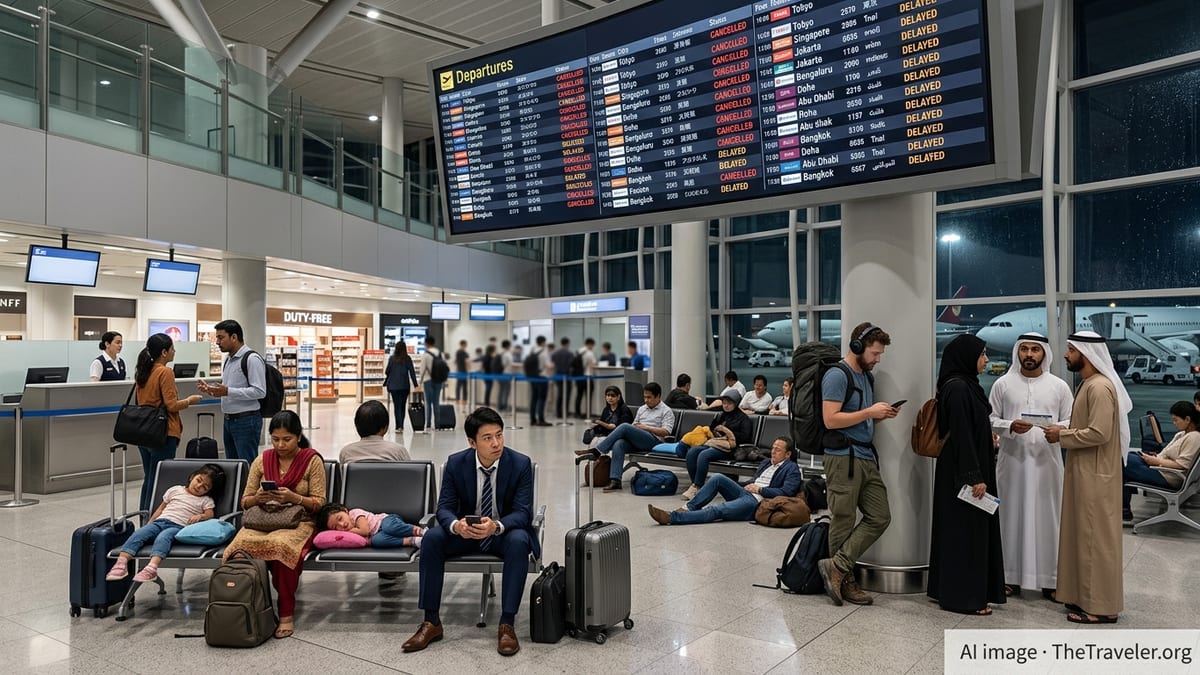
For travelers caught up in the June 25 chaos, the practical consequences are familiar and frustrating. Visual accounts and local media reports describe scenes of crowded terminals, snaking rebooking queues, and passengers camping out in seating areas as they wait for updated departure times. With 3,781 flights delayed, even minor schedule changes have quickly translated into missed connections and forced overnights.
Publicly available guidance from consumer groups and aviation analysts reiterates that affected passengers should first confirm their flight status via airline apps or airport information systems before heading to the airport. With call centers and check-in counters under pressure, digital channels remain the fastest way to secure rebookings, track baggage, or apply for meal and hotel vouchers where policies permit.
Legal protections vary by jurisdiction, and there is no single Asia-wide equivalent to European compensation rules. However, passenger-advocacy organizations note that carriers commonly provide basic assistance such as refreshments and accommodation when delays extend overnight, particularly when disruptions relate to operational or scheduling issues rather than exceptional weather events.
Travel specialists also emphasize the importance of documenting out-of-pocket expenses and retaining boarding passes and delay notifications, as these may support later claims through travel insurance providers. With further unsettled weather forecast across parts of East and Southeast Asia, passengers with upcoming itineraries are being urged to build in additional connection time and monitor conditions closely in the days ahead.
A Region in a Prolonged Period of Travel Volatility
The events of June 25 form part of a broader pattern of aviation volatility across Asia through the first half of 2026. Previous episodes in March, April, and early June saw hundreds of cancellations and thousands of delays as storms, airspace congestion, and resource constraints repeatedly tested the resilience of regional carriers and infrastructure.
Industry observers point out that airlines are still fine-tuning post-pandemic schedules at the same time as leisure and business demand remains strong, leaving little slack to absorb shocks such as typhoons, technical issues, or air traffic control restrictions. Each disruption day not only inconveniences travelers in the moment but also creates a backlog of displaced passengers and aircraft that can take several days to unwind.
For tourism-dependent destinations across Japan, Southeast Asia, and the Gulf, sustained flight unreliability carries broader economic implications. Hoteliers, tour operators, and local transport providers are already reporting volatile booking patterns linked to travelers’ uncertainty about air links, especially on cross-border itineraries requiring multiple connections.
While airlines across the region are working to restore schedules and adjust capacity where possible, the latest wave of cancellations and delays underscores how sensitive the system remains to external shocks. With peak summer travel approaching, both carriers and passengers are likely to face continued periods of disruption as Asia’s aviation network navigates an increasingly complex operating environment.