


Rising above Luza Square at the eastern end of Stradun, Dubrovnik’s Bell Tower is one of the city’s most photographed landmarks. You will see it in almost every postcard rack and panoramic shot of the Old Town. Yet many visitors pass underneath it without really understanding what it is, how it fits into the city’s history, or how to plan their visit around the bells that still shape local life. Here is what to know before you go.
Get the latest updates straight to your inbox!
Understanding the Bell Tower’s Place in Dubrovnik
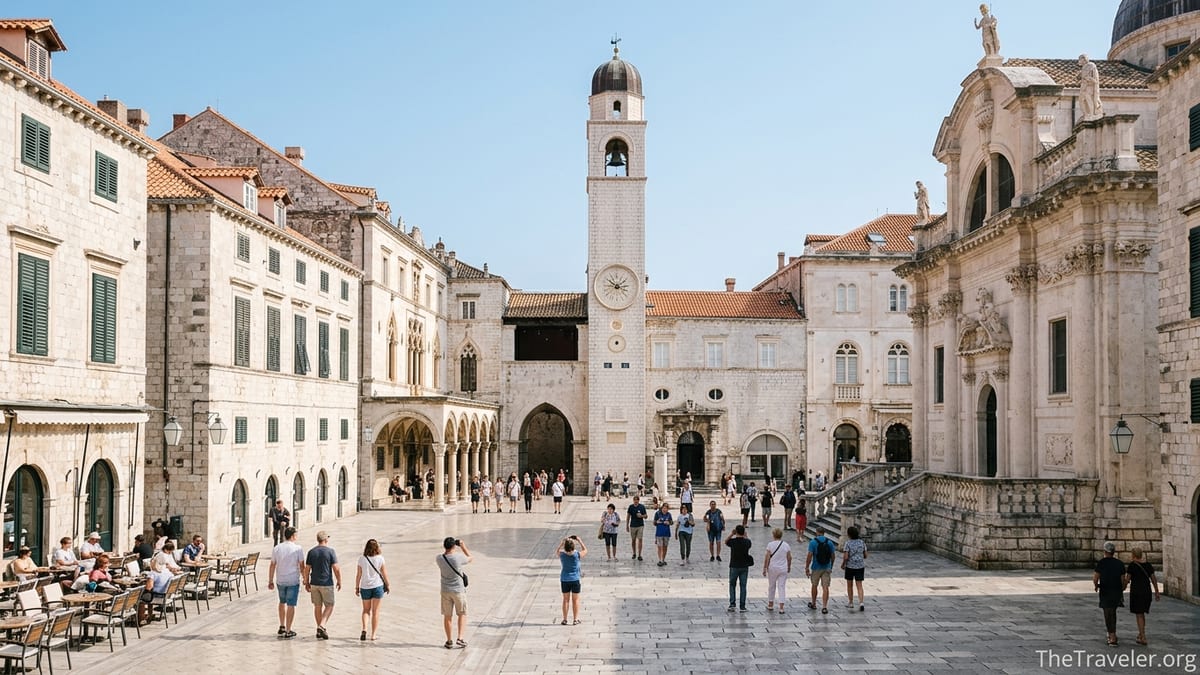
The Bell Tower, often called the City Bell Tower or Clock Tower, anchors the eastern end of Stradun, Dubrovnik’s main pedestrian street. It stands on Luza Square alongside Sponza Palace and opposite St Blaise’s Church, so when you are in what feels like the Old Town’s main crossroads, you have found it. At about 31 meters tall, with a thin square shaft and a small dome on top, it is easily picked out above the orange rooftops of the walled city.
The current structure dates from 1929, when it was rebuilt in the image of the original 15th century tower that had become dangerously unstable. The original bell tower, erected in 1444, survived centuries of earthquakes, including the devastating 1667 quake that flattened much of Dubrovnik. Over time the structure began to lean toward Stradun, and the decision was taken in the 1920s to demolish it and reconstruct a faithful copy using modern engineering methods to withstand future tremors.
Even though the tower itself is relatively new, its spirit is medieval. The same bronze bell, cast in 1506 by renowned bell founder Ivan Rabljanin, still hangs in the belfry and sounds over the Old Town every day. The two striking figures at the top, the famous “Green Men” known locally as Maro and Baro, are replicas of the original bronze jacks that have been tolling the hours for centuries. When you hear them ring, you are listening to a sound that has marked time for generations of Dubrovnik’s residents.
For travelers, this means the Bell Tower is less a standalone attraction and more an essential point of orientation. If you get turned around in the Old Town’s alleys, simply follow any street that slopes down until you reach Stradun, then walk toward the end marked by the slender white tower and its big clock face. You will naturally pass it several times a day when exploring the city walls, Sponza Palace, Rector’s Palace, or the churches clustered around Luza Square.
What You Can and Cannot Do at the Bell Tower
One of the most important things to know in advance is that, as of mid 2026, visitors generally cannot go inside or climb up the Bell Tower. There is no regular ticketed entry or staircase tour like you find at other European towers. The interior is used for the clock mechanism and bell, and access is limited to maintenance staff and, occasionally, specialist tours connected with local institutions. Most guidebooks and local tourism materials describe the tower as a sight to admire from the outside rather than a building to enter.
If you arrive expecting a climb like the campanile in Venice or the cathedral towers in Paris, you may be disappointed. There is no ticket booth at the foot of the tower, no advertised opening hours, and no public viewing platform. The base of the structure meets the pavement directly on Luza Square, and people sit on the low stone edges nearby, but the actual doorway to the tower itself is not used as a public entrance.
Instead, think of the Bell Tower as a scenic backdrop and acoustic landmark. Its main “experience” is hearing the hourly chimes echo around the stone facades and watching the small green figures strike the bell. Many visitors time a quick photo stop just before the hour, standing by Orlando’s Column in the middle of Luza Square and pointing their camera up at the figures as they swing their hammers. The sound is loud but brief, and it becomes part of the rhythm of any day spent in the Old Town.
Occasionally, during cultural events or special heritage days, local organizations may arrange expert-led visits that include the interior of the tower or the mechanism. These are rare, announce quietly through local channels, and usually aimed at residents or specialized groups rather than casual tourists. If access ever changes in a lasting way, you are most likely to see it mentioned on current Dubrovnik tourist information pages or at the official tourist office just outside Pile Gate.
When to Go and How the Bells Shape Your Day
The Bell Tower itself is visible around the clock, and Luza Square is publicly accessible day and night, so there are no opening hours or admission fees to worry about. Instead, the timing question is really about light, heat, and crowds. In the peak summer months from June to August, Stradun and Luza Square become extremely busy from mid-morning through late afternoon, especially when multiple cruise ships are in port. If you want relatively calm views of the tower, aim for early morning before 9 am or later in the evening after 7 pm.
In practical terms, many travelers start their day with a walk down Stradun from Pile Gate, coffee in Luza Square, and a first clear look at the Bell Tower as the low morning light hits the white stone. Local cafes around the square often serve espresso for the equivalent of a few euros, and you can sit facing the tower, listening to the city wake up. This is also when photographers get some of their best shots, with softer shadows and fewer tour groups crowded into the frame.
The hourly chimes are a constant throughout the day, but they feel different at different times. Around midday, when the square is at its busiest and heat bounces off the limestone, the bell can be surprisingly loud. In the evening, after sunset, the warm lighting on the tower and nearby facades creates a more atmospheric scene. Many visitors stop for gelato or a glass of local white wine in one of the bars just off Luza Square and wait for the bells to mark the hour as the sky deepens to dark blue.
If you are particularly sensitive to noise, keep in mind that the ringing is brief but quite intense directly beneath the tower. Parents with small children sometimes step a little back toward Sponza Palace or St Blaise’s Church just before the hour so that the sound is less overpowering. On the other hand, visitors who enjoy the drama of historic bells often deliberately stand in the middle of the square beside Orlando’s Column to feel the full resonance.
Getting the Best Views and Photos of the Bell Tower
Although you cannot climb the Bell Tower itself, there are several excellent vantage points from which to photograph or simply admire it. The most straightforward is from the middle of Stradun, walking from Pile Gate toward Luza Square. As you approach the eastern end of the street, the tower appears perfectly framed above the polished stone pavement, with the clock face and bell clearly visible. This is where many postcards are shot, especially in the early morning or during the golden hour near sunset.
For a higher perspective, the city walls offer some of the best views of the tower against the sea of terracotta roofs. When you walk the walls clockwise from the main entrance near Pile Gate, you eventually reach the section above the eastern side of the Old Town. From here you can photograph the Bell Tower from slightly above, with Luza Square and the dome of St Blaise’s Church in front of it. Late afternoon light from the west casts the tower in gentle relief and picks out the details of its white stone.
Another useful viewpoint is from the steps of St Blaise’s Church itself. Standing on the top step and looking back toward Stradun, you get a near-frontal view of the tower with Orlando’s Column in the foreground. In the evenings during the Dubrovnik Summer Festival, when stages, banners, or sound equipment sometimes occupy parts of Luza Square, this raised vantage point can help you see above the temporary structures and still capture a clear shot.
Because the Bell Tower is quite slim, wide-angle lenses can sometimes distort it if you stand too close. Phone cameras cope reasonably well if you step back into the middle of Stradun or the far side of Luza Square. If you are shooting with a dedicated camera, a focal length somewhere around 35 to 50 mm on a full-frame body tends to give a natural look from ground level. At night, when the tower is illuminated, using a tripod or resting your camera on a stone ledge will help avoid blur, as the square’s lighting is attractive but not extremely bright.
History and Stories Behind Maro, Baro, and the Clock
Beyond its visual presence, the Bell Tower carries layers of history that add depth to any visit. The original 15th century tower symbolized civic pride for the Republic of Ragusa, as Dubrovnik was known in its heyday as an independent maritime city-state. The bell signaled curfews, fires, council meetings, and even enemy sightings at sea, making it a kind of early public communication system for residents who lived within the walls.
The two bronze figures at the summit, affectionately called Maro and Baro, are among Dubrovnik’s most recognizable characters. Often nicknamed the “Green Men” because of the greenish patina on their bronze, they are mechanical jacks that swing their hammers to strike the bell. Today you see modern replicas, while the originals are preserved for conservation reasons, but they follow the same rhythm that locals have known for centuries. Children visiting the square often enjoy waiting to see them move, and parents pass on the local names and stories.
The clock face itself, sometimes described as resembling an octopus because of its ornate, curving metalwork, is another distinctive feature. It displays not just the time but also phases of the moon, a reminder of Dubrovnik’s connection to the sea and navigation traditions. In the days when ships from all over the Mediterranean crowded the harbor, being able to read the time and lunar cycle from the main square had practical as well as symbolic importance.
Over the centuries, earthquakes forced repeated repairs and reinforcements. After damage from the major 1979 earthquake that affected parts of the Adriatic region, engineers undertook structural consolidation in the late 1980s. They tied the tower more securely to neighboring buildings and strengthened it internally so that it could flex slightly without cracking during tremors. Travelers today mostly notice only the seamless exterior stonework, but the careful engineering behind it explains why the tower remains stable despite resting on ground that has shaken many times in its history.
Practical Tips: Crowds, Costs, and Nearby Sights
One advantage of the Bell Tower for budget-conscious travelers is that it costs nothing to enjoy. There is no entry fee, and simply standing in Luza Square gives you a full view. Many visitors pair a visit to the square with paid attractions close by, such as Sponza Palace, the Rector’s Palace, or the city walls. You might, for example, buy a city walls ticket in the morning, walk a section of the walls until the sun grows hot, then come down into Luza Square to rest in the shade within sight of the tower.
Because Luza Square sits at a natural choke point in the Old Town, it can become very crowded when large cruise groups arrive. Guides often stop their groups by Orlando’s Column or in front of Sponza Palace and use the Bell Tower as a reference point. If you prefer a calmer experience, step a few meters away into one of the side lanes leading toward the Dominican Monastery or off toward the small streets behind St Blaise’s Church. You can still see the top of the tower peeking over the roofs while escaping the densest crowds.
Facilities around the tower are straightforward. There are several cafes and bars directly facing Luza Square and on the first blocks of Stradun, where an espresso or soft drink usually costs a bit more than in less central streets but provides the classic view of the tower. Public restrooms are signposted nearby, including facilities inside certain museums that are accessible with a ticket. During high season, you will also see stalls or small stands selling ice cream and drinks on or just off Stradun, convenient if you are simply lingering in the square waiting for the next chime.
If you want a break from the heat or crowds, stepping into Sponza Palace, which functions as the state archives and a small exhibition space, offers a quiet courtyard just steps from the Bell Tower. Likewise, the cool interior of St Blaise’s Church across the square provides a peaceful contrast to the bustle outside. You can easily spend an hour moving between these surrounding sights without walking more than a few dozen meters, with the Bell Tower always visible above the rooftops to reorient you.
Staying Safe and Comfortable Around the Bell Tower
Although there are no interior stairs for visitors to climb in the Bell Tower, the area around Luza Square still calls for some basic precautions. The limestone paving stones that give Dubrovnik its characteristic gleam can become very slippery when wet or polished by years of footsteps. After rain or in the early morning when surfaces can be damp, walk carefully, especially on the slight slopes leading down toward the square from side streets. Simple footwear with some grip will be more comfortable than smooth-soled shoes.
In summer, the square can become a heat trap in the middle of the day, with sunlight reflecting off the pale stone. Carrying water, wearing a hat, and taking advantage of any shade cast by the surrounding buildings are sensible measures, particularly for older travelers or families with young children. Because the hourly bells can be surprisingly loud at close range, some parents bring lightweight ear protection or simply move a bit farther away from directly under the belfry just before the hour to avoid startling their children.
Pickpocketing is not rampant in Dubrovnik, but Luza Square and Stradun are places where you should use the usual big-city awareness. The moment when everyone looks up at the tower and raises their phones to photograph the Green Men striking the bell can be an opportunity for petty thieves. Keeping bags zipped, not leaving valuables on cafe tables unattended, and using a money belt or interior pocket for passports and larger amounts of cash are straightforward precautions.
At night, the area around the Bell Tower remains lively but generally feels safe, with a steady flow of tourists and locals passing through on their way to restaurants or festival performances. Street lighting highlights the tower and nearby buildings, and police patrols are common during peak season. If you are returning late to accommodation outside the Old Town after an evening in Luza Square, factor in the extra time and effort required to navigate the city’s many staircases, particularly if your hotel or apartment sits above the walls.
The Takeaway
Visiting Dubrovnik’s Bell Tower is less about buying a ticket and more about understanding how a single piece of architecture weaves through every part of the Old Town experience. You will see it while crossing Stradun, hear it while sipping coffee in Luza Square, and glimpse it from the city walls as the bell chimes float up over terracotta roofs. Knowing that the current tower is a 20th century reconstruction, housing a 16th century bell and centuries-old traditions, adds a layer of appreciation to what might otherwise seem like just another pretty landmark.
By timing your visit to the square for early morning or evening, watching for the Green Men striking the bell on the hour, and using the surrounding cafes, churches, and palaces to structure your time, you can turn a simple stop into one of the most atmospheric parts of your stay in Dubrovnik. Even if you never step inside the tower itself, it will become a familiar companion during your days in the city, marking the passing hours as you explore streets and walls that have stood for hundreds of years beneath its watch.
FAQ
Q1. Can you climb the Bell Tower in Dubrovnik?
The Bell Tower is not normally open for climbing, and there is no public staircase or ticketed entry. Visitors experience it from Luza Square and the surrounding streets.
Q2. Is there an entrance fee to see the Bell Tower?
No, there is no fee to see the Bell Tower. It is a public landmark on Luza Square, and you can view it freely at any time of day.
Q3. When do the bells ring at the Dubrovnik Bell Tower?
The bells strike on the hour, with the figures known as Maro and Baro hitting the main bell. The sound is loud but brief and can be heard across the Old Town.
Q4. Where is the Bell Tower located within the Old Town?
The Bell Tower stands at the eastern end of Stradun on Luza Square, right next to Sponza Palace and opposite St Blaise’s Church, close to the small city gate toward the old port.
Q5. What is special about the figures Maro and Baro on the tower?
Maro and Baro are bronze bell strikers, often called the Green Men because of their patina. They mechanically strike the bell each hour and are a beloved symbol of Dubrovnik.
Q6. What is the best time of day to photograph the Bell Tower?
Early morning and late afternoon offer softer light and fewer crowds. Many photographers like the view from the middle of Stradun or from the city walls above the eastern side of the Old Town.
Q7. Are there good viewpoints of the Bell Tower from the city walls?
Yes. Walking the city walls gives elevated views of the tower. The stretch above the eastern Old Town lets you frame the Bell Tower with Luza Square and nearby domes.
Q8. Is the area around the Bell Tower suitable for children and older travelers?
The square itself is flat, but polished stone can be slippery and the bells are loud at close range. With sensible footwear and a little distance during the chimes, most visitors manage comfortably.
Q9. What other attractions are near the Bell Tower?
Nearby sights include Sponza Palace, St Blaise’s Church, Orlando’s Column, Rector’s Palace, and the entrance to the city walls, all within a short walk of Luza Square.
Q10. Do I need to book anything in advance to enjoy the Bell Tower?
No booking is needed for the Bell Tower itself. However, if you plan to combine your visit with the city walls or popular museums nearby, it can be useful to check current ticket options and hours in advance.