


More news on this day
Hundreds of airline passengers were left stranded across Brazil after a wave of cancellations and delays rippled out from São Paulo on Tuesday, disrupting operations in Rio de Janeiro, Curitiba, Cuiabá and Foz do Iguaçu and forcing travelers on LATAM Brasil, GOL, Azul Brazilian, LATAM Paraguay and other carriers to scramble for alternative plans.
Get the latest news straight to your inbox!
Chain Reaction From São Paulo Airspace Failure
Published coverage in Brazilian media indicates that the disruption began with a technical issue affecting air traffic management in the busy São Paulo terminal area. Operations at São Paulo’s main hubs, including Guarulhos and Congonhas, were temporarily suspended while traffic control systems were stabilized, creating an immediate bottleneck for domestic and regional flights.
As departures and arrivals were halted or slowed at these airports, flights scheduled to and from major Brazilian cities began to stack up. Data compiled from airport reports and news outlets shows at least 37 flights cancelled and around 600 delayed across the network, a scale of disruption that quickly pushed aircraft and crews out of position nationwide.
Because Guarulhos connects São Paulo with a wide range of domestic destinations such as Curitiba, Cuiabá and Foz do Iguaçu, the failure had an outsized impact on those cities despite the technical problem originating in São Paulo’s airspace. The congestion fed on itself through the day as later rotations depended on aircraft that never arrived.
Congonhas, a key shuttle airport linking São Paulo with Rio de Janeiro and southern Brazil, also reported irregular operations, further deepening knock-on delays along one of the country’s busiest corridors.
Airports From Rio to Foz do Iguaçu Feel the Impact
Reports from Paraná and other states describe cancellations and extensive delays at airports far from São Paulo itself. In the Curitiba region, media coverage notes that dozens of flights were either cancelled outright or forced into long waits on the ground or in holding patterns as they awaited clearance to enter the congested São Paulo airspace.
Foz do Iguaçu, a key gateway for leisure travel to the famous waterfalls and national parks, also experienced disrupted operations. Regional coverage points to flights being diverted between secondary airports in Paraná as traffic managers worked to spread the load and maintain minimum safety margins, stranding tourists in both directions of their journeys.
Further north, Cuiabá’s Marechal Rondon Airport, a growing domestic hub for central Brazil, registered delays tied to connections with São Paulo and Rio de Janeiro. Flight-tracking and schedule data show irregular departure and arrival times on routes that normally operate at high frequency, particularly those feeding into Guarulhos.
In Rio de Janeiro, both the Galeão international airport and the centrally located Santos Dumont airport felt the cascade, with shuttle flights to and from São Paulo running behind schedule. Travelers on these short sectors were among the most visibly affected, often facing repeated boarding time revisions.
Airlines Scramble to Reprotect Passengers
The disruption hit Brazil’s three largest carriers hardest. Publicly available flight information shows LATAM Brasil canceling and delaying multiple services on trunk routes linking São Paulo with Curitiba, Foz do Iguaçu and Cuiabá. Some of these flights are shared with LATAM Paraguay on regional itineraries, compounding the impact on cross-border travelers.
GOL and Azul Brazilian Airlines also saw their schedules squeezed. GOL, a major operator on São Paulo to Rio and São Paulo to southern Brazil routes, had aircraft and crews out of position for much of the day. Azul, which relies on complex connections through its own hubs as well as São Paulo, reported altered routings and delays on flights converging on Paraná and other states.
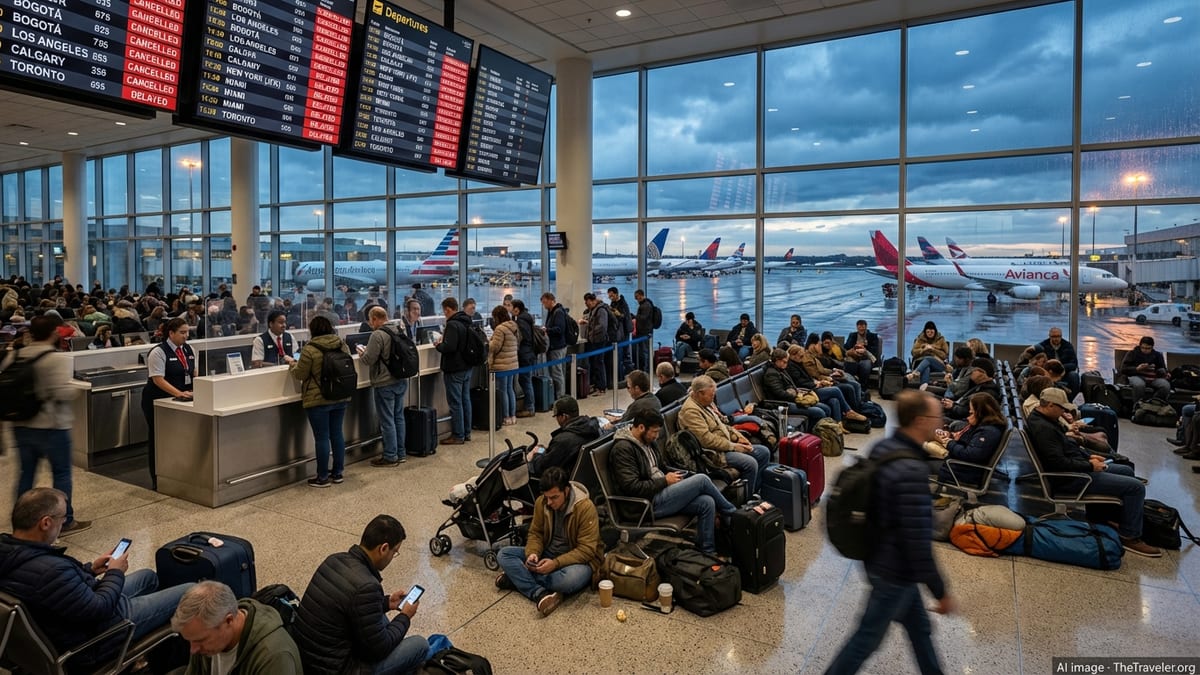
Rebooking options proved limited during peak disruption, as many later flights were already heavily booked. Social media posts and local coverage describe long queues at service desks and crowded waiting areas as carriers attempted to reassign passengers, provide meal vouchers and arrange overnight accommodation in the worst affected cases.
Travelers holding multi-leg itineraries, especially those involving onward international segments from São Paulo and Rio, faced additional uncertainty. Missed connections forced some to wait for the next day’s departures, effectively extending the disruption beyond the initial window of technical problems.
Knock-On Effects for Tourism and Business Travel
The timing and geography of the disruption created particular challenges for Brazil’s tourism sector. Foz do Iguaçu, one of the country’s most visited nature destinations, relies heavily on coordinated domestic flights from São Paulo and Rio de Janeiro. Delays and cancellations on these feeders left tour operators, hotels and transfer services juggling last-minute changes to itineraries.
In Curitiba and other southern cities, the problems affected a mix of business and leisure traffic. Public information from airport operators indicates that passenger volumes were high at the time of the incident, amplifying the operational impact on check-in, security control and baggage handling as large numbers of travelers remained in terminals longer than planned.
Destinations such as Cuiabá, used as a gateway for the Pantanal region and other eco-tourism areas, likewise saw knock-on effects. With aircraft arriving late or in some cases not at all, local tourism businesses were forced to re-coordinate ground transport, excursions and accommodation for visitors who arrived hours behind schedule.
The incident underscores how dependent Brazil’s domestic and regional tourism flows are on reliable operations at São Paulo’s core airports. Even a relatively short interruption in air traffic control systems can send ripples across the network that last well into the following day.
Calls for Resilience in Brazil’s Air Network
Aviation specialists quoted in Brazilian coverage have pointed to this latest disruption as a reminder of the pressures on the country’s busiest air corridors. With São Paulo handling a large share of domestic and international movements, any failure in traffic management systems can affect carriers and airports hundreds of kilometers away.
Industry observers say that expanding redundancy in critical systems, improving communication with passengers and investing in more flexible scheduling could help mitigate similar events in future. The experience of airports in Curitiba, Foz do Iguaçu and Cuiabá during the incident is being cited as evidence that secondary hubs need better tools to manage inflows when primary centers falter.
For now, operations across Brazil have largely returned to normal, but the backlog created by the 37 cancellations and more than 600 delays will linger in traveler memories. The scale and speed of the disruption highlight both the density of Brazil’s air network and its vulnerability when key nodes such as São Paulo experience sudden operational shocks.