


More news on this day
Hundreds of cancellations and thousands of delays rippled across Asia’s air network today, as operational data pointed to at least 491 flights cancelled and more than 6,400 delayed from the Philippines to China and the Gulf, overwhelming terminals at Davao, New Delhi, Sharjah, Jakarta, Shanghai and several secondary hubs.
Get the latest news straight to your inbox!
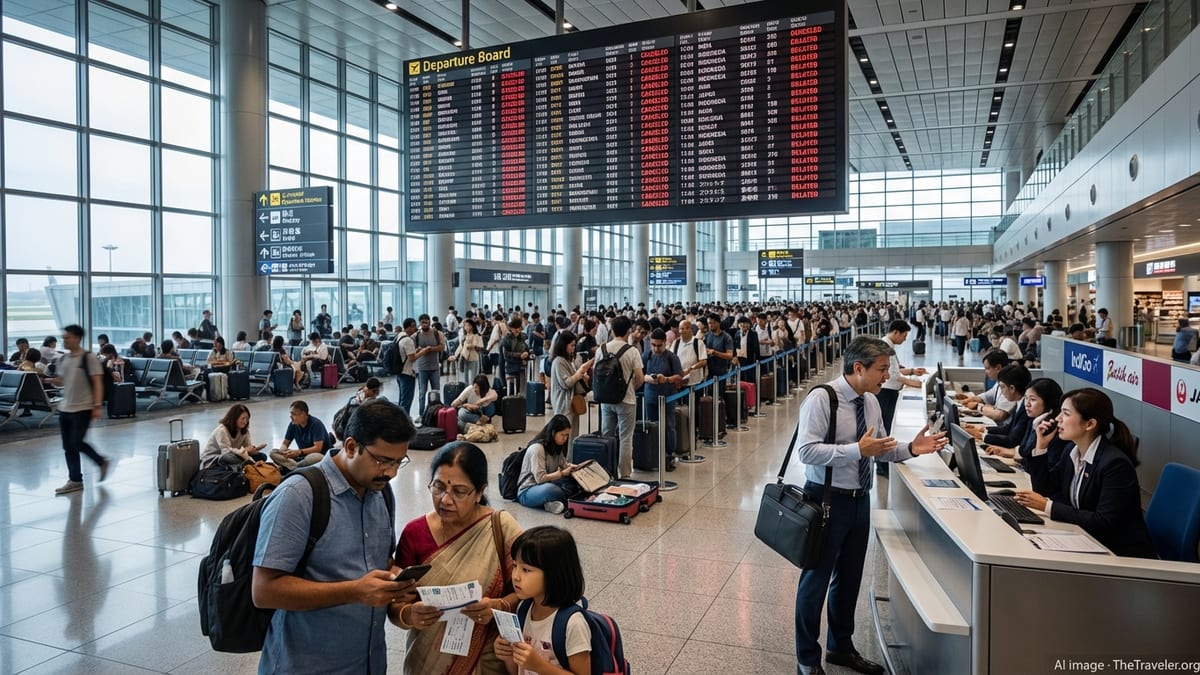
Widespread Disruptions From South Asia to the Gulf
Publicly available flight-tracking snapshots and aviation noticeboards indicate that traffic across Asia and neighboring Gulf gateways has entered another period of intense disruption, with cancellations and delays clustering around India, the Philippines, Indonesia, China and Saudi Arabia. Aggregated counts compiled from multiple monitoring feeds for the current 24-hour window point to roughly 491 cancellations and about 6,404 delays, a pattern consistent with recent high-disruption days reported across the region.
The latest wave appears particularly acute on trunk routes linking South and Southeast Asia with the United Arab Emirates and Saudi Arabia, as congestion in Gulf airspace compounds existing operational pressures. Airports serving New Delhi and other major Indian metros have repeatedly appeared near the top of regional delay rankings in recent months, while Gulf hubs such as Sharjah continue to absorb knock-on disruption from altered routings and compressed turnaround times.
Secondary and regional airports are also feeling the strain. Davao in the southern Philippines, which has already experienced intermittent cancellations tied to network adjustments and global aircraft issues in recent months, again reported pockets of irregular operations as schedules were redrawn and frequencies trimmed. Similar patterns are emerging at Indonesian and Chinese gateways, where even modest timetable changes can cascade into large numbers of delayed departures.
Across the network, the overall picture is of a system that remains operational but brittle, with rolling delays rather than complete shutdowns. Travelers are still moving, yet often with missed connections, last-minute rebookings and extended time on the ground at overstretched terminals.
Key Airports Under Pressure: Davao, Delhi, Sharjah, Jakarta and Shanghai
India’s capital remains one of the flashpoints. Historical winter-weather data from Delhi show how easily visibility issues and congestion can push delay counts into the hundreds in a single day, and today’s disruption statistics again place the airport among Asia’s worst affected. The pattern reflects both strong underlying demand and limited slack in aircraft and crew rotations on domestic and international routes.
In the southern Philippines, Davao is functioning as a barometer of strain on thinner point-to-point routes. Recent schedule changes and route suspensions involving services from Davao to regional destinations have already reduced connectivity, leaving less room for airlines to absorb fresh irregularities. When cancellations occur on these thinner routes, passengers often have fewer same-day alternatives and are more likely to face overnight stays or complex re-routings via Manila or Cebu.
In the Gulf, Sharjah has emerged as a critical pressure point for South Asian traffic. Operational records and airline notices over the past two months show repeated adjustments on sectors linking Sharjah with Delhi and other Indian cities, as well as Pakistan and Southeast Asia. These changes, combined with airspace constraints affecting parts of West Asia, have contributed to elevated delay averages on certain Sharjah–India rotations and a higher-than-normal share of short-notice cancellations.
Further south, Jakarta’s Soekarno Hatta International continues to register heavy traffic and frequent schedule slippage. Jakarta often appears near the top of Asia’s delay tallies, with domestic carriers and regional operators contending with tightly banked departure waves and limited spare capacity. When significant disruption strikes elsewhere in the network, Jakarta’s role as a hub amplifies the impact, producing clusters of late-night and early-morning delays.
China Hubs and Regional Carriers Caught in the Crossfire
On the Chinese mainland, Shanghai’s major airports remain central to the latest disruption cycle. Flight-status summaries from recent weeks have repeatedly shown Shanghai Pudong and Hongqiao among Asia’s leading contributors to daily delay statistics, reflecting dense schedules operated by Chinese majors alongside international partners. Today’s figures again place Shanghai near the top tier of affected hubs, with large numbers of late departures rather than mass cancellations.
The concentration of delays in and out of China has direct implications for regional low-cost and hybrid carriers operating cross-border routes. Services marketed under brands such as China Express are particularly exposed to congestion on popular domestic and short-haul international sectors, where quick turnarounds and tight aircraft utilization leave little buffer when rotations run late.
Knock-on effects are also evident among Southeast Asian and Indian low-cost operators. AirAsia and its regional affiliates, which maintain extensive intra-Asia networks, have already navigated a series of schedule cuts and route suspensions over recent months, including on Philippines and Indonesia services. Today’s regionwide disruption adds further complexity, as even flights that operate can incur prolonged ground holds or arrival delays when upstream sectors are affected.
Indian carrier SpiceJet has likewise faced elevated operational challenges this year, including previous days when dozens of its flights to and from Delhi were cancelled in response to airspace and capacity constraints. While many of its services continue to run, any renewed turbulence in Gulf corridors or at key Indian hubs risks recreating similar patterns of concentrated cancellations on short notice.
Gulf and South Asian Corridors Drive Delay Totals
The sharp imbalance between the number of cancellations and the much larger pool of delays reflects the particular role of Gulf–Asia corridors in the current disruption. Airspace changes and routing adjustments through West Asia have, on multiple recent occasions, produced high delay totals without proportional shutdowns, as airlines opt to keep flights operating on elongated or re-routed paths rather than cancel outright.
Public data for selected Sharjah–Delhi and related services show average delays stretching well beyond half an hour, with some rotations arriving close to an hour behind schedule. While such delays may appear modest in isolation, they can trigger missed connections at tightly banked hubs, which in turn inflate total delay and misconnection figures for the broader region.
Saudi gateways such as Jeddah and Riyadh, which anchor a dense mesh of pilgrim and labor traffic from South and Southeast Asia, are also implicated in today’s disruption numbers. Any schedule instability in these markets tends to reverberate through carriers in India, Pakistan, Bangladesh, the Philippines and Indonesia, as aircraft and crew are cycled across multiple high-load sectors.
The result is a regional picture where many flights still operate but with unpredictable timing, turning even straightforward point-to-point journeys into complex, multi-hour ordeals for travelers caught on the wrong side of a delay bank.
What Travelers Can Expect as Disruptions Continue
For passengers booked on services operated by carriers such as China Express, AirAsia, SpiceJet, FlyDubai and other regional airlines, today’s figures highlight the importance of treating timetables as provisional rather than fixed. Monitoring tools and airline alerts show that flight statuses on numerous Asian routes are shifting throughout the day as carriers shuffle aircraft to patch network gaps.
Travel forums and recent coverage of Asia’s aviation performance underline how recurring bouts of disruption have become a defining feature of the post-pandemic travel landscape, particularly during weather events, holiday peaks or geopolitical flare-ups. While major hubs have restored much of their pre-2020 capacity, resilience has lagged behind, leaving airports and airlines vulnerable to sudden spikes in delays.
Industry data on on-time performance across Asia-Pacific carriers also suggest that even slight deterioration in punctuality can quickly translate into thousands of delayed passengers when volumes are high. On days like today, the combination of congested hubs, stretched aircraft utilization and constrained airspace transforms relatively small schedule changes into large statistical swings.
With cancellations nearing 500 and delays surpassing 6,400 in the latest regional snapshot, Asia’s air travelers face another challenging day of missed connections, rebooked itineraries and crowded terminals, as airlines work to realign their networks and clear growing backlogs across the Philippines, India, Saudi Arabia, Indonesia, China and beyond.