


More news on this day
Asia’s aviation sector is entering one of its most turbulent years in recent history as fuel shocks, geopolitical conflict and aircraft shortages collide to squeeze capacity, push up fares and strain airport infrastructure across the region in 2026.
Get the latest news straight to your inbox!
Fuel Shock Turns Growth Engine Into Pressure Cooker
Asia Pacific has been the world’s fastest growing aviation market, with long term forecasts projecting the region will account for nearly half of global aircraft demand and a services market worth more than 1.3 trillion US dollars by 2044. Yet the 2026 spike in jet fuel prices has abruptly shifted focus from expansion to survival for many carriers, particularly those with thin margins and high exposure to short haul routes.
Analysts tracking refined fuel markets report that jet fuel shortages and price surges have become a defining feature of the year, especially after the escalation of conflict around the Strait of Hormuz, a key chokepoint for global oil flows. Research from economic consultancies indicates that airlines across Asia are trimming lower yielding services, especially intra regional sectors, to conserve fuel and preserve profitability while prioritising higher revenue long haul operations.
Recent financial disclosures underscore the impact. A review of second quarter 2026 results from major Asia Pacific airlines shows that, despite solid or even record passenger revenues, operating margins have been sharply eroded by fuel costs. Carriers such as Singapore Airlines and Japan Airlines have reported margin compressions of several percentage points, while budget operators in Southeast Asia have shifted strategy to focus on yield and liquidity rather than pure growth as the fuel crisis deepens.
Industry bodies add that the fuel shock is feeding back into demand. According to global traffic statistics for June 2026, international capacity within Asia has fallen compared with a year earlier, in part because some airlines are pulling back frequency on shorter routes where high fuel prices are hardest to absorb. The result for travelers is a combination of tighter seat supply and higher average fares, even as underlying demand for air travel remains robust.
Geopolitical Conflict Disrupts East–West Corridors
The fuel crisis has been compounded by geopolitical upheaval in the Gulf, which plays an outsized role in linking Asia with Europe, Africa and the Americas. An assessment published in May 2026 by Airports Council International Asia Pacific and Middle East found that restrictions on Gulf airspace effectively removed close to one fifth of all East–West connecting capacity from the global network within hours of the conflict’s onset.
Traffic data from nine major Middle East hubs show that scheduled operations during March and April 2026 averaged barely half of pre conflict levels, with flight counts dropping to roughly one third of planned capacity on the first day of hostilities before partially recovering. These hubs handled more than 320 million passengers in 2025, underlining the systemic nature of the disruption for Asia bound and Asia originating itineraries.
For Asian carriers, the loss of these connective corridors has forced rapid rerouting, longer flight times and higher fuel burn as aircraft avoid affected airspace. Publicly available analyses highlight how traffic flows have shifted toward European and Asian airlines operating alternative routings, while some long haul city pairs have seen reduced frequency or temporary suspensions. The network disruption is adding pressure to already strained schedules and complicating efforts to rebuild connectivity to pre pandemic levels.
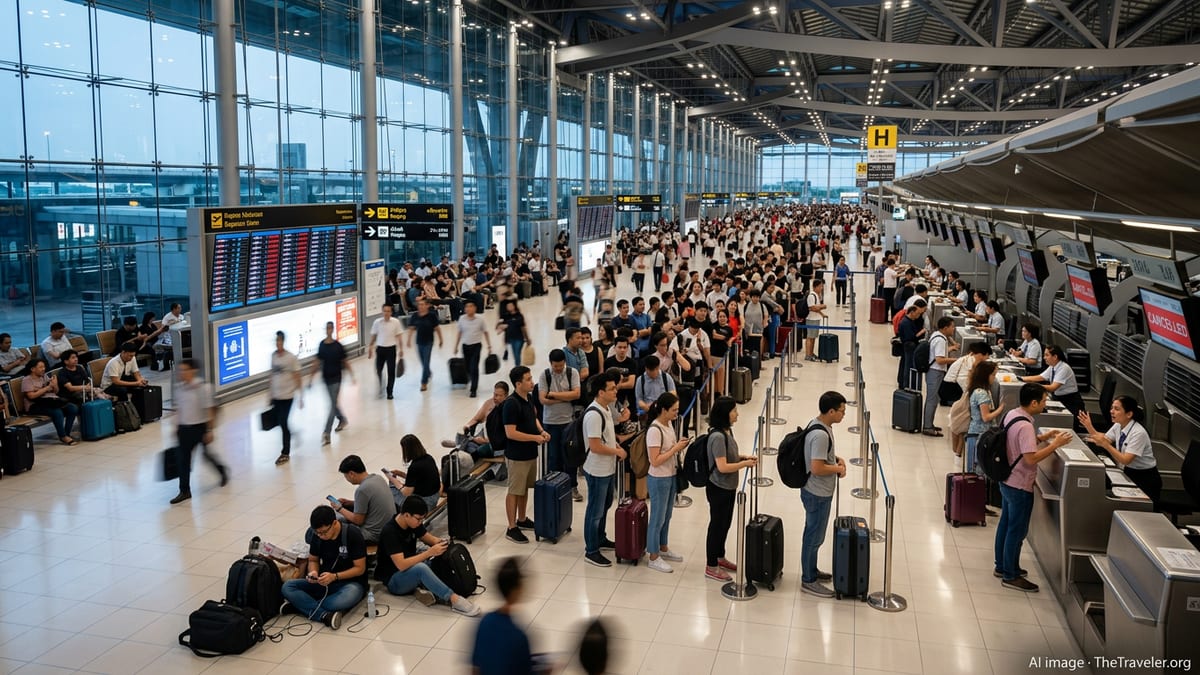
Downstream, airports in North Asia and key Southeast Asian hubs are absorbing displaced traffic, intensifying congestion and stretching infrastructure. Seoul Incheon, for example, has issued repeated passenger advisories in late August 2026 warning of peak time crowding across routes to Japan, China, Southeast Asia, Europe and the Americas, as travelers re route through alternative hubs to bypass the Gulf.
Supply Chain Bottlenecks and Aircraft Shortages
Beyond immediate fuel and airspace shocks, structural supply chain problems are deepening what regional media have termed an aviation crisis. Industry publications across Asia report that airlines are grappling with delayed aircraft deliveries, shortages of engines and spare parts, and maintenance bottlenecks that are forcing them to keep older jets in service longer than planned.
These constraints are particularly acute in Asia’s narrowbody fleets, which underpin high frequency domestic and regional networks. Maintenance and overhaul capacity has struggled to keep pace with the rapid rebound in flying since borders reopened, and some carriers have been compelled to ground aircraft while waiting for critical components. This has limited their ability to add capacity even where demand is strong and fares are high enough to justify expansion.
Manufacturers and lessors continue to forecast strong long term growth in Asia Pacific, with one major airframe maker projecting the region will need nearly 20,000 new passenger aircraft over the next two decades. However, the same forecasts acknowledge that supply chain and labor constraints are likely to remain a near term drag, implying that the gap between potential demand and actual seat capacity could persist well beyond 2026.
For passengers, the supply squeeze manifests as fewer flight options, fuller cabins and less operational flexibility when disruptions occur. For airlines, it amplifies the impact of every aircraft taken out of service for unscheduled maintenance or safety checks, as spare capacity to cover such gaps is limited and expensive.
Passenger Demand Stays Resilient Despite Rising Fares
Despite the multiple shocks hitting Asia’s aviation ecosystem, demand indicators suggest travelers remain eager to fly. At the global level, data released in late July 2026 show that total passenger traffic is still above 2025 levels, even though growth moderated and overall demand slipped modestly in June. The Asia Pacific region continues to narrow the gap with pre pandemic volumes, led by large domestic markets and recovering international corridors.
North Asia in particular has re emerged as a powerhouse. Presentations at the 2026 annual meeting of the International Air Transport Association describe how China’s domestic market has solidified its position as one of the largest in the world, though international routes, especially to North America, have yet to fully recover. Forecasts presented at the same gathering anticipate that North Asian airlines will collectively generate more than 100 billion US dollars in revenue this year, underscoring the scale of the market even amid turbulence.
In Southeast Asia, flight data providers note that capacity remains below earlier projections for 2026, reflecting both fuel driven cutbacks and household budget pressures from higher living costs. Yet the region’s busiest hubs, including Bangkok, Singapore and Kuala Lumpur, continue to report strong load factors and steady growth in outbound tourism. Low cost carriers are selectively restoring routes that can sustain higher yields, while trimming marginal services that are too fuel intensive.
Industry analysts argue that Asia’s expanding middle class and the increasing importance of air travel for business and leisure will keep demand on an upward trajectory, even if the path is bumpier than previously expected. The challenge for policymakers and industry leaders is how to manage this demand in a period where external shocks are more frequent and the buffers that once absorbed them are thinner.
Safety Performance Under Scrutiny as Operations Intensify
The combination of high utilization, aging aircraft and network stress has sharpened attention on safety performance across Asia’s airlines and airports. Historical data compiled by international organizations show that Asia Pacific operators improved their overall accident rate between 2024 and 2025, aligning more closely with or better than global averages. However, regional safety assessments also identify specific areas where regulatory oversight and infrastructure investment lag behind, including accident investigation capacity and aerodrome ground aids.
Recent years have seen turbulence encounters emerge as a leading cause of accidents in the region, a trend that safety reports expect to address in the 2026 to 2028 global aviation safety planning cycle. The rise in such events mirrors global concerns about more frequent and severe clear air turbulence, which can injure passengers and crew even when aircraft remain structurally sound and fully controllable.
National investigation agencies across Asia continue to publish detailed reports on serious incidents, underscoring the complexity of factors involved. Official databases for 2026 list events ranging from runway excursions and tail strikes to hard landings in challenging weather, often linked to human factors such as workload, fatigue or miscommunication alongside technical or environmental contributors.
Safety experts emphasise that the current crisis is not defined by a surge in catastrophic accidents, but by the risk that sustained operational and financial stress could erode safety margins if not carefully managed. In an environment of high fuel costs, tight schedules and scarce spare aircraft, the pressure to keep flights operating on time is intense. Publicly available safety guidance stresses the importance of maintaining robust reporting cultures, investing in training and ensuring that economic pressures do not compromise conservative decision making in the cockpit or the control tower.
Japan Times coverage of Asia’s air travel crisis
ACI Asia Pacific & Middle East assessment of Gulf conflict impacts
IATA June 2026 air passenger demand statistics