


Few ancient figures feel as present in today’s world as Athena. Her owl still looks out from Greek euro coins, her name crowns universities, and her image appears on souvenir helmets in Athens. For travelers tracing the roots of Western mythology, understanding who Athena was and what she represents turns a temple ruin or museum statue into a living story. This guide walks through the key facts about Athena, from her legendary birth and symbols to her Roman counterpart Minerva and the myths that still shape how visitors experience Greece and Italy today.
Get the latest updates straight to your inbox!
Athena in a Nutshell: Who She Was and Why She Matters
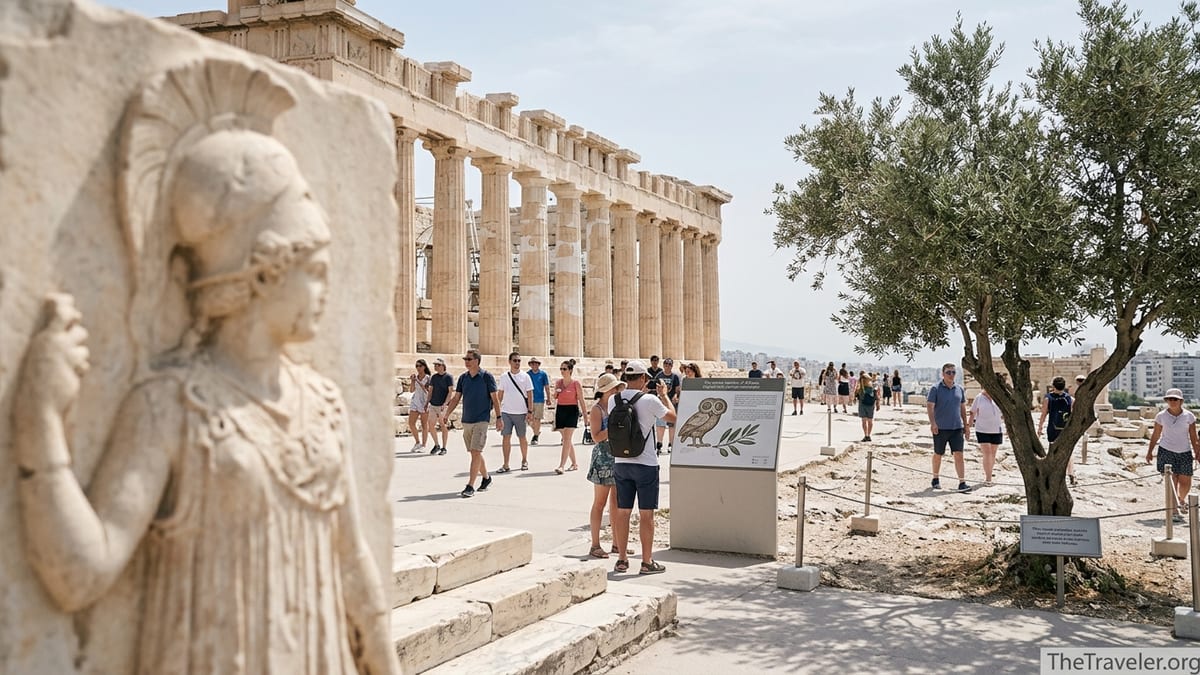
Athena is one of the major Olympian deities in Greek mythology, best known as the goddess of wisdom, strategy in war, and crafts. Ancient sources describe her as a protector of cities, heroes, and artisans, a deity people called upon when they needed clear thinking more than brute force. When you stand on the Acropolis in Athens or walk through the sculpture halls of the Acropolis Museum and the British Museum, many of the most striking statues in bronze or marble are versions of Athena, easily recognized by her helmet and spear.
Unlike some gods associated with wild behavior, Athena represents order and rationality. In Homeric epics, she guides heroes like Odysseus with careful plans rather than reckless battles. For modern visitors, this makes her a kind of patron of thoughtful travel and careful observation. Whether you are deciphering a frieze on the Parthenon or following ancient walking routes in Athens’ historic center, knowing Athena’s character helps explain why she became the city’s patron and a symbol of civic identity.
Athena also has lasting cultural influence well beyond Greece. Her name has been borrowed for think tanks, academic programs, and even tech projects that want to emphasize intelligence and strategy. When you see an owl on a university crest in Europe or North America, it often quietly nods to Athena’s legacy. Tracing that symbol back to its source, starting with a visit to Athens or Rome, deepens the story behind these familiar modern emblems.
Parents and Birth: From Zeus’s Head to the Athenian Skyline
One of the best known facts about Athena is how she was born. According to Greek myth, her parents are Zeus, king of the gods, and the Titaness Metis, a figure associated with cunning intelligence. After a prophecy warned that Metis would bear a child who could one day rival him, Zeus swallowed her while she was pregnant. Later, he developed a splitting headache. When another god split his skull open, Athena emerged fully grown and fully armed, shouting a battle cry. Travelers will often see this moment carved or painted on temple pediments and vases in museums from Athens to Berlin.
This extraordinary birth story underlines a paradox: Athena is both the daughter of a powerful mother and the direct product of Zeus’s mind. Many scholars see this as mythic shorthand for a particular kind of intelligence, one that blends practical craft and political savvy. If you are touring archaeological sites in Greece, guides will sometimes point out how this dual origin helps explain her complex role as both a defender of the existing order and a challenger of reckless behavior, including that of other gods.
The city of Athens anchors this story in real geography. From the rocky plateau of the Acropolis, which you can climb today via a carefully managed visitor path, you look out over a dense urban landscape that still bears Athena’s name. The skyline is dotted with modern apartment blocks, but the outline of the Parthenon still dominates. When you hear your guide describe the goddess “born from Zeus’s head,” it is worth glancing up at the massive marble blocks and realizing that for Athenians of the 5th century BCE, their entire city quite literally lived under the gaze of that powerful intellect.
Key Symbols: Owl, Olive Tree, Armor and Aegis
Athena’s symbols are among the most recognizable in mythology, and travelers encounter them constantly in Greek and Roman sites. The owl is perhaps the most famous. It represents sharp vision in the dark and has long been linked to careful thought. On ancient Athenian silver tetradrachm coins, and on the modern Greek one euro coin, the small owl appears with a sprig of olive. If you browse coin cases in the Numismatic Museum in Athens or the National Archaeological Museum, you will see rows of these owls staring back at you from behind glass.
The olive tree is another key symbol. An old local story from Athens explains that when the city had to choose a divine patron, Poseidon offered a saltwater spring by striking a rock with his trident, while Athena planted the first olive tree. The Athenians chose her gift, valuing wood, oil, and fruit over impressive but less useful seawater. When you walk through modern Athens, you can still see olive trees around the Acropolis hill and in the Agora, reminders that Athena’s gift was tied to long-term prosperity rather than short-term spectacle.
Athena is almost always shown wearing armor and a helmet, carrying a spear. These are not decorative accessories. They signal her role in war as a strategist and protector. If you stand in front of Roman copies of the lost statue Athena Parthenos in museums such as the National Archaeological Museum in Athens, you will notice the heavy folds of her cloak, the detailed helmet crest, and the relaxed but ready pose of her spear. She also carries the aegis, a protective goatskin or shield, often decorated with the head of the Gorgon Medusa. On temple sculptures, like fragments from the Parthenon, the aegis appears as a textured surface draped over her chest, symbolizing both danger to enemies and safety for those under her care.
Minerva: Athena’s Roman Counterpart and How to Spot Her
For travelers who split their time between Greece and Italy, it is useful to know that Athena’s Roman equivalent is Minerva. When the Romans adopted many Greek gods, they associated Athena with Minerva, a deity already linked to wisdom and the arts in Italian and Etruscan religion. Over time, the two figures blended so closely that many statues in Rome of a warrior goddess in helmet and armor are effectively versions of Athena with Latin inscriptions.
There are, however, subtle differences. Roman writers emphasized Minerva’s role in crafts, law, and the peaceful side of strategy more than open warfare. In Rome, you are more likely to find Minerva connected to guilds, writers, and artists. For example, the great temple complex on the Capitoline Hill linked Minerva with Jupiter and Juno as part of a powerful trio protecting the city, and shrines to Minerva stood near areas where craftsmen and scribes worked. When you visit archaeological museums in Rome, read the small labels carefully; Minerva may appear in contexts where Greek visitors would expect Athena to be purely a war goddess.
Visually, Minerva and Athena are almost indistinguishable. Both are shown with the owl, spear, and shield, and both sometimes hold a small figure of Nike, the personification of victory. In the Vatican Museums, Capitoline Museums, and regional collections from Naples to Turin, statues of Minerva share the same poised stance and calm expression seen in Greek originals. For a traveler, the key is not to worry too much about drawing a strict line between the two. Instead, notice how the same basic image of a wise, armed woman adapts to different cities and political systems over centuries.
Sacred Animals and Trees: Meeting Athena’s Owl and Olive in Real Life
Athena’s sacred owl is not an abstract symbol. It corresponds to a real bird, the little owl, which still lives in the Mediterranean region. Birdwatchers occasionally spot these compact, bright-eyed owls on rocky outcrops and ruined walls in Greece and Italy, especially in quieter rural areas and on islands. If you join an evening walking tour near sites such as the Acropolis or the ancient Agora, your guide may point out an owl silhouette or call out if they hear its distinctive call. Seeing the bird in person can turn a stone carving from a museum into something unexpectedly vivid.
The olive tree is likewise part of the everyday landscape. In Attica, the region around Athens, olive groves fill low hills, and individual trees push up between apartment blocks and alongside tram tracks. When you head out of central Athens on a day trip to places like Cape Sounion or Marathon, bus windows frame long lines of twisted trunks and silvery leaves. Many of these groves have been cultivated for generations, with small family producers selling oil in unbranded bottles at local markets and roadside stands. Guides and signage at archaeological sites often remind visitors that for ancient Athenians, this hardy tree was more than shade. It was a sign that the land and its people had the favor of Athena.
Travelers can literally taste Athena’s legacy by sampling local olive oil tastings in shops around Plaka in Athens or in small towns on the Peloponnese peninsula. Staff sometimes reference the goddess when describing the importance of early harvest oils or the cultural value of olive pressing. In this way, mythology knits together with agriculture, tourism, and daily life. The goddess’s sacred tree becomes a bottle on a restaurant table, a souvenir tin in your suitcase, and a living connection between ancient stories and modern economies.
Temples, Statues and Where to Find Athena Today
The most famous temple dedicated to Athena is the Parthenon, which crowns the Acropolis in Athens. Built in the 5th century BCE, it served as both a religious center and a symbol of the city’s power. Today, visitors reach the Parthenon by climbing a marked path up the Acropolis slope, passing ticket checks and informational boards along the way. The interior statue of Athena that once stood there, a towering work of gold and ivory, is lost, but museum reconstructions and Roman copies give a sense of its scale. Standing on the Parthenon’s southern side at sunset, with the city spread below, it is easy to understand why ancient writers saw Athena as both a guardian and a constant presence in Athenian life.
The Acropolis complex includes other shrines associated with the goddess. The Erechtheion, with its famous Caryatid porch, honored both Athena and Poseidon and marked places connected to their legendary contest over the city. Nearby, the small Temple of Athena Nike celebrated victory and overlooked the main approach to the hill. All three sites are accessible with a standard Acropolis ticket, and guided tours often use them to explain the different aspects of Athena: city protector, strategist in war, and guardian of sacred ground.
Outside Athens, Athena’s presence appears in temples and sculptures throughout the ancient Greek world. On the island of Rhodes, remains of a sanctuary to Athena Polias still stand on a hill above the modern city. In Turkey, at the archaeological site of Pergamon, museum displays include reliefs showing Athena aligned with local rulers. In Italy, statues of Minerva in Rome’s Capitoline Museums or the Vatican Museums echo the same helmeted figure. For travelers interested in building an “Athena trail,” it is possible to link visits between these sites, moving from Greek mainland temples to island sanctuaries and Roman reinterpretations, seeing how one goddess adapted to different political and cultural landscapes.
Common Myths and Misconceptions about Athena
Athena’s popularity has produced a number of modern misconceptions, especially through films, novels, and games. One frequent misunderstanding is that she is simply a female version of Ares, the Greek god of war. In fact, ancient texts consistently present her as a strategist who prefers planning, negotiation, and defensive war. If you listen to audio guides at major museums, you will often hear curators emphasize the difference between Ares, associated with chaotic bloodshed, and Athena, who stands for organized defense and just causes. Statues reinforce this contrast: Ares is more often shown dynamic and aggressive, while Athena looks composed, prepared, and in control.
Another misconception is that Athena is a purely gentle goddess of wisdom with little connection to conflict. Modern educational materials sometimes highlight her role in crafts and city life but underplay scenes where she actively supports warriors. In Homer’s Iliad and Odyssey, she appears on battlefields and in councils of war, advising heroes on tactics and personally intervening at key moments. Travelers who rely only on modern textbook summaries can be surprised when guides at sites like Troy or Mycenae discuss Athena as an involved war deity. The museums at these sites often show her on armor or shields, reminding visitors that wisdom and warfare were not separate ideas in the ancient imagination.
A third confusion involves Athena’s relationship to women and feminism. Some modern readings celebrate her as a strong female figure, while others point out that she often sides with male heroes against female characters. On the ground, this debate shows up in contemporary art and installations near archaeological sites and in university exhibitions. For example, temporary shows in Athens or Rome sometimes reinterpret classical statues of Athena to raise questions about gender and power. While these interpretations are modern, they can enrich a visit by encouraging travelers to compare what ancient myths say with present-day values.
The Takeaway
For travelers, Athena is more than a name in a guidebook. She is a thread that ties together coins, trees, sculptures, and city plans from Greece to Italy. Understanding her symbols and stories turns a ruined column into a signpost and a museum label into a doorway to older ways of thinking. When you hold a Greek coin with an owl, walk through an olive grove overlooking the Aegean, or look up at the battered but still commanding Parthenon, you are moving through spaces shaped by her long shadow.
Knowing the basics of her parentage, the meaning of her owl and olive, and her link to Minerva in Rome allows visitors to read ancient sites with greater confidence. Misconceptions fall away, replaced by a nuanced view of a goddess who combined intellect and force, craft and law. Whether your itinerary centers on Athens alone or stretches from the Acropolis to the Capitoline Hill, letting Athena’s story guide your steps brings a deeper coherence to your journey through the ancient Mediterranean world.
FAQ
Q1. Who were Athena’s parents in Greek mythology?
Zeus and the Titaness Metis are named as Athena’s parents. Myth describes Zeus swallowing Metis and later giving birth to Athena fully grown from his head.
Q2. What are the main symbols of Athena that travelers should look for?
Key symbols include the owl, the olive tree, a crested helmet, spear, shield, and the aegis decorated with a Gorgon head. These appear on coins, statues, and temple carvings.
Q3. How is Athena different from Minerva in Roman tradition?
Minerva is Athena’s Roman counterpart, but Roman writers emphasized her as a patron of law, arts, and crafts. She remained wise and strategic, but her public cult in Rome highlighted learning and skilled work more than direct warfare.
Q4. Where can I see important temples of Athena today?
The most important cluster is on the Acropolis in Athens, including the Parthenon, the Erechtheion, and the Temple of Athena Nike. Smaller sanctuaries appear at sites such as Rhodes, Pergamon, and various regional museums across Greece and Turkey.
Q5. Why is the owl associated with Athena and Minerva?
The owl, especially the little owl native to the Mediterranean, was seen as sharp-eyed in the darkness. Over time it came to symbolize insight and learning, fitting Athena’s image as a clear-sighted goddess of wisdom.
Q6. What is the story behind Athena’s olive tree?
According to Athenian legend, Athena and Poseidon competed to become patron of the city. Poseidon produced a saltwater spring, while Athena planted an olive tree. The citizens chose her gift, and the tree became a sign of peace and prosperity.
Q7. Was Athena only a war goddess?
No. While she played a major role in war as a strategist and protector of cities, she was also patron of weaving, metalworking, and other crafts, and a guardian of civic life, law, and education.
Q8. Is Athena considered a feminist icon today?
Modern views differ. Some see her as a powerful female figure in a male-dominated mythic world, while others note that she often supports male heroes and existing power structures. These debates frequently appear in contemporary art and scholarship rather than in ancient sources themselves.
Q9. How can I recognize Athena or Minerva in museums if labels are missing?
Look for a calm-faced woman wearing a helmet, sometimes with a spear and shield, often accompanied by an owl or displaying the Gorgon head on an aegis. This combination almost always signals Athena or Minerva.
Q10. Are there modern ways to experience Athena’s legacy when visiting Greece?
Yes. Beyond archaeological sites, you can follow walking tours focused on myths, taste olive oils in regions historically tied to her cult, examine coins and jewelry featuring her owl, and attend lectures or museum talks that explore how her image has evolved from antiquity to the present.