


High above modern Athens, the Parthenon still dominates the city skyline, even in ruin. Travelers come for the views and the famous columns, but beneath the marble lies a deeper story: why this temple was dedicated to Athena in the first place, what it once contained, and how to understand what you are looking at today. This guide blends history with on-the-ground context so that your visit becomes more than a photo stop: it becomes a conversation with the goddess who gave Athens her name.
Get the latest updates straight to your inbox!
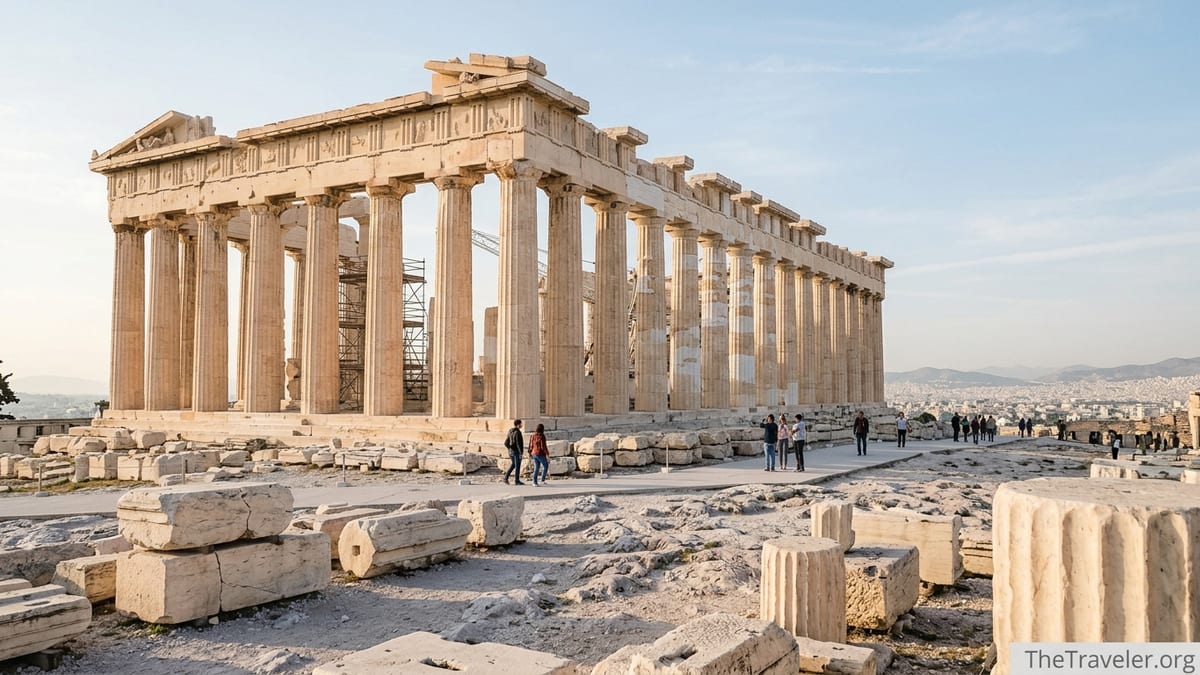
Athena and Athens: Why This City Chose Her
To understand why the Parthenon was dedicated to Athena, start with the city itself. According to myth, Athens once had to choose a patron god. Poseidon offered a saltwater spring and a warhorse, symbols of sea power and conquest. Athena offered an olive tree, promising peace, wisdom, and long-term prosperity. The Athenians chose Athena’s gift, and the city took her name. When you stand on the Acropolis today and look toward the modern city, you are looking out over the landscape that the Athenians associated with that first, sacred gift.
Historically, Athena embodied the qualities that democratic Athens wanted to project in the 5th century BCE: strategic intelligence instead of brute force, civic responsibility instead of tyranny, and skill in crafts and technology. She was not only a war goddess but also the protector of weaving, metalwork, and shipbuilding, all crucial to an Athenian economy built on trade and craftsmanship. Dedicating the most ambitious temple in the Greek world to her was a way of saying that the city’s power rested on wisdom and civic cooperation.
When Pericles launched his major building program after 450 BCE, Athens was at the height of its influence in the Aegean. The Delian League treasury and wartime contributions from allied cities helped fund a project that would turn the Acropolis into a stone manifesto of Athenian greatness. The Parthenon was the center of this program, a colossal offering to the city’s patron goddess and a visible statement to allies and rivals that Athena’s city sat at the top of the Greek world.
Today, walking up Dionysiou Areopagitou Street toward the Acropolis entrance, it is easy to forget that this was once a sacred approach to meet a goddess, not a tourist path. Yet the decision to dedicate the Parthenon to Athena still frames your visit: every sculpted figure, every architectural choice, and the overall scale of the building were designed to honor her and, through her, the civic identity of Athens itself.
Parthenon Basics: What This Temple Was and Was Not
The Parthenon was constructed between about 447 and 432 BCE in the age of Pericles, designed by the architects Iktinos and Kallikrates with the sculptor Pheidias overseeing the decoration and the central statue. It is a Doric temple with eight columns on its short sides and seventeen along its long sides, using fine Pentelic marble quarried from nearby Mount Penteli. When you step onto the Acropolis plateau and see the Parthenon for the first time, imagine it not as the pale ruin you see today but as a vivid structure painted with strong reds and blues, studded with bronze attachments, and filled with glittering gold inside.
Despite its religious function, the Parthenon was never the main “parish church” of ancient Athens. Rituals and sacrifices to Athena primarily centered on another building, the Erechtheion, further along the north side of the Acropolis. The Parthenon functioned more like a monumental treasury and ceremonial backdrop. Its inner rooms housed both the colossal statue of Athena Parthenos and a large portion of the city’s wealth, including tribute from allied cities and sacred offerings.
The name “Parthenon” itself comes from the word parthenos, meaning “virgin,” one of Athena’s epithets. Originally it referred to a specific chamber inside the temple and only later came to designate the entire building. When ancient Athenians spoke of going “up to Athena,” they were often referring to the whole Acropolis complex, not just this single temple. As a visitor, you are following in the same footsteps, but now with a much wider time span under your feet.
Standing at the southeast corner, where many guided tours pause, you can clearly see how the Parthenon dominates the plateau and how its orientation faces east. That orientation was crucial. Religious ceremonies would approach from the west but the main entrance and sculptural focus were on the eastern side, toward the rising sun, connecting Athena’s temple to cosmic order as much as to city politics.
The Lost Athena Parthenos: Statue of Gold and Ivory
At the heart of the Parthenon stood one of the most famous artworks of the ancient world: the statue of Athena Parthenos, created by the sculptor Pheidias around the mid 5th century BCE. The statue was chryselephantine, made of gold and ivory over a wooden core, and stood roughly 12 to 13 meters high. Travelers today cannot see it in Athens, but ancient visitors entering the dim cella from the east would have been confronted with a towering goddess whose golden armor reflected torchlight and daylight filtered through the doorway.
Ancient authors describe Athena wearing a helmet and a long peplos garment, holding Nike, the personification of Victory, in her right hand and a spear and shield by her side. A coiled snake, associated with the mythical king Kekrops of Athens, rose near the shield. The gold plates covering her garments were reportedly removable, both as a symbol of wealth and as a practical way to melt and reuse the metal in crisis. In effect, the statue doubled as a religious monument and a reserve of state capital.
Although the original is lost, travelers who want to imagine its impact have two realistic options. In Athens, the Acropolis Museum displays detailed models, Roman-era copies of small-scale Athena statues, and sculptural fragments that echo Pheidias’s style. In Nashville, Tennessee, a full-scale concrete reconstruction of the Parthenon includes a modern recreation of Athena Parthenos, covered in gold leaf and painted details. Even though it is a modern interpretation, many visitors who have seen both the Nashville statue and the Acropolis ruins say the replica helps them grasp the original’s overwhelming scale.
What happened to the statue is still debated. It may have been removed to Constantinople in late antiquity and destroyed during later upheavals, or it may have perished in a fire while still in Athens. Either way, by the time Western travelers began drawing and studying the Parthenon in the 17th and 18th centuries, the central goddess who once defined the interior was already gone, leaving behind only cuttings in the marble floor where her base once stood.
Reading the Sculptures: How Athena’s Story Covered the Temple
Even without the statue, Athena still dominates the Parthenon’s surviving sculpture. The east pediment above the main entrance showed her miraculous birth from the head of Zeus, surrounded by other Olympian gods reacting to the event. The west pediment depicted her contest with Poseidon for control of the city, the very myth that explained why Athens was hers. When you walk around the Parthenon today, only fragmentary figures remain in situ, but you can picture these triangular spaces once crowded with dynamic marble gods and horses.
Below the pediments, 92 metopes ran around the outside of the building, each a carved panel showing mythic battles: gods against giants, Greeks against Amazons and centaurs, scenes from the Trojan War. These struggles between order and chaos were read by Athenians as allegories of their own recent victories over Persia and internal conflicts. Though many metopes are eroded or missing, several of the best-preserved examples are housed in the Acropolis Museum and the British Museum, while others remain high on the building. From the south side of the Acropolis plateau, you can still spot centaurs grappling with Lapiths in high relief.
Inside, an Ionic frieze ran around the upper walls of the cella. It likely showed the Panathenaic procession, the great festival in which Athenians carried a new woven robe, or peplos, to Athena. Figures of riders, elders, musicians, and sacrificial animals move along the frieze, culminating in a central scene where attendants handle folded cloth, probably representing the robe. When you visit the Acropolis Museum, the glass-walled Parthenon Gallery arranges surviving blocks of this frieze at eye level, in the same sequence and orientation as they would have appeared on the temple. Walking this gallery gives a rare chance to view a once-distant narrative as closely as its original sculptors.
For travelers, this sculptural program turns the Parthenon into a three-dimensional storybook of Athena’s relationship with Athens. Before your visit, it is worth looking at photographs or illustrations of the east and west pediment reconstructions so you can mentally “fill in” the missing figures when you stand before the ruined gables. Guided tours often carry laminated diagrams showing which god stood where. Even if you are exploring on your own, pausing near the east end and picturing Athena bursting from Zeus’s head above you can transform an anonymous ruin into a living mythological scene.
From Temple to Church, Mosque, and Ruin
The Parthenon’s dedication to Athena did not fix its identity forever. As religious landscapes changed, the building was repurposed. By the late antique and early Byzantine period, it became a Christian church dedicated to the Virgin Mary. Many sculptures connected explicitly to pagan worship were removed or reworked, including portions of the central pediment figures. Walking around the east end today, you are seeing not only classical damage but also deliberate Christian-era alterations that erased the clearest images of Athena’s divine birth.
Later, during Ottoman rule, the Parthenon was converted again, this time into a mosque. A minaret rose from one corner, and the interior layout shifted to accommodate Islamic prayer. While little of this phase survives visibly on site, 18th-century drawings by European travelers captured the mosque’s silhouette nestled within the ancient colonnade. The layering of these religious uses means that the building you see today is the result of centuries of adaptation, not a frozen snapshot of the 5th century BCE.
The most catastrophic single event for the Parthenon came in 1687, when a Venetian bombardment ignited an Ottoman gunpowder magazine stored inside the temple. The explosion blew out much of the central structure and hurled columns and sculptures down the slope. Many of the scattered fragments you see protected by low fences around the Acropolis plateau are the direct result of that night. When you photograph the open central space of the Parthenon, you are looking into a wound left by an early modern war, not by antiquity itself.
In the early 19th century, Lord Elgin’s agents removed a large portion of the Parthenon’s sculptural decoration and shipped it to Britain, where it remains in the British Museum. For travelers in Athens, this history explains why many original metopes and frieze panels you might expect to see on the Acropolis are now in museums abroad. The Acropolis Museum presents high-quality casts where originals are missing and displays originals in its galleries, clearly labeled by provenance. This mix of original and replica can feel confusing on site, but it is part of the larger story of how Athena’s temple became a global object of debate and conservation.
Visiting Today: Practical Context on the Acropolis
For modern visitors, the Parthenon is both an archaeological site and a carefully managed construction zone. On most days, you will see scaffolding and cranes as the Acropolis Restoration Service continues a long-term program of stabilizing and partially reassembling the structure. Ticket policies and opening hours can change, but as of mid 2026, travelers typically pay a combined ticket in the range of a few dozen euros that covers the Acropolis and several nearby sites. Seasonal discounts often apply in winter and for children, students, and seniors, so it is worth checking current details with official Greek cultural authorities before you go.
The site is busiest from mid-morning to early afternoon, especially when multiple cruise ships are in port at Piraeus. If you want to experience the Parthenon in relative quiet, aim for the first time slot in the morning or the last entry in the evening, when summer light is softer and temperatures are lower. In July and August, midday heat can be intense, and the marble surfaces reflect sunlight strongly, so travelers should bring water, a hat, and sun protection. There is limited shade on the Acropolis plateau, and crowds tend to cluster at viewpoints framing the Parthenon with the city below.
On arrival, you will pass through security, then climb the sloping path to the Propylaea, the monumental gateway. From there, the Parthenon appears slightly to your right, with the smaller Temple of Athena Nike perched near the edge of the rock. It is often tempting to walk straight to the Parthenon’s south side for the classic postcard shot, but taking a slow loop around the whole perimeter gives a better sense of the building’s scale and its relationship to other structures dedicated to Athena, such as the Erechtheion with its famous Caryatid porch.
Photography is allowed on the Acropolis, though the use of drones and tripods is typically restricted. The best wide-angle shots that show Athena’s temple against the city are often taken from the southwest corner near the retaining wall, or from the Belvedere lookout facing the Propylaea. For travelers who want to connect their photos to the goddess’s story, including a glimpse of the olive trees on the slopes below or the line of the Saronic Gulf in the background helps echo the myths of Athena’s gift and her protection of Athenian ships.
Inside the Acropolis Museum: Meeting Athena’s World
No visit to the Parthenon is complete without time in the Acropolis Museum at the foot of the hill. The museum’s top floor is dedicated almost entirely to the Parthenon’s sculptural program. Glass walls allow visitors to see the real Acropolis while walking among the metopes, frieze blocks, and pediment fragments displayed at eye level and in their original sequence. If you visited the Parthenon first, the museum helps decode what you saw from a distance; if you start in the museum, it equips you to “read” the ruins once you go up.
In the Parthenon Gallery, look for the frieze sections showing horsemen and the central scene with the folded cloth, likely representing the robe offered to Athena during the Panathenaic festival. Nearby, explanatory panels in multiple languages outline how these scenes wrap around the building and what they meant in the context of Athenian civic religion. Spending even 30 to 45 minutes walking the perimeter of this gallery can dramatically change how meaningful the scattered sculptures on the Acropolis feel when you see them later the same day.
Elsewhere in the museum, visitors can see earlier representations of Athena from the Archaic period, including dedicated statues and reliefs that predate the Parthenon. These works reveal how the goddess’s image evolved from stiff, stylized figures to the naturalistic, powerful form that Pheidias sculpted in the 5th century BCE. You will also encounter architectural fragments from other Athena-related buildings, such as the Temple of Athena Nike, whose delicate reliefs show the goddess adjusting her sandal and interacting with victory trophies.
Practical details matter here as well. The museum café’s terrace offers a direct, framed view of the Parthenon, making it an ideal place to reflect on what you have seen. Many travelers plan their day so that they visit the Acropolis site early, escape the midday heat inside the climate-controlled museum, and then return to the streets of Plaka or Makrygianni in the late afternoon. This rhythm allows you to connect the marble world of Athena with the living city below without feeling rushed or overwhelmed.
The Takeaway
For all its fame, the Parthenon makes more sense when you remember that it was built first and foremost as a gift to Athena. The Athenians dedicated their finest marble, their greatest sculptor, and a large share of their political capital to a temple that embodied their identity as a city guided by wisdom and strategic power. Even as the building shifted from temple to church to mosque and finally to ruin and symbol, Athena’s imprint remained visible in the stories carved across its surfaces and in the city that still bears her name.
As a traveler, your experience of the Parthenon will be richer if you see it not only as a monument of classical architecture but also as a layered record of devotion, ambition, and change. Standing on the Acropolis rock, with the wind picking up dust from the marble blocks, you share a vantage point with ancient worshippers, medieval pilgrims, Ottoman soldiers, and modern conservators. The lost golden statue may never be recovered, but its memory survives in the space it once occupied and in the stories that continue to draw visitors to Athena’s hill.
When you leave the site and look back from a café terrace in Plaka or from the Lycabettus Hill viewpoint at sunset, the Parthenon’s silhouette against the sky can feel almost weightless. Knowing why it was dedicated to Athena and how her presence shaped the building turns that familiar postcard outline into something more personal: a reminder that every great city tells itself a story about who it is, and in Athens, that story still belongs to the goddess of wisdom.
FAQ
Q1. Why was the Parthenon dedicated specifically to Athena?
Athens considered Athena its patron goddess, associated with wisdom, strategic warfare, and crafts. The Parthenon was built in the 5th century BCE as a monumental offering to her and as a symbol of the city’s identity and power at the height of its democratic empire.
Q2. What does the name “Parthenon” actually mean?
The name comes from the Greek word “parthenos,” meaning “virgin,” one of Athena’s epithets. It originally referred to a particular room in the temple and later came to designate the entire building dedicated to Athena Parthenos.
Q3. Can I see the original statue of Athena Parthenos in Athens today?
No. The original gold and ivory statue created by Pheidias has been lost since antiquity, likely destroyed by fire or during late antique upheavals. In Athens you can see related sculptures, models, and Roman-era copies in the Acropolis Museum, which help reconstruct what the statue once looked like.
Q4. What is the best way for a visitor to imagine the lost statue?
Inside the Acropolis Museum, scale models and display panels show reconstructions based on ancient descriptions. Travelers who also visit the full-scale replica of the Parthenon in Nashville, Tennessee, can experience a modern interpretation of the statue’s size and presence, even though it is not an ancient object.
Q5. Were religious ceremonies actually held inside the Parthenon?
Major rituals to Athena usually took place in open-air altars and in other temples on the Acropolis, especially the Erechtheion. The Parthenon functioned more as a monumental treasury and a backdrop for festivals such as the Panathenaia, while the colossal statue inside served as an awe-inspiring focus rather than the center of regular indoor worship.
Q6. What should I look for when viewing the Parthenon from the outside?
Walk around the entire perimeter to notice the eight-by-seventeen column arrangement, the triangular pediments at each end that once showed Athena’s birth and her contest with Poseidon, and any surviving metopes on the south side featuring battles between centaurs and humans. From the southeast corner, you get one of the clearest views of the building’s proportions.
Q7. How does the Acropolis Museum help me understand Athena’s temple?
The museum’s Parthenon Gallery arranges original and cast sculptures at eye level in the same order and orientation they had on the temple. This layout lets you walk around the frieze, metopes, and pediment fragments while seeing the real Acropolis through glass walls, making it easier to connect specific scenes and figures to the ruins you see outside.
Q8. Is the Parthenon still an active religious site today?
No. Today the Parthenon is an archaeological monument and a symbol of Greek cultural heritage, not an active place of worship. Although it once served as a pagan temple, then a Christian church and later a mosque, its current role is educational and symbolic rather than religious.
Q9. Are there specific times that are better for visiting the Parthenon?
Early morning and late afternoon are usually the most pleasant, especially in summer, when temperatures and crowds peak around midday. These times also offer softer light for photography and a better chance to walk around the temple without dense tour groups blocking key viewpoints.
Q10. What footwear and clothing are recommended for visiting the Acropolis?
Wear sturdy, closed-toe shoes with good grip because marble surfaces can be smooth and slippery, especially after rain. Light clothing, a hat, and sun protection are advisable in warm months, and bringing a refillable water bottle helps you cope with the exposed, often windy plateau around Athena’s temple.